
Loading NuWatt Energy...
We use your location to provide localized solar offers and incentives.
We serve MA, NH, CT, RI, ME, VT, NJ, PA, and TX
Loading NuWatt Energy...
NuWatt designs, installs, and manages solar, battery, heat pump, and EV charger systems across 9 states. One company, one warranty, one point of contact.
Get a Free Quote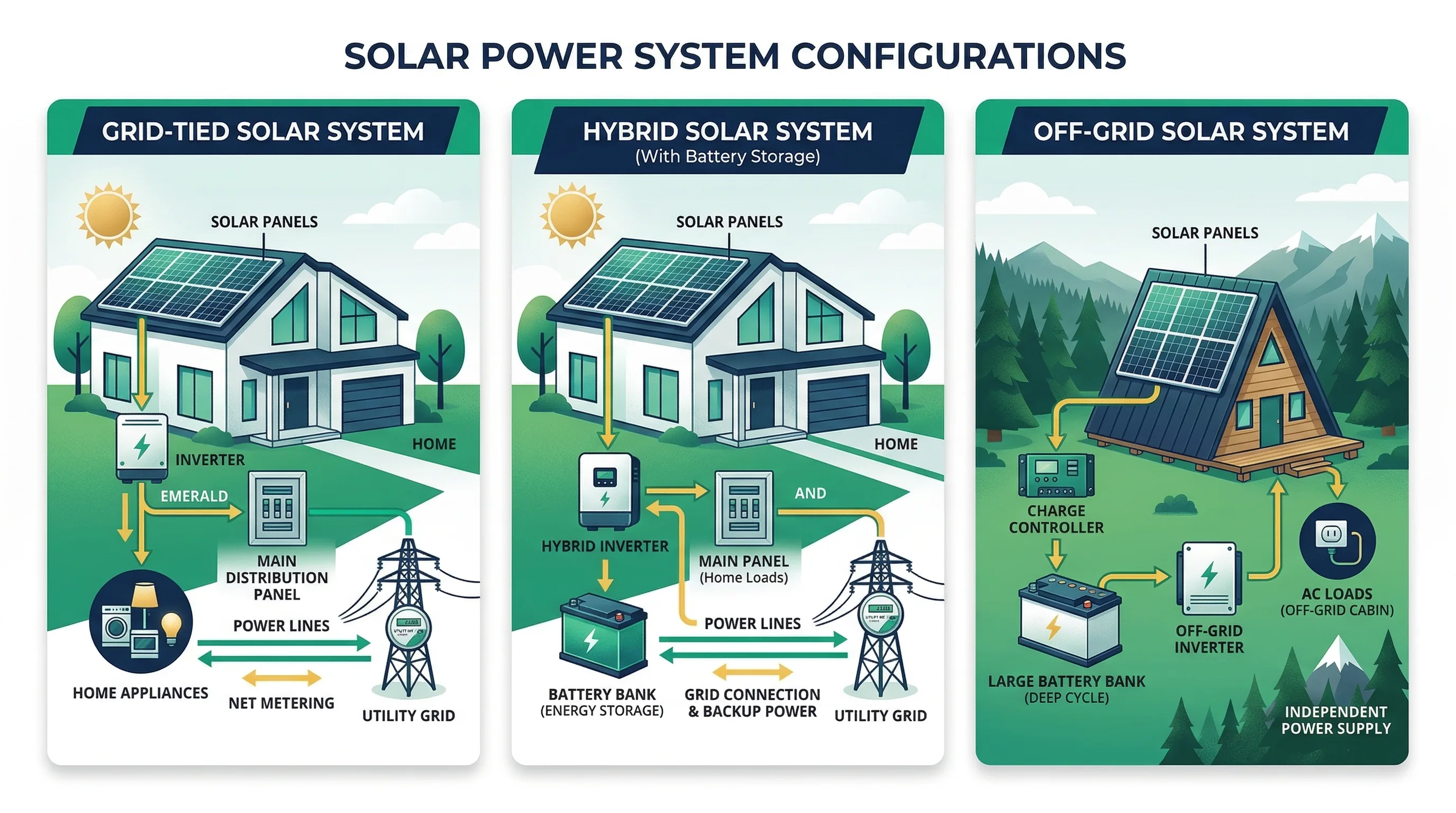
Grid-tied is cheapest and best for 95% of homes. Hybrid adds battery backup. Off-grid is for remote properties only — it costs 3-5x more. Here is the honest comparison.
Quick Answer
Grid-tied ($15K-$30K, no battery): cheapest, net metering, 95% of installs. No backup during outages. Hybrid ($28K-$50K, with battery): grid-tied + battery backup for essentials. Best of both worlds. Off-grid ($50K-$100K+): fully independent, massive battery bank, backup generator usually needed. Only practical for remote/rural properties with no grid access. For suburban and urban homes, grid-tied or hybrid is the right choice.
Select a system type to see its features, costs, and who it is best for.
The best of both worlds. Grid-connected with battery backup. During outages, your battery + solar keep essential loads running. During normal operation, you get net metering credits. Can also optimize time-of-use rates and participate in demand response programs.
Cost
$28,000-$50,000
Payback
8-12 years
Battery
10-20 kWh (1-2 batteries)
Best For
Homes wanting backup + net metering
Connected, no battery
Grid + battery backup
Fully independent
Every factor that matters, compared across all three system types.
| Feature | Grid-Tied | Hybrid | Off-Grid |
|---|---|---|---|
| Installed cost (8-12 kW) | $15,000-$30,000 | $28,000-$50,000 | $50,000-$100,000+ |
| Battery required? | No | Yes (10-20 kWh) | Yes (40-100+ kWh) |
| Net metering credits? | Yes | Yes | No (not connected) |
| Backup during outages? | No | Yes (essential loads) | Yes (full home) |
| Grid connection? | Yes | Yes | No |
| Monthly utility bill? | $10-$35 (min charge) | $10-$35 (min charge) | $0 (no utility) |
| Backup generator needed? | No | No (optional) | Usually yes |
| Maintenance complexity | Low | Low-Medium | High |
| Best for | 95% of homes | Outage-prone areas | Remote/rural only |
| % of residential installs | ~80% | ~19% | <1% |
Best for: 95% of suburban/urban homes
Best for: Outage-prone areas, peace of mind
Best for: Remote/rural properties only
We are going to be direct here. Off-grid solar is romanticized online, but for most people it is impractical, expensive, and unnecessary.
An off-grid system for a typical 3-bedroom home costs $50,000-$100,000+ because you need to size for the worst-case scenario (multiple cloudy winter days). A grid-tied system for the same home costs $15,000-$30,000 and gives you the same amount of clean energy — plus net metering credits that effectively make the grid your free battery.
Off-grid systems require active management: monitoring battery state-of-charge, running the generator during extended cloudy periods, replacing batteries every 10-15 years ($15,000-$40,000), and carefully managing your energy consumption. Grid-tied systems are essentially maintenance-free.
If you want backup power, a hybrid system gives you 95% of the benefit of off-grid at 50-60% of the cost. You get battery backup for outages, net metering credits during normal operation, and the safety net of grid power if your battery runs low. It is the best of both worlds for suburban and urban homes.
We focus on what works for 99%+ of homeowners.
If you need off-grid, we can refer you to a specialized installer in your area.
Grid-tied solar is a system connected to the utility grid without battery storage. It produces electricity during the day, powers your home, and sends excess to the grid for net metering credits. At night or during low production, you draw from the grid. It is the cheapest option ($15,000-$30,000) and accounts for 95% of residential installations. The one limitation: no backup power during outages — when the grid goes down, your solar shuts off for safety.
Hybrid solar combines a grid-tied system with battery storage. During the day, panels power your home and charge the battery. At night, the battery provides power. If the grid goes down, the battery provides backup for essential loads (lights, refrigerator, router, medical devices). You still get net metering credits. Cost: $28,000-$50,000. This is the fastest-growing segment as battery prices drop.
Off-grid solar is a completely independent system with no utility connection. It requires a large solar array, a substantial battery bank (40-100+ kWh), a charge controller, and usually a backup generator. You produce and store all your own electricity. Cost: $50,000-$100,000+. It is only practical for rural/remote properties where grid connection would cost $20,000+ or is impossible. Less than 1% of residential solar installations are off-grid.
Technically yes, but it is almost never practical or cost-effective in a suburban setting. Off-grid systems cost 3-5x more than grid-tied, require massive battery banks, may need a backup generator, and you forfeit net metering credits worth $1,500-$3,000/year. You would also need to disconnect from the utility (some municipalities require grid connection for occupancy permits). For suburban homes that want backup power, hybrid is the right choice.
No. Grid-tied solar (no battery) is the most common and most cost-effective option. The grid effectively acts as your "battery" — you export excess during the day (earning credits) and draw from the grid at night (using credits). A battery adds backup power and can optimize time-of-use rates, but it is not required. Most NuWatt customers start grid-tied and add a battery later when prices drop or their needs change.
Grid-tied solar WITHOUT a battery shuts off during outages. This is a safety requirement called "anti-islanding" — your panels must stop sending electricity to downed power lines so utility workers are not electrocuted. With a battery (hybrid system), your solar panels continue operating in "island mode," powering your home through the battery while disconnected from the grid.
A typical off-grid home needs 40-100+ kWh of battery storage to handle 2-3 days of cloudy weather without a generator. At $400-$600/kWh installed, that is $16,000-$60,000 just for batteries (plus $15,000-$30,000 for the solar array, charge controller, and installation). Compare this to a hybrid system that typically uses 10-20 kWh of battery ($5,000-$12,000) for emergency backup only.
NuWatt specializes in grid-tied and hybrid solar systems, which are the right fit for 99%+ of our customers. We do not install off-grid systems because they require different engineering, specialized equipment, and ongoing maintenance that does not align with our service model. If you need an off-grid system (remote cabin, rural property with no grid access), we can refer you to a specialized off-grid installer.
NuWatt designs grid-tied and hybrid solar systems across 9 states. Tell us about your home and we will recommend the right configuration.