
Loading NuWatt Energy...
We use your location to provide localized solar offers and incentives.
We serve MA, NH, CT, RI, ME, VT, NJ, PA, and TX
Loading NuWatt Energy...
NuWatt designs, installs, and manages solar, battery, heat pump, and EV charger systems across 9 states. One company, one warranty, one point of contact.
Get a Free QuoteThe definitive reference guide to solar energy terminology. 120+ terms explained in plain language with illustrations, diagrams, and real-world context.
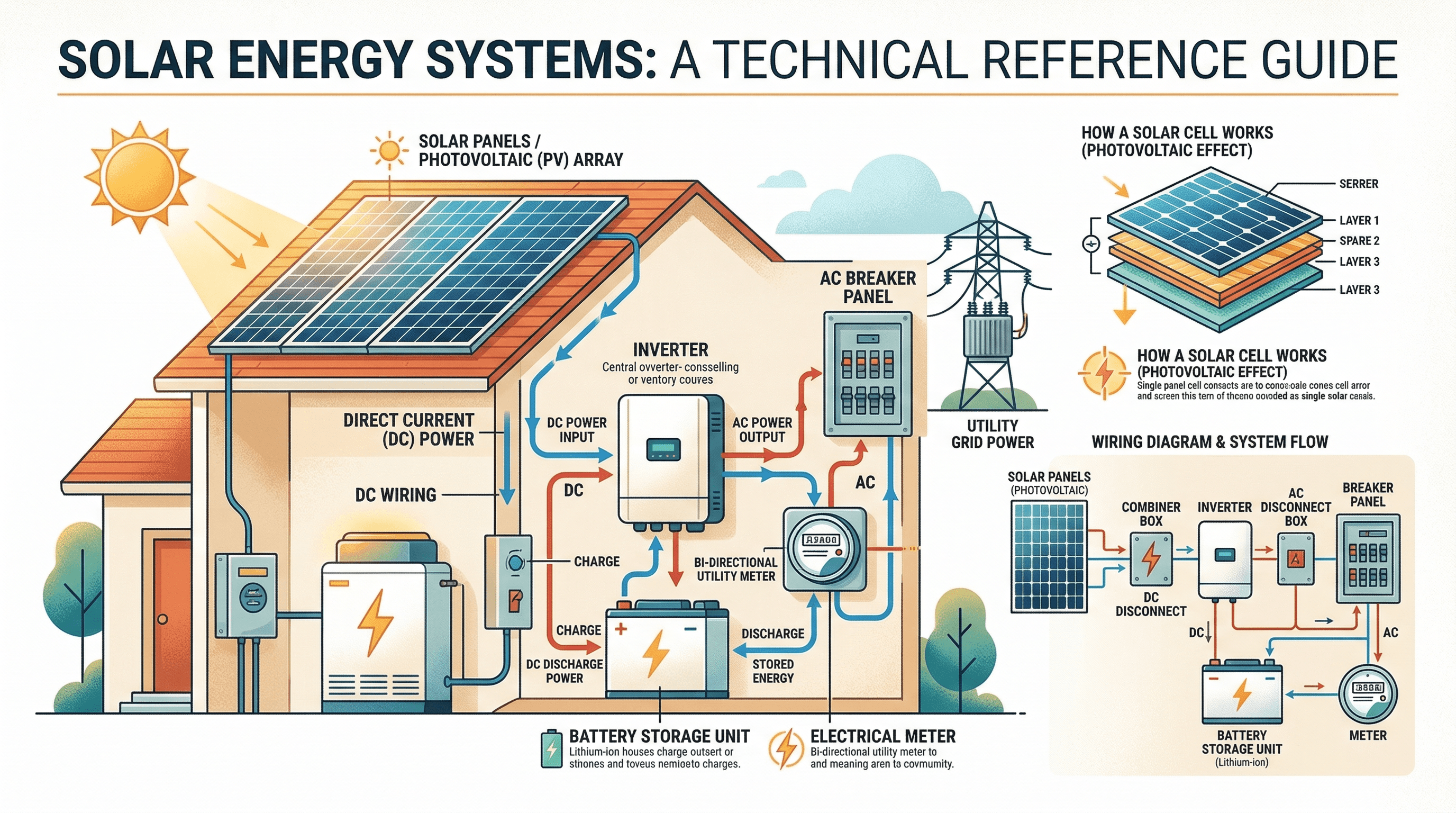
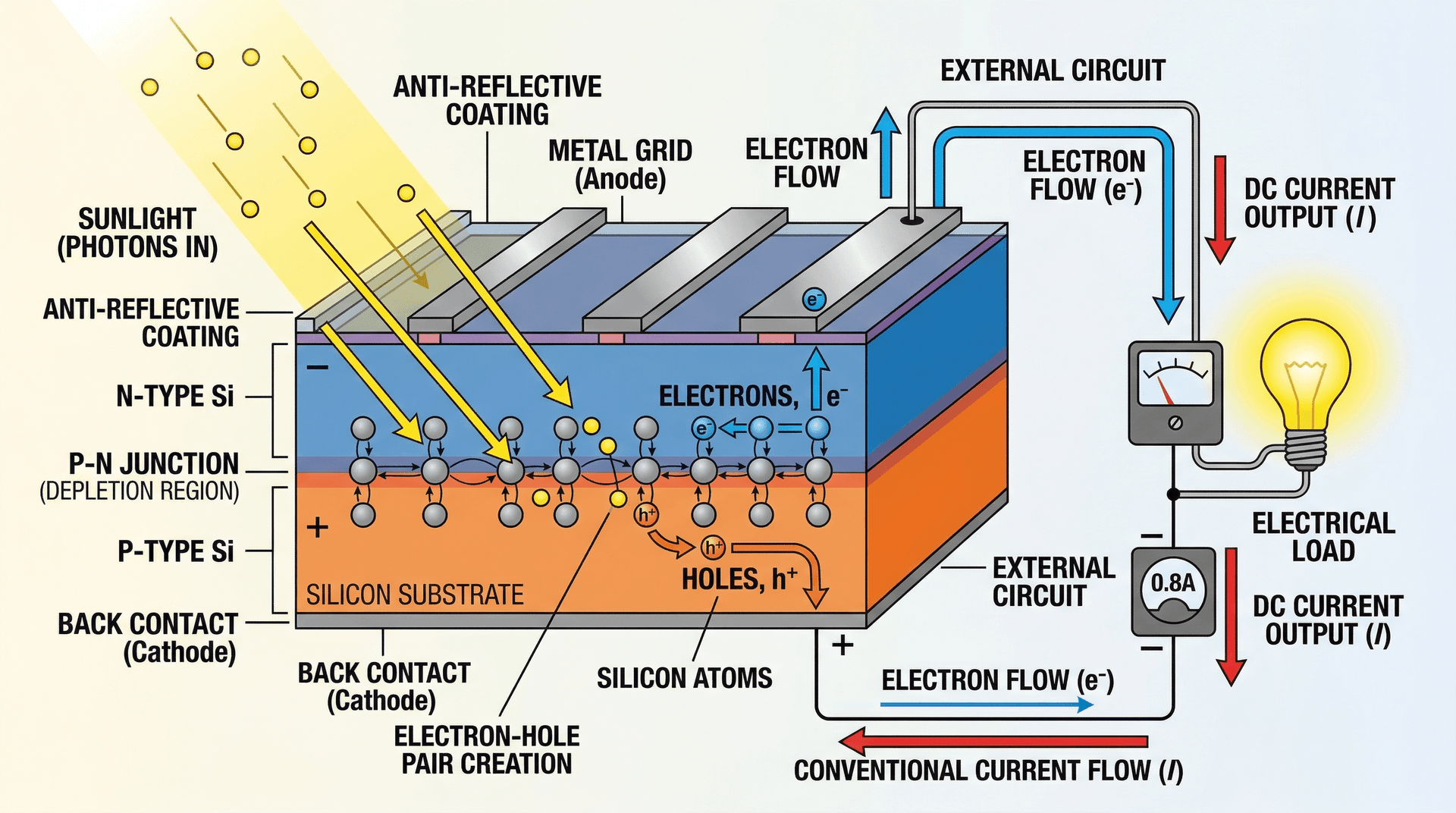
Every solar panel contains dozens of photovoltaic (PV) cells made from semiconductor material — typically crystalline silicon. When photons from sunlight strike a PV cell, they knock electrons free from their atoms, creating a flow of direct current (DC) electricity. This is the photovoltaic effect, first observed in 1839 and the fundamental physics behind every solar installation on Earth.
That DC power flows from the panels through wiring to an inverter, which converts it to alternating current (AC) — the type of electricity your home uses. The inverter is the brain of the system, constantly optimizing power output and communicating with your monitoring platform.
From the inverter, AC power flows to your electrical panel (breaker box), where it powers your home in real time. Any excess electricity flows through your utility meter back to the grid. In states with net metering, the meter spins backward and you earn credits. At night or on cloudy days, you draw grid power as usual — or pull from a battery storage system if you have one.
The full energy path: Sunlight → PV Cells → DC Power → Inverter → AC Power → Electrical Panel → Home / Grid / Battery. That is the entire system in one sentence. Every term in this glossary connects to some part of that chain.
Search by keyword, filter by category, or browse alphabetically. Click any term to expand its full definition with related concepts.
Showing 120 of 120 terms
Alternating current is the type of electricity used in homes and businesses. The current changes direction many times per second (60 Hz in the US). Solar panels produce DC power, which must be converted to AC by an inverter before your home can use it.
A fixed per-kilowatt-hour payment for solar generation used in some states, such as New Jersey. ADI replaced the SREC-II program and provides a predictable, long-term income stream for solar system owners over a 15-year period.
The local government body or building department that reviews and approves solar installations. The AHJ issues building permits, conducts inspections, and ensures the system meets local codes before it can be turned on.
A measure of how much sunlight a surface reflects. High-albedo surfaces like snow or white roofing reflect more light, which can boost production on bifacial solar panels. Albedo is expressed as a value between 0 (no reflection) and 1 (total reflection).
A unit measuring the flow rate of electric current, similar to how gallons per minute measures water flow. Solar panels and inverters have amperage ratings that determine how much current they can safely handle. Your main electrical panel also has an amp rating (typically 100A or 200A).
A thin layer applied to solar cell surfaces that reduces light reflection and increases the amount of sunlight absorbed. Without this coating, bare silicon would reflect about 30% of incoming light. Modern coatings reduce reflection to under 2%, significantly boosting panel efficiency.
An unintended electrical discharge that can occur in wiring or connections, creating intense heat and a potential fire hazard. Solar systems are required to have arc-fault detection and interruption (AFCI) built into the inverter or installed as a separate device to protect against this risk.
The cost a utility would have paid to generate or purchase electricity that a solar system produces instead. Some states use avoided cost as the basis for compensating solar owners, which is typically lower than the retail electricity rate.
The compass direction a solar panel faces, measured in degrees from north. A south-facing roof (180 degrees azimuth) is ideal for solar production in the Northern Hemisphere. East (90 degrees) and west (270 degrees) orientations produce about 15-20% less energy than due south.
When solar-generated electricity flows backward through the meter and onto the utility grid. This happens when your solar system produces more power than your home is using. Proper interconnection and a bidirectional meter are required for safe backfeed.
A mounting system that uses heavy weights (usually concrete blocks) to hold solar panels in place on flat roofs, rather than drilling into the roof. Ballasted mounts avoid roof penetrations and potential leaks, making them popular for commercial flat-roof installations.
The minimum energy a photon of light must have to knock an electron free in a solar cell and generate electricity. Silicon has a band gap of 1.1 electron volts (eV). This property determines which wavelengths of light a solar cell can convert to power.
A device that stores excess solar energy for use when the sun is not shining, during power outages, or during high-rate time-of-use periods. Common residential batteries include Tesla Powerwall, Enphase IQ, and Franklin WH. Typical capacity ranges from 10-15 kWh per unit.
Any energy generation or storage equipment installed on the customer side of the utility meter. Rooftop solar and home batteries are behind-the-meter resources. The utility only sees the net electricity flowing in or out, not the total solar production.
A solar panel that can generate electricity from both its front and back surfaces. The back side captures reflected light (albedo) from the ground or roof, boosting total output by 5-25% depending on the surface below. These panels work best when elevated above light-colored surfaces.
An accelerated tax deduction that allows businesses to deduct a large percentage of a solar system cost in the first year of operation, rather than spreading it over the normal 5-year MACRS schedule. For 2026, the bonus depreciation rate is 20%, dropping to 0% in 2027.
A small electronic component inside a solar panel that provides an alternate path for electrical current when one section of the panel is shaded. Without bypass diodes, a single shaded cell could reduce the output of the entire panel. Most panels have 3 bypass diodes protecting groups of cells.
The ratio of actual energy produced by a solar system to the maximum it could produce if it ran at full power 24/7. Residential solar in the Northeast has a capacity factor around 13-16%, while the Southwest reaches 20-25%. This reflects the reality that the sun does not always shine.
A wholesale electricity market mechanism where generators are paid to be available during peak demand periods, even if they are not actively producing. In New England, ISO-NE runs the Forward Capacity Market. Home batteries participating in demand response programs tap into this value stream indirectly.
Paying for a solar system outright without financing. Cash purchases provide the highest long-term return on investment because there are no interest payments or leasing fees. However, the upfront cost is significant, typically $20,000-$40,000 for a residential system.
The percentage of sunlight energy that a single solar cell converts into electricity under standard test conditions. Top monocrystalline cells now exceed 24% efficiency. Cell efficiency is always higher than module efficiency because modules have inactive areas like frames and cell gaps.
An electrical enclosure that combines the output wires from multiple strings of solar panels into a single, higher-current feed running to the inverter. It contains fuses or breakers for overcurrent protection. Combiner boxes are most common in larger residential and commercial systems.
A shared solar installation that allows multiple subscribers to benefit from solar energy without installing panels on their own roof. Subscribers receive credits on their utility bill based on their share of the project output. Community solar is ideal for renters, condo owners, or homes with shaded roofs.
The metal or plastic tubing that protects electrical wiring as it routes from the solar panels on the roof down to the inverter and main electrical panel. Conduit must be properly secured and weatherproofed. Longer conduit runs add to installation cost.
The total installed cost of a solar system divided by its size in watts. This is the standard metric for comparing solar pricing. In 2026, residential solar costs typically range from $2.80-$3.50/W before any incentives, depending on the state and equipment chosen.
The intentional reduction of solar power output, usually ordered by the grid operator when there is more electricity supply than demand. Curtailment wastes potential solar energy and can reduce the financial return of large solar installations. It is most common in areas with very high solar penetration.
Direct current is the type of electricity produced by solar panels and stored in batteries. The current flows in one direction only. An inverter must convert DC to AC before the power can be used by most household appliances or sent to the grid.
The rate at which a solar panel loses output capacity over time, typically 0.3-0.5% per year for modern panels. A panel with a 0.4% annual degradation rate will still produce about 90% of its original output after 25 years. Manufacturers guarantee a minimum production level through their performance warranty.
A fee on commercial electricity bills based on the highest power draw (peak demand in kW) during a billing period. Even one 15-minute spike can set the demand charge for the entire month. Solar alone does not reduce demand charges well, but solar plus battery storage can shave peaks effectively.
A program where battery owners are paid to discharge stored energy back to the grid during peak demand events, reducing strain on the power system. In New England, ConnectedSolutions pays $225-$275 per kW of capacity per summer season, providing significant annual revenue for battery owners.
Small-scale power generation located at or near where electricity is consumed, rather than at a large central power plant. Rooftop solar is the most common form of distributed generation. It reduces transmission losses and grid congestion.
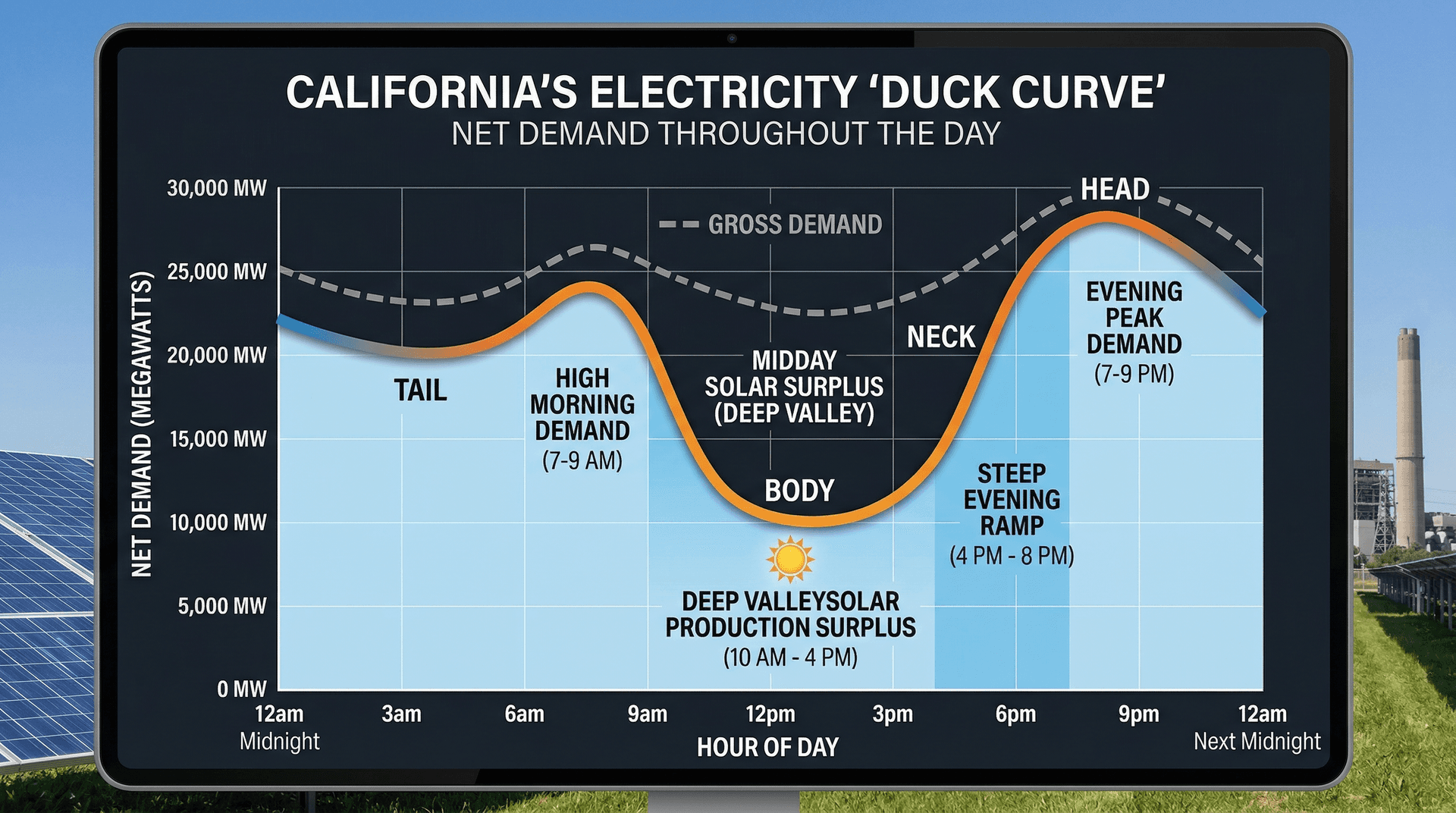
A graph of net electricity demand that dips in the middle of the day (when solar production peaks) and spikes in the evening (when solar drops off and people come home). The shape resembles a duck. This pattern creates challenges for grid operators who must rapidly ramp up other power sources at sunset.
A provision in a solar lease or PPA contract that increases the payment amount by a fixed percentage each year, typically 1-3%. Over a 20-25 year lease, even a small escalator can significantly increase total costs. Always compare the escalated cost against projected utility rate increases.
A policy that pays solar system owners a fixed rate for every kilowatt-hour of electricity they send to the grid, regardless of how much they consume. Feed-in tariffs are common in Europe but rare in the US, where net metering is more prevalent. Some state programs (like Rhode Island REG) function similarly.
The required clear space between solar panels and the edges of a roof, ridgeline, or other features to allow firefighter access and ventilation. The 2017 and later NEC codes typically require 3-foot pathways on residential roofs. Setback rules reduce the usable roof area for solar panels.
The point at which the cost of solar electricity equals or is less than the cost of buying electricity from the utility grid. Most US states reached grid parity years ago for residential solar. As utility rates continue rising and solar costs decline, the economic advantage of solar grows.
A solar system connected to the utility grid that can both draw power from and send power to the grid. This is by far the most common type of residential solar installation. Grid-tied systems do not provide backup power during outages unless paired with a battery.
An unintended electrical connection between a current-carrying conductor and a grounded surface, which can create a shock or fire hazard. Solar inverters have built-in ground fault protection that shuts down the system if a ground fault is detected.
A solar cell that is cut in half during manufacturing, reducing electrical resistance and improving performance, especially in partial shade. Half-cut cell panels typically have 120 or 144 cells (double the standard 60 or 72). Most premium panels made since 2022 use half-cut cell technology.
An advanced solar cell design that layers amorphous silicon onto a crystalline silicon wafer, combining the best properties of both. HJT cells have excellent temperature performance and can exceed 25% efficiency. They are among the highest-performing residential panel technologies available.
An inverter that can manage both solar panels and battery storage in a single unit. Hybrid inverters simplify installation and reduce costs compared to having separate solar and battery inverters. They can also provide backup power during grid outages.
A solar installation that is connected to the utility grid AND includes battery storage. This provides the best of both worlds: net metering credits when the grid is available, and backup power during outages. Hybrid systems are the fastest-growing segment of residential solar.
The total amount of solar radiation (energy) received on a surface over a specific time period, usually expressed in kWh per square meter per day. Insolation varies by location, season, and weather. The US Southwest receives about 6-7 kWh/m2/day, while New England gets 3.5-4.5 kWh/m2/day.
The process of connecting a solar system to the utility grid. Your installer files an interconnection application with the utility, which reviews the system design and may inspect it before granting permission to operate. Interconnection timelines vary from 2 weeks to 3+ months depending on the utility.
A formal contract between a solar system owner and the utility that establishes the terms and conditions for connecting to the grid. It covers system size, metering arrangements, safety requirements, and liability. This agreement must be signed before your system can legally operate.
A financial metric that represents the annualized return on a solar investment, accounting for the timing of all cash flows. An IRR of 10-15% is common for cash-purchased residential solar systems. Higher utility rates and better incentives increase the IRR.
The device that converts the DC electricity produced by solar panels into the AC electricity used by your home and the grid. The inverter is one of the most critical and expensive components of a solar system. The three main types are string inverters, microinverters, and power optimizers with a central inverter.
The instantaneous power of sunlight hitting a surface, measured in watts per square meter (W/m2). Standard test conditions use 1,000 W/m2 as the reference irradiance. Actual irradiance changes throughout the day and year based on sun angle, clouds, and atmospheric conditions.
When a solar system continues to energize a section of the grid during a power outage, creating a dangerous "island" of live wires that utility workers do not expect. Anti-islanding protection is built into all grid-tied inverters and automatically shuts down the system when the grid goes down.
A federal tax credit of 30% or more for commercial and third-party-owned solar systems. Section 48 is still available for projects that begin construction before July 4, 2026. The credit is claimed by the system owner (typically a financing company), not by the homeowner or the installer. Bonus adders can bring the total to 40-70%.
A weatherproof enclosure on the back of a solar panel where the electrical connections come together and bypass diodes are housed. The junction box protects internal wiring from moisture and provides the connection point for cables that link panels together in a string.
A unit of power equal to 1,000 watts. Solar system sizes are measured in kilowatts. A typical home system is 6-12 kW. The kW rating represents the maximum power output under ideal conditions. One kilowatt running for one hour produces one kilowatt-hour of energy.
A unit of energy equal to using 1,000 watts for one hour. Your electricity bill is measured in kWh. A typical US home uses about 10,000-11,000 kWh per year. Solar system production is estimated in kWh per year, making it easy to compare against your consumption.
The ratio of energy produced (kWh) per kilowatt of installed solar capacity (kWp) over a year, also known as specific yield. In New England, typical values are 1,100-1,300 kWh/kWp. The US Southwest can exceed 1,700 kWh/kWp. This metric normalizes production across different system sizes for fair comparison.
The total lifetime cost of a solar system divided by the total energy it produces over its life, expressed in cents per kWh. LCOE allows direct comparison between solar and utility electricity costs. Residential solar LCOE in 2026 is typically $0.06-0.12/kWh, well below retail rates in most states.
Lithium iron phosphate, a battery chemistry increasingly used in home solar batteries. LFP batteries are safer (no thermal runaway risk), last longer (5,000+ cycles), and use no cobalt compared to NMC alternatives. Most new residential battery products in 2025-2026 use LFP chemistry.
The dominant battery technology for residential solar storage. Lithium-ion batteries offer high energy density, long cycle life, and declining costs. The two main sub-types for home storage are NMC (nickel-manganese-cobalt) and LFP (lithium iron phosphate), with LFP becoming the preferred choice.
An analysis of your home electrical usage to determine the right solar system size and whether your main electrical panel can handle the additional solar circuit. Load calculations consider your annual consumption, peak electrical loads, and future additions like EVs or heat pumps.
The Modified Accelerated Cost Recovery System allows businesses to depreciate (deduct) the cost of a solar system over 5 years for tax purposes. Combined with the Section 48 ITC, MACRS significantly reduces the effective cost of commercial solar. Residential homeowner-owned systems do not qualify for MACRS.
Replacing your home electrical panel (breaker box) with a higher-capacity one, typically from 100 amps to 200 amps, to accommodate a solar system, EV charger, or heat pump. Panel upgrades cost $1,500-$4,000 and add time to the installation. Many modern homes already have 200A panels.
A unit of power equal to 1,000 kilowatts or 1,000,000 watts. Megawatts are used to measure the capacity of large solar installations and utility-scale power plants. A 1 MW solar array can power roughly 150-200 average homes.
The physical enclosure on the outside of your home where the utility meter connects. When adding solar, the utility may need to swap the meter for a bidirectional (net) meter that can measure both incoming and outgoing electricity. Some older meter sockets need replacement to accommodate modern meters.
A small inverter installed on each individual solar panel that converts DC to AC right at the panel. Microinverters provide panel-level optimization, meaning shade on one panel does not affect the others. Enphase is the leading microinverter manufacturer. They also enable panel-level monitoring.
A category of devices that manage power at each individual solar panel rather than at the system level. MLPE includes microinverters and power optimizers. These devices improve performance in partial shade, meet rapid shutdown requirements, and enable panel-level monitoring.
The percentage of sunlight energy that a complete solar panel (module) converts into electricity. Module efficiency is lower than cell efficiency because the panel includes inactive areas like frames and spacing. Top residential panels in 2026 achieve 22-24% module efficiency.
A type of solar cell made from a single crystal of silicon, identifiable by its uniform dark appearance. Monocrystalline cells are more efficient (20-24%) than polycrystalline cells and dominate the residential market. Nearly all premium panels sold in 2026 use monocrystalline silicon.
The set of electrical safety standards published by the NFPA that governs how solar systems must be designed, installed, and inspected. The NEC is updated every three years (current version: 2023). Key solar provisions cover rapid shutdown, fire setbacks, wire sizing, and grounding.
A compensation structure where excess solar electricity sent to the grid is credited at a rate lower than the retail price you pay for electricity. Unlike full net metering (1:1 credit), net billing typically credits at the wholesale or avoided-cost rate. Several states are transitioning from net metering to net billing.
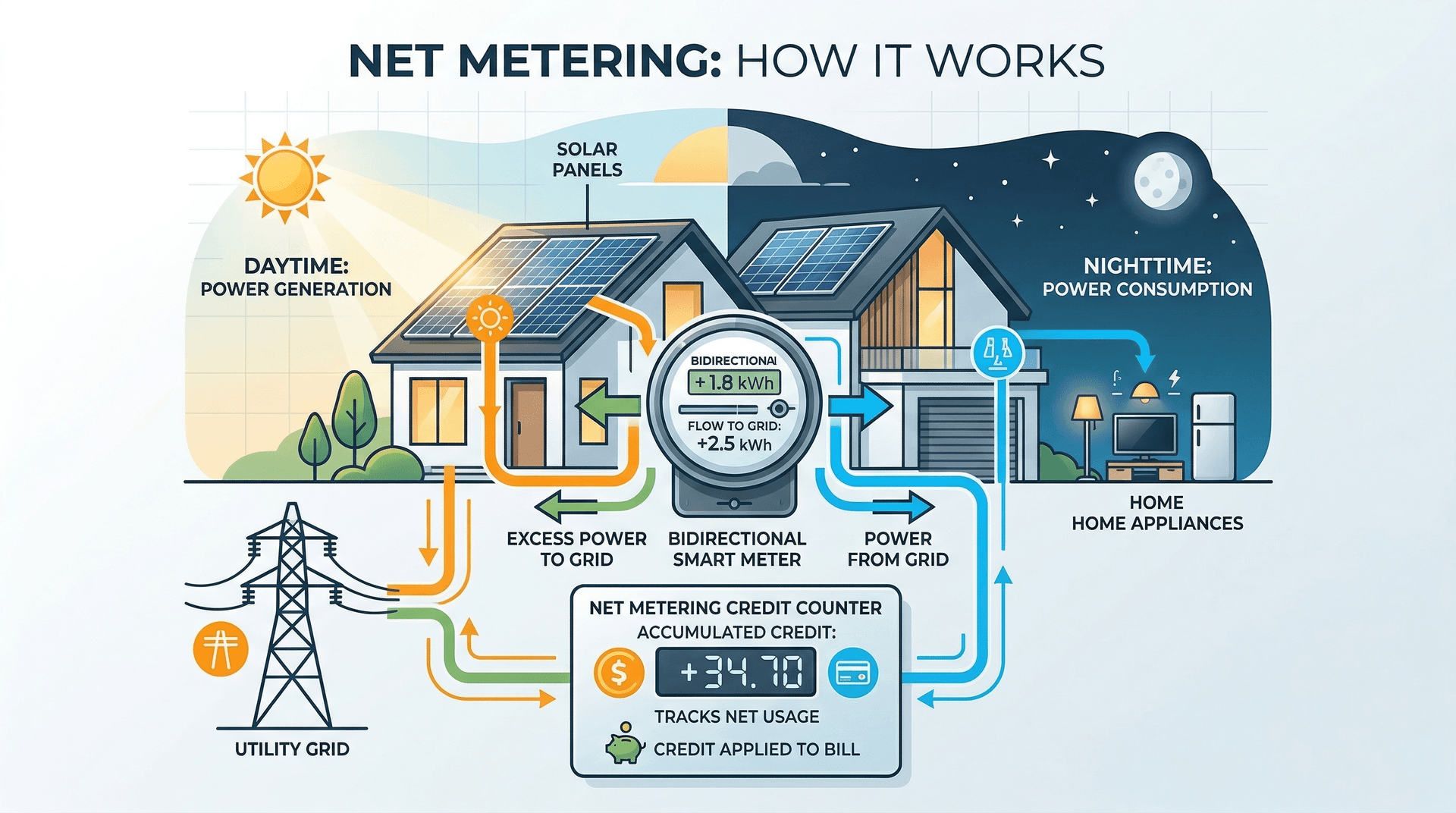
A billing arrangement where excess solar electricity sent to the grid earns credits on your utility bill. With full net metering, each kWh exported is worth the same as each kWh consumed (1:1). Credits offset electricity purchased at other times, such as nighttime. Net metering policies vary significantly by state.
Dollar or kWh credits applied to your electricity bill when your solar system produces more power than you consume. Credits typically roll forward month to month and are used to offset electricity costs during lower-production months (winter). Credit expiration and true-up policies vary by utility.
The temperature a solar cell reaches under more realistic conditions than STC: 800 W/m2 irradiance, 20C ambient, and 1 m/s wind. NOCT is typically 42-48C. Panel specifications often show power output at both STC and NOCT to give you a better real-world performance expectation.
A solar system that operates completely independently of the utility grid, relying on batteries to store energy for use when the sun is not shining. Off-grid systems require significantly more battery storage and a backup generator for extended cloudy periods. They are primarily used in remote locations without grid access.
The boundary between two types of silicon in a solar cell: p-type (positive, with missing electrons called "holes") and n-type (negative, with extra electrons). This junction creates an electric field that pushes freed electrons in one direction, generating current when light hits the cell.
A manufacturing process that coats the surface of a solar cell with a thin protective layer to reduce electron recombination (where freed electrons fall back into "holes" instead of flowing as current). Better passivation means higher cell efficiency. PERC, TOPCon, and HJT cells each use different passivation techniques.
The number of years it takes for a solar system to save enough on electricity bills (and earn enough from incentives) to equal its upfront cost. In the Northeast in 2026, typical payback periods are 8-15 years for cash purchases, depending on the state, utility rates, and available incentives.
The highest level of electricity demand on the grid, typically occurring on hot summer afternoons when air conditioning use spikes. Peak demand drives the need for expensive peaker power plants and is the target of demand response programs. Solar production often coincides with peak demand, providing grid benefits.
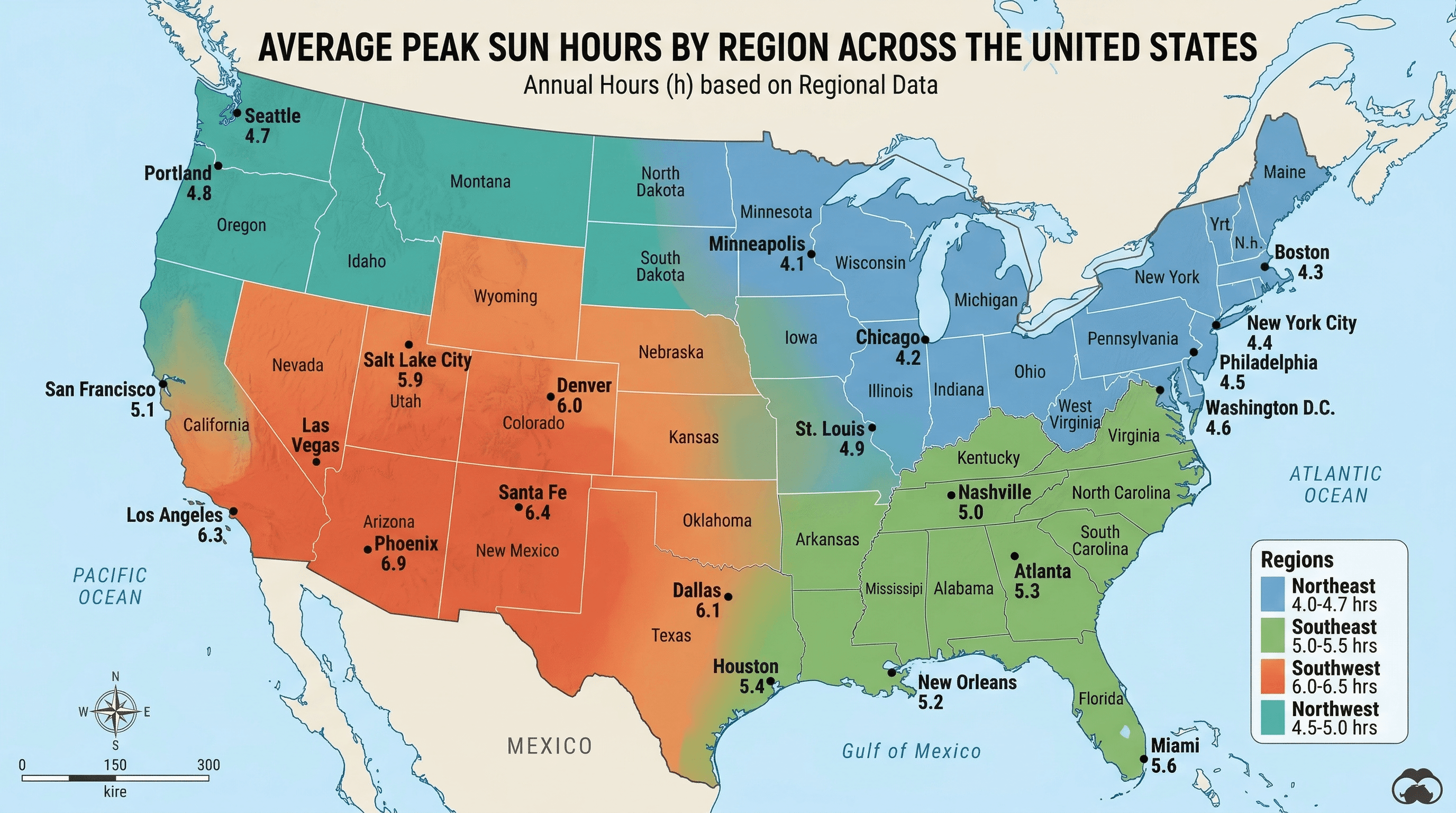
The equivalent number of hours per day when solar irradiance averages 1,000 W/m2. If an area receives 4.5 peak sun hours, a 1 kW solar panel would produce approximately 4.5 kWh that day. New England averages 3.5-4.5 peak sun hours; the Southwest gets 5.5-7.
A roof mounting system that attaches solar panel racking to the roof structure using bolts or screws that pass through the roofing material and into the rafters. This is the most common residential mounting method. Each penetration is sealed with flashing to prevent leaks.
Passivated Emitter and Rear Contact, a solar cell design that adds a reflective passivation layer to the back of the cell, capturing light that would otherwise pass through. PERC was the industry standard from 2019-2024, reaching about 23% efficiency. It is gradually being replaced by TOPCon and HJT.
The physical process by which sunlight creates an electrical voltage in a material, specifically at the junction of two different semiconductor layers (p-type and n-type). When photons from sunlight knock electrons free in the semiconductor, an electric current flows. This is the fundamental science behind all solar panels.
A type of solar cell made from multiple silicon crystals melted together, recognizable by its blue, speckled appearance. Polycrystalline cells are less efficient (15-18%) but cheaper to manufacture than monocrystalline. They have largely disappeared from the US residential market but remain common in utility-scale projects.
A DC-to-DC converter attached to each solar panel that maximizes the power output of that individual panel before sending it to a central string inverter. Optimizers provide panel-level performance similar to microinverters but at a lower cost. SolarEdge is the primary manufacturer.
A contract where a third-party company installs and owns solar panels on your roof, and you buy the electricity at a fixed rate (typically below your utility rate). You do not own the system, so the company claims the Section 48 tax credit. PPAs require no upfront cost but provide lower savings than owning the system.
The ratio of a solar system actual annual energy output (kWh) to its rated capacity (kW), also called specific yield. A system rated at 8 kW that produces 9,600 kWh/year has a production ratio of 1,200 kWh/kW. This metric accounts for real-world losses from temperature, shade, wiring, and inverter efficiency.
A set of more realistic testing conditions for solar panels compared to STC, using 1,000 W/m2 irradiance but a higher cell temperature (45C vs 25C) and accounting for real mounting conditions. PTC ratings are typically 10-15% lower than STC ratings and give a better indication of real-world performance.
The official approval from your utility to turn on your solar system and begin sending power to the grid. PTO is the final step after installation, inspection, and interconnection approval. Until you receive PTO, your system must remain off. Wait times range from a few days to several months depending on the utility.
The structural framework that secures solar panels to your roof or the ground. Racking includes rails, clamps, and roof attachments. The two main types are penetrating mounts (bolted through the roof into rafters) and ballasted mounts (weighted on flat roofs). Racking costs are typically $0.10-0.25/W.
A NEC safety requirement that solar panels on a roof must be able to reduce their voltage to safe levels (under 80V) within 30 seconds when the system is shut down. This protects firefighters from electrocution risk. Microinverters and power optimizers inherently meet this requirement.
A tradable certificate representing the environmental attributes of 1 MWh of electricity generated from a renewable source. When you produce solar energy, you create RECs that can be sold separately from the electricity itself. REC values vary by state from under $1 to over $50 depending on market supply and demand.
The total financial return from a solar investment expressed as a percentage of the initial cost. A solar system that costs $25,000 and saves $75,000 over its lifetime has a 200% ROI. Cash purchases typically yield higher ROI than financed systems because there are no interest costs.
A state law requiring utilities to source a minimum percentage of their electricity from renewable sources by a target date. RPS policies create demand for renewable energy and drive programs like SREC markets. States with aggressive RPS targets (like Massachusetts and New Jersey) tend to have stronger solar incentives.
EXPIRED. The federal residential solar Investment Tax Credit under Section 25D expired on December 31, 2025. It previously allowed homeowners to claim 30% of their solar installation cost as a tax credit. As of 2026, homeowners purchasing solar with cash or a loan receive $0 in federal tax credits.
A material that conducts electricity better than an insulator but worse than a metal. Silicon is the most common semiconductor used in solar cells. By adding tiny amounts of other elements (doping), manufacturers create the positive and negative layers needed for the photovoltaic effect.
An assessment of how trees, buildings, chimneys, and other obstructions block sunlight from reaching your roof throughout the year. Shade analysis is a critical part of solar design, determining panel placement and expected production. Modern tools use satellite imagery, LIDAR, or on-site devices like a Solar Pathfinder.
A thin slice of purified silicon crystal that forms the base of a solar cell. Wafers are typically 150-180 micrometers thick. They are cut from silicon ingots, doped to create a P-N junction, and then coated with anti-reflective material. Larger wafer sizes (182mm and 210mm) are the current industry standard.
The standard electrical service for residential homes, delivering power through two wires (one hot, one neutral) at 120/240 volts. Most home solar systems are designed for single-phase connection. If your home has three-phase service (rare for residential), the inverter configuration may differ.
An intelligent electrical panel (like Span or Lumin) that provides circuit-level monitoring and control, allowing you to prioritize which circuits receive power during a grid outage or manage how solar and battery energy is distributed. Smart panels can eliminate the need for a traditional transfer switch.
The percentage of available sunlight that actually reaches your roof after accounting for shade from surrounding objects. A solar access rating of 90% means your roof receives 90% of the sunlight it would get with no obstructions. Most installers require a minimum solar access of 75-80% to recommend installation.
An agreement where a third-party company installs and owns solar panels on your roof, and you pay a fixed monthly fee to use the system. Like a PPA, you do not own the panels. The leasing company claims the Section 48 ITC. Leases require no upfront cost but provide the lowest long-term savings compared to cash or loan.
A loan specifically designed to finance a solar system purchase. You own the system and keep all the energy savings. Interest rates in 2026 typically range from 5-9% APR for 10-25 year terms. Since the residential ITC (Section 25D) has expired, there is no longer a tax credit to offset loan costs.
A device made of interconnected solar cells that converts sunlight into electricity. Modern residential panels typically contain 60-72 cells, produce 350-475 watts, and measure about 3.5 by 6.5 feet. Panels carry a 25-30 year performance warranty guaranteeing at least 80-87% of original output.
A motorized mounting system that tilts solar panels to follow the sun across the sky, maximizing energy production. Single-axis trackers follow the sun east to west; dual-axis also adjust for seasonal angle changes. Trackers can boost production 15-35% but are expensive and primarily used in utility-scale projects, not residential.
The period of the day when your roof receives direct sunlight and solar panels produce meaningful energy, typically from 9 AM to 3 PM. The solar window varies by season, location, and shading. A wider solar window means more energy production and a better return on investment.
A measure of how effectively a solar cell converts different wavelengths (colors) of light into electricity. Different cell technologies respond better to different parts of the light spectrum. This is why some panels perform slightly better in overcast conditions (which shift the spectrum toward blue/UV light).
A special type of REC specifically for solar energy, worth one per MWh of solar production. Some states require utilities to purchase SRECs to meet solar carve-outs in their renewable portfolio standards. SREC values fluctuate based on supply and demand; some states have transitioned to fixed-rate programs like ADI.
The laboratory conditions used to rate solar panel output: 1,000 W/m2 irradiance, 25C cell temperature, and air mass 1.5 spectrum. The wattage on a panel label (e.g., 440W) is measured at STC. Real-world conditions rarely match STC, so actual production is typically 10-20% lower.
A central inverter that converts DC power from a "string" (series) of solar panels into AC power. String inverters are less expensive than microinverters but have a drawback: if one panel in the string is shaded, it can reduce the output of the entire string. Often paired with power optimizers to mitigate this.
An engineering assessment of whether your roof can support the added weight of solar panels and racking. Solar panels typically add 3-5 pounds per square foot. Older roofs, flat roofs with ballasted mounts, and areas with heavy snow loads may require a structural engineer sign-off before installation.
The overall efficiency of an entire solar installation, accounting for all losses from the panel to your electrical panel: module efficiency, inverter losses, wiring losses, soiling, temperature effects, and shade. System efficiency is typically 75-85% of the panel rated output under STC.
The rate at which a solar panel output decreases as its temperature rises above 25C (the STC baseline). Expressed as a percentage per degree Celsius, typical values range from -0.30% to -0.40%/C. A panel with -0.35%/C loses 3.5% output for every 10C above 25C. Lower (closer to zero) is better.
A solar cell technology made by depositing thin layers of photovoltaic material onto glass, metal, or flexible substrates. Thin-film panels are lighter and less expensive per panel but have lower efficiency (10-13%) and require more roof space. They are primarily used in commercial and utility-scale projects.
An electrical service using three alternating currents offset in phase, delivering more efficient power for large commercial and industrial loads. Three-phase service is uncommon in residential buildings but standard in commercial properties. Solar installations on three-phase services require compatible inverters.
The angle at which solar panels are tilted from horizontal, measured in degrees. For fixed residential rooftop systems, the optimal tilt angle roughly equals the latitude of the location (about 40-45 degrees in the Northeast). Most roofs have a pitch of 20-40 degrees, which is close enough to optimal for strong production.
An electricity rate structure that charges different prices based on the time of day. Peak rates (highest) are typically 4-9 PM, off-peak (lowest) overnight, and mid-peak during the daytime. Solar panel owners on TOU rates benefit by exporting power during mid-peak and using stored battery power during peak.
Tunnel Oxide Passivated Contact, a next-generation solar cell technology that adds an ultra-thin oxide layer and doped polysilicon to improve electron flow and reduce losses. TOPCon cells reach 24-25%+ efficiency and are rapidly replacing PERC as the mainstream cell technology in 2025-2026.
A rate-setting methodology that calculates the full value solar energy provides to the grid, including energy, capacity, environmental, and grid support benefits. Some states use this calculation to set compensation rates for solar owners. Value-of-solar rates can be higher or lower than retail rates depending on the methodology.
A policy that allows the credits from a single solar installation to be shared across multiple electric meters or utility accounts. Virtual net metering enables community solar projects, multi-unit buildings, and municipal installations to distribute solar benefits to participants who do not host the panels themselves.
The electrical "pressure" that pushes current through a circuit, measured in volts (V). Solar panels produce 30-50 volts DC each. When panels are connected in a string (series), their voltages add up. The inverter converts this high-voltage DC into the 120/240V AC used in your home.
The basic unit of electrical power, equal to one volt times one ampere. Solar panel output is rated in watts (e.g., a 440W panel). Your home electricity usage is measured in watts at any instant and kilowatt-hours over time. One watt used for one hour equals one watt-hour (Wh).
The market where electricity generators sell power in bulk to utilities and retail suppliers, operated by regional entities like ISO-NE, PJM, and ERCOT. Wholesale prices are much lower than retail rates (typically $0.03-0.08/kWh). Net billing and avoided-cost policies often tie solar compensation to wholesale prices.
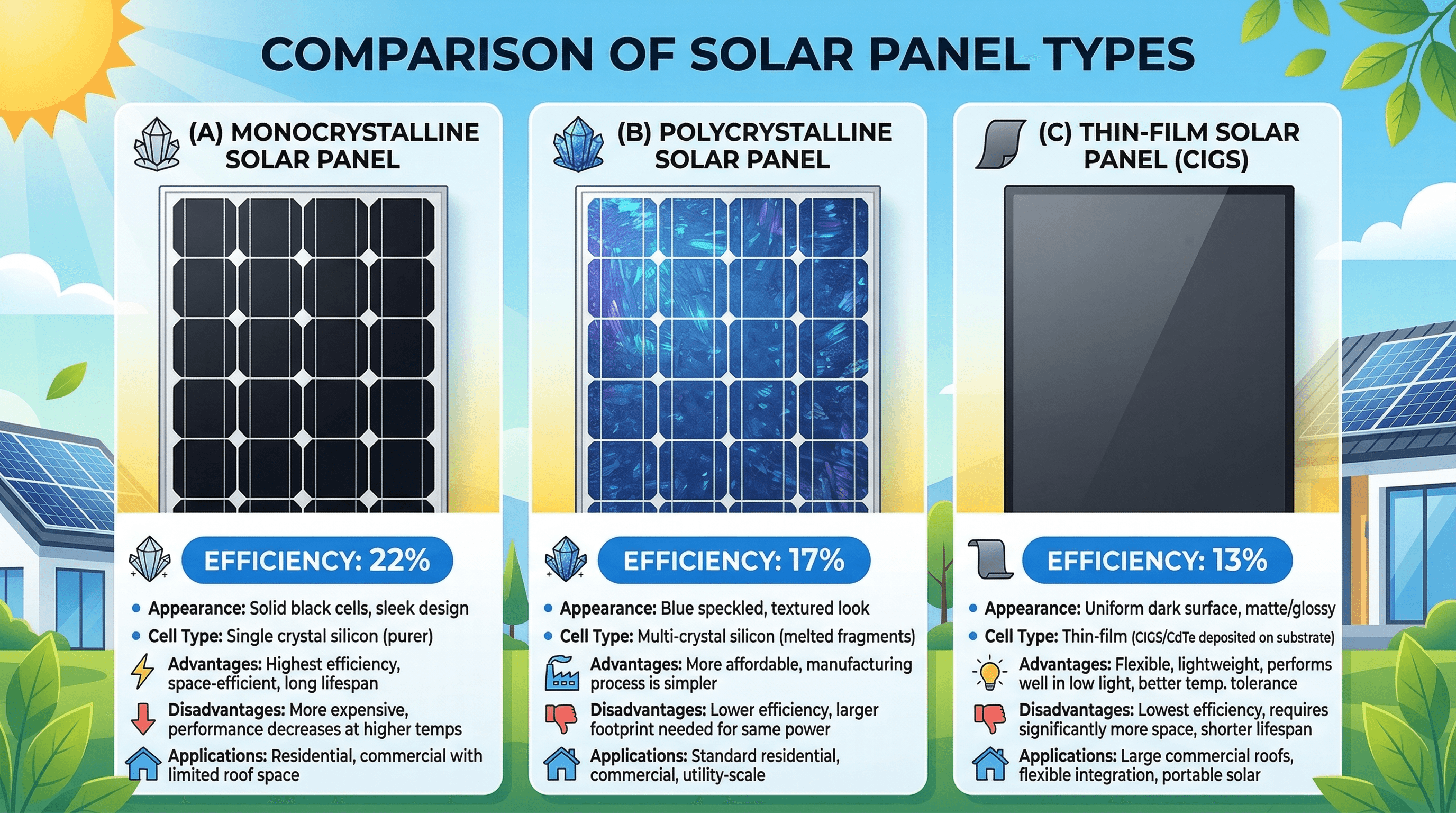
Most residential installations in 2026 use monocrystalline panels for their balance of efficiency and cost. Premium installs are shifting to TOPCon and HJT (heterojunction) cells, which deliver 23–25% efficiency and better performance in low light and high heat. Polycrystalline panels are fading from the US market but remain common globally. Thin-film is primarily used in commercial ground-mount and building-integrated applications.
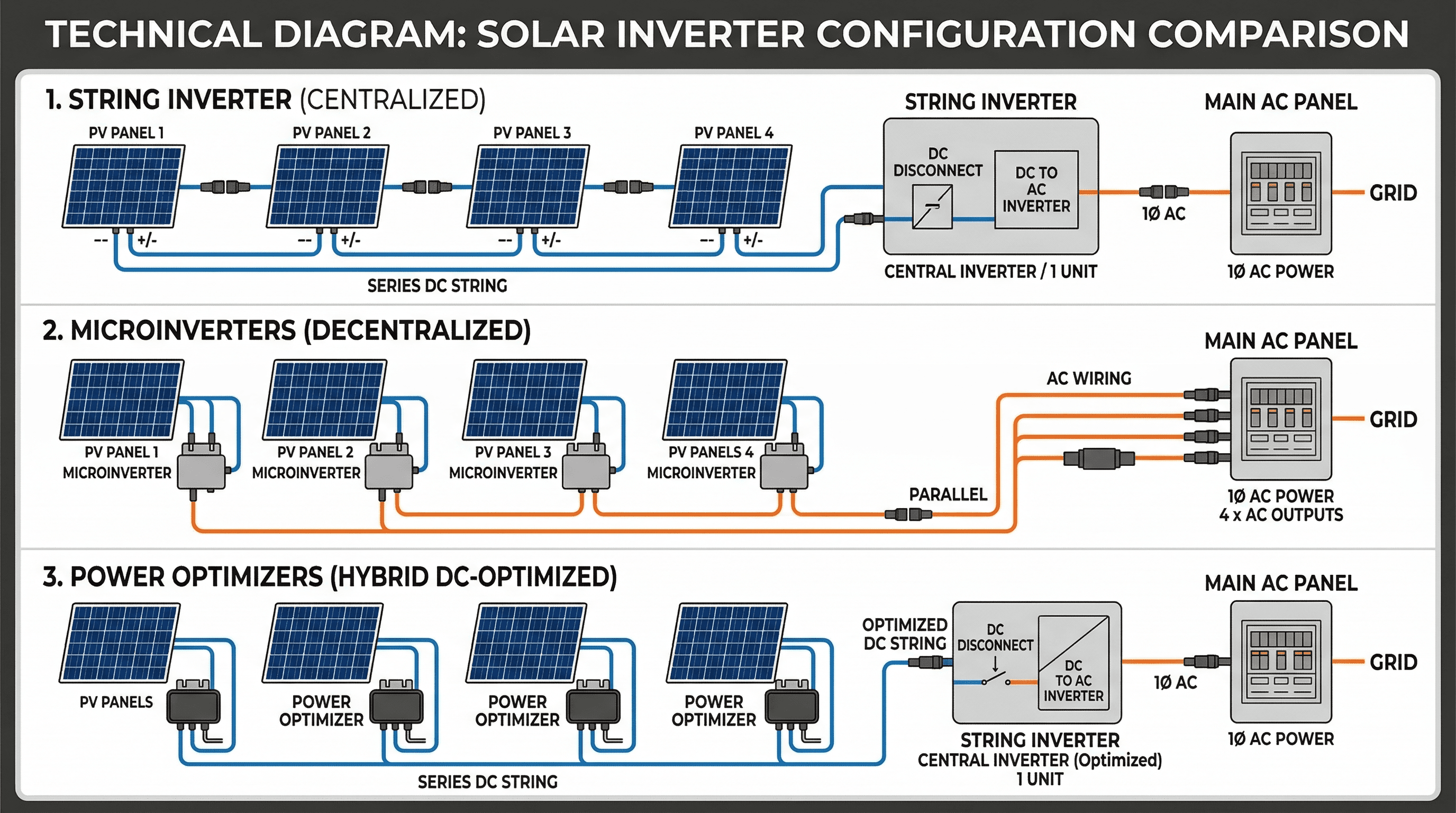
One central unit converts DC from all panels to AC. Simple, reliable, lowest cost.
Individual inverter on each panel. Each panel operates independently.
DC optimizers on each panel feed into a central inverter. Hybrid approach.
Your inverter choice depends on your roof. If you have partial shading from trees or dormers, microinverters or power optimizers ensure one shaded panel does not drag down the entire array. For unshaded roofs, a string inverter offers the best value. Most premium residential installs in 2026 use Enphase microinverters or SolarEdge optimizers with a central inverter.
Net metering is the billing mechanism that makes residential solar financially viable. During the day, your panels often produce more electricity than your home uses. That excess flows to the grid, and your meter credits you — effectively spinning backward.
At night or on cloudy days, you draw power from the grid as usual. At the end of each billing cycle, you pay only the net difference. Most states settle accounts annually (a "true-up"), and any excess credits above your annual usage are typically paid out at the wholesale rate.
Net metering policies vary significantly by state. Some offer full 1:1 retail credit, while others have moved to reduced-rate "net billing" structures. Check your state's net metering policy.
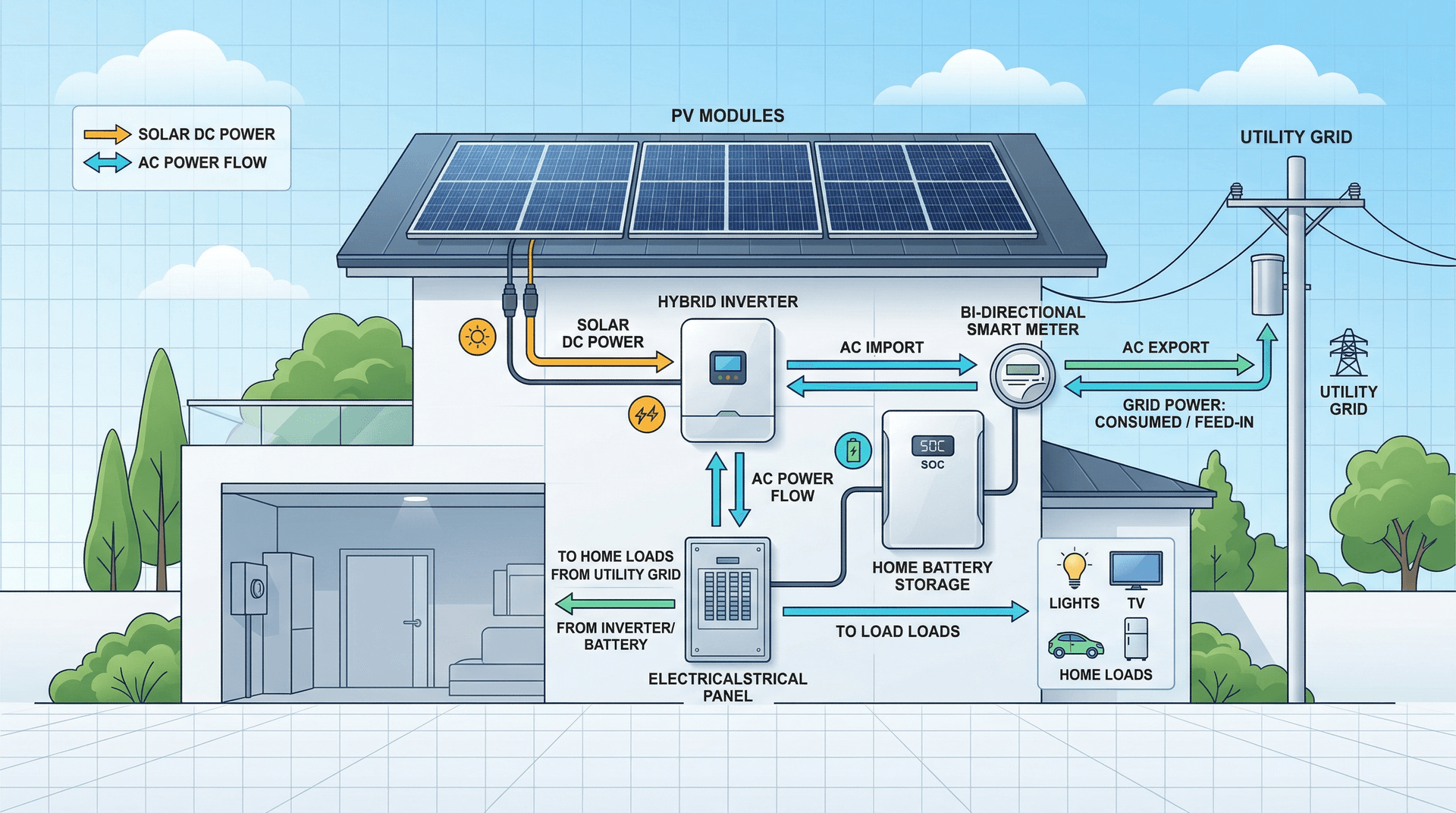
A home battery stores excess solar energy for use when the sun is not shining. The power flow is: Solar Panels → Inverter → Battery → Home → Grid. During the day, excess solar charges the battery. In the evening, the battery discharges to power your home before you draw from the grid.
Key battery terms to understand: kWh capacity (total energy stored — a typical home battery is 10–15 kWh), depth of discharge (how much you can safely use — typically 80–100%), and round-trip efficiency (energy in vs. energy out — typically 85–95%). A 13.5 kWh battery with 90% round-trip efficiency delivers about 12.15 kWh of usable energy per cycle.
Peak sun hours measure how many hours per day sunlight intensity equals 1,000 W/m² — the equivalent of direct noon sun. It is the single most important factor in estimating how much electricity your panels will produce.
| State | Peak Sun Hours / Day | Annual kWh per kW Installed |
|---|---|---|
| MA | 4.5 | ~1,314 |
| CT | 4.5 | ~1,314 |
| RI | 4.6 | ~1,343 |
| NH | 4.4 | ~1,285 |
| NJ | 4.7 | ~1,372 |
| ME | 4.5 | ~1,314 |
| VT | 4.3 | ~1,256 |
| PA | 4.7 | ~1,372 |
| TX | 5.5 | ~1,606 |
| AZ | 6.5 | ~1,898 |
| CA | 5.8 | ~1,694 |
| FL | 5.5 | ~1,606 |
| NY | 4.6 | ~1,343 |
| CO | 5.5 | ~1,606 |
Annual kWh estimate uses 80% system efficiency factor (accounting for inverter losses, wiring, temperature, soiling).
The "duck curve" describes the shape of net electricity demand on the grid throughout the day in regions with high solar adoption. During midday, solar floods the grid and net demand plummets — creating the belly of the duck. As the sun sets, millions of homes switch on lights, AC, and appliances while solar output drops to zero, causing a steep evening ramp — the neck of the duck.
This pattern explains why time-of-use (TOU) rates charge more for evening electricity and why battery storage is increasingly valuable: charge during the cheap midday surplus, discharge during the expensive evening peak. The duck curve is reshaping how utilities price electricity and why demand-response programs like ConnectedSolutions pay battery owners to discharge during peak hours.
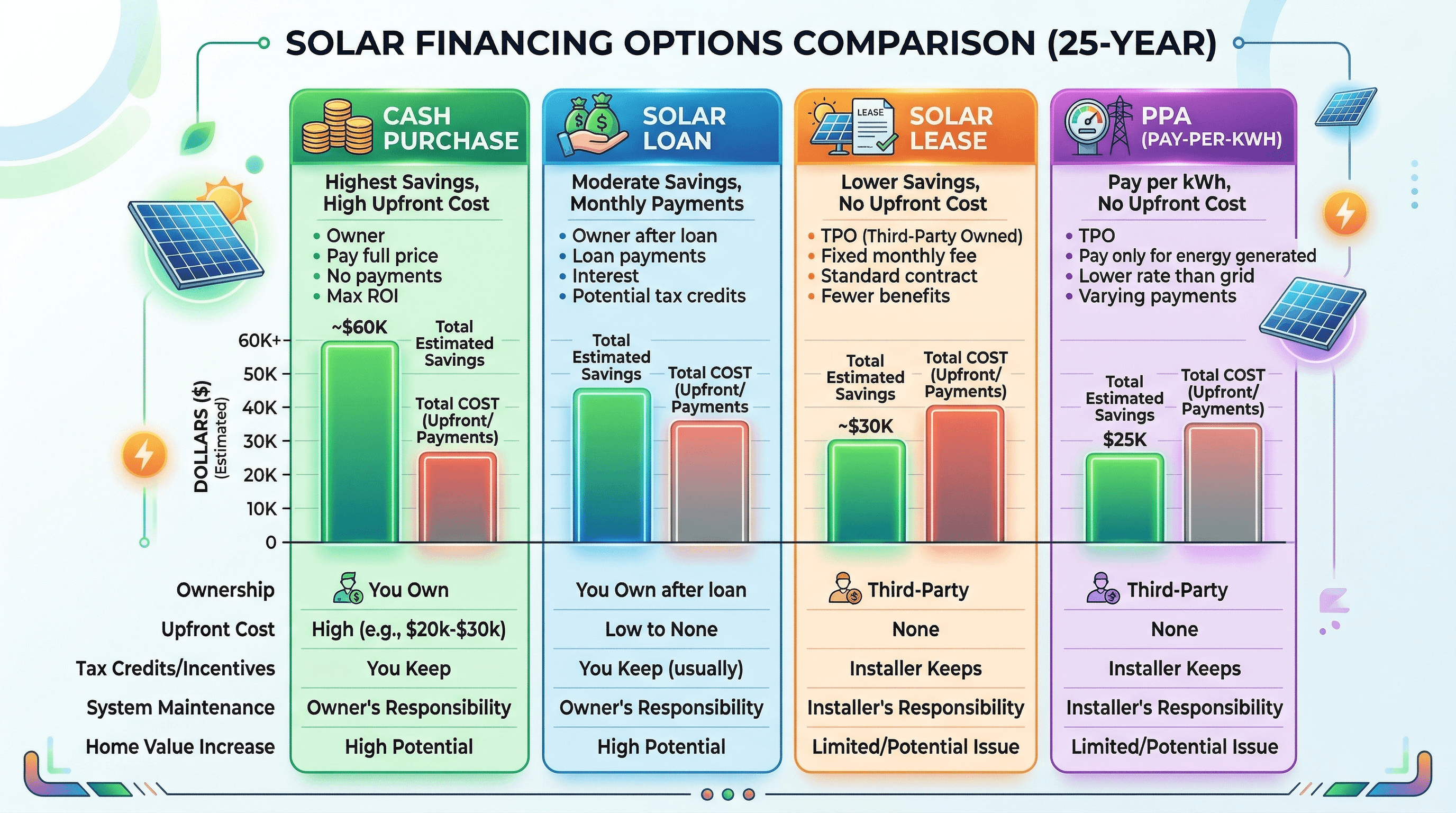
| Method | Upfront | Interest | 25-Year Savings | Ownership |
|---|---|---|---|---|
| Cash Purchase | $24K–$35K | $0 | Highest | Yes |
| Solar Loan | $0 | 6–8% APR typical | Moderate | Yes (builds equity) |
| Solar Lease | $0 | Fixed monthly | Lower | No |
| PPA | $0 | Per-kWh rate | Lower | No |
Important (2026): The Section 25D residential solar investment tax credit expired December 31, 2025. Homeowners who purchase solar with cash or a loan receive no federal tax credit. However, lease and PPA providers — as third-party commercial system owners — may still access the Section 48 commercial ITC for projects beginning construction before July 4, 2026.
Each financing method has trade-offs between upfront cost, long-term savings, and system ownership. Read our full solar financing guide for a detailed comparison with real numbers.
The distinction between kW (kilowatt) and kWh (kilowatt-hour) is foundational. A kW measures instantaneous power — how much electricity your system can produce at any moment. A kWh measures energy over time — the total electricity produced or consumed. Your system size is in kW; your electric bill charges you per kWh. A 10 kW system producing power for 5 peak sun hours generates 50 kWh that day.
kW (kilowatt) is a unit of power — think of it as the speedometer on your car. kWh (kilowatt-hour) is a unit of energy — think of it as the odometer measuring total distance traveled. A 10 kW solar system running at full power for one hour produces 10 kWh of energy. Your utility bills you per kWh consumed.
STC stands for Standard Test Conditions — the laboratory environment used to rate solar panel output. STC specifies 1,000 W/m² irradiance (bright noon sun), 25°C cell temperature, and 1.5 air mass. Real-world conditions rarely match STC exactly, which is why actual production is typically 75–85% of the STC nameplate rating. PTC (PVUSA Test Conditions) and NOCT (Nominal Operating Cell Temperature) offer more realistic benchmarks.
No. The Section 25D residential solar investment tax credit expired on December 31, 2025. Homeowners who purchase solar with cash or a loan in 2026 receive no federal tax credit. However, lease and PPA providers — as third-party commercial owners — may still access the Section 48 commercial ITC for projects beginning construction before July 4, 2026. State-level incentives (SMART, ADI, REF, net metering) remain active and vary by location.
Net metering credits your excess solar generation at the full retail electricity rate — you effectively spin your meter backward. Net billing (sometimes called "net billing 3.0" or "avoided cost" billing) credits your exports at a lower rate, typically the utility's wholesale or avoided-cost rate. Net metering is more favorable for solar owners but is being phased out in many states. Check your state's current policy before going solar.
LCOE stands for Levelized Cost of Energy — the total lifetime cost of your solar system divided by the total energy it produces over its lifetime, expressed in cents per kWh. It lets you compare solar to your utility rate on an apples-to-apples basis. If your solar LCOE is $0.08/kWh and your utility charges $0.28/kWh, you save $0.20 on every kWh your system produces. LCOE accounts for installation cost, financing, maintenance, degradation, and system lifetime.
Now that you know the terminology, get a personalized solar design for your home. Our instant estimator uses your actual roof, local rates, and current incentives.