
Loading NuWatt Energy...
We use your location to provide localized solar offers and incentives.
We serve MA, NH, CT, RI, ME, VT, NJ, PA, and TX
Loading NuWatt Energy...
NuWatt designs, installs, and manages solar, battery, heat pump, and EV charger systems across 9 states. One company, one warranty, one point of contact.
Get a Free Quote
Red flags, predatory tactics, and how to vet your installer — especially now that the federal tax credit is gone and scam activity is surging.

SECTION 25D
EXPIRED
Dec 31, 2025
RED FLAGS
12
Warning signs
SCAM TYPES
8
Documented
VETTING STEPS
8
Checklist
Section 25D expired December 31, 2025. Homeowners who buy solar with cash or a loan get $0 in federal tax credits. But many salespeople haven't updated their pitches — or are deliberately lying.
Without the ITC driving easy sales, some installers are resorting to aggressive and deceptive tactics to maintain volume. Door-to-door sales have surged 40%+ in early 2026.
The commercial ITC (Section 48/48E) still exists for third-party-owned systems (leases, PPAs). Some salespeople exploit this confusion, telling homeowners they "still qualify for 30%" without explaining it only applies to TPO arrangements where a financing company — not you — claims the credit.
With the ITC gone, some installers have shifted to predatory loan products with 25-40% dealer fees to maintain their margins. A $30,000 system becomes a $42,000 loan, with the extra $12,000 going to the installer as a hidden commission.
From fake tax credit claims to predatory financing — here are the most common scams targeting homeowners after the 25D expiry.
Installers falsely claiming homeowners still get a 30% federal tax credit for cash or loan purchases.
Section 25D expired December 31, 2025. There is no federal residential solar tax credit for homeowner-owned systems in 2026. Yet many salespeople — especially door-to-door reps — still quote the old 30% ITC to inflate apparent savings and close deals. Some even show outdated marketing materials or fabricated "government program" flyers.
A salesperson shows you a savings estimate with "$8,400 federal tax credit" on a $28,000 system. That credit does not exist for homeowner purchases in 2026. The real cost is $28,000, not $19,600.
Walk away immediately. An installer willing to lie about a $8,000+ tax credit will cut corners everywhere else. Report them to your state Attorney General and the FTC.
Solar loans with massive hidden dealer fees that inflate your total cost by $7,000-$15,000 or more.
Many solar loans advertise low interest rates (0.99%-3.99%) but hide massive "dealer fees" (also called "origination fees" or "channel partner compensation") of 25-40% or higher. A $30,000 system with a 30% dealer fee means you're borrowing $39,000 — the extra $9,000 goes to the installer as a commission, not toward your solar equipment. Your loan balance is far higher than what your system is actually worth.
Your quote says $3.00/W for a 10 kW system ($30,000). The loan documents show a principal of $42,000. The hidden $12,000 (40% dealer fee) is the installer's commission baked into your loan.
Always ask: "What is the dealer fee on this loan?" Compare the loan principal to the cash price. Use NuWatt's dealer fee calculator at /tools/dealer-fee-calculator to see the real cost.
Aggressive door-to-door salespeople using manufactured urgency and pressure tactics.
Post-25D expiry has triggered a surge in aggressive door-to-door solar sales. Reps create fake urgency ("this offer expires tonight," "your neighbor just signed up," "utility rates are doubling next month") to prevent you from doing research or getting competing quotes. Some claim to be from your utility company or a "government energy program."
A rep knocks on your door claiming to be "from the utility company" and says you qualify for a "limited-time solar savings program" that expires today. They need you to sign now to "lock in your rate."
Never sign anything at the door. A legitimate installer will happily give you time to research and compare. Your state's 3-day cancellation right (FTC Cooling-Off Rule) applies to door-to-door sales, but it's better to never sign in the first place.
Quoting premium panels but installing cheaper, lower-quality equipment.
The proposal shows Tier-1 panels (REC, Panasonic, SunPower) but the contract fine print says "or equivalent." On installation day, you get unknown-brand panels with lower efficiency, shorter warranties, or no UL listing. Sometimes the inverter is also swapped for a cheaper model.
Your proposal shows REC Alpha Pure-R 430W panels. The contract says "REC Alpha or equivalent." You get 400W panels from an unknown brand with a 12-year warranty instead of 25.
Demand exact model numbers for every component in the contract. No "or equivalent" clauses. Get the equipment datasheets and verify the manufacturer's warranty directly.
Solar leases with buried escalators, transfer restrictions, and removal costs.
Some lease and PPA agreements include 2-3% annual escalators that make your payments higher than utility rates within a few years. They also have punitive early termination fees ($10,000-$25,000), make selling your home difficult (buyer must qualify for lease transfer), and charge $5,000-$10,000 for panel removal if you want out.
A 25-year PPA starts at $0.12/kWh with a 2.9% annual escalator. By year 15, you're paying $0.18/kWh. By year 25, you're paying $0.24/kWh — potentially more than the utility rate. Early termination fee: $15,000.
If considering a lease or PPA, compare the total 25-year cost to buying outright. Look at NuWatt's Propel program (/propel) — ownership transfers to you at year 5 with no escalators.
Installers who skip building permits, electrical inspections, or utility interconnection.
To save time and money, some installers skip required building permits, structural engineering reviews, or electrical inspections. This means your system may not meet code, your homeowner's insurance may not cover fire damage, and your utility won't approve net metering. You're left with an illegal installation.
Your system is installed in two days with no permit sticker visible. When you try to connect to the grid, the utility rejects your interconnection application because there's no inspection certificate.
Verify the permit with your local building department before work begins. Never let installation start without a visible permit. Ask for the inspection certificate before making final payment.
New companies with no track record that may not be around for your 25-year warranty.
A company pops up with aggressive marketing, low prices, and big promises. They install systems quickly but cut corners on quality. When issues arise — leaking roof, underperforming panels, inverter failure — the company has dissolved, rebranded, or moved to a different state. Your warranty is worthless.
You find your installer's phone number disconnected 18 months after installation. Their website is gone. Your roof is leaking around the panel mounts and no one will honor the workmanship warranty.
Check the company's business registration, contractor license, and insurance. Ask for 5+ references from installations completed at least 2 years ago. Verify they carry workmanship warranty insurance through a third party.
Installing more panels than you need to inflate the sale price.
Some installers design systems 150-200% of your actual usage to maximize the contract value. In states without favorable net metering (or where net metering credits have been reduced), the excess production generates little to no financial return. You're paying for panels that don't save you money.
Your annual usage is 8,000 kWh. The installer quotes a 15 kW system producing 18,000 kWh — 225% of your needs. At $3.00/W, that's $45,000 instead of $24,000 for a properly sized system.
Share 12 months of utility bills and ask for a production-to-consumption ratio. Target 100-110% offset in states with strong net metering, 80-90% where net metering is weak.
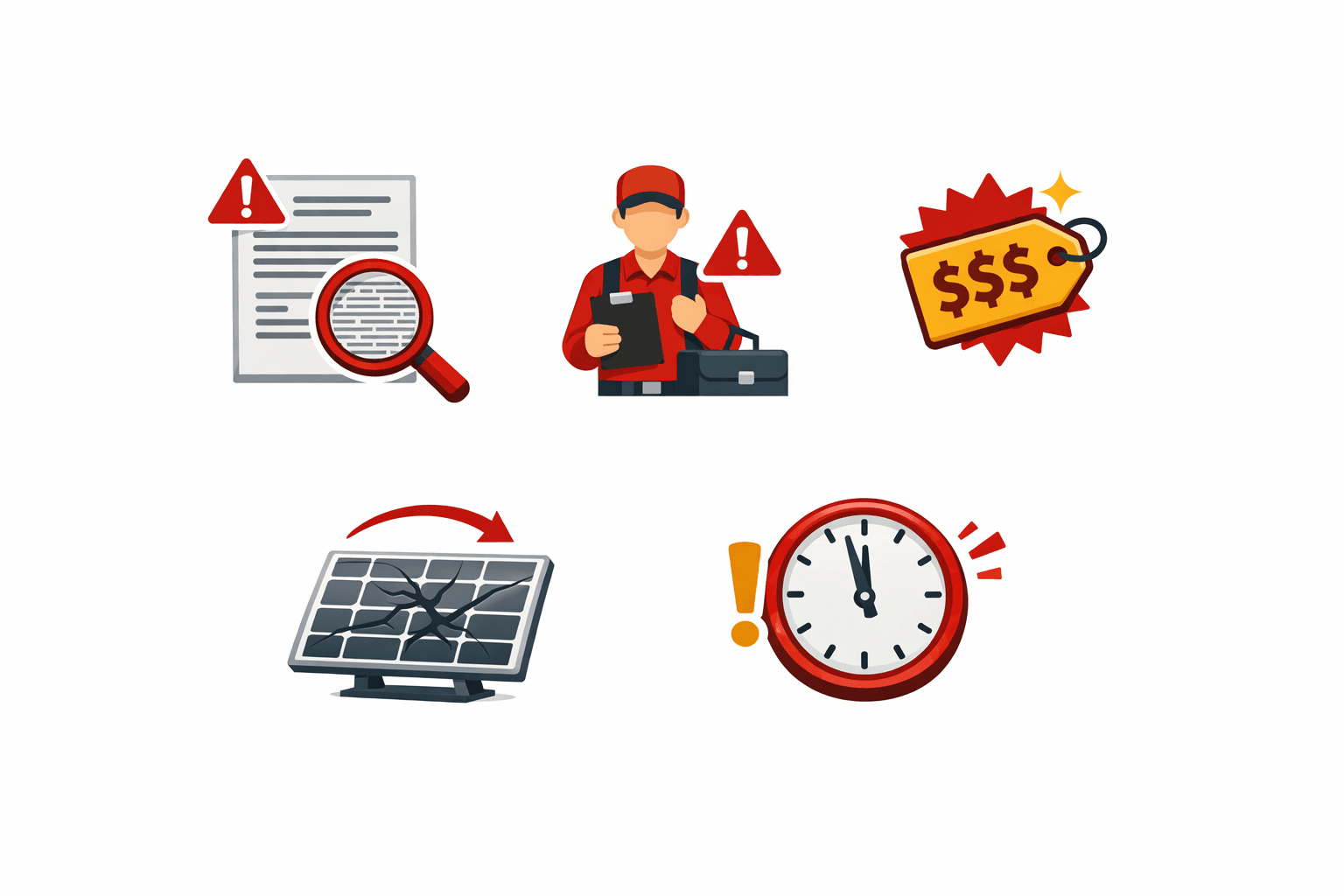
If an installer triggers even one of these, proceed with extreme caution. Multiple red flags? Walk away.
Claims you get a 30% federal tax credit for cash/loan purchases
Section 25D expired Dec 31, 2025. There is no residential solar ITC in 2026.
"Sign today" or "offer expires tonight" pressure
Legitimate installers never pressure for same-day signatures. Good deals don't disappear overnight.
Claims to be "from your utility company"
Utilities do not sell solar door-to-door. This is illegal impersonation in most states.
Won't provide a written quote to take home
Any company that won't let you review their proposal independently is hiding something.
Loan amount significantly exceeds quoted system price
The gap is a hidden dealer fee (25-40%+) that's the installer's commission, not your solar equipment.
Can't show state contractor license or insurance
Every state requires electrical/contractor licensing for solar installations.
"Or equivalent" equipment clauses in the contract
This lets the installer swap your premium panels for cheap alternatives.
Says permits "aren't needed" or will be "handled later"
Permits are legally required. No permit = no inspection = no insurance coverage = no net metering.
Can't provide local references from installations 2+ years old
If they can't show systems that have been running for 2+ years, they may not be around for your warranty.
Claims to be a "government solar program" or "utility rebate program"
There is no government program that provides free or deeply discounted solar to homeowners in 2026.
Demands large upfront payment (>20%) before any work begins
Reputable installers typically require 10-20% at signing, with balance at completion.
Provides a quote without a site survey or aerial/satellite assessment
Accurate quotes require roof measurements, shading analysis, and structural assessment.
Example: A $30,000 solar system financed with different dealer fee levels. The dealer fee is the installer's hidden commission baked into your loan amount.
| Dealer Fee | System Cost | Your Loan Amount | Overpayment |
|---|---|---|---|
| 0% (No fee) | $30,000 | $30,000 | $0 |
| 20% | $30,000 | $36,000 | +$6,000 |
| 30% | $30,000 | $39,000 | +$9,000 |
| 40% | $30,000 | $42,000 | +$12,000 |
Always ask: "What is the dealer fee on this loan?" Compare the loan principal to the cash price. If the installer won't disclose the fee, walk away. Use our dealer fee calculator to see the real cost.
Follow every step before signing anything. A legitimate installer will pass all 8 with ease.

Check the installer's state contractor license and electrical license through your state's licensing board.
Search your state's contractor licensing database by company name. In MA, check the Division of Professional Licensure. In CT, check DCP. Every state has a searchable database.
Pro Tip: Ask for the license number upfront. If they hesitate, that's a red flag.
Verify they carry general liability ($1M+), workers' comp, and completed operations coverage.
Ask for a Certificate of Insurance (COI) naming you as additionally insured. Call the insurance company directly to confirm the policy is active.
Pro Tip: If a worker is injured on your roof without workers' comp, YOU could be liable.
NABCEP (North American Board of Certified Energy Practitioners) certification is the gold standard for solar installers.
Search the NABCEP directory at nabcep.org. The company should have at least one NABCEP-certified PV Installation Professional on staff.
Pro Tip: NABCEP certification requires passing an exam, documented field experience, and continuing education. It's not easy to get — which is the point.
Check Google Reviews, BBB, Yelp, SolarReviews, and EnergySage. Look for patterns, not individual complaints.
Search the company on Google, BBB.org, and SolarReviews.com. Read the 1-star AND 3-star reviews carefully — they're more informative than 5-star reviews.
Pro Tip: Be wary of companies with hundreds of 5-star reviews but no detailed written reviews. Fake review farms are common in solar.
Ask for 5+ references from installations completed at least 2 years ago in your area.
Call the references. Ask: Was the installation on time? Any issues after installation? How responsive is the company when you call? Would you hire them again?
Pro Tip: Drive by one or two reference installations to see the workmanship from the street. Neat, symmetrical arrays indicate professional work.
Never sign with the first company. Get at least 3 quotes to understand the market rate in your area.
Request quotes from 3-5 installers. Compare not just price but equipment, warranty terms, payment schedules, and estimated production.
Pro Tip: If one quote is 30%+ below the others, something is off — cheap equipment, hidden fees, or a company that won't be around for warranty claims.
Read every page before signing. Pay special attention to equipment specs, warranty terms, escalator clauses, and cancellation terms.
Look for: exact equipment model numbers (no "or equivalent"), warranty duration and coverage, payment schedule, cancellation rights, and total cost of financing.
Pro Tip: Take the contract home. Any company that won't let you review the contract overnight is not trustworthy.
Ask who handles permits, how long the process takes, and when inspections are scheduled.
The installer should pull permits before work begins. After installation, a city/town inspector and your utility must both approve the system before it goes live.
Pro Tip: Ask to see a copy of the building permit before installation day. Verify the permit number with your local building department.
Save all contracts, emails, texts, proposals, and marketing materials. Take photos of the installed system and any issues.
The FTC Cooling-Off Rule gives you 3 business days to cancel any sale made at your home. Some states extend this to 5-7 days for solar contracts.
Every state Attorney General has a consumer protection division. File a complaint online — it's free and creates a record.
File a report at ReportFraud.ftc.gov. The FTC tracks patterns across companies and states.
If the installer violated licensing requirements, your state contractor board can revoke their license and potentially order restitution.
Many consumer protection attorneys work on contingency (no upfront cost). State consumer protection laws often allow recovery of attorney fees plus treble damages.
We built NuWatt specifically to be the kind of solar company we'd trust with our own homes.
We will never claim you get a federal tax credit that doesn't exist. We explain the real 2026 economics honestly — including state incentives and third-party ownership options.
Our quotes show exact $/W pricing, total system cost, and any financing terms — including dealer fees. No hidden charges. Ever.
Fully licensed electrical contractor with $2M+ in liability coverage and workers' comp. NABCEP-certified installation professionals on every job.
We handle all permits, inspections, and utility interconnection. Your system isn't "done" until it passes final inspection and the utility approves your net metering application.
Our Propel program uses Section 48E legitimately — a third-party owner captures the 30% ITC and passes savings to you. Ownership transfers to you at year 5. No escalators, no removal fees.
Learn moreWe publish detailed comparisons against major competitors. We're confident enough to show you exactly how we stack up.
Learn moreNo — not for homeowner-owned systems. Section 25D expired December 31, 2025. If you buy solar with cash or a loan in 2026, you get $0 in federal tax credits. The only remaining federal incentive is Section 48/48E, which applies to third-party-owned systems (leases, PPAs) where the financing company — not the homeowner — claims the credit. Any installer telling you that you personally get a 30% tax credit for purchasing solar in 2026 is lying.
Verify their state contractor license through your state's licensing board, confirm they carry general liability and workers' comp insurance, check for NABCEP certification, read reviews across multiple platforms (Google, BBB, SolarReviews), and ask for at least 5 local references from installations completed 2+ years ago. A legitimate installer will provide all of this without hesitation.
A dealer fee (also called origination fee or channel partner compensation) is a percentage added to your loan amount that goes directly to the installer as a commission — typically 25-40% of the system cost. It's how lenders subsidize low-interest-rate loans. A $30,000 system with a 30% dealer fee means you borrow $39,000. The extra $9,000 isn't for your solar equipment — it's the installer's cut. Always ask "What is the dealer fee?" before signing any solar loan.
Yes. Solar leases and PPAs are still available because the financing company (the system owner) can claim the Section 48/48E investment tax credit. However, read the fine print carefully — watch for annual escalator clauses above 2%, punitive early termination fees, and unclear buyout terms. NuWatt's Propel program offers a transparent alternative with ownership transfer at year 5 and no escalators.
This is almost certainly a scam. Utility companies do not sell solar panels door-to-door. Ask for identification, write down the company name, and report them to your utility company and state Attorney General. Do not share your utility bill, sign anything, or provide personal information.
Residential solar in 2026 typically costs $2.75-$3.50/W before any incentives (with no federal tax credit). For a typical 8 kW system, that's $22,000-$28,000. Prices vary by state, equipment quality, roof complexity, and installer. If a quote is significantly below $2.50/W, investigate the equipment quality and check for hidden dealer fees. If it's above $4.00/W, get more quotes.
The FTC Cooling-Off Rule gives you 3 business days to cancel any purchase of $25 or more made at your home (including door-to-door solar sales). The clock starts when you sign the contract. You must cancel in writing. Some states have extended this to 5-7 days specifically for solar and home improvement contracts. The installer is legally required to inform you of this right at signing.
For many homeowners, yes — especially in states with high electricity rates ($0.20+/kWh), strong net metering, or state incentives. The payback period is longer (8-15 years instead of 6-10), but solar panels last 25-30 years and protect against rising utility rates. The math depends on your state, utility rate, roof orientation, and financing terms. Run the numbers honestly — which is exactly what NuWatt does.
If your installer goes out of business, your equipment manufacturer warranties (typically 25 years for panels, 12-25 years for inverters) remain valid — you'll just need to work directly with the manufacturer or another installer for warranty claims. However, your workmanship warranty (roof penetrations, wiring, mounting) dies with the company unless they carried third-party warranty insurance. This is why choosing an established, financially stable installer matters more than saving a few hundred dollars.
Absolutely. File complaints with your state Attorney General and the FTC even if you successfully canceled. Your report creates a paper trail that helps regulators identify patterns and take action against repeat offenders. It also protects the next homeowner who might not catch the scam in time.
Compare on these metrics: (1) $/W cash price (total cost divided by system size in watts), (2) equipment specs (exact panel and inverter model numbers), (3) estimated annual production in kWh, (4) warranty terms (equipment + workmanship), (5) total cost of financing (if applicable, including dealer fees), and (6) installer track record (years in business, reviews, references). Don't compare based on monthly payment alone — that hides dealer fees and loan terms.
No fake tax credits. No hidden dealer fees. No pressure tactics. Just honest pricing and real savings from a licensed, insured, NABCEP-certified installer.
How third-party ownership still captures the 30% ITC
Read guideDetailed comparison of pricing, warranties, and service
Read guide$0 down, ownership at year 5, no escalators
Read guideSee the real cost of your solar loan
Read guideHonest math without the tax credit
Read guideCash, loan, lease, PPA — compare all options
Read guide