
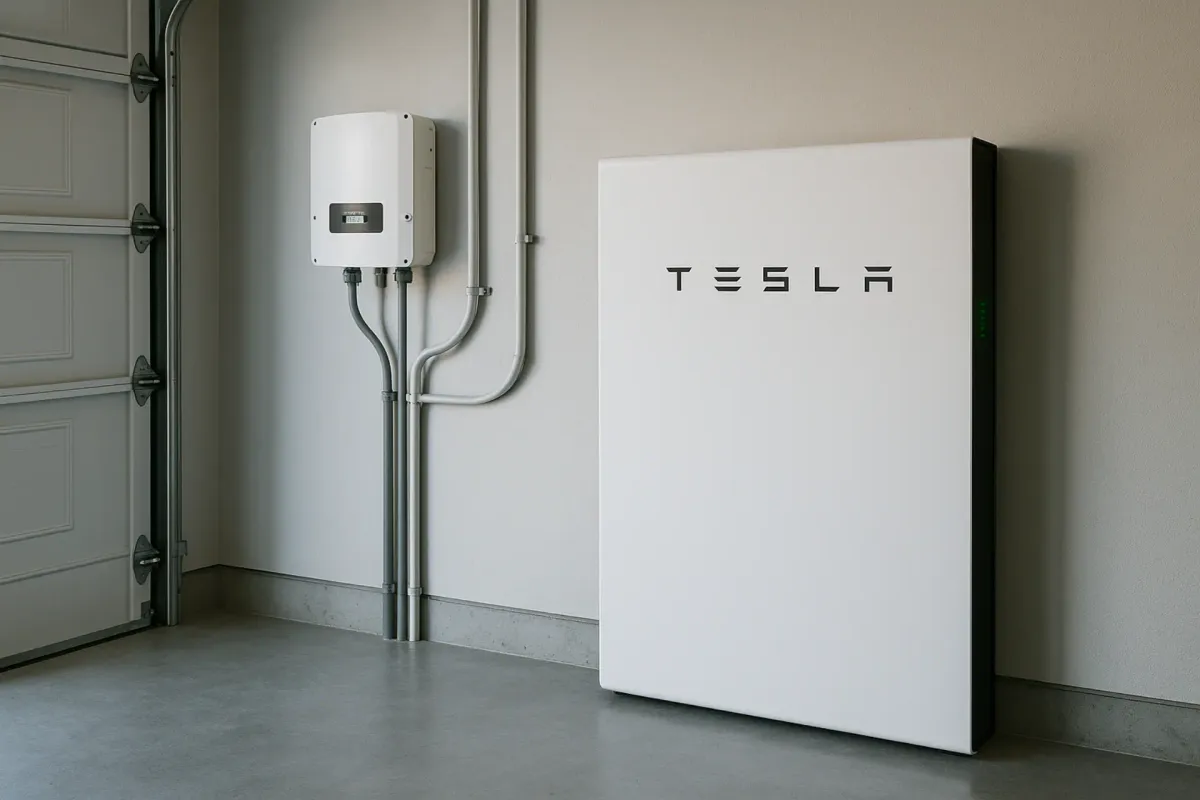
A solar + battery system costs $30,000–$50,000 depending on storage capacity, with backup runtime of 8–24 hours for essential loads. Here is how to size it right and whether the economics work.
Price Range
$8,500–$12,500
per battery installed
Capacity
5–13.6 kWh
per unit
Backup Runtime
4–24+ hrs
depending on loads
ConnectedSolutions
$1,125/yr
MA demand response
Home Battery Comparison: 2026 Top 3
Home battery storage costs have dropped 40% since 2020, but adding a battery still increases your solar investment by $8,500–$12,500 per unit. The decision should be based on backup needs, TOU rate arbitrage, and demand response programs like ConnectedSolutions — not just financial ROI alone.
Best Warranty
Enphase IQ 5P
Modular — stack 2–4 units for 10–20 kWh. Best with Enphase microinverter systems. 3.84 kW continuous output per unit.
Most Popular
Tesla Powerwall 2
All-in-one AC battery — works with any solar system. 5 kW continuous, 7 kW peak. Built-in Backup Gateway switches in 30ms.
Whole-Home Backup
Franklin WH 13.6
10 kW continuous, 15 kW peak — handles central AC and well pumps. Backs up entire 200A panel without subpanel rewiring.
How to Size Your Battery: 3-Step Framework
The most common mistake is buying too much battery. A 13 kWh battery sounds small compared to your 800 kWh monthly usage, but backup power isn't about running your entire home for days — it's about keeping essentials running during an outage.
List Your Critical Loads
Refrigerator (150W), freezer (100W), lights (100W), WiFi/router (20W), phone charging (10W), sump pump cycling (83W avg). Total essential load: ~460W continuous.
Calculate Runtime Needed
Check your utility's outage history. Typical outages: 2–6 hrs. Storm outages: 24–72 hrs. Size for typical outages. A 13 kWh battery at 80% DoD = 10.4 kWh usable. At 460W draw = 22.6 hours.
Factor In Solar Recharging
During daytime outages, your solar panels recharge the battery. A 10 kW system producing 6 kW midday can power 1.5 kW loads AND recharge the battery simultaneously — extending runtime indefinitely.
Backup Runtime by Load Profile
How long a single 13 kWh battery powers different load profiles:
Essentials Only
Fridge, lights, WiFi, phone charging
Essentials + Comfort
Above + TV, microwave, some outlets
Partial Home
Above + well pump, sump pump
Whole Home
Everything incl. HVAC, EV charger
Real-World Backup Scenarios
Scenario 1: Summer Storm (8 hrs, solar available)
Power out at 2pm. Battery at 60% (7.8 kWh). Essentials-only draw (0.5 kW). Storm clears by 5pm — solar recharges battery. Total used: 4 kWh battery + 2 kWh solar. Battery ends at 70%.
Scenario 2: Winter Ice Storm (3 days, no solar)
Power out at 8pm in January. No solar for 3 days (ice-covered panels). Battery at 90% (11.7 kWh). Essentials-only (0.5 kW) drains 12 kWh/day. Battery depletes by 8pm the next day. No backup for days 2–3.
Scenario 3: Medical Equipment Needs
CPAP machine (50W = 1.2 kWh/day) + oxygen concentrator (300W = 7.2 kWh/day) + essentials (12 kWh/day). Total: 20.4 kWh/day. One 13 kWh battery provides ~15 hours.
Solar + Battery Economics
Adding a battery increases system cost by $8,500–$12,500 per unit. In most states, the pure financial return is lower than solar alone because you're storing cheap solar energy to use later instead of exporting at net metering rates. The value comes from three revenue streams:
Backup Power
Peace of mind
Can't put a price on not losing $800 of food in a 3-day outage, or keeping medical equipment running.
TOU Arbitrage
$800–$1,200/yr
Store solar off-peak ($0.15/kWh), discharge on-peak ($0.44/kWh). Works with Eversource MA TOU rates.
ConnectedSolutions
$600–$1,125/yr
MA, RI, CT pay you to discharge during peak demand. $225/kW/season. 10–15 events per summer.
Massachusetts Homeowner Example
Solar Only (10 kW)
$32,500
SMART incentive: -$4,000
Payback: 9 years
25-year savings: $122,000
Solar + 1 Battery (10 kW + 13 kWh)
$44,000
SMART incentive: -$4,000
Battery revenue: $1,400/yr (TOU + ConnectedSolutions)
Battery payback: 8.2 years
25-year savings: $135,000
ConnectedSolutions: The Battery Game-Changer
ConnectedSolutions (MA, RI, CT) and similar programs (VT) pay battery owners to provide grid services. When the grid is stressed — hot summer afternoons, cold winter mornings — the utility remotely discharges your battery to reduce peak demand.
How It Works in Massachusetts
$225 per kW per summer season
10–15
events per summer (June–Sept)
$1,125/yr
5 kW battery enrollment
$11,250
over 10 years
An $11,500 battery generating $1,125/yr in ConnectedSolutions plus $700/yr in TOU savings has a 6.4-year payback vs 15+ years without these programs.
Does a Battery Make Sense for You?
Battery Makes Sense
- TOU rates with 2× or more peak/off-peak spread
- ConnectedSolutions or demand response is available
- Frequent or prolonged power outages in your area
- Medical equipment requiring constant power
- Utility transitioning to net billing (low export rates)
Skip the Battery
- 1:1 net metering with no TOU rates — grid is your free battery
- Reliable grid power with rare outages
- No demand response programs and no TOU rates in your state
- Stretching budget for solar — get panels first, add battery later
Battery Chemistry & Safety
All modern home batteries use lithium-ion chemistry — the same technology in EVs and phones. Lithium iron phosphate (LFP) is becoming the standard for home storage due to superior safety, longer cycle life (6,000+ vs 4,000 cycles for NMC), and better thermal stability. Tesla Powerwall 2 uses NMC; Enphase IQ and Franklin use LFP.
Fire risk reality check
Home battery fires are extremely rare — estimated at 1 in 10 million installed units per year. For comparison, gas furnaces have a 1 in 100,000 annual fire risk. Proper installation with code-compliant disconnects and thermal monitoring makes modern batteries safer than many household appliances.
Size Your Solar + Battery System
Get a customized quote for solar with or without battery storage for your home.