Loading NuWatt Energy...

We use your location to provide localized solar offers and incentives.
We serve MA, NH, CT, RI, ME, VT, NJ, PA, and TX
Loading NuWatt Energy...
NuWatt designs, installs, and manages solar, battery, heat pump, and EV charger systems across 9 states. One company, one warranty, one point of contact.
Get a Free Quote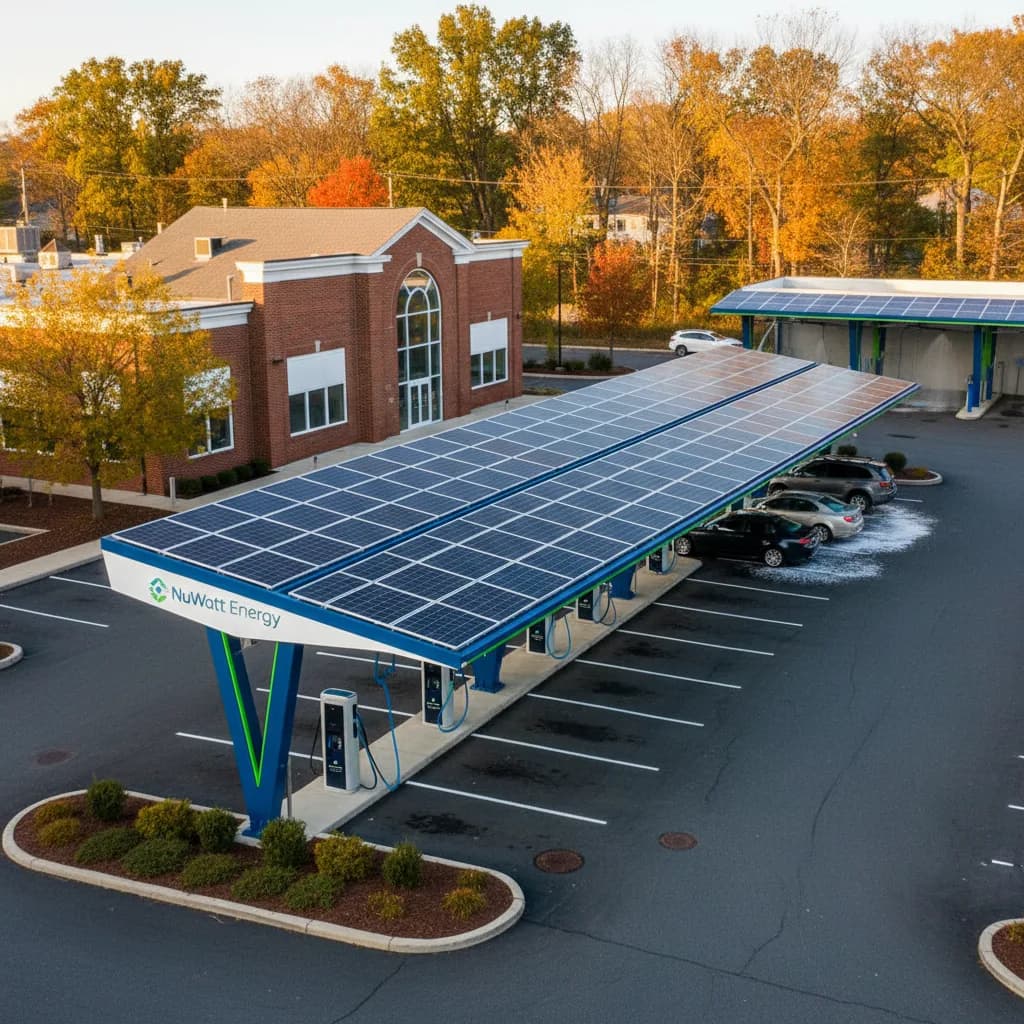
Why car washes are one of the highest-leverage EV charging verticals — dwell time, parking already there, recurring traffic, demand-charge math that works
5–10 min
Avg dwell time
L2 + DCFC
Optimal mix
$45K/yr
Typical added revenue + savings
$200K transformer
Battery buffering avoids
Yes, for most express and multi-bay operators. Car washes combine the three factors that make EV charging work — 5 to 10 minute dwell time, existing parking infrastructure, and repeat customers. A typical CT project adds $45K/year in revenue plus savings and pays back in 8 to 10 years post-incentive.
Car washes sit in a sweet spot almost no other commercial real estate occupies. A driver who pulls into a wash is going to be on the property for 5 to 10 minutes of active wash plus an optional 5 to 10 minutes of drying, vacuuming, and detailing. That is a 15-minute captive window — long enough for an L2 charger to add 10 miles of range or a DCFC to add 130 miles. It is also the exact window an EV driver wants because it beats the most common reason drivers skip public charging: they do not want to stand around waiting. At a car wash they are already waiting.
This guide is the NuWatt operator playbook for adding EV charging to a car wash site — national in scope, with a Connecticut worked example where the incentive math is among the most favorable in the country thanks to EnergizeCT, Eversource CT make-ready, and Section 48E on a paired solar canopy. The federal Section 30C charger credit expired June 30, 2026 — chargers placed in service by that date can still be claimed on IRS Form 8911.
The retail EV charging business is a dwell-time business. Car washes already solve for dwell time.
A full-service wash plus drying runs 10 to 15 minutes. That is long enough for a DCFC to deliver 100+ miles of range and for an L2 to top up commute charge. The customer is already there and already waiting.
Express and full-service wash sites are built around 20 to 60 parking and dry-off spots. EV charging slots into that footprint with minimal civil work — the asphalt is already graded and striped.
Unlimited-wash monthly members visit 4 to 8 times per month. That is a recurring visit cadence most retail charging locations can only dream of — and it means charging revenue compounds with wash revenue.
The car wash market is hyper-commoditized. Chargers plus a solar canopy become a visible brand statement on the street, separating a site from the three washes within a 5-mile radius.
Match the tier to your capital plan and customer volume. Most operators should start with Tier 1 and graduate as charging utilization proves out.
Tier 1
2–4 L2 ports for customers
ROI thesis:Customer retention + EnergizeCT / MassEVIP / state EVSE rebate covers 30–50% of install. Best for: single-site express wash, tunnel throughput < 30 cars/hr.
Tier 2
L2 + DCFC under solar canopy
ROI thesis: Demand-charge savings + solar offset + managed-charging revenue. Reference: CT car wash sample project.
Tier 3
Multi-site rollout + fleet partnership
ROI thesis: Standardized playbook amortizes engineering + utility interconnection across sites. Fleet partnerships (Amazon DSP, FedEx Ground) add predictable overnight load.
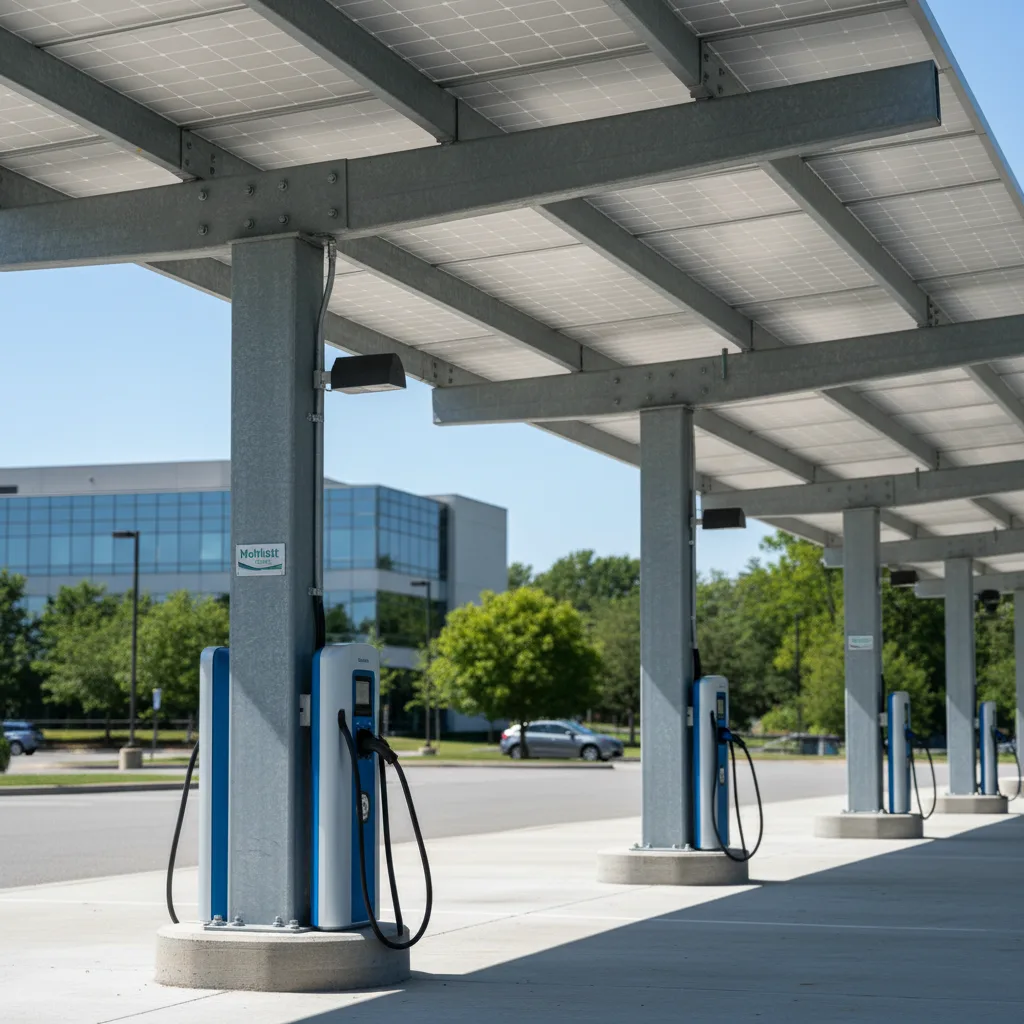
NuWatt's flagship car wash reference is a Hartford-area multi-bay express wash that we engineered as a 115 kW solar carport paired with 4 ChargePoint CP6000 L2 chargers, 2 mid-power DCFC units, and a 200 kWh battery-buffered architecture. The bundle stacked Section 48E on the canopy, Section 30C on the chargers (a credit that expired June 30, 2026), and the EnergizeCT commercial program on top.
| Solar carport | 115 kW bifacial |
| EV charging | 4 L2 + 2 DCFC |
| Battery buffering | 200 kWh / 100 kW |
| Gross project cost | $730,000 |
| Net post-incentive | $410,000 |
| Annual savings + revenue | ~$45,000/yr |
Illustrative example. This sample project shows representative numbers based on NuWatt benchmark data and 2026 CT incentive programs. Your actual project depends on site conditions and incentive availability at the time of install.
The charging window is set by your wash + dry cycle — not by the charger. Plan the port mix around the window you have.
Wash cycle
5 min
Dry / vacuum
10 min
Charging window
15 min
| Charger | Power | 15-min kWh | Range added | Use case |
|---|---|---|---|---|
| L2 (11 kW) | 11 kW | ~2.75 kWh | ~10 mi | Commute top-up, loyalty perk |
| L2 (19.2 kW) | 19.2 kW | ~4.8 kWh | ~16 mi | Premium L2, CP6000-class |
| DCFC (50 kW) | 50 kW | ~12.5 kWh | ~45 mi | Mid-power, budget DCFC |
| DCFC (150 kW) | 150 kW | ~37.5 kWh | ~130 mi | Flagship — meaningful charge |
Range estimates assume 3.5 mi/kWh average EV efficiency across sedans and crossovers. Individual vehicles vary — a Rivian R1T delivers ~2.1 mi/kWh while a Hyundai Ioniq 6 delivers ~4.1 mi/kWh.
The operator takeaway: L2 at a car wash is a retention play (useful top-up, not a full charge) and DCFC is the revenue play (meaningful range added per session). A Tier 2 build with both is the most flexible deployment because the L2 ports soak up member traffic while the DCFC ports attract higher-margin session revenue from drivers specifically seeking fast charging near a highway exit.
All states still stack with Section 48E on a paired solar canopy. The federal Section 30C charger credit expired June 30, 2026 — installs placed in service by then claim it on Form 8911.
| State | EVSE rebate program | Make-ready | Managed charging |
|---|---|---|---|
| CT | EnergizeCT: 50% EVSE | Eversource CT / UI: 100% | $5–$40/plug/month |
| MA | MassEVIP Workplace + Public | Eversource / National Grid | ConnectedSolutions |
| NJ | NJ Clean Energy EVSE | PSE&G EV Ecosystem | Utility pilot |
| PA | AFIG grants (competitive) | Utility-specific | Limited |
| NH | NH DES VW-settlement grants | Eversource NH limited | None statewide |
| RI | DriveEV RI | Rhode Island Energy | ConnectedSolutions |
| VT | VT Dept of Buildings EVSE | GMP / BED | Utility pilot |
| ME | Efficiency Maine EVSE | CMP / Versant limited | None statewide |
| TX | TCEQ All-Electric + utility rebates | Oncor / CenterPoint pilot | ERCOT demand response |
Programs subject to funding windows and annual caps. NuWatt confirms availability at the time of quote.
The charging install that does not integrate with your wash software is a missed opportunity. Modern car wash POS systems (Sonny's CarWash Controls, DRB Patheon, ICS Site Watch) and modern networked chargers (ChargePoint, Blink, SemaConnect) both support open APIs. The highest-leverage integrations are:
Solar canopies work at almost any commercial parking lot — but car washes have three unusual reasons the canopy is a particularly strong product fit:
A single 150 kW DCFC session is a 150 kW instantaneous grid draw. Your commercial utility tariff does not just bill energy (kWh) — it also bills peak monthly demand (kW). On Eversource CT's G-3 commercial rate, each kW of monthly peak costs roughly $13.50 per month. One unbuffered DCFC session pushing peak demand by 150 kW adds $2,000 per month, or $24,000 per year, in demand charges on a single charger.
Battery buffering changes the math. A 200 kWh / 100 kW battery sits between the grid and the DCFC. When a session starts, the battery discharges the surge current (up to 100 kW) while the grid only delivers a smoothed ~30 kW. Peak demand stays flat. Annual demand-charge avoidance runs $18,000 to $22,000 per DCFC on the CT G-3 tariff, paying back the battery within 5 to 7 years on demand charges alone.
A separate and larger win: without battery buffering, a single DCFC install often requires a new utility transformer because the existing service cannot support the surge. Transformer upgrades at car washes regularly cost $150,000 to $250,000 and add 40 to 60 weeks to the interconnection timeline. A battery typically avoids the upgrade entirely — which is the single biggest reason car wash operators go battery-buffered on their first DCFC install.
Cross-reference: For the full engineering breakdown of battery-buffered DCFC architecture — including sizing curves, OCPP integration, and cost-per-kWh economics — see the battery-buffered DCFC 2026 guide.
Free site walk, engineering review, and a tier-specific quote. 9-state service area. PWA-compliant install every job.
Start a car wash EV assessmentNo, when the charging bays are sited correctly. The most common layout puts L2 chargers on the dry-off apron and adjacent employee/customer parking — not on the wash tunnel itself. DCFC bays, if included, go on the perimeter so a long-dwell charger does not block the conveyor exit. Throughput is only compromised when operators put chargers inside the vacuum bays or the final-finish area, where they create conflicts with wash customers who need the space for the 10-minute dry step. NuWatt sites the chargers during design review against your actual tunnel throughput so a 15-minute charge window never backs up a 3-minute wash cycle.
Internal Revenue Service
Internal Revenue Service
EnergizeCT
Eversource Connecticut
NJ Clean Energy
National Renewable Energy Laboratory
U.S. DOE fueleconomy.gov
NuWatt Engineering
NuWatt engineers, permits, and builds the canopy + charger + battery stack end-to-end. 9 states. PWA-compliant. Federal + state incentive captured.
Last verified by NuWatt Engineering Team on 2026-04-14. Incentive programs, tariff rates, and tax-credit deadlines are subject to change — confirm at time of quote.