Loading NuWatt Energy...

We use your location to provide localized solar offers and incentives.
We serve MA, NH, CT, RI, ME, VT, NJ, PA, and TX
Loading NuWatt Energy...
NuWatt designs, installs, and manages solar, battery, heat pump, and EV charger systems across 9 states. One company, one warranty, one point of contact.
Get a Free Quote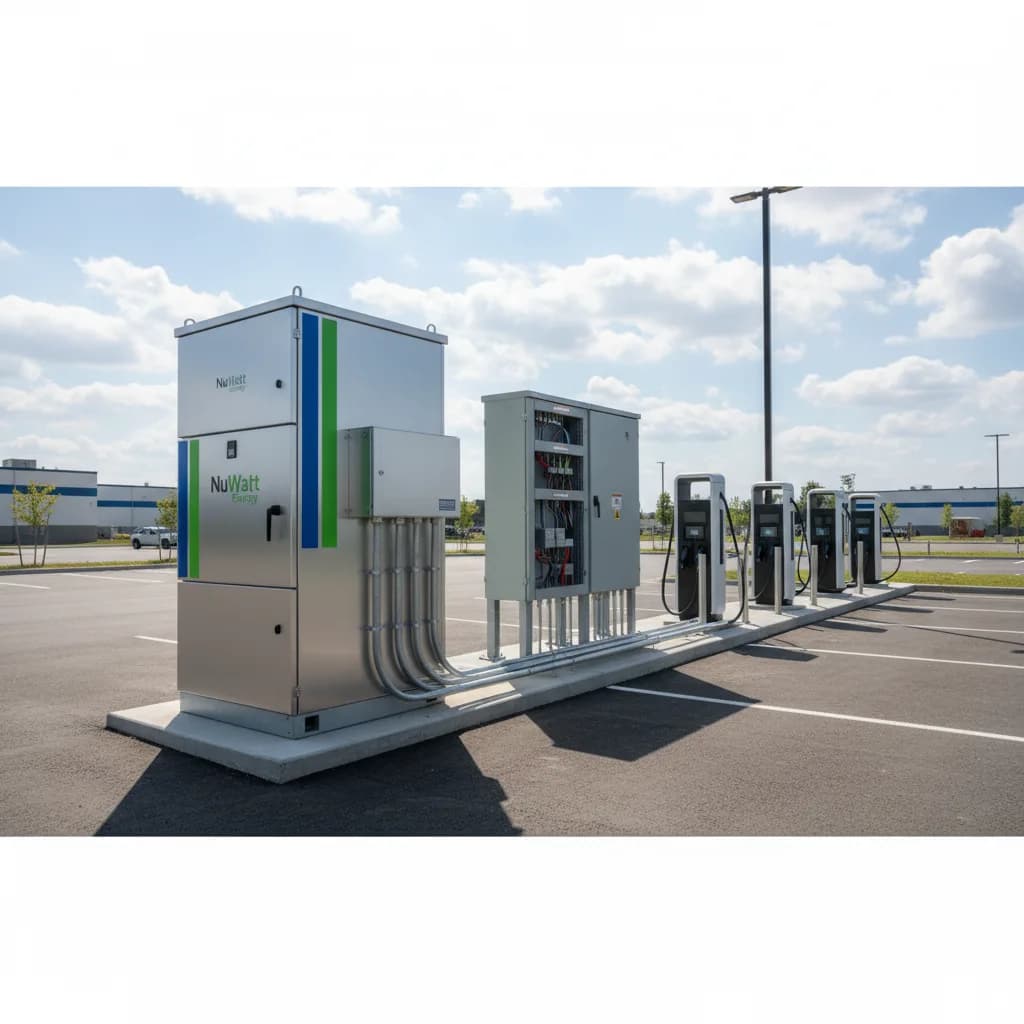
How battery buffering eliminates transformer upgrades, cuts demand charges 70%+, and unlocks DCFC at sites with limited service capacity.
70%+
Demand charge reduction
$200K
Typical transformer upgrade avoided
12 mo
Utility lead-time avoided
9
NuWatt projects benchmarked
Battery-buffered DC fast charging is a commercial EV charging architecture that places a lithium battery between the grid and the DC fast chargers. The battery absorbs each session's peak power and recharges slowly from the grid — enabling DCFC deployment without a transformer upgrade.
Battery-buffered DC fast charging is a category of commercial EV charging infrastructure that places an on-site battery storage system between the grid service and the DC fast chargers. The battery absorbs the high power demand of fast-charging events, drawing from the grid at a lower steady rate and recharging during off-peak hours. This approach allows commercial sites to deploy DCFC without the transformer upgrades, service entrance increases, or utility-engineering delays that would otherwise block the project.
The architecture emerged in the late 2010s as a response to two structural constraints in the commercial charging market. First, many small and mid-size commercial sites were built with 200-amp or 400-amp service — adequate for lighting, HVAC, and office load, but nowhere near the 350 to 800 amps required to support a single 150 kW DC fast charger on an unbuffered connection. Second, utility transformer upgrades frequently quote between $75,000 and $400,000 and carry interconnection timelines of 6 to 18 months in congested territories. A battery sized to the site's utilization profile neutralizes both constraints: it smooths the peak the grid sees, keeps the service entrance unchanged, and sidesteps the utility engineering queue entirely because most behind-the-meter battery installations clear interconnection with expedited review.
The trade is capital versus capital. A 150 kW DCFC dispenser paired with a 200 kWh battery typically costs $320,000 to $420,000 installed before incentives. The same dispenser with a full transformer upgrade and service entrance rebuild can run $280,000 to $550,000 depending on utility territory — sometimes more once utility-owned line work and easements enter the picture. The battery path almost always wins on schedule, often wins on demand charges, and wins on capital when the avoided transformer upgrade is above $100,000. It loses when utilization is high enough that the battery cannot recharge between sessions; in that regime the grid draw becomes the dominant load regardless of whether a battery sits in front of it.
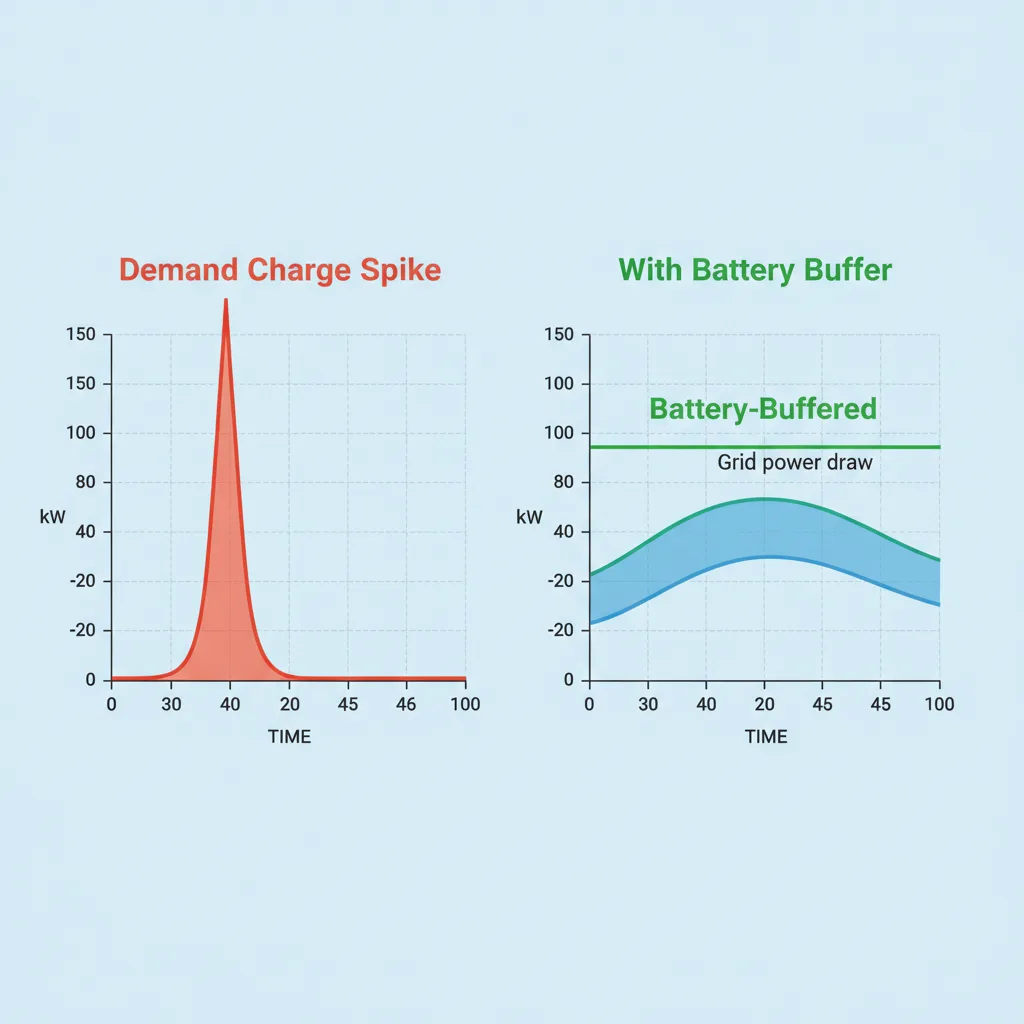
A battery-buffered DCFC stack is an energy router. The energy management system (EMS) monitors the grid meter in real time and decides every few seconds where power should flow. During a fast-charging session, the EMS pulls energy from the battery and, if present, on-site solar — holding grid draw to the target setpoint. Between sessions, the EMS trickles energy from the grid into the battery, ideally during off-peak hours when time-of-use rates are cheapest and when the utility is unlikely to set a demand peak.
A site screen. If three or more rows return YES, a battery-buffered design is likely the right architecture. If three or more return NO, start with a transformer upgrade.
| Site condition | Battery? | Rationale |
|---|---|---|
| Site service is 200A or smaller | YES | Battery buffer eliminates the forced service upgrade. |
| Utility transformer upgrade quoted >$100K | YES | Battery capex is typically $150K for 200 kWh — often cheaper than the upgrade alone. |
| Utility interconnection timeline >6 months | YES | Battery avoids the utility engineering queue entirely. |
| DCFC sessions <10 per day | YES | Low utilization keeps grid draw modest and maximizes demand charge savings. |
| DCFC sessions 10–30 per day | MAYBE | Depends on session duration and battery sizing — model it. |
| DCFC sessions >50 per day | PROBABLY NO | Battery cannot recharge fast enough between sessions — transformer preferred. |
| Utility demand tariff >$15/kW | YES | High demand charges make peak shaving economics dominant. |
| Demand tariff <$5/kW or energy-only rate | NO | Limited peak-shaving savings — case is weaker. |
| Corridor DCFC on high-traffic interstate | NO | Sustained high utilization favors transformer and grid-scale service. |
A Hartford-area multi-bay car wash operator wanted to add two 150 kW DC fast chargers plus four workplace Level 2 chargers under a new 115 kW solar carport. The existing 400A 480V service could not support the DCFC peak without a transformer upgrade quoted at roughly $180,000 and a 9-month utility timeline. A 200 kWh / 100 kW battery buffer smoothed grid draw to approximately 30 kW even during full 150 kW sessions, kept the service entrance unchanged, and unlocked the full 30C + 48E + EnergizeCT incentive stack.
Illustrative example. Representative numbers based on NuWatt benchmark data 2026 and CT incentive programs. Actual project economics depend on site-specific conditions and incentive availability at time of install.
NuWatt installs multiple platforms. No single brand wins every site — the match depends on utilization, footprint, and whether the battery is integrated with the dispenser or stands alone.
Compact integrated battery + DCFC, US-based, fast deploy
Pros
Cons
Popular early entrant, integrated battery + DCFC, larger footprint
Pros
Cons
Utility-scale battery (>2 MWh) paired with separate DCFC
Pros
Cons
Modular battery pairs with any DCFC brand
Pros
Cons
A single 150 kW DCFC session sets a monthly demand peak. With a 200 kWh battery buffer, peak grid draw holds at roughly 30 kW. The table below compares monthly demand-charge impact at buffered vs unbuffered grid draw for the biggest utilities in NuWatt's nine-state footprint. Rates are current as of April 2026.
| Utility / Rate | Demand rate | Unbuffered /mo | Buffered /mo | Monthly savings |
|---|---|---|---|---|
| Eversource CT — Rate G-3 | $13.50 / kW | $2,025 | $405 | $1,620 |
| Eversource MA — Rate G-3 | $12.80 / kW | $1,920 | $384 | $1,536 |
| National Grid MA — Rate G-2 | $11.25 / kW | $1,688 | $338 | $1,350 |
| PSE&G NJ — Rate GLP | $10.10 / kW | $1,515 | $303 | $1,212 |
| Oncor TX — Secondary ≥10 kV | $8.20 / kW | $1,230 | $246 | $984 |
| PECO PA — Rate GS | $9.40 / kW | $1,410 | $282 | $1,128 |
| United Illuminating CT — GST | $14.05 / kW | $2,108 | $422 | $1,686 |
| Central Maine Power — Medium GS | $9.75 / kW | $1,463 | $293 | $1,170 |
Assumes 150 kW peak draw event (unbuffered) vs 30 kW sustained draw (buffered) during the monthly demand interval. Annual savings scale roughly 12× the monthly delta.
Battery-buffered DCFC projects often touch three distinct property categories under federal tax law: the EV charger and its dedicated make-ready (Section 30C eligible if placed in service by June 30, 2026 — the credit has since expired), the solar canopy with DC-coupled battery (Section 48E eligible; safe harbor closed July 4, 2026, with new starts placed in service by December 31, 2027), and the shared switchgear and trenching that neither credit cleanly owns. Counsel segregates the basis so each credit applies to the property it was written for — double-dipping is the single most common audit flag in commercial clean-energy work.
Covered the DCFC dispenser, dedicated make-ready conduit, and hardware installation costs for property placed in service by June 30, 2026 — the credit has since expired. Required an IRS-designated census tract. 30% rate with PWA compliance, capped at $100,000 per port. Claimed on Form 8911.
Covers the solar canopy and the battery when DC-coupled to the PV. AC-coupled batteries behind the PV meter often still qualify under separate 48E rules. 30% base rate, bonus adders for energy communities and domestic content.
The cleanest design pattern we see in 2026 puts the solar canopy and battery on one side of a common bus with the DCFC dispenser on the other. Tax counsel files the canopy + battery under 48E — and, for chargers placed in service by June 30, 2026, the charger under 30C. Shared infrastructure — switchgear, trenching, transformers — is allocated by installed cost ratio. This pattern is audit-defensible, and it is the structure we used on the Connecticut car wash project detailed above.
Full Section 30C commercial guideA 500 kWh battery on a 5-sessions-per-day site never pays back the extra cells. Right-size to the 90th-percentile day.
Under-specced batteries deplete mid-session, exposing the site to the full grid draw — and the full demand charge — exactly when you are trying to avoid it.
Many commercial customers default onto a time-of-use rate when a demand-charge rate would be cheaper with a buffered system. Re-run tariff optimization post-install.
Tax counsel must segregate property basis. 30C covered the charger and its make-ready (property placed in service by June 30, 2026); 48E covers PV and DC-coupled storage. Double-dipping on the same property is a red flag.
Some AHJs treat EV-coupled batteries differently from solar-coupled batteries. File under the correct category for your jurisdiction to avoid resubmission.
Battery cabinets need annual thermal inspection and EMS firmware updates. A site without a service contract degrades quietly until a failure reveals the gap.
Site walk, load study, EnergizeCT or state EVSE program eligibility scan. For chargers placed in service by June 30, 2026, Section 30C census-tract verification supports the Form 8911 claim.
Utilization model built from operator traffic data; battery sized to cover 90 to 95 percent of peak events without exceeding target grid draw.
Interconnection application (behind-the-meter battery streamlines most queues), building permit, electrical permit, AHJ battery-storage review.
After program pre-approval letters — order battery skid, inverter, DCFC dispensers, and switchgear concurrently.
Pad pour, conduit trenching, battery setting, switchgear termination, dispenser mounting.
EMS configuration, utility witness test, load bank test of the battery, dispenser network provisioning, payment flow validation.
File 48E with tax team (plus Form 8911 for any 30C-eligible property placed in service by June 30, 2026), submit EnergizeCT incentive claim paperwork, enroll in ISO-NE managed-charging revenue streams where applicable.
Pre-incentive, 2026 pricing. Ranges reflect regional labor variance and switchgear complexity. For chargers placed in service by June 30, 2026, the incentive stack (30C + 48E + state EVSE program) typically returned 35 to 55 percent; newer installs stack 48E and state EVSE programs.
| Configuration | Low | Typical | High | Fit |
|---|---|---|---|---|
| 50 kW DCFC + 100 kWh battery | $180,000 | $230,000 | $270,000 | Single dispenser, light utilization (<8 sessions/day) |
| 100 kW DCFC + 150 kWh battery | $260,000 | $320,000 | $380,000 | Popular retail and hospitality footprint |
| 150 kW DCFC + 200 kWh battery | $310,000 | $370,000 | $430,000 | NuWatt CT car wash benchmark configuration |
| 2× 150 kW DCFC + 400 kWh battery | $540,000 | $620,000 | $700,000 | Two dispensers, moderate-high utilization |
| 350 kW DCFC + 500 kWh battery | $680,000 | $790,000 | $900,000 | Approaches transformer-upgrade crossover zone |
Battery-buffered DC fast charging is a commercial EV charging architecture that places a lithium-ion battery storage system between the grid service and the DC fast chargers. The battery absorbs the brief high-power demand of each fast-charging session and recharges at a lower, steady rate from the grid. This lets a site deploy DCFC without upgrading the utility transformer or service entrance, which is typically the single most expensive and slowest step in a conventional DCFC project.
Primary Section 30C tax filing reference.
Current 48E guidance including storage treatment.
Installed-cost benchmarks by system size and chemistry.
Live G-3 tariff including demand charge schedule.
State commercial EVSE rebate and make-ready program.
Industry technical guidance on commercial BESS.
Enables battery + DCFC participation in grid-services revenue.
Independent LFP and NMC cycle-life degradation data.
New England capacity tag methodology for demand-charge modeling.
DCFC dispenser input-power specifications.
NuWatt engineers run site-specific utilization models, utility tariff scenarios, and incentive stacks before you sign a design contract.
Last verified by NuWatt Engineering Team on 2026-04-14. Numbers are illustrative — actual project economics depend on site-specific utilization, utility tariff, and incentive availability at time of install.