Loading NuWatt Energy...

We use your location to provide localized solar offers and incentives.
We serve MA, NH, CT, RI, ME, VT, NJ, PA, and TX
Loading NuWatt Energy...
NuWatt designs, installs, and manages solar, battery, heat pump, and EV charger systems across 9 states. One company, one warranty, one point of contact.
Get a Free Quote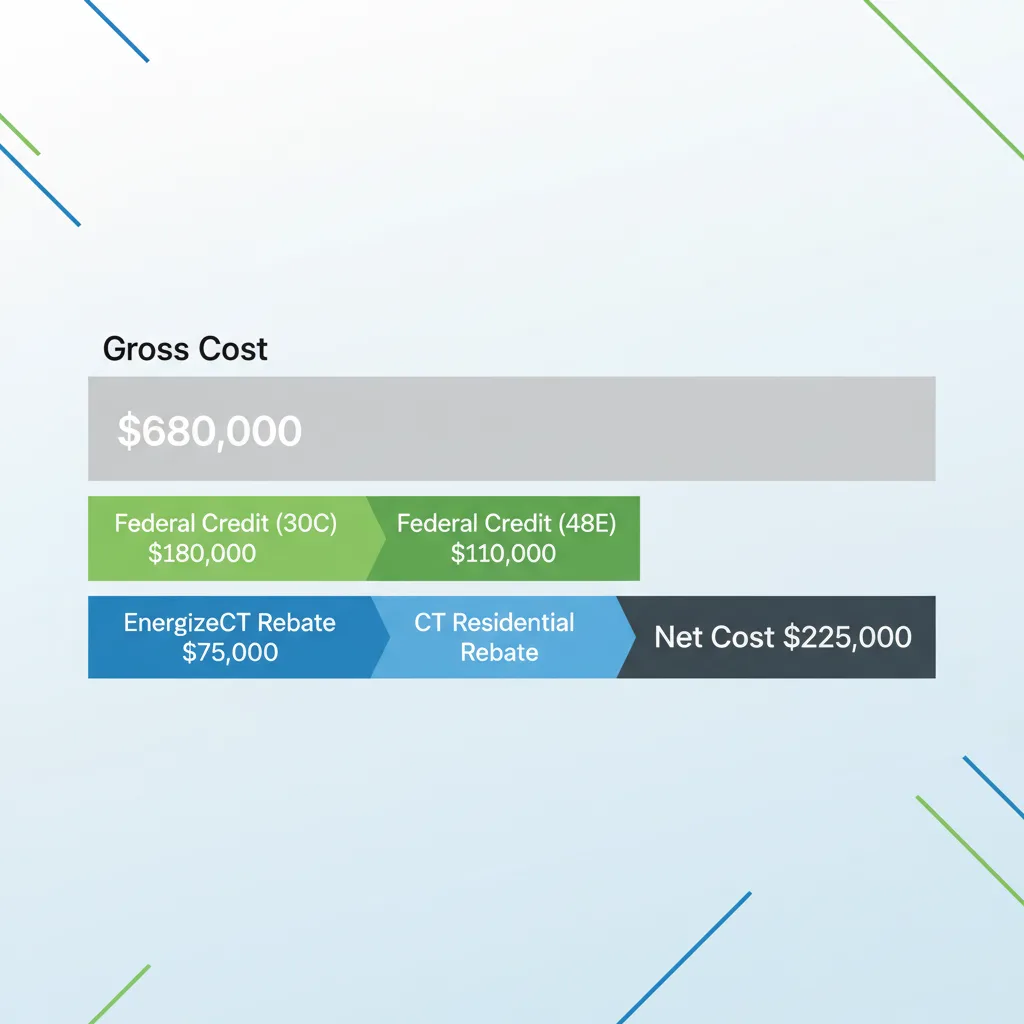
Independent cost ranges for 18 commercial EV charger SKUs across NuWatt's 9-state service area, sourced from completed project data and verified industry benchmarks.
18
SKUs benchmarked
9
States covered
6
Segment use cases
Quarterly
Update cadence
Commercial Level 2 ports install for roughly $6,000–$13,000 each and DCFC ports for $140,000–$260,000 each, installed, before incentives. Site conditions, state labor multipliers, and make-ready scope drive most of the variance.
This reference page aggregates installed-cost benchmarks for commercial Electric Vehicle Supply Equipment (EVSE) across nine U.S. states — Massachusetts, Connecticut, New Hampshire, Rhode Island, Vermont, Maine, New Jersey, Pennsylvania, and Texas — using project data compiled by NuWatt Energy during Q4 2025 through Q1 2026. Figures are reconciled against published National Renewable Energy Laboratory (NREL), Rocky Mountain Institute (RMI), and International Council on Clean Transportation (ICCT) benchmarks and updated quarterly. The intent is reference-grade, planning-appropriate ranges — not binding quotes.
How these installed-cost ranges are assembled
Cost ranges represent installed-cost benchmarks compiled from NuWatt project data Q4 2025 – Q1 2026 across Massachusetts, Connecticut, New Hampshire, Rhode Island, Vermont, Maine, New Jersey, Pennsylvania, and Texas.
Hardware ranges reflect manufacturer MSRP plus typical reseller discounts (5–15%) and include freight to the contiguous United States and Section 301 tariffs effective April 2026. They exclude last-mile freight to the job site.
Labor ranges reflect two labor scenarios — prevailing-wage-and-apprenticeship (PWA) compliant and non-PWA market-rate — and apply the state multipliers shown further down. Prevailing-wage scenarios are indexed to Davis-Bacon wage determinations published by the U.S. Department of Labor.
Make-ready ranges assume sites with adequate base electrical service, a reachable subpanel, and trenching runs up to 150 feet. Major service upgrades, utility transformer replacements, hazloc classification work, and primary-side utility costs are itemized separately and explicitly excluded from these bands.
All ranges are rounded to the nearest $50 on hardware and nearest $100 on labor + make-ready. Outliers below the 10th percentile and above the 90th percentile of the underlying dataset are trimmed before the range is reported.
All figures are installed cost per port, in U.S. dollars, before any federal, state, or utility incentive. Hardware column shows list price plus typical discount band. Install columns reflect site-type labor and make-ready scope for Pennsylvania-baseline labor; apply the state multiplier in the table below for MA/NJ/CT/Texas etc.
| SKU | Hardware MSRP | Install — Residential | Install — Workplace | Install — Multifamily | Install — Light Commercial |
|---|---|---|---|---|---|
| ChargePoint Home Flex | $549–$699 | $900–$1,800 | $2,000–$3,500 | $3,000–$5,000 | $2,500–$4,500 |
| Tesla Wall Connector (Gen 3) | $475–$550 | $850–$1,700 | $1,900–$3,400 | $2,900–$4,800 | $2,400–$4,200 |
| Tesla Universal Wall Connector | $595–$650 | $900–$1,800 | $2,000–$3,500 | $3,000–$4,900 | $2,500–$4,300 |
| Wallbox Pulsar Plus 40A | $649–$749 | $950–$1,800 | $2,100–$3,600 | $3,100–$5,000 | $2,600–$4,400 |
| Autel MaxiCharger AC Home | $699–$899 | $950–$1,900 | $2,200–$3,800 | $3,200–$5,300 | $2,800–$4,700 |
| JuiceBox 40 | $649–$749 | $900–$1,750 | $2,000–$3,500 | $3,000–$5,000 | $2,600–$4,400 |
| JuiceBox 48 | $719–$849 | $1,000–$1,900 | $2,200–$3,800 | $3,300–$5,300 | $2,800–$4,700 |
| Enphase IQ EV Charger | $799–$999 | $1,000–$2,000 | $2,300–$4,000 | $3,400–$5,500 | $2,900–$4,800 |
| Grizzl-E Classic | $399–$549 | $750–$1,600 | $1,800–$3,200 | $2,800–$4,600 | $2,300–$4,000 |
| Grizzl-E Duo | $899–$1,099 | N/A (dual-port) | $3,000–$5,000 | $4,200–$6,500 | $3,800–$5,800 |
| Siemens VersiCharge | $599–$749 | $900–$1,800 | $2,100–$3,600 | $3,000–$5,000 | $2,600–$4,400 |
| Leviton Evr-Green 40/48 | $649–$849 | $950–$1,850 | $2,200–$3,700 | $3,200–$5,200 | $2,700–$4,600 |
| Clipper Creek HCS-40 | $565–$715 | $850–$1,750 | $2,000–$3,500 | $3,000–$4,900 | $2,500–$4,300 |
Source: NuWatt project benchmark data Q4 2025 – Q1 2026; OEM datasheets; NREL EVSE cost reference (2015, updated 2023). Rounded. Excludes transformer upgrades, hazloc work, and primary utility costs.
Workplace, multifamily, fleet depot, and DCFC site installs for the five most-quoted commercial SKUs in NuWatt’s 2026 pipeline. DCFC figures are per port, not per cabinet; cabinets frequently host two or four ports.
| SKU | Hardware | Install — Workplace | Install — Multifamily | Install — Fleet Depot | Install — DCFC Site |
|---|---|---|---|---|---|
| ChargePoint CP6000 (22 kW L2) | $3,200–$4,500 | $6,500–$10,000 | $8,000–$13,000 | $8,500–$12,500 | N/A |
| Blink Series 7 (19.2 kW L2) | $2,800–$4,000 | $6,000–$9,500 | $7,500–$12,500 | $8,000–$12,000 | N/A |
| ABB Terra HP (180–350 kW DCFC) | $110,000–$145,000 | N/A | N/A | $180,000–$240,000 | $190,000–$260,000 |
| Kempower C-Series (150–400 kW DCFC) | $95,000–$135,000 | N/A | N/A | $160,000–$220,000 | $170,000–$240,000 |
| Tritium PKM150 (150 kW DCFC) | $75,000–$105,000 | N/A | N/A | $130,000–$180,000 | $140,000–$200,000 |
Source: NuWatt project benchmark data Q4 2025 – Q1 2026; manufacturer price sheets; RMI DCFC cost analysis.
Pennsylvania is the 1.00× baseline because its labor market sits near the national median for commercial electrical work. All other states multiply the install ranges above.
| State | Labor multiplier | Notes |
|---|---|---|
| Massachusetts | 1.10× | High prevailing-wage labor; Boston Metro premium |
| New Jersey | 1.10× | PSE&G jurisdiction, dense urban permit cycles |
| Connecticut | 1.05× | Fairfield County premium; EnergizeCT procurement rules |
| Pennsylvania | 1.00× | Baseline — average Northeast labor market |
| Rhode Island | 1.05× | Small trade pool; RI Energy interconnection fees |
| Vermont | 1.00× | Baseline — GMP territory is well supplied |
| New Hampshire | 1.00× | Baseline — non-union dominant |
| Maine | 0.95× | Lower labor rates offset by longer travel |
| Texas | 0.95× | Non-union market; shorter permit windows in ERCOT |
Applied to the single-family residential baseline for a given charger SKU. Municipal projects are most expensive because procurement complexity compounds with prevailing wage.
| Segment | Multiplier | Notes |
|---|---|---|
| Residential (single-family) | 1.0× | Baseline — single circuit, panel-adjacent mount |
| Workplace | 1.5× | Pedestal mount, trench to distribution, wayfinding |
| Multifamily | 1.7× | Load management + billing software + sub-metering |
| Light industrial | 1.6× | Dedicated feeder, hazloc bollards, 3-phase conversion |
| Campus | 1.5× | Master-plan coordination, shared distribution |
| Municipal / government | 1.8× | Prevailing wage + procurement complexity |
| Fleet depot | 1.6× | Paired battery or transformer upgrade, SCADA |
The flagship Connecticut multi-bay car-wash bundle NuWatt engineered in early 2026 pairs a 115 kW steel-framed solar carport over customer parking with four ChargePoint CP6000 Level 2 ports and two 150 kW-class DCFC units, buffered by a 200 kWh / 100 kW battery storage system. The total gross installed cost is approximately $730,000, reduced to roughly $410,000 after Section 48E on the canopy, Section 30C with prevailing wage on the chargers (a credit that expired June 30, 2026), and EnergizeCT rebates on EVSE and make-ready. Per-port blended capital is ~$68,000 across six ports — in line with this benchmark’s mid-band for a CT commercial site.
Summary — CT car-wash flagship
Illustrative. Based on NuWatt benchmark data and 2026 CT incentive programs; the 30C line applied to chargers placed in service by June 30, 2026 — the federal credit has since expired. Actual projects vary with site conditions and incentive availability.
Representative $500,000 commercial EV scope: four DCFC ports plus switchgear and make-ready in Connecticut, PWA-compliant, census-tract-qualified, served by Eversource CT. The Section 30C stage applies only to property placed in service by June 30, 2026 — the credit has expired for later installs.
| Stage | Line item | Value | Running total |
|---|---|---|---|
| 1 | Gross installed cost (pre-incentive) | $500,000 | $500,000 |
| 2 | Section 30C credit (30% w/ PWA, capped $100K per item; 4 ports) | −$120,000 | $380,000 |
| 3 | EnergizeCT EVSE rebate (50% of $200K EVSE) | −$100,000 | $280,000 |
| 4 | EnergizeCT make-ready reimbursement (100% of $50K) | −$50,000 | $230,000 |
| Net | Net effective cost after stack | $230,000 | ~46% of gross |
Source: NuWatt CT project benchmarks 2026; EnergizeCT program docs; IRS Form 8911. Illustrative — actual credit amounts depend on PWA compliance, census-tract eligibility, and utility territory.
Site-specific factors not captured in the benchmark ranges
Last verified by the NuWatt Engineering Team on 2026-04-14
Updated quarterly. Next scheduled refresh: July 2026.
Researchers, agencies, and commercial buyers can request the raw benchmark dataset (line-item SKU, labor, and make-ready ranges by state and segment) for internal modeling. NuWatt provides the CSV at no cost for academic and non-commercial research; commercial consultancies may be subject to a licensing fee.
Two chargers with identical hardware MSRPs can finish installation at costs a factor of two apart. The difference is not the box on the wall; it is what happens between the service entrance and the charger. Three variables drive nearly all of the variance.
Service capacity headroom. A commercial site with 400 amps of spare capacity at the main distribution panel will install four Level 2 ports for the cost of hardware, a feeder, and a half-day of trenching. The same site with only 60 amps of headroom requires a service upgrade that rarely costs less than $25,000 and sometimes exceeds $100,000 when the utility transformer needs replacement. Transformer lead times in 2026 run 40 to 60 weeks in much of the Northeast, adding storage and remobilization costs on top of the transformer itself.
Trench length and surface type. Every linear foot of asphalt trenching costs roughly $60 to $120 when amortized across cut, boring, conduit, backfill, and repaving. Concrete surfaces run 30% to 50% higher. A 75-foot trench from a subpanel to a pedestal is a $5,000 line item; a 400-foot run across a parking lot to a DCFC pad is a $35,000 line item. Site walks during the scoping phase catch these variances; rushed quotes miss them.
Labor market and wage determination. A non-union commercial electrician in Maine or rural Texas bills at roughly $90 to $115 per hour all-in. The same electrician on a prevailing-wage job in Cambridge or Jersey City bills at $165 to $220 per hour, with apprenticeship ratios that constrain crew composition. Public funds, most utility EVSE rebates, and any NEVI-funded work trigger Davis-Bacon — meaning PWA is the default assumption in this benchmark rather than the exception.
Commercial Level 2 pedestal hardware has been essentially flat year-over-year at the 22 kW class, with ChargePoint, Blink, JuiceBox, and Enphase all clustering in a $2,800–$4,500 unit range. DCFC hardware has softened by roughly 8–12% at the 150 kW tier as Kempower, Tritium, and newer Chinese-origin entrants pressure the incumbents. The 350 kW tier remains a premium category where ABB Terra HP and Kempower C-Series set the market at $110,000–$145,000 per cabinet before make-ready.
Section 301 tariffs on Chinese-sourced EVSE components applied from 2024 onward have added roughly 6–9% to landed hardware cost for products with Chinese cell or semiconductor content. The Buy-America provisions in NEVI-funded projects further constrain sourcing — a distinction that does not apply to private commercial projects but matters on any NEVI or DERA-funded build.
The state multipliers apply to the labor and make-ready portions of the installed cost, not to the hardware. A 1.10× Massachusetts multiplier on a $12,000 workplace install at the Pennsylvania baseline therefore produces approximately $13,200, not $13,200 plus a 10% uplift on hardware. For quick estimation, multiply the install column in the matrix by the state multiplier, then add the hardware column unchanged.
The multipliers capture labor market, prevailing-wage defaults, and typical permit complexity. They do not capture utility territory differences — Eversource CT territory, for example, interconnects faster for DCFC than some PSE&G New Jersey districts at the same labor cost. For territory-specific detail, the state-utility tables in the Incentive Tracker are the starting point.
A board memo or capital request typically needs three numbers: a defensible gross installed cost, a reasonable incentive stack, and a risk-adjusted contingency. The matrices above provide the first. The “Incentive impact” table and the NuWatt CT flagship example provide a representative second. For the third, a 15% contingency is appropriate on workplace or multifamily L2 jobs with adequate service; 20–25% is prudent on DCFC projects or any site where the transformer or service is suspect. NuWatt’s engineering team sizes the contingency line during site assessment.
Two misuses to avoid. First, do not multiply the per-port midpoint by the port count without adjusting for multi-port pedestal economics — a dual-port pedestal saves roughly 20–30% of the per-port install cost versus two single pedestals because the trench and foundation are shared. Second, do not assume the benchmark includes interconnection application fees, which run $500 to $5,000 depending on utility and tier, because those are pass-through and vary by tariff.
NREL’s 2015 “Costs Associated With Non-Residential EVSE” study remains the canonical citation for early-deployment EVSE costs. RMI, ICCT, and BloombergNEF have since published market-wide updates — RMI’s 2023 cost-reduction analysis and ICCT’s 2024 installed-cost report are the most recent peer references. This NuWatt benchmark is narrower in geography (the 9-state service area) but narrower in time (Q4 2025 – Q1 2026) and deeper in SKU coverage (18 commercial products versus the typical 3 to 6 in federal studies), making it the most geographically specific commercial EVSE cost reference published for the Northeast and Texas in 2026.
Third-party researchers who have cited NuWatt benchmark data in published work, or who wish to license the raw dataset for internal modeling, may contact the NuWatt engineering team directly. Citation preference: “NuWatt Energy Commercial EV Charger Installed Cost Benchmark 2026 (Q1 revision). NuWatt Engineering Team, April 2026.”
NREL’s 2015 "Costs Associated With Non-Residential EVSE" baseline reported median DCFC install at roughly $22,000–$45,000 per port, and 2023 follow-up studies pushed that to $35,000–$110,000 per port depending on site. Our 2026 benchmarks land above NREL’s 2015 medians because of three post-2020 cost pressures: trenching labor inflation, 3-phase transformer lead time surcharges, and network software licensing now bundled into hardware contracts. Below the NREL ceiling you should expect to see only retrofit sites with existing service capacity.
Primary data comes from NuWatt project records; public benchmarks are reconciled against the following published references.
NREL Costs Associated With Non-Residential EVSE
Foundational NREL benchmark for L2 and DCFC installed cost by site type.
RMI Reducing EV Charging Infrastructure Costs
RMI study on what drives DCFC and depot install cost variance.
Energy.gov AFDC — EVSE Cost Overview
Alternative Fuels Data Center reference on EVSE installation cost drivers.
ICCT Charging Installation Cost Report
International Council on Clean Transportation install-cost meta-analysis.
BloombergNEF Electric Vehicle Outlook 2025
BNEF forecast on DCFC hardware cost curves and utilization.
IRS Form 8911 Instructions (Section 30C)
Authoritative per-item cost allocation rules for the 30C credit.
IRS Form 3468 (Section 48E)
Governing basis form for solar + battery investment credit stacking.
ChargePoint CP6000 Datasheet
OEM specifications used for the commercial L2 benchmark row.
ABB Terra HP Datasheet
OEM reference pricing and hardware cost band for DCFC benchmark.
Kempower C-Series Datasheet
OEM hardware and cabinet layout reference for depot use case.
Tritium PKM150 Datasheet
OEM 150 kW DCFC hardware reference.
Eversource CT G-3 Rate Tariff
Base demand charge referenced for CT make-ready examples.
NuWatt Project Benchmark Data (Q4 2025 – Q1 2026)
Primary source — NuWatt completed projects and quoted scopes across the 9-state service area.
NuWatt’s engineering team runs a full load study, utility coordination, and PWA-compliant labor model for every commercial EV project.
Last verified by the NuWatt Engineering Team on 2026-04-14. Benchmark updated quarterly. Next refresh July 2026.