Loading NuWatt Energy...

We use your location to provide localized solar offers and incentives.
We serve MA, NH, CT, RI, ME, VT, NJ, PA, and TX
Loading NuWatt Energy...
NuWatt designs, installs, and manages solar, battery, heat pump, and EV charger systems across 9 states. One company, one warranty, one point of contact.
Get a Free QuoteConnecticut has been hit by 5 major storms causing 300,000+ outages since 2011. Hurricane Isaias left over 1 million without power for up to 12 days. If you have grid-tied solar without a battery, your panels shut off too. Here is exactly why, what to do about it, and how CT’s ESS incentive makes battery backup surprisingly affordable.
Shuts Off
Grid-Tied During Outage
Stays On
With Battery Backup
$30-$130/kWh
CT ESS Enrollment
$300-$550/kW/yr
ESS Active Dispatch
If your solar system is connected to the grid without a battery, it shuts off instantly when the power goes out. This is a federal safety requirement (UL 1741 anti-islanding) that prevents your solar from backfeeding electricity into downed power lines and electrocuting utility workers.
The only wayto keep your solar running during a CT power outage is with a battery backup system (Tesla Powerwall, Enphase IQ Battery, etc.) or a hybrid inverter with islanding capability. When the grid goes down, the battery disconnects your home from the grid and creates a “microgrid” that your solar panels and battery power together.
Connecticut’s ESS program pays $30-$130 per kWh at enrollment plus $300-$550 per kW every year for ten years toward battery storage, bringing net costs as low as $2,000 for a 13.5 kWh system.
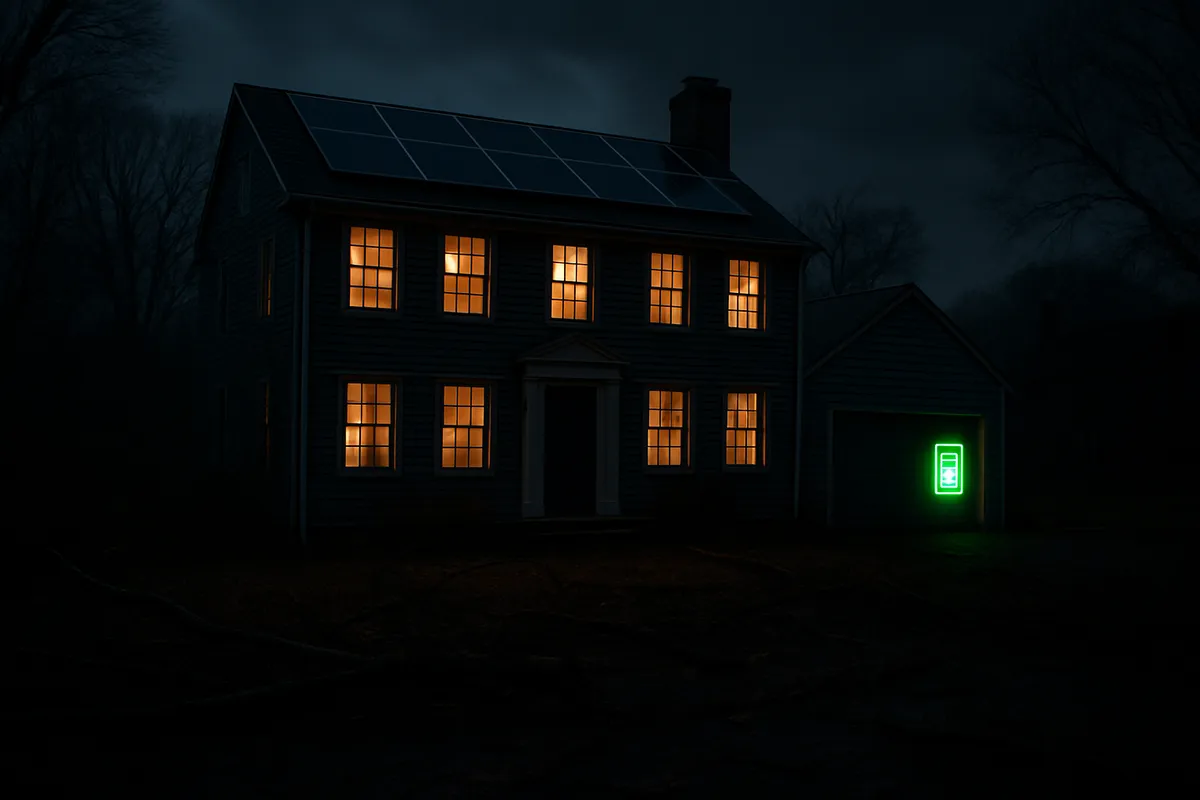
Your solar inverter — the device that converts DC power from panels to AC power for your home — is required to detect when the utility grid goes down and immediately stop producing power. This happens within 2 seconds (often within 60 milliseconds). The standard is called UL 1741 anti-islanding, and every grid-tied inverter sold in the United States must comply.
The reason is straightforward: utility workers repairing downed lines need to know those lines are dead. If your solar system were backfeeding electricity into a line that a worker assumes is de-energized, it could be fatal. This is non-negotiable regardless of how small your system is.
Connecticut’s tree canopy, aging grid infrastructure, and exposure to nor’easters and tropical storms create a uniquely outage-prone environment. Eversource CT alone reported 11 major outage events between 2011 and 2024.
Customers Affected
1,000,000+
Max Restoration Time
12 days
Utility
Eversource
Category 1. Eversource faced massive criticism. PURA launched investigation. $28.6M fine.
Customers Affected
700,000+
Max Restoration Time
9 days
Utility
Both
Inland flooding, widespread tree damage. Eastern CT hardest hit.
Customers Affected
800,000+
Max Restoration Time
11 days
Utility
Both
Rare October nor'easter. Heavy wet snow on fully-leafed trees caused catastrophic damage.
Customers Affected
300,000+
Max Restoration Time
5 days
Utility
Both
Three consecutive storms in two weeks. Extended school closures statewide.
Customers Affected
500,000+
Max Restoration Time
4 days
Utility
UI
UI territory restored faster than Eversource. Still significant in metro areas.
August 4, 2020 changed Connecticut’s relationship with power reliability. Over 1 million customers lost power, many for 8-12 daysin August heat. Eversource was fined $28.6 million by PURA for its response. Food spoiled, medical equipment failed, and many elderly residents required evacuation. If any single event explains why CT homeowners are adding batteries in 2026, it is Isaias.
The battery gateway detects the grid outage within milliseconds. Unlike a grid-tied inverter that shuts down, the battery system's transfer switch activates.
The automatic transfer switch (ATS) disconnects your home from the utility grid within 200 milliseconds. This creates a safe, isolated microgrid for your home.
The battery immediately begins powering your critical load panel — refrigerator, lights, internet router, phone charging, medical equipment, and select outlets.
During daylight hours, your solar panels produce power that charges the battery and powers the home simultaneously. This cycle can sustain essential loads indefinitely.
When utility power returns, the system detects stable grid voltage, reconnects your home, and resumes normal solar + grid operation. Many homeowners don't even notice.
Connecticut’s Energy Storage Solutions (ESS) program is one of the most generous battery incentives in the country. Administered through EnergizeCT, it pays a one-time Enrollment Incentive set by your circuit location, then a performance incentive set by income tier every year across a 10-year Active Dispatch commitment. Solar is not required — standalone batteries qualify.
$300/kW-yr
Max: $16,000 (50% of cost)
Note: Plus a $405 enrollment incentive on a 13.5 kWh Powerwall
Homes in towns not on the CT DECD distressed list
$450/kW-yr
Max: $16,000 (50% of cost)
Note: Same $405 enrollment incentive; only the performance rate differs
Homes in CT DECD distressed municipalities
$550/kW-yr
Max: $16,000 (50% of cost)
Note: Household income qualification, available in any CT town
Income-qualifying households (LMI)
Performance rates are paid annually for ten years on measured average kW-AC contribution during Active Dispatch events, not on nameplate capacity. The separate enrollment incentive is $30/kWh at commissioning — $130/kWh for homes on a Grid Edge circuit, so $405 or $1,755 on a 13.5 kWh battery. Grid Edge is a circuit-level designation, never a town-level one.
Source: CT Energy Storage Solutions Program Manual (revised Feb 11, 2026), Tables 9 and 16; PURA Docket 25-08-05 final decision Dec 17, 2025, effective April 1, 2026.
| Battery | Capacity | Backup Hours | Cost | After ESS | ESS Dispatch (standard, assumes rated kW measured) |
|---|---|---|---|---|---|
| Tesla Powerwall 3 | 13.5 kWh | 8-12 hrs | $10,500 | $10,095 | $3,450/yr |
| Enphase IQ Battery 5P | 5 kWh | 4-6 hrs | $6,500 | $6,350 | $1,152/yr |
| Enphase IQ Battery 10T | 10.08 kWh | 6-10 hrs | $10,000 | $9,698 | $1,152/yr |
| SolarEdge Home Battery | 9.7 kWh | 6-9 hrs | $9,500 | $9,209 | $1,500/yr |
*Net cost assumes the $30/kWh non-Grid Edge Enrollment Incentive; a Grid Edge circuit pays $130/kWh. Dispatch revenue shown at the standard $300/kW/yr tier on the battery’s rated output — ESS actually pays on measured average contribution during events, so reserving part of the battery for backup lowers the paid kW. Underserved and income-qualified households earn more. Earlier ESS revenue is for Eversource/UI summer demand response participation. Backup hours assume essential loads only.
When the grid is up and running, your battery earns money through Active Dispatch under Connecticut’s Energy Storage Solutions program. ConnectedSolutions closed to new CT enrollments on December 1, 2023; ESS replaced it. Eversource and United Illuminating call the events, but the rates are set statewide by PURA and depend on your income tier — not on which utility serves you.
A common concern: “If my battery is dispatched for demand response, will it be empty when I need it for an outage?” Most battery systems allow you to set a minimum backup reserve (typically 20-30% of capacity). This reserve is never dispatched for ESS. Even during a called event, your battery retains enough charge for 3-5 hours of essential load backup. Note that the reserve you hold back also reduces the capacity you commit at enrollment, and the performance incentive is paid on measured capacity. Storms rarely coincide with dispatch events, which happen on clear, hot summer days and during winter cold snaps.
*Standard ESS tier and a non-Grid Edge circuit shown; underserved and income-qualified households and Grid Edge addresses do better. The performance incentive is paid on the measured average contribution during events, so reserving part of the battery for backup reduces the paid kW below the 11.5 kW rated figure used here. Batteries need a minimum 10-year manufacturer warranty and a minimum 10-year workmanship warranty from your installer. Source: PURA Docket No. 25-08-05 decision (December 17, 2025); CT Energy Storage Solutions Program Manual revised February 11, 2026. Verified August 3, 2026.
If you already have solar panels but no battery, retrofitting is absolutely possible. The process depends on your existing inverter type:
Seamless integration with existing Enphase ecosystem. No additional inverter needed. Battery connects to existing Envoy gateway.
DC-coupled for higher efficiency. Requires compatible SolarEdge inverter (HD-Wave or newer). May need a Backup Interface unit.
AC-coupled — works with any existing solar system. Requires a gateway and critical load subpanel. Most flexible retrofit option.
Get a personalized battery quote including your CT ESS incentive estimate and ESS Active Dispatch revenue projection. Free, no-obligation assessment.
Standard grid-tied solar panels shut off during a power outage. This is required by UL 1741 anti-islanding rules to protect utility workers. Your solar panels will NOT power your home during an outage unless you have a battery backup system (like Tesla Powerwall 3) or a hybrid inverter with islanding capability.
Grid-tied solar inverters are required by federal safety standards (UL 1741) to shut down when the grid goes down. This anti-islanding protection prevents solar electricity from backfeeding into downed power lines and electrocuting utility workers. The inverter detects the grid loss within milliseconds and stops producing power.
A home battery system in Connecticut typically costs $10,000-$18,000 before incentives. The CT ESS (Energy Storage Solutions) Enrollment Incentive takes $30/kWh off at install, or $130/kWh if your home is on a Grid Edge circuit — $405 or $1,755 on a 13.5 kWh battery. The larger money arrives afterwards as a performance incentive of $300-$550/kW every year for ten years. A single Tesla Powerwall 3 (13.5 kWh) provides 8-12 hours of essential load backup.
Through Active Dispatch under the Energy Storage Solutions program. ConnectedSolutions closed to new Connecticut enrollments on December 1, 2023 and ESS replaced it. Eversource and United Illuminating call events — 30 to 60 in summer between June 1 and September 30, and 1 to 10 in winter between November 1 and March 31, each lasting one to three hours inside a noon to 9 PM window. ESS pays $300/kW/year for standard customers, $450/kW/year in underserved communities, and $550/kW/year for income-qualified households, at the same rate every year of a 10-year commitment, based on the capacity you commit at enrollment.
A single 13.5 kWh battery (like Tesla Powerwall 3) powers essential loads (refrigerator, lights, internet, phone charging, medical equipment) for 8-12 hours. With solar recharging during the day, a battery can sustain essential loads indefinitely during extended outages. Two batteries extend backup to 16-24 hours without solar recharge.
Hurricane Isaias (August 2020) left over 1 million CT customers without power, many for 8+ days. Eversource took 12 days to fully restore service. Other notable outages include Tropical Storm Irene (2011, 700,000+ without power), Winter Storm Alfred (2011, 800,000+ without power for up to 11 days), and the March 2018 nor'easters (300,000+ affected).
Yes. Batteries like the Tesla Powerwall 3, Enphase IQ Battery, and SolarEdge Home Battery can be retrofitted to existing solar systems. The cost and complexity depend on your inverter type. String inverter systems may need a gateway or critical load panel. Enphase microinverter systems pair seamlessly with IQ Batteries. The CT ESS incentive applies to retrofit battery installations.