Loading NuWatt Energy...

We use your location to provide localized solar offers and incentives.
We serve MA, NH, CT, RI, ME, VT, NJ, PA, and TX
Loading NuWatt Energy...
NuWatt designs, installs, and manages solar, battery, heat pump, and EV charger systems across 9 states. One company, one warranty, one point of contact.
Get a Free QuoteHomes on the most outage-prone circuits enroll in Connecticut's ESS battery program at $130/kWh instead of the standard $30/kWh — more than four times the Enrollment Incentive for the same battery. On top of that every enrollee earns $300 to $550 per kW every year for ten years.
Program status: ESS moved to the enrollment plus performance model on April 1, 2026, and every application submitted since then follows it. Grid Edge is now a distinct Enrollment Incentive rate of $130/kWh rather than a percentage adder. The figures on this page and in the calculator below are the current ones.
Grid Edgeis the higher Enrollment Incentive rate under Connecticut's Energy Storage Solutions (ESS) program. It rewards homeowners who install batteries on grid-constrained circuits — the top 10% of Eversource and United Illuminating distribution circuits ranked by outage count or by outage duration since July 1, 2012.
A Grid Edge address enrolls at $130/kWh against a standard rate of $30/kWh. It sits alongside, not on top of, the income-based performance tiers: your circuit sets the enrollment rate and your income tier sets the $300 to $550 per kW annual payment. An income-qualified household on a Grid Edge circuit collects the best of both.
Ranking is done on recorded outage history since July 1, 2012, so the qualifying circuits tend to cluster in:
PURA restructured ESS in Docket No. 25-08-05, decided December 17, 2025. The declining-block upfront incentive and the Passive Dispatch track were both eliminated for new enrollments and replaced with a small Enrollment Incentive plus much larger performance payments. The left column below is closed history; the right column is what you get today.

| Feature | Closed structure (through Mar 31, 2026) | Current structure |
|---|---|---|
| Model | Declining-block Upfront Incentive | Enrollment + Performance |
| What sets the $/kWh payment | Income tier | Circuit location |
| Standard / non-Grid Edge | $250/kWh at launch, $162.50/kWh final block | $30/kWh enrollment |
| Grid Edge | +50% adder on the tier rate | $130/kWh enrollment |
| Cap on the up-front payment | $16,000 or 50% of cost | No cap — the rate is simply per kWh |
| Performance payments | $200/kW summer + $25/kW winter (yrs 1-5), $115 + $15 (yrs 6-10) | $300-$550/kW-yr, all 10 years |
| Dispatch options | Active or Passive Dispatch | Active Dispatch only |
| Where the value sits | Mostly day one | Mostly across the 10-year term |
Take a standard-tier homeowner on a Grid Edge circuit with a Tesla Powerwall 3 (13.5 kWh, assuming ~5 kW average measured contribution during events). The Enrollment Incentive is $1,755 at install, and the performance incentive adds $1,500 a year for ten years — about $16,755 in total. Compared with the closed structure you carry more cost in year one and collect materially more over the full term, so the question is cash flow rather than total value.
Source: PURA Docket No. 25-08-05 decision (December 17, 2025); CT Energy Storage Solutions Program Manual revised February 11, 2026. Verified August 3, 2026.
Compare your incentive with and without a Grid Edge circuit at current rates. Select your battery and income tier to see the full breakdown.
Current ESS rates — compare a standard circuit with Grid Edge
Grid Edge advantage: Enrolling at $130/kWh instead of $30/kWh adds $1,350 at installation. It does not change your performance rate.
Grid Edge circuits are the top 10% of Eversource and UI distribution circuits ranked by outage count or outage duration since July 1, 2012. Rates per PURA Docket No. 25-08-05 decision (December 17, 2025) and the CT Energy Storage Solutions Program Manual revised February 11, 2026. Verified August 3, 2026.
Grid Edge eligibility is determined by your electrical circuit, not your ZIP code. Both CT utilities publish interactive maps showing which circuits are classified as constrained.
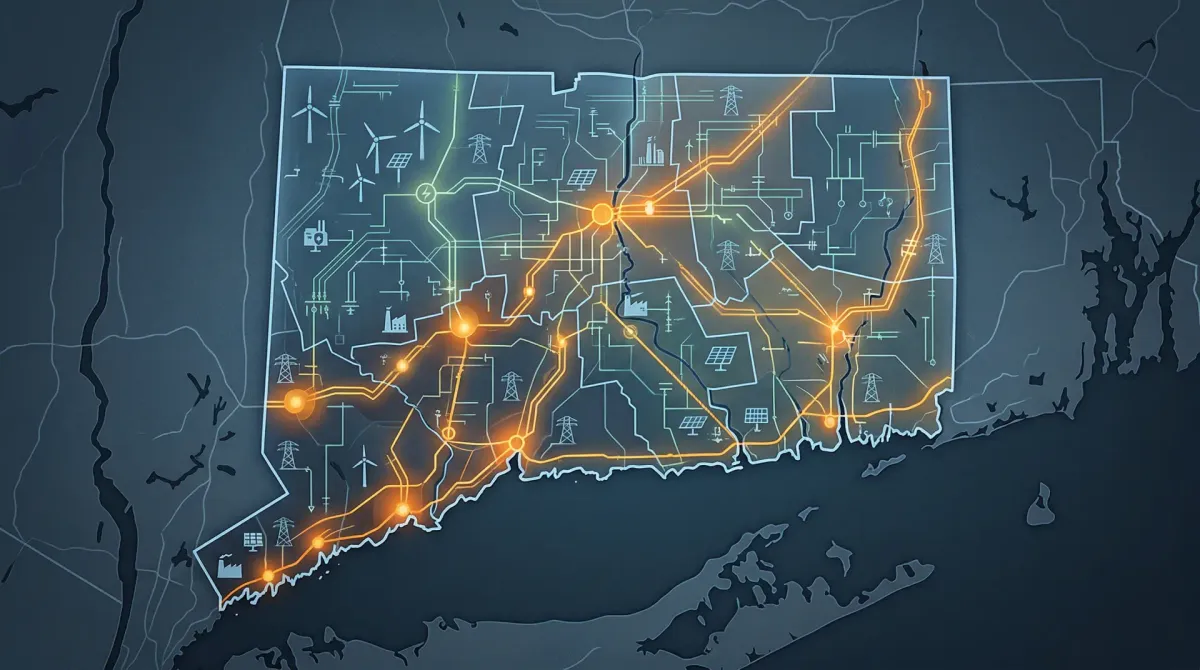
Covers Hartford, central, north, and east CT (~70% of customers). Interactive map showing grid modernization zones.
View Eversource mapCovers New Haven, Bridgeport, southwest CT (~30% of customers). Smart grid infrastructure and constrained circuits.
View UI mapGrid Edge is just one layer. Here's the full value stack for a Tesla Powerwall 3 (13.5 kWh, 11.5 kW) on a Grid Edge circuit at the standard income tier, at current rates.
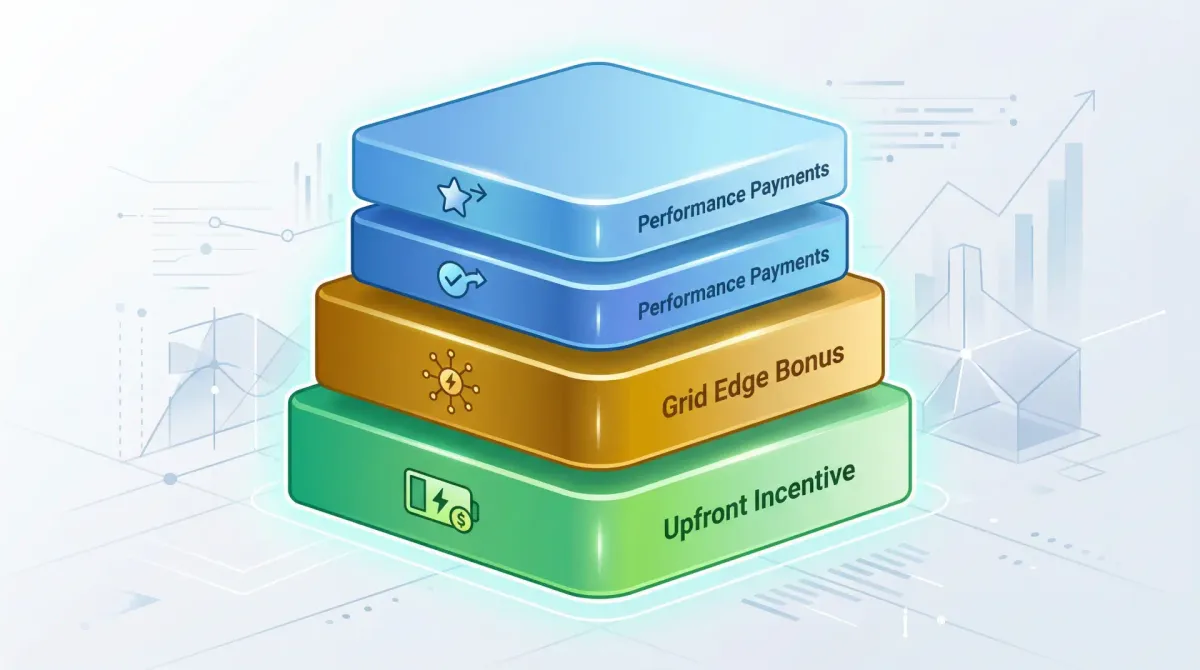
Based on a Tesla Powerwall 3 (13.5 kWh, 11.5 kW rated output), standard income tier, Grid Edge circuit, at current ESS rates. The performance incentive is paid on the measured average contribution during Active Dispatch events, not nameplate — if you reserve part of the battery for backup, the paid kW is lower than the nameplate figure used here. Underserved and income-qualified households earn $450 and $550 per kW per year instead of $300. TOU arbitrage and self-consumption savings are additional. Source: PURA Docket No. 25-08-05 decision (December 17, 2025); CT Energy Storage Solutions Program Manual revised February 11, 2026. Verified August 3, 2026.
Any battery that qualifies for the CT ESS program also qualifies for the Grid Edge adder. Here are the most common options:
Most popular, integrated inverter
AC-coupled, legacy model
Modular, pairs with Enphase microinverters
Larger Enphase option
DC-coupled, SolarEdge ecosystem
Whole-home backup capable
Scalable 3–18 kWh
Premium smart home integration
Grid Edge is a higher Enrollment Incentive rate under Connecticut's ESS (Energy Storage Solutions) program. If your home sits on a grid-constrained circuit identified by Eversource or United Illuminating, you enroll at $130/kWh instead of the standard $30/kWh. For a 13.5 kWh battery that is $1,755 rather than $405. Under the closed pre-April 2026 structure Grid Edge worked as a 50% adder on the old upfront incentive; since April 1, 2026 it is simply its own rate.
Grid Edge eligibility is based on your electrical circuit, not your ZIP code. The qualifying set is the top 10% of Eversource and United Illuminating distribution circuits ranked by outage count or by outage duration since July 1, 2012. Both utilities publish interactive maps showing constrained circuits, and your battery installer can verify your circuit's status during the site assessment.
The ESS program moved from an upfront incentive model to an enrollment plus performance model, so Grid Edge changed shape rather than disappearing. It used to be a 50% adder on a declining-block upfront incentive; it is now its own Enrollment Incentive rate of $130/kWh against a standard rate of $30/kWh. Applications submitted on or after April 1, 2026 all follow the new structure — there is no longer an earlier structure to choose between.
Yes, but they work on different parts of the incentive. Grid Edge sets your Enrollment Incentive ($130/kWh instead of $30/kWh). Your income tier sets your performance incentive ($300/kW/year standard, $450/kW/year underserved, $550/kW/year income-qualified, paid every year for ten years). An income-qualified household on a Grid Edge circuit therefore gets both the higher enrollment rate and the higher performance rate — the best combination available in Connecticut.
Any battery that qualifies for the standard ESS program also qualifies at the Grid Edge rate. This includes Tesla Powerwall 2/3, Enphase IQ Battery 5P/10T, SolarEdge Home Battery, Franklin WH aPower, Generac PWRcell, and sonnen ecoLinx. The battery must meet ESS technical requirements for Active Dispatch, carry at least a 10-year manufacturer warranty, and come with a minimum 10-year workmanship warranty from your installer.
No. The ESS program — including the Grid Edge rate — does not require solar pairing. The program manual explicitly allows battery storage to be standalone or coupled with another resource such as solar. Pairing with solar still maximizes value, because you charge from your own production instead of paying grid rates, but it is not an eligibility requirement.
Commercial ESS applicants use a different structure entirely. Priority commercial projects receive a $10/kWh Enrollment Incentive and non-priority commercial projects receive none; the value sits in the performance incentive, which pays $325/kW for years 1-5 and $175/kW for years 6-10 for small and medium C&I (annual peak demand under 500 kW), or $275/kW and $175/kW for large C&I (500 kW or greater). Commercial and industrial applicants also pay a $350 non-refundable application fee, which residential applicants do not.
The ESS application typically takes 2-4 weeks for approval. Your installer submits the application, and EnergizeCT/CT Green Bank verifies your Grid Edge circuit eligibility during review. Your battery needs at least a 10-year manufacturer warranty and your contractor must provide a minimum 10-year workmanship warranty.
Full ESS program overview: $30-$130/kWh at enrollment plus $300-$550/kW/year for ten years.
Read guideEversource Rate 7 & UI Rate RT time-of-use arbitrage with battery storage.
Read guideNetting Tariff vs Buy-All. Solar Energy Adjustment and how batteries help.
Read guide$2.60-3.10/W installed. City-by-city breakdown and net cost after exemptions.
Read guideIncome tiers that stack with Grid Edge for maximum battery incentives.
Read guideCommercial ESS performance rates + Section 48/48E ITC for larger projects.
Read guideGrid Edge circuits enroll at $130/kWh instead of $30/kWh, and every ESS enrollee earns $300 to $550 per kW every year for ten years. NuWatt Energy can verify your circuit eligibility and handle the ESS application.