Loading NuWatt Energy...

We use your location to provide localized solar offers and incentives.
We serve MA, NH, CT, RI, ME, VT, NJ, PA, and TX
Loading NuWatt Energy...
NuWatt designs, installs, and manages solar, battery, heat pump, and EV charger systems across 9 states. One company, one warranty, one point of contact.
Get a Free QuoteConnecticut EV owners pay $0.27-$0.28/kWh for grid electricity — among the highest in America. Adding 2-4 kW of extra solar panels eliminates your fuel bill entirely. Section 30C gives you up to $1,000 toward a Level 2 charger, but it expires June 30, 2026. Here is everything you need to know.
2-4 kW
Extra Solar for EV
$1,200-$2,400
Annual Fuel Savings
$1,000
30C Charger Credit
55,000+
CT EV Registrations
Most EV owners driving 12,000 miles/year need 2,400-4,900 extra kWh of electricity annually. In Connecticut, that translates to 2-4.2 kW of additional solar capacity, or 5-10 extra 420W panels. This adds $5,200-$12,600 to your solar system cost at CT prices ($2.60-$3.00/W).
The result: your annual fuel cost drops from $1,400-$1,680 (gasoline) to $0 (solar). The extra solar panels pay for themselves in 4-7 years through eliminated fuel costs alone — before considering rising gas prices.
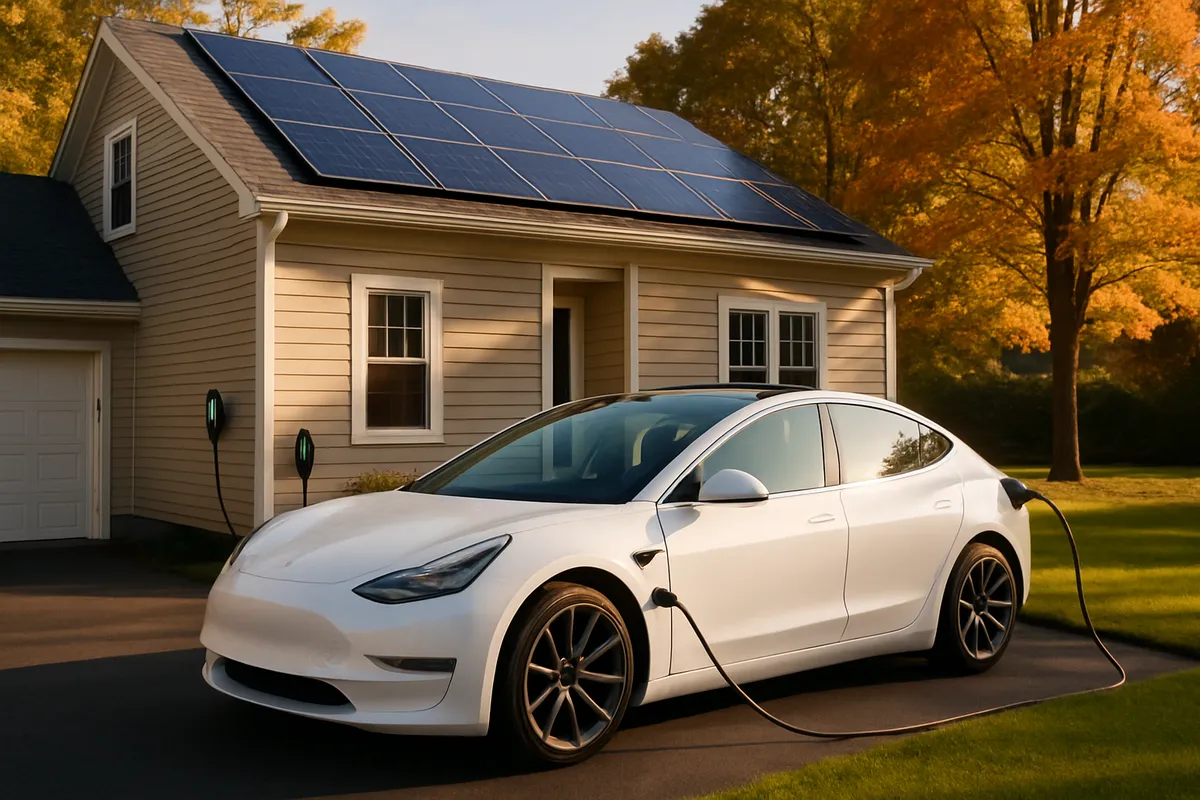
Connecticut averages 1,175 kWh per kW of solar capacity per year. This table shows how much extra solar you need based on your EV’s real-world efficiency.
| EV Model | Efficiency (mi/kWh) | Annual kWh Needed | Extra Solar (kW) | Extra 420W Panels |
|---|---|---|---|---|
| Tesla Model 3 | 3.8 mi/kWh | 3,158 kWh | 2.7 kW | 6 panels |
| Tesla Model Y | 3.3 mi/kWh | 3,636 kWh | 3.1 kW | 7 panels |
| Chevy Equinox EV | 3.5 mi/kWh | 3,429 kWh | 2.9 kW | 7 panels |
| Ford Mustang Mach-E | 3 mi/kWh | 4,000 kWh | 3.4 kW | 8 panels |
| Hyundai Ioniq 5 | 3.4 mi/kWh | 3,529 kWh | 3 kW | 7 panels |
| Rivian R1S | 2.4 mi/kWh | 5,000 kWh | 4.3 kW | 10 panels |
| BMW iX | 2.8 mi/kWh | 4,286 kWh | 3.6 kW | 9 panels |
| VW ID.4 | 3.2 mi/kWh | 3,750 kWh | 3.2 kW | 8 panels |
*Based on 12,000 miles/year. Efficiency from EPA real-world data. CT solar production: 1,175 kWh/kW/year. Panel count uses 420W panels. Actual system sizing should account for existing home consumption.
Connecticut’s high electricity rates ($0.27-$0.28/kWh) make grid-charged EV ownership more expensive than in most states. Solar eliminates this disadvantage entirely.
| Fuel Method | Cost/Mile | Annual (12K mi) | CO2/Year | Price Trend |
|---|---|---|---|---|
| Gasoline (25 MPG) | $0.14 | $1,680 | 4.6 tons | Volatile — gas prices swing 30-50% year to year |
| Gasoline (30 MPG) | $0.12 | $1,400 | 3.8 tons | Volatile — gas prices swing 30-50% year to year |
| EV — CT Grid ($0.27/kWh) | $0.08 | $945 | 1.2 tons | CT rates rising 3-5% per year historically |
| EV — CT Grid Off-Peak TOU | $0.05 | $580 | 1.2 tons | Cheaper overnight, but still rising with rates |
| EV — Solar Powered | $0.00 | $0 | 0 tons | Fixed — solar cost locked at installation |
Over 20 years (the typical solar system lifespan), a CT homeowner who charges their EV with solar saves $28,000-$48,000 compared to gasoline — assuming 3% annual gas price inflation. The extra 3 kW of solar costs approximately $7,800-$9,000 upfront, meaning you earn 3-5x your investment in avoided fuel costs alone.
Section 30C provides a 30% tax credit on EV charger equipment and installation costs, up to $1,000 for residential and $100,000 for commercial. The charger must be placed in service before June 30, 2026. There is no replacement credit after this date.
A typical Level 2 home charger costs $500-$1,200 for the unit plus $500-$1,500 for installation. With Section 30C covering 30% (up to $1,000), your net cost could be as low as $300-$700 for a professional installation.
Connecticut’s CHEAPR program (Connecticut Hydrogen and Electric Automobile Purchase Rebate) is administered by CT DEEP. Historically it has provided:
CHEAPR funding is subject to annual legislative allocation. Check ct.gov/deep for current 2026 availability.
Eversource CT offers a time-of-use (TOU) rate structure that significantly benefits EV owners who charge overnight:
Best for overnight EV charging
Avoid charging during this window
Default rate without TOU enrollment
TOU is especially valuable with solar: panels export during on-peak hours (earning higher credits) while EV charges during off-peak hours (at lower rates).
Pull your last 12 months of electric bills from Eversource or UI. The average CT home uses 8,000-10,000 kWh/year. This is your baseline.
Example: 9,200 kWh/year home usage
Use the table above to find your EV's annual kWh. Most EVs driven 12,000 miles need 3,000-5,000 kWh/year additional.
Example: Tesla Model Y = 3,636 kWh/year
Add home usage plus EV usage. This is your total annual electricity need.
Example: 9,200 + 3,636 = 12,836 kWh/year total
Connecticut averages 1,175 kWh per kW of solar per year. Divide your total by 1,175 to get your system size.
Example: 12,836 / 1,175 = 10.9 kW system (round to 11 kW)
CT solar costs $2.60-$3.10/W installed. An 11 kW system runs $28,600-$34,100.
Example: 11 kW x $2.85/W = $31,350
Most popular home charger. Adjustable amperage works with any panel size.
Best for Tesla owners. Works with other EVs via J1772 adapter.
Best value. Integrates with Emporia energy monitoring for excess solar charging.
4.6 tons/yr
Gas Car CO2
Average 25 MPG, 12K miles
1.2 tons/yr
EV on CT Grid
CT grid mix (nuclear + renewables)
0 tons/yr
EV on Solar
100% clean, on-site generation
Connecticut’s grid is relatively clean thanks to the Millstone Nuclear Power Station (providing ~50% of CT electricity). However, solar EV charging eliminates even this residual carbon footprint. Over 20 years, a solar-powered EV avoids approximately 92 tons of CO2 compared to a gasoline vehicle — equivalent to planting 1,500 trees.
We will size your solar system for both your home and EV, include the Level 2 charger, and apply all available incentives. Section 30C expires June 30, 2026 — act now.
Most EVs need 2,400-4,900 extra kWh per year (12,000 miles at 3-4 mi/kWh). In Connecticut, that translates to 2-4.2 kW of additional solar capacity, or roughly 5-10 extra 420W panels. Connecticut averages 1,175 kWh per kW per year of solar production.
Charging an EV from the CT grid at $0.27-$0.28/kWh costs $810-$1,370/year (12,000 miles). Solar-powered EV charging costs effectively $0/kWh once the system is paid off, saving the full amount. Even during the payback period, solar electricity costs roughly $0.06-$0.08/kWh — saving $600-$1,000/year vs. grid charging.
Section 30C provides a tax credit of 30% of EV charger equipment and installation costs, up to $1,000 for residential. It covers Level 2 (240V) chargers. IMPORTANT: Section 30C expires June 30, 2026. After that date, there is no federal EV charger tax credit. The charger must be installed and placed in service before June 30, 2026 to qualify.
The Connecticut CHEAPR (Connecticut Hydrogen and Electric Automobile Purchase Rebate) program provides rebates for EV purchases. For EV chargers specifically, CHEAPR has offered $500 rebates for Level 2 home charger installations. Check ct.gov/deep for current 2026 availability as funding is subject to annual allocation.
Eversource Connecticut offers a time-of-use (TOU) rate that benefits EV owners. Off-peak charging (typically 9pm-1pm) is significantly cheaper than on-peak rates. While not exclusively an "EV rate," the TOU structure rewards overnight EV charging when solar is not producing. Contact Eversource to switch to TOU if you charge overnight.
Technically yes, but it is not recommended during extended outages. EV charging draws 7-11 kW (Level 2), which would drain a typical 13.5 kWh home battery in 1-2 hours. During outages, prioritize essential home loads. If you must charge your EV, do it during peak solar production (10am-2pm) when panels can directly power the charger without draining battery reserves.
A CT homeowner driving 12,000 miles/year saves $1,200-$2,400 annually by switching from gasoline to solar-powered EV charging. This assumes $3.50/gallon gas at 25-30 MPG ($1,400-$1,680/year for gas) vs. $0 marginal cost for solar electricity. If your EV replaces a less efficient vehicle (20 MPG), savings are even higher.