Loading NuWatt Energy...

We use your location to provide localized solar offers and incentives.
We serve MA, NH, CT, RI, ME, VT, NJ, PA, and TX
Loading NuWatt Energy...
NuWatt designs, installs, and manages solar, battery, heat pump, and EV charger systems across 9 states. One company, one warranty, one point of contact.
Get a Free Quote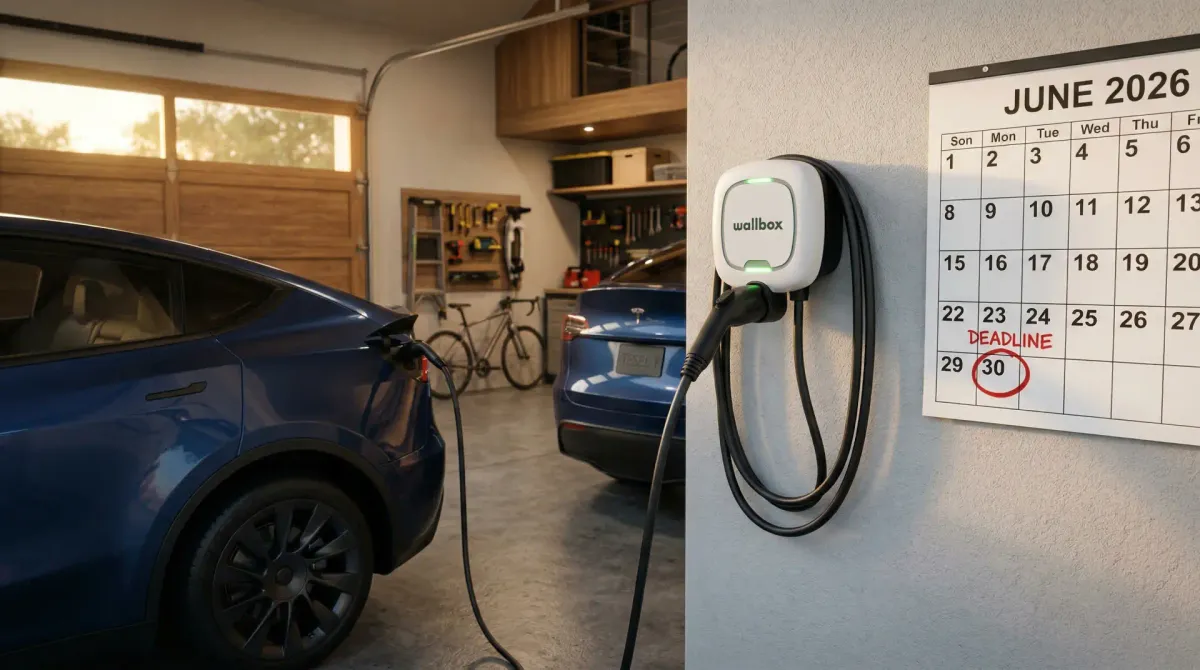
Section 30C was the last federal tax credit available to homeowners for any residential energy improvement. The solar ITC is gone. The heat pump credit is gone. And as of June 30, 2026, the residential home EV charger credit (up to $1,000) is gone too. What’s left for homeowners: state and utility EV charger rebates. The commercial 30C credit (up to $100,000 per unit) ended the same day — both halves of Section 30C expired June 30, 2026.
Expired June 30, 2026
the residential Section 30C credit is no longer available
Expired Jun 30, 2026
Still active — $100K/unit
State & utility rebates
Quick Answer
The residential Section 30C home EV charger tax credit expired June 30, 2026 and is no longer available. It was the last remaining federal residential energy tax credit — the solar ITC (25D) and heat pump credit (25C) both expired December 31, 2025, and the home EV charger credit (up to $1,000) followed on June 30, 2026. A home charger installed after that date does not qualify for any federal credit. What remains for homeowners are state and utility EV charger rebates and off-peak charging rates. The commercial 30C credit (up to $100,000 per charging unit) expired the same day — the June 30, 2026 cutoff applies to business property too.
Section 30C of the Internal Revenue Code — officially the Alternative Fuel Vehicle Refueling Property Credit — provided a federal tax credit for installing EV charging equipment at your home or business. It covered both the charger hardware and professional installation labor.
Originally enacted as part of the Energy Policy Act of 2005, Section 30C was extended and modified by the Inflation Reduction Act (IRA) in 2022. Under the One Big Beautiful Bill Act (OBBBA) signed on July 4, 2025, Section 30C expired for property placed in service after June 30, 2026 — the cutoff applies to both the residential ($1,000 cap) and commercial ($100,000 per unit) credits, per the IRS.
That expiration completed a clean sweep. Every residential energy tax credit is now gone:
| Credit | Section | Status | Max Value |
|---|---|---|---|
| Residential Solar ITC | 25D | Expired Dec 31, 2025 | 30% of system cost |
| Energy Efficiency (Heat Pumps, etc.) | 25C | Expired Dec 31, 2025 | $2,000/yr |
| EV Charger Installation (Residential) | 30C | Expired June 30, 2026 | $1,000 residential |
| EV Charger Installation (Commercial) | 30C | Active — businesses & fleets | $100K per unit (commercial) |
Commercial solar ITC (Section 48/48E) remains available for third-party system owners — the begin-construction safe harbor closed July 4, 2026, and new starts generally must be placed in service by December 31, 2027. Homeowners purchasing solar systems directly receive no federal tax credit.
Most federal tax credits expire on December 31 of a given year. The residential Section 30C credit was different. The OBBBA set a June 30, 2026 expiration — a mid-year cutoff that surprised homeowners and tax professionals alike, and it has now passed.
The rule that tripped people up: the charger had to be installed and placed in service on or before June 30, 2026 — not ordered, not purchased, not scheduled. Because a typical install takes 3 to 8 weeks (ordering equipment, scheduling an electrician, permits, inspection), many people who started late missed it.
If you installed a home charger after June 30, 2026, there is no federal credit to claim. The good news: state and utility EV charger rebates remain, and so does the commercial 30C credit. Here is where to look next.
The credit expired
Section 30C residential credit ended June 30, 2026
A home EV charger installed and placed in service after June 30, 2026 no longer qualifies for any federal tax credit. There is no residential federal EV charger credit going forward.
Step 1
Check your utility for EV charger rebates
Many utilities offer rebates on qualifying Level 2 home chargers and incentives for enrolling in managed or off-peak charging programs. Start with your electric utility’s EV programs page.
Step 2
Check your state EV charger programs
Several states run their own EV charger rebate programs separate from the federal credit. Check your state energy office for current amounts and eligibility.
Step 3
Look at off-peak charging rates
Even where no rebate exists, a time-of-use or EV rate plan can cut what you pay to charge at home. Ask your utility whether a lower off-peak EV rate is available.
Also expired
Commercial 30C credit for businesses and fleets
The commercial Section 30C credit (up to $100,000 per charging unit) ended on the same date — per the IRS, the credit applies to business/organization property placed in service through June 30, 2026. Businesses should look to state programs and utility make-ready funding.
Expired June 30, 2026
The federal home EV charger credit (up to $1,000) is no longer available
What It Was Worth (Now Expired)
Up to $100,000
30% of cost, per charging unit
Commercial Savings Examples
The residential home credit expired June 30, 2026, but the census-tract geography still matters for the commercial 30C credit and for homeowners reconciling a charger they placed in service on or before that date. Starting in 2023, the IRA added a geographic restriction: the EV charger must be installed at a property located in either a low-income community or a non-urban (rural) census tract.
This sounds restrictive, but the qualifying area is far broader than most people realize. "Non-urban" covers most of suburban and rural America. "Low-income community" does not mean you personally need to be low-income — it refers to the census tract's classification.
Even within cities, some census tracts qualify. The only way to know for certain is to check your specific address.
Use the Department of Energy's AFVR Property Eligibility Locator or the IRS Section 30C page to enter your property address. You will get an immediate yes/no answer.
For the commercial credit, confirm the tract before you commit. And note the residential credit is closed: a home charger installed after June 30, 2026 is not eligible regardless of census tract.
The federal residential credit is gone, but a good home charger still pays off — and many utility rebate programs apply to these same Level 2 (240-volt) models. Both hardwired and plug-in (NEMA 14-50) chargers are common; utility rebates typically require a new, qualifying unit, so keep your receipt either way.
Here are our top picks for residential EV charger installations. Check each against your utility’s current rebate list before you buy:
Works with all EVs (J1772 + NACS)
Best for: Tesla owners who want multi-car flexibility
Price
$595
Amps
48A
Range/Hr
44 mi
Wi-Fi enabled, energy tracking
Best for: Homeowners who want smart features + monitoring
Price
$699
Amps
50A
Range/Hr
37 mi
Best budget option, solar integration
Best for: Budget-conscious buyers, solar homes
Price
$399
Amps
48A
Range/Hr
37 mi
Built-in holster, NEMA 4 outdoor rated
Best for: Outdoor installations, harsh weather areas
Price
$649
Amps
50A
Range/Hr
37 mi
Made in Canada, rugged build, no Wi-Fi
Best for: Cold climate reliability, no-frills durability
Price
$449
Amps
40A
Range/Hr
30 mi
If you are considering solar panels for your home, adding an EV charger during the same installation is one of the smartest moves you can make right now. Here is why:
Bundling saves $300-$500 on mobilization costs since the electrical crew is already on site. Your electrician can run the 240V circuit while doing the solar interconnection.
A typical EV adds 3,000-5,000 kWh/year to your electricity use. That's 6-10 additional solar panels to offset, saving you $600-$1,200 per year in fuel costs versus gasoline.
Planning solar and EV charging together ensures your system is sized to handle both loads. Adding panels later is more expensive per watt than including them upfront.
Add a battery and you can charge your EV from stored solar energy overnight, even during grid outages. True energy independence for transportation and home power.
The residential solar ITC (Section 25D) expired on December 31, 2025. Homeowners who buy solar systems in 2026 receive no federal tax credit on the solar portion. However, your solar system still pays for itself through electricity savings — typically in 8-12 years depending on your state and utility rates. The residential EV charger credit (30C) expired June 30, 2026, so there is no federal credit on the charger either — but state and utility EV charger rebates may still apply.
Third-party ownership (lease/PPA) structures may still access the commercial ITC (Section 48/48E) for projects beginning construction before July 4, 2026. Learn more about solar lease vs. buy options.
The commercial Section 30C credit is one of the most generous — and most underutilized — tax credits available to businesses today. At up to $100,000 per charging unit, the math is compelling for any business considering employee or customer charging.
Apartment Complexes
Install chargers for residents. Credit per unit means 10 chargers = up to $300,000 in credits.
Retail / Restaurants
Customer-facing chargers increase dwell time and foot traffic while earning tax credits.
Office Buildings
Employee charging as a benefit. Reduces recruitment costs and meets ESG commitments.
Hotels / Hospitality
EV charging is becoming a booking decision factor. Capture the growing EV driver market.
Fleets / Logistics
Electrify your fleet vehicles with depot charging. Credits offset infrastructure costs.
Parking Garages
Monetize parking spaces with paid EV charging. Credits reduce payback period significantly.
Total Cost
$85,000
30C Credit (30%)
$25,500
Net Cost
$59,500
Per Charger
$5,950
After July 1, 2026, the same installation costs $85,000 with zero credit offset. That is $25,500 left on the table.
The credit is closed to new installations, but if you installed and placed a charger in service on or before June 30, 2026 — residential or commercial — this is the process for claiming it on your 2026 return.
Confirm census tract eligibility
Use the DOE/IRS locator tool to confirm the property was in a qualifying census tract. This still applies to the commercial credit and to any residential charger placed in service by June 30, 2026.
Confirm the charger was placed in service in time
For the residential credit, the new Level 2 or Level 3 charger had to be professionally installed, complete, and operational on or before June 30, 2026. Installations after that date do not qualify for the residential credit.
Keep all documentation
Save your receipt/invoice showing the charger cost and installation labor separately. Keep the installation date documented. Save confirmation of your eligible census tract status.
File IRS Form 8911
When you file your 2026 federal tax return (typically by April 15, 2027), complete IRS Form 8911 — Alternative Fuel Vehicle Refueling Property Credit. The credit amount flows to your Form 1040.
Apply the credit to your tax liability
The credit is non-refundable — it reduces your federal income tax dollar-for-dollar up to the cap. If your tax liability is less than the credit, you cannot get the excess back as a refund. Commercial entities can carry forward unused credit.
Since the credit is non-refundable, make sure your 2026 federal income tax liability is at least $1,000 to get the full benefit. If your tax liability is lower (for example, due to other credits or low income), you will only offset what you owe. Most homeowners with W-2 income well exceed the $1,000 threshold. Consult your tax advisor for personalized guidance.
No. The residential Section 30C EV charger tax credit expired June 30, 2026 and is no longer available. It had a mid-year expiration set by the One Big Beautiful Bill Act (OBBBA) signed in July 2025 — not the usual December 31 cutoff. A home charger installed and placed in service after June 30, 2026 does not qualify for any federal credit.
Yes. The residential solar ITC (Section 25D) expired December 31, 2025 and the energy efficiency credit (Section 25C) for heat pumps, insulation, and water heaters also expired December 31, 2025. The residential Section 30C home EV charger credit was the last one standing — and it too expired June 30, 2026. There are now zero federal residential energy tax credits.
For homeowners, the credit was 30% of total installation cost (equipment + labor), capped at $1,000, and it expired June 30, 2026. The commercial 30C credit for businesses and fleets — 30% of cost per charging unit, capped at $100,000 per unit — expired on the same date; the IRS applies the June 30, 2026 placed-in-service cutoff to business property as well. The residential credit was non-refundable while it was available.
Not federally. The residential Section 30C credit expired June 30, 2026, so a home charger placed in service after that date does not qualify for any federal tax credit. What remains are state and utility EV charger rebates — many utilities offer rebates on Level 2 chargers and discounted off-peak charging rates. Check your state energy office and your utility for current EV charger programs.
State and utility programs are what remain. Many utilities offer rebates on qualifying Level 2 home chargers and enrollment incentives for managed/off-peak charging, and several states run their own EV charger rebate programs. These vary by location and change frequently, so check your utility and state energy office directly for current amounts and eligibility.
Bundling EV charger installation with solar still saves on mobilization costs and lets you size your solar system to offset your EV charging load — typically adding 2-4 kW (5-9 extra panels). Neither the residential solar ITC (25D) nor the residential EV charger credit (30C) is available any longer, but your solar system still pays for itself through electricity savings, and state and utility rebates may apply to both.
Yes. Homeowners who installed and placed a qualifying charger in service on or before June 30, 2026 claim the credit on IRS Form 8911 (Alternative Fuel Vehicle Refueling Property Credit) with their 2026 federal tax return, keeping the receipt/invoice, the installation date, and confirmation the property was in an eligible census tract. Installations after June 30, 2026 do not qualify for the residential credit.
No. No legislation extended the residential Section 30C credit beyond June 30, 2026, and it expired on that date. The OBBBA that set the deadline was passed with a clear intent to phase out clean energy credits. The residential home EV charger credit is no longer available.
The $100,000 commercial credit cap is per individual charging unit, not per location. A business installing 5 Level 2 stations at $10,000 each could claim $3,000 per unit ($15,000 total). This makes the commercial credit extremely valuable for multi-unit installations at apartment complexes, parking garages, and workplaces.
The residential Section 30C EV charger tax credit expired June 30, 2026 and is not coming back. But state and utility EV charger rebates and off-peak charging rates still cut your costs. Get a free quote and we’ll help you find what you qualify for in your area.
Free site assessment. Professional installation. We handle permits and inspections.
Does Your Panel Upgrade Qualify?
IRS-confirmed: dedicated electrical panels and wiring for the charger count toward the 30% credit. Real cost math + invoice language.
EV Charger Tax Credit: Complete Guide
Deep dive into Section 30C eligibility, savings calculations, and claiming process.
Best Home EV Chargers 2026
Compare 18 Level 2 chargers side-by-side. Reviews, specs, and compatibility.
Tesla vs ChargePoint vs Emporia
Head-to-head comparison of the top 3 most popular home EV chargers.
How to Size Solar for EV Charging
Calculate how many extra panels you need to offset your EV charging load.
EV Charger Installation Cost Guide
What to expect for equipment, labor, permits, and electrical upgrades.
Solar Tax Credit 2026: What Changed
The residential solar ITC (25D) is dead. What homeowners need to know now.
Solar Lease vs. Buy in 2026
Third-party ownership structures that still access the commercial ITC (48/48E).
Whole Home Electrification Guide
Solar, heat pump, battery, and EV charger — the full home energy upgrade roadmap.
Sarah tracks state and federal energy incentives, utility rate structures, and rebate programs. She has helped hundreds of homeowners navigate complex incentive stacks.