
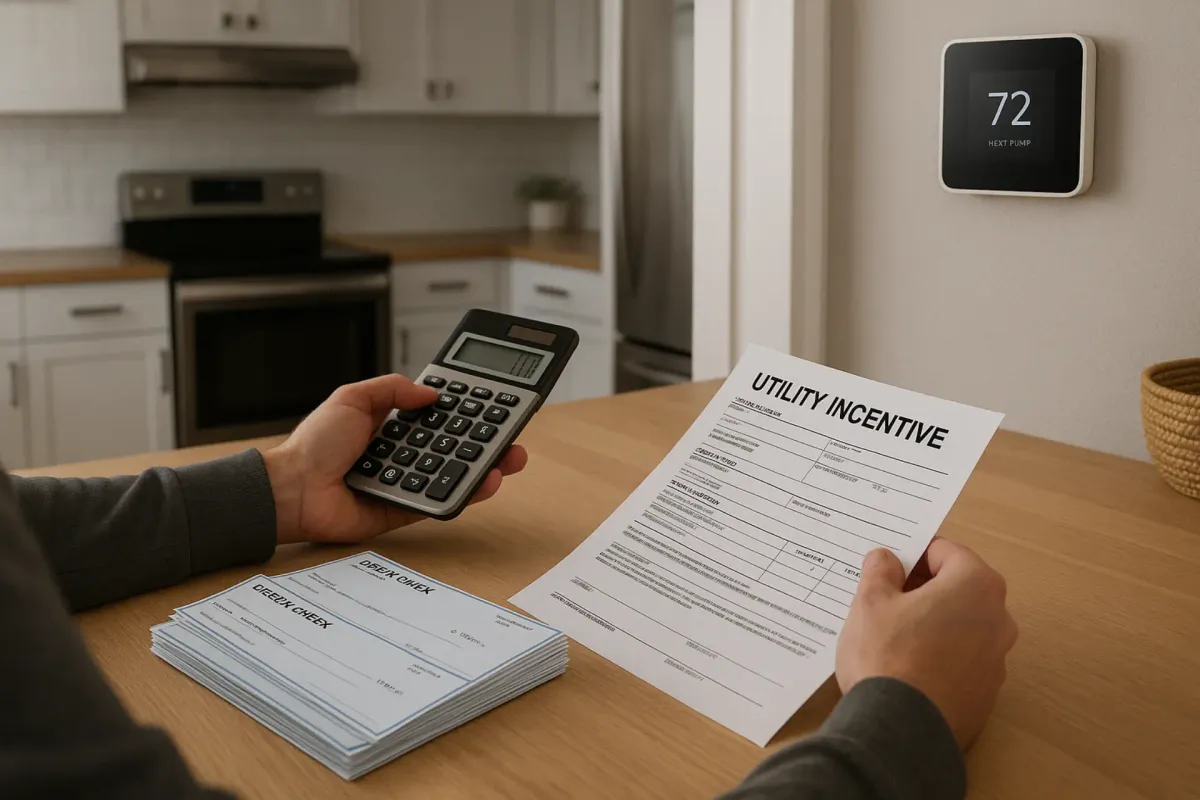

In 2026, there is no federal credit to stack. Your savings come from combining state program rebates with utility incentives.
Home Electrification Experts — Full-Service Design to Install, 9 States
Max Stacking
$17,000+
MA income-eligible
Typical Stack
$9,000–$12,000
state + utility
Income-Eligible
Up to $11,500
enhanced tiers
Application Time
60–90 days
after install deadline
How Stacking Works in 2026
With the federal tax credit gone, the concept of "stacking" incentives has changed dramatically. In 2024, stacking meant combining a federal tax credit with state rebates and utility incentives — a three-layer cake that could cover 60% or more of your heat pump cost. In 2026, the federal layer is gone, but two powerful layers remain: state program rebates and utility-specific incentives. For income-eligible households, enhanced state program tiers can restore much of the lost federal benefit.
The good news is that most state programs explicitly allow stacking with utility rebates. The key is knowing which programs exist in your state, whether they can be combined, and in what order to apply. Getting this wrong can cost you thousands of dollars. Getting it right can cut your net cost by 50-85% depending on where you live.
Here is a concrete example. A Massachusetts homeowner installing a $14,000 cold-climate heat pump system can stack: Mass Save rebate ($8,500) + utility-specific bonus ($500 from Eversource for cold-climate units). That is $9,000 in combined incentives on a $14,000 system, bringing the net cost down to $5,000. Income-eligible households may qualify for enhanced tiers that reduce the cost even further.
Understanding the Three Incentive Layers
Before diving into state-by-state stacking combinations, it helps to understand what each incentive layer is and where the money comes from:
Layer 1: State Program Rebates
Flagship programs funded by state energy offices or ratepayer charges. Examples: Mass Save (MA), Clean Heat RI (RI), Energize CT (CT). Usually largest single rebate. Amounts: $450 (PA) to $11,500 (RI).
Layer 2: Utility-Specific Incentives
Individual utilities offer bonuses on top of state program. Eversource (CT) offers per-ton bonuses for cold-climate units. Eversource (MA) offers per-ton bonuses. Often $200-$1,500. Some automatic, others require separate application.
Layer 3: Income-Eligible Enhanced Tiers
Many state programs offer enhanced rebate tiers for low and moderate-income households. Examples: RI Clean Heat covers 100% of cost (up to $18,000) for income-eligible homes. MA Mass Save offers enhanced whole-home rebates. Income thresholds vary by state, typically up to 80-150% of Area Median Income.
Stackable Combinations by State
The following table shows how incentive stacking works across every state NuWatt serves. The "Max Combined" column assumes a household qualifies for all available programs including income-eligible enhanced tiers where applicable. Your actual combined savings depends on your specific income level, utility, and equipment choices.
| State | State Program | + Utility Rebate | + Income-Eligible | Max Combined |
|---|---|---|---|---|
| Massachusetts | $8,500 | Yes | Yes* | $16,000+ |
| Rhode Island | $11,500 | Yes | Yes* | $15,000+ |
| New Jersey | $7,500 | Yes | Yes* | $12,000+ |
| Connecticut | $3,750 | Yes | Yes* | $7,500+ |
| Maine | $3,000 | Yes | Yes* | $9,000+ |
| New Hampshire | $1,250 | Yes | Pending | $8,000+ |
| Vermont | $2,200 | Yes | Yes* | $5,000+ |
| Pennsylvania | $450 | Yes | Pending | $2,000+ |
| Texas | $500 | Yes | No | $1,000+ |
* Income-eligible enhanced tiers are for households at or below 80-150% of Area Median Income, varying by state.
Step-by-Step Stacking Process
The order in which you apply for incentives matters. Here is the process NuWatt follows to maximize stacking for every customer:
Start with a home energy assessment
Most state programs require or recommend an energy audit before approving heat pump rebate. In MA, Mass Save Home Energy Assessment is free. In CT, Home Energy Solutions audit costs $50-$149. Assessment establishes baseline energy use and recommends right sizing.
Apply for the state program rebate first
Almost always the largest single incentive. Many state programs require pre-approval before installation begins. In RI, Clean Heat RI rebate is applied at point of sale — installer handles paperwork and you pay reduced price directly. In other states, rebate check arrives 4-8 weeks after installation.
Check utility-specific bonuses
Contact your specific utility to ask about additional incentives. Some utilities automatically apply their bonus when state rebate is processed. Others require separate application. Ask your installer — they should know which utilities require separate paperwork.
Check income-eligible enhanced tiers
Many state programs offer significantly higher rebates for low and moderate-income households. Your installer or state energy office can check eligibility. Enhanced tiers stack with base rebates, so qualifying for income-eligible rates does not disqualify you from other incentives.
Document everything
Keep copies of energy audit report, all contractor invoices, equipment model numbers, permit records, and rebate application confirmations. If any program audits your claim, you will need this documentation.
File applications within deadlines
Most programs require applications within 60-90 days of installation. Missing a deadline can forfeit thousands of dollars in rebates.
Real-World Stacking Examples
Here are three real scenarios from NuWatt customers that show how stacking works in practice:
Worcester, MA — Oil-to-Heat-Pump Conversion
2,100 sqft Colonial, 3-ton cold-climate ducted system
Providence, RI — Income-Eligible Household
1,400 sqft Ranch, 2-ton ductless system (3 heads)
Bridgeport, CT — Gas-to-Heat-Pump Switch
1,800 sqft Cape, 2.5-ton ducted system replacing gas furnace
Get a Quote with All Available Rebates
NuWatt handles every rebate application. See your net cost upfront.
How to Maximize Your Savings
Apply for state program first — largest rebate, often requires pre-approval
Check utility rebates separately — some automatic, others need applications
Ask about income eligibility — enhanced state program tiers can double your savings
Time your purchase wisely — apply early in calendar year when funding is fresh
Use a participating installer — they handle paperwork and ensure equipment qualifies
Bundle improvements — bonus rebates for adding insulation, air sealing, HP water heater
Common Stacking Mistakes to Avoid
Over the past year, we have seen homeowners leave thousands of dollars on the table due to avoidable mistakes. Here are the most common errors:
Assuming the federal credit still exists
Section 25C and 25D are both dead for homeowner purchases. Do not include federal tax credit in your savings calculations.
Installing before applying
Several programs require pre-approval before installation begins. If you install first and apply later, rebate application may be denied.
Using a non-participating contractor
Most state programs maintain list of registered contractors. If your installer is not on the list, you may lose rebate eligibility entirely.
Missing application deadlines
Most programs require you to file rebate application within 60-90 days of installation. Missing deadline by a week can lose $5,000+ in rebates.
Not checking income eligibility
Income thresholds for enhanced rebate tiers are higher than most people expect. For Boston metro, a family of four earning up to ~$180,000 may qualify for enhanced tiers. Always check.
Choosing equipment that does not qualify
Not all heat pumps qualify for every rebate program. Many require cold-climate rated equipment or minimum HSPF2/SEER2 ratings. Cheaper unit might cost you $5,000 in lost rebates.
Ready to Get a Heat Pump Quote?
Get a free, no-obligation quote from NuWatt Energy. We handle design, permits, and installation.
Frequently Asked Questions
Can I combine state rebates with utility rebates?▼
What is the maximum rebate I can get?▼
Continue Reading
Heat Pump Tax Credit 2026: Federal Credit Expired, Rebates Remain
New installations and a 2025 return filed in 2026 are different. Understand the Section 25C air-source deadline, geothermal distinction, and separate state rebate rules.
Heat Pump Rebates 2026: Step-by-Step Claim Guide
Heat pump rebates range from $450 in Pennsylvania to $11,500 in Rhode Island. This guide covers the exact steps to claim your rebate in each state.
Heat Pump ROI: Cost, Incentives, and Payback by State
Heat pump payback ranges from 2 years in Rhode Island (thanks to $11,500 in rebates) to 8+ years in Pennsylvania. This state-by-state breakdown shows exact costs, incentives, and timelines.