
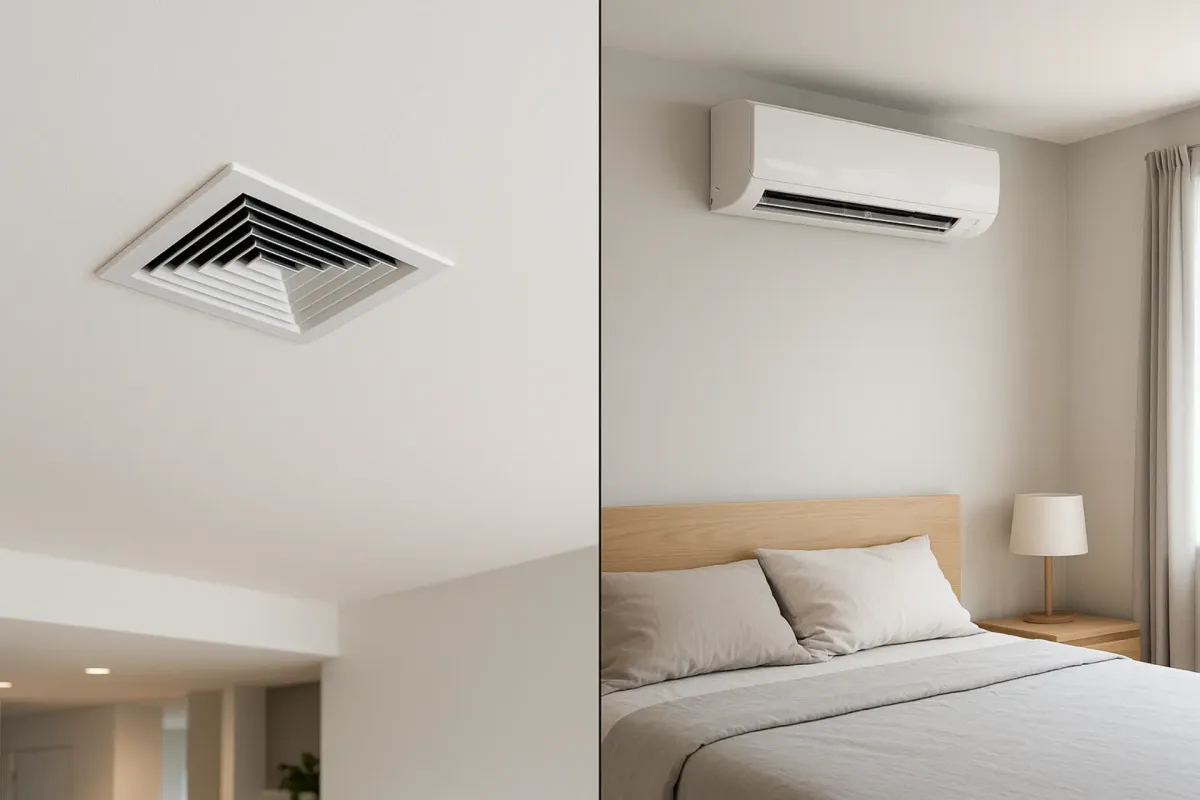

Whole-home ductless costs $15,000–$25,000 but saves 15–25% on energy. Central ducted costs $12,000–$18,000 but loses 10–30% to duct losses. Here is how the math works over 10 years.
Home Electrification Experts — Full-Service Design to Install, 9 States
Ductless Cost
$12K–$22K
whole-home multi-zone
Ducted Cost
$12K–$18K
with existing ducts
Efficiency Gap
10–30%
ductless advantage
Comfort Winner
Ductless
per-room control
The Whole-Home Decision
When a heat pump needs to handle every room of your house — not just supplement an existing furnace — the choice between ductless mini-splits and a central ducted system becomes the single biggest decision in your project. Both technologies use the same refrigeration cycle. Both deliver heating and cooling. But they distribute conditioned air in fundamentally different ways, and that difference affects cost, efficiency, comfort, aesthetics, and maintenance for the next 15-20 years.
This guide covers whole-home systems only. If you're adding a heat pump to one or two rooms while keeping an existing furnace, see our ductless mini-split for one room guide. For dual-fuel setups where the heat pump shares duty with a furnace, see our dual-fuel setup guide.
Whole-Home Ductless: How It Works
A whole-home ductless system uses one or two outdoor compressor units connected via refrigerant lines to individual indoor heads in each room or zone. Each indoor unit has its own thermostat, fan speed, and temperature setting. Refrigerant travels directly from the outdoor unit to each head — no ductwork, no air handler, no blower losses.
For a typical 2,000-2,500 sq ft New England home, a whole-home ductless system requires 3-6 indoor heads depending on room count and layout. Most systems use a multi-port outdoor unit (one outdoor unit connected to 3-5 heads) rather than individual 1-to-1 pairs, which reduces outdoor equipment and simplifies installation.
3-Zone
3 indoor heads · 1,200–1,800 sq ft
Configuration: Open-plan living + 2 bedrooms
Outdoor: 1x 36,000 BTU outdoor unit
Best for: Smaller homes, condos, apartments, or supplementing existing system
$12,000–$16,000
installed, before rebates
4-Zone
4 indoor heads · 1,800–2,400 sq ft
Configuration: Living room + kitchen + 2-3 bedrooms
Outdoor: 1x 42,000–48,000 BTU outdoor unit
Best for: Most common whole-home ductless setup for typical New England homes
$16,000–$20,000
installed, before rebates
5-Zone
5 indoor heads · 2,400–3,200 sq ft
Configuration: Full coverage including basement or bonus room
Outdoor: 1x 48,000–60,000 BTU or 2x smaller units
Best for: Larger homes or homes needing every room individually controlled
$20,000–$25,000
installed, before rebates
Central Ducted: How It Works
A central ducted heat pump uses a single outdoor compressor unit connected to an indoor air handler. The air handler contains a blower fan, evaporator coil, and filter. It pushes conditioned air through a duct system — the same type of ductwork used by a traditional furnace or central air conditioner — with supply registers in each room and return air grilles pulling air back to the handler.
The appeal of ducted systems is simplicity: one outdoor unit, one indoor unit, one thermostat, and invisible operation. The air handler lives in a utility closet, basement, or attic. Only the supply and return vents are visible in living spaces. For homeowners who dislike the look of wall-mounted mini-split heads, ducted systems solve the aesthetics problem entirely.
Modern ducted heat pumps from Bosch, Carrier, Daikin, and Mitsubishi offer variable-speed compressors and inverter-driven blowers that rival ductless efficiency — ifthe ductwork is properly sealed and insulated. The critical qualifier is duct condition. Even the best ducted heat pump can't overcome leaky, uninsulated ducts running through unconditioned spaces.
Compact Air Handler (Attic/Closet)
2–3 ton · 18–20 SEER2 / 9–10 HSPF2
Fits in tight spaces. Horizontal or vertical mount. Works with existing duct trunk lines. Ideal for ranch homes and single-story.
$12,000–$16,000 installed
before rebates
Full-Size Air Handler (Basement)
3–5 ton · 19–22 SEER2 / 9.5–11 HSPF2
Higher airflow for larger homes. Variable-speed blower for better humidity control. Can support zone dampers for multi-zone operation.
$14,000–$20,000 installed
before rebates
Head-to-Head Comparison
Here's the definitive breakdown across every factor that matters. Each category has a clear winner — but the overall winner depends on which factors matter most for your specific home:
Installed Cost
DuctedDuctless
$12,000–$22,000
Ducted
$12,000–$18,000
Ducted is cheaper when existing ductwork is in good condition. Ductless wins on price when home has no ducts.
Efficiency (SEER2)
DuctlessDuctless
20–30 SEER2
Ducted
16–22 SEER2
Ductless delivers refrigerant directly to each room — no duct losses. Real-world efficiency advantage: 10-30%.
Heating (HSPF2)
DuctlessDuctless
10–14 HSPF2
Ducted
8–11 HSPF2
Same principle — no duct losses in heating mode, where efficiency matters most in New England.
Noise (Indoor)
DuctlessDuctless
19–32 dBA
Ducted
35–50 dBA
Wall-mount heads are whisper-quiet. Ducted systems have blower noise plus duct velocity noise.
Aesthetics
DuctedDuctless
Visible wall units
Ducted
Hidden (only vents visible)
Biggest ductless drawback. Wall-mount heads are visible in every room. Ceiling cassettes solve this at higher cost.
Zone Control
DuctlessDuctless
Every head is a zone
Ducted
Single zone (or 2-3 with dampers)
Ductless gives independent temperature control per room. Ducted requires zone dampers ($1,500-$3,000 extra) for multi-zone.
Maintenance
TieDuctless
Clean filters per head
Ducted
One filter, duct cleaning every 5-7 yrs
Ductless has more individual filters but they are easy to clean. Ducted needs occasional duct cleaning and sealing.
Comfort Consistency
DuctlessDuctless
Excellent per-room control
Ducted
Good if ducts are well-designed
Ductless can maintain different temperatures in every room. Ducted struggles with rooms far from the air handler.
Installation Time
DuctlessDuctless
2–4 days
Ducted
3–7 days
Ductless requires small line-set penetrations. Ducted may require new or modified ductwork, adding time.
The Hidden Factor: Duct Losses
This is the single most underrated factor in the ducted vs. ductless decision. Even a "good" duct system loses 10-15% of energy through leaks, conduction through duct walls, and temperature gain/loss in unconditioned spaces. Older duct systems in uninsulated attics or crawl spaces can lose 25-40% of the energy the heat pump produces.
Ductless systems have zero duct losses because refrigerant — not air — travels between the outdoor and indoor units. Refrigerant lines are insulated and lose less than 1% of energy in transit. This is why a ductless system rated at 22 SEER2 often outperforms a ducted system rated at 22 SEER2 in real-world conditions.
Ducted: Effective Efficiency
A 20 SEER2 ducted system with 15% duct losses delivers only 17 SEER2 worth of conditioning to your rooms. With older ducts (25% loss), effective efficiency drops to 15 SEER2.
Ductless: Effective Efficiency
Insulated refrigerant lines lose less than 1% of energy. A 22 SEER2 ductless system delivers 21.8 SEER2 to your rooms. What you buy is what you get.
The takeaway: if your ducts are in poor condition — running through an unconditioned attic, crawl space, or have visible disconnections — ductless eliminates the problem entirely. If your ducts are well-sealed and run through conditioned space (like a finished basement), the efficiency gap shrinks to 5-10%.
Not Sure Which System Fits Your Home?
Our heat pump specialists assess your home's ductwork, layout, and insulation to recommend the right whole-home system. Free in-home consultation across New England.
Real-World Scenarios: Which System Wins?
Theory is helpful, but real homes have specific constraints that tip the decision one way or the other. Here are four common New England scenarios we encounter regularly:
1920s Colonial — No Ductwork
2,400 sq ft
Three-story colonial with plaster walls and no existing ducts. Running new ductwork would require soffits in every room, destroying character. A 4-zone ductless system with outdoor unit and wall-mount heads in each main living area preserves the home while providing room-by-room control.
$18,000–$22,000 ductless vs $22,000–$30,000 new ducted
2005 Ranch — Existing Ductwork
1,800 sq ft
Single-story ranch with well-sealed flex ductwork in conditioned attic space. Ducts are in good condition, properly insulated, and leak-tested under 5%. A ducted air handler connects to existing ducts with minimal modification. One thermostat controls the whole house.
$12,000–$15,000 ducted vs $14,000–$18,000 ductless
1970s Split-Level — Partial Ductwork
2,200 sq ft
Split-level with ductwork on the main floor only. Upper bedrooms and lower-level family room have baseboard heat. Best approach: ducted air handler serves the main floor through existing ducts, plus 2-3 ductless heads for unducted rooms. Total system cost falls between full ductless and full ducted.
$16,000–$20,000 hybrid
New Construction — Clean Slate
2,000 sq ft
New build with no constraints. Ducted is simpler with one thermostat and hidden vents, but ductless delivers 15-25% better efficiency over the system’s lifetime. For maximum efficiency and per-room control, go ductless. For aesthetics and simplicity, go ducted. Many builders now spec ductless to hit energy code requirements more easily.
$14,000–$18,000 either approach
Total Cost of Ownership: 15-Year Comparison
Upfront cost is only part of the picture. Energy efficiency, maintenance, and equipment lifespan determine which system is actually cheaper over its lifetime. Here's the full 15-year cost of ownership for a 2,200 sq ft New England home, comparing a 4-zone ductless system to a ducted air handler with existing ductwork:
Whole-Home Ductless (4-Zone)
Central Ducted (Existing Ducts)
The 15-year total cost is remarkably similar — within $600 of each other. Ductless costs more upfront but saves on energy. Ducted costs less upfront but higher ongoing energy expense erases the savings over time. The tie-breaker isn't cost — it's comfort, zone control, and whether you have usable ductwork.
Making Your Decision: A Framework
After analyzing hundreds of whole-home heat pump installations across New England, here's our decision framework. Answer these four questions and your path becomes clear:
Do you have existing ductwork in good condition?
Ducted becomes viable and cost-effective. Have ducts professionally tested for leakage (should be under 10%).
Ductless is almost always the better choice. Installing new ductwork costs $5,000-$15,000 and requires soffits or chases that change room aesthetics.
Do you want independent temperature control in each room?
Ductless provides this automatically — every head is its own zone. Perfect for families with different comfort preferences.
Ducted with a single thermostat is simpler to operate. One temperature setting for the whole house.
Are aesthetics a top priority?
Ducted system is invisible — only vents are visible. Consider ceiling cassettes ($800-$1,200 more per head) if going ductless for a flush-mount look.
Ductless wall-mount heads are functional and modern. Most homeowners adjust to the look within weeks.
Is maximum energy efficiency important to you?
Ductless wins by 10-30% in real-world efficiency. If you want the lowest energy bills possible, ductless is the clear choice.
Ducted systems with modern inverter-driven compressors are still 200-300% more efficient than fossil fuel heating. Both are huge upgrades.
New England Rebates Apply to Both Systems
Both ductless and ducted whole-home heat pump systems qualify for the same state rebate programs. Your rebate amount depends on system capacity and your income level, not the distribution method. Current programs:
- Massachusetts (Mass Save): Whole-Home tier up to $8,500 ($2,650/ton), or up to $9,500 with sizing + weatherization bonuses. Available to all ratepayers. Enhanced tiers available for income-eligible households.
- Connecticut (Energize CT): Up to $2,250 per system for qualifying cold-climate heat pumps.
- Rhode Island (Clean Heat RI): Up to $11,500 for income-eligible households; standard rebates for all income levels.
- New Hampshire (NHSaves): $250/ton standard rebate for oil/gas/propane switch (up to $1,250). Enhanced rebate of $1,250/ton for electric resistance replacement (up to $6,250). R-32/R-454B refrigerant required.
- Vermont (Efficiency Vermont): Up to $5,000 for cold-climate heat pumps with ENERGY STAR certification.
- Maine (Efficiency Maine): Up to $8,000 for income-eligible households; standard rebates of $2,000-$4,000 for all homeowners.
Income-eligible households may qualify for enhanced rebate tiers in most states, which can significantly reduce the net cost for both system types.
Get a Whole-Home Heat Pump Assessment
We evaluate your home's ductwork, insulation, and layout to recommend the right system \u2014 ductless, ducted, or hybrid. Free consultations across New England.
Frequently Asked Questions
Is whole-home ductless more expensive than ducted?▼
Can I cool my entire house with mini-splits?▼
Continue Reading
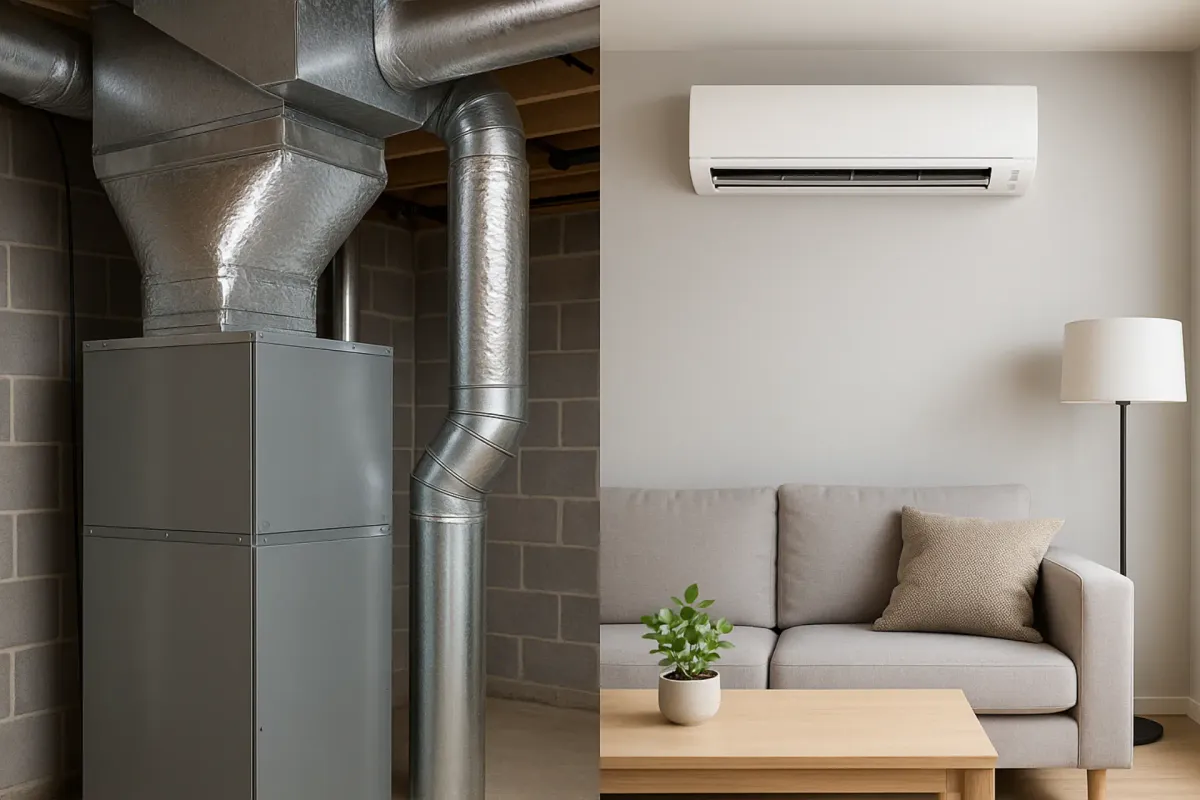
Ducted vs Ductless Heat Pumps: Manual J-Based Comparison by Home Type
Ducted heat pumps use existing ductwork and provide whole-home coverage from a single unit. Ductless mini-splits need no ducts and offer room-by-room control. The right choice depends on your home's existing infrastructure and layout.

Mini-Split Cost 2026: $3,500–$20,000 Installed
A single-zone mini-split costs $3,500–$5,500 installed. A 3-zone system runs $8,500–$13,000, while 5+ zones can reach $20,000. Compare gross planning ranges, quote scope, and current state incentives.
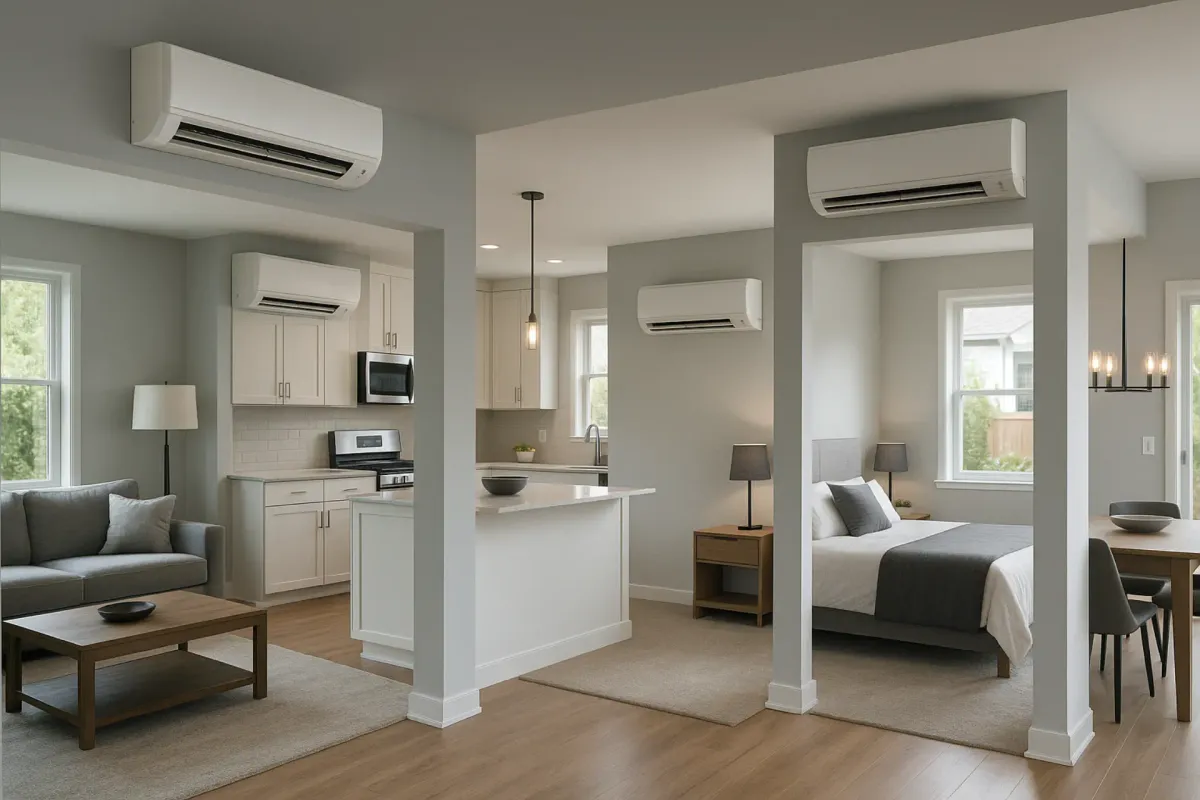
Room-by-Room Comfort: Multi-Zone Ductless Design Mistakes to Avoid
The #1 multi-zone mistake is connecting too few indoor heads to an oversized outdoor unit. This causes short-cycling, poor humidity control, and energy waste. Each indoor head should be matched to the room's actual heating load.