Loading NuWatt Energy...

We use your location to provide localized solar offers and incentives.
We serve MA, NH, CT, RI, ME, VT, NJ, PA, and TX
Loading NuWatt Energy...
NuWatt designs, installs, and manages solar, battery, heat pump, and EV charger systems across 9 states. One company, one warranty, one point of contact.
Get a Free Quote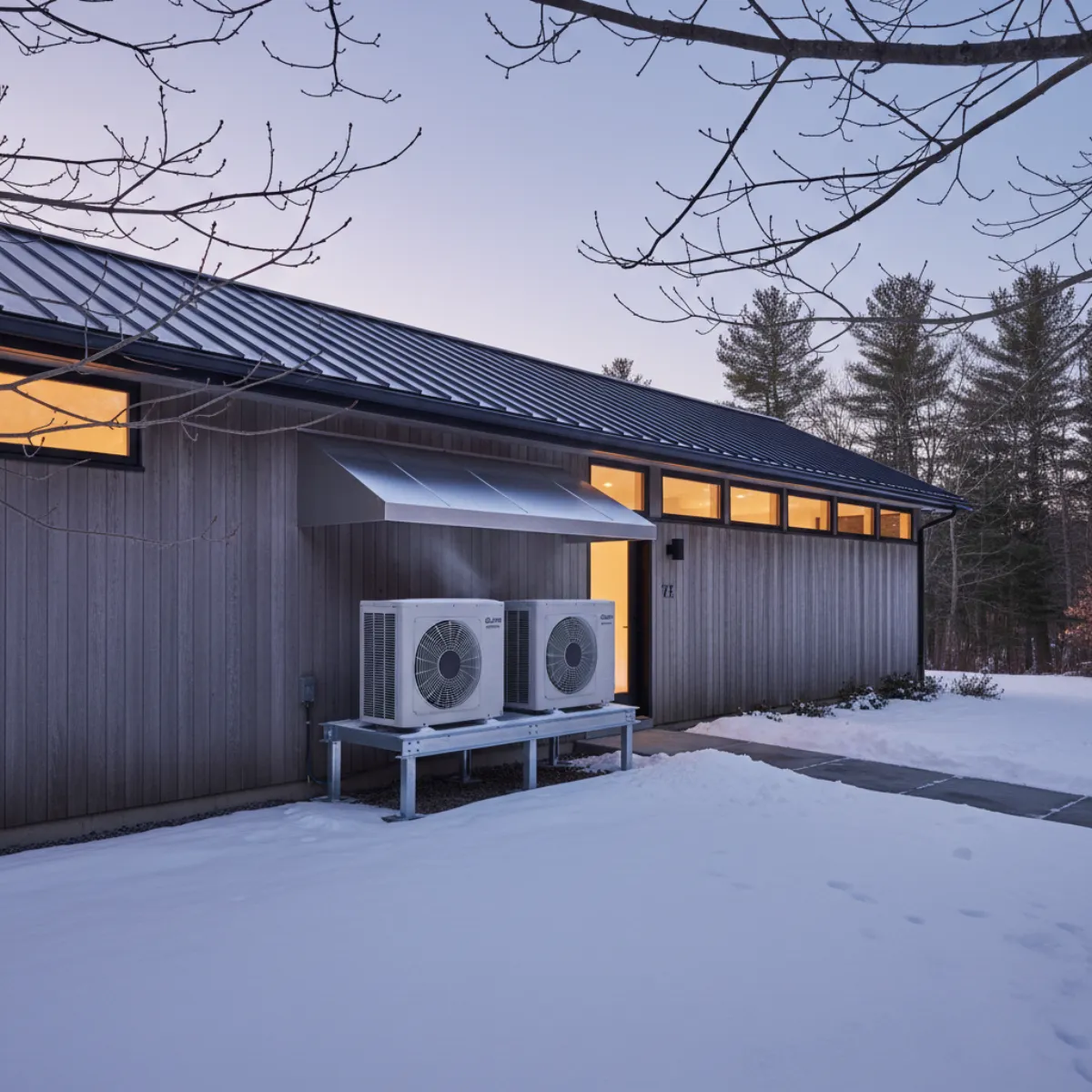
A Lexington home used a 5-zone cold-climate ductless design to reduce gas heating and replace aging AC. The project focused on right-sizing, first-winter backup controls, and Mass Save documentation for a high-efficiency partial electrification path.
A Lexington heat pump design is cold-climate ready when capacity is checked at local winter design temperatures, not just rated at mild conditions. This case used a 3-ton Mitsubishi Hyper-Heat system, 5 zones, Manual J sizing, gas backup controls, and Mass Save pathway planning.
| Category | Project Detail | Why It Matters |
|---|---|---|
| Home type | Renovated colonial, 2,200 sq ft | Sets the envelope, duct, and zoning constraints. |
| Previous heating | Gas furnace and aging central AC | Determines fuel-switching economics and backup strategy. |
| Equipment | Mitsubishi Hyper-Heat ductless system | Cold-climate equipment selection affects winter performance. |
| Capacity and zones | 3 tons, 5 zones | Shows whether the project is room-level or whole-home. |
| Rebate pathway | Partial-home pathway with whole-home planning | Rebate rules vary by state, utility, equipment, and project scope. |
| Cost range | $22,000-$29,000 before rebates | Useful for comparing quote reasonableness. |
| Net cost range | $14,500-$21,500 after standard rebate target | Shows cost after standard rebate target, before final approval. |
| Estimated savings | $1,000-$1,700 | Modeled operating-cost impact, not a guarantee. |
Replacing AC with AC-only equipment would lock in missed heating savings for another decade.
The home had mixed envelope quality, making a single capacity rule unreliable.
Gas backup needed to be available without taking over normal heat pump operation.
Outdoor placement had to preserve landscaping and winter service access.
NuWatt modeled the heating and cooling load room by room and selected a cold-climate ductless system.
Five indoor zones addressed bedrooms, office, and main living areas separately.
Controls were set so the heat pumps operated as primary heat through normal winter conditions.
The design included a first-winter settings review so lockout and comfort could be tuned after real operation.
| Decision | Reason | Field Note |
|---|---|---|
| Avoid AC-only replacement | A heat pump solved cooling and added efficient heating with one equipment change. | Replacement timing is one of the best moments to electrify. |
| Set heat pumps as primary | If backup takes over too early, savings and emissions reductions shrink. | Controls are a core design deliverable. |
| Schedule first-winter review | Real winter behavior can reveal setpoint or backup adjustments. | Post-install review improves outcomes beyond installation day. |
Cold-climate output checked for Lexington.
Bedrooms, office, and living areas.
Heat pump replaced AC-only path.
Depends on approved scope.
Gas reduction plus efficient cooling.
Multi-zone ductless installation.
Room comfort issues, AC replacement timing, and backup requirements.
Manual J, zone plan, equipment selection, and placement.
Outdoor unit, indoor heads, line sets, electrical, and controls.
First-winter settings and backup behavior check.
Final costs, rebates, and savings require a site-specific quote, utility confirmation, equipment selection, home energy assessment, and Mass Save approval.
Often, yes. If AC is already due for replacement, a heat pump can provide both cooling and efficient heating rather than locking into AC-only equipment.
Yes, when cold-climate output is checked against local design temperatures and the system is commissioned correctly.
Yes. Many homeowners keep gas backup during a transition. Controls should be set so the heat pump remains primary during normal winter weather.
It depends on layout and loads. Bedrooms, offices, and main living areas often need separate zones because occupancy and solar gain vary.
Mass Save may require or recommend weatherization based on the home energy assessment. Addressing weatherization improves heat pump performance.