Loading NuWatt Energy...

We use your location to provide localized solar offers and incentives.
We serve MA, NH, CT, RI, ME, VT, NJ, PA, and TX
Loading NuWatt Energy...
NuWatt designs, installs, and manages solar, battery, heat pump, and EV charger systems across 9 states. One company, one warranty, one point of contact.
Get a Free QuoteNo jargon. No sales pitch. Just a clear explanation of how sunlight becomes electricity on your roof—and what it actually costs in 2026.
25-30
Year lifespan
$2.70-3.20
Per watt (2026)
0
Moving parts
Quick Answer
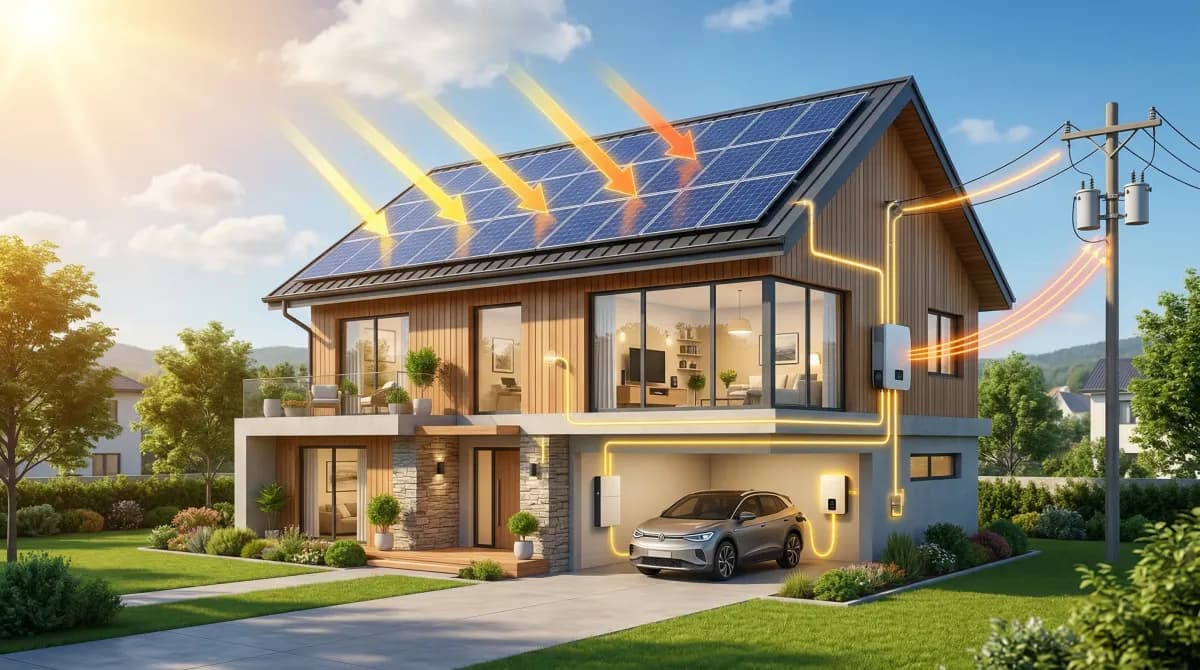
Solar panels work by using photovoltaic cells to convert sunlight into direct current (DC) electricity. An inverter converts that DC power to alternating current (AC) your home can use. Any surplus electricity goes to the grid, and your utility gives you a credit through net metering. A typical home system costs $2.70-$3.20 per watt in 2026, lasts 25-30 years, and requires no fuel or moving parts.
Here is the entire concept of home solar, stripped to its basics:
Step 1
Photons from sunlight knock electrons loose in silicon cells, creating an electrical current.
Step 2
The panels produce DC electricity. An inverter converts it to AC power your home can use.
Step 3
Your home uses the electricity first. Anything left over flows to the grid automatically.
Step 4
Net metering: your meter spins backward when you export. You get a credit on your bill.
That is it. No fuel, no combustion, no noise, no emissions. The sun rises, your panels make electricity, and your utility bill shrinks. The system has no moving parts, which is why solar panels last 25-30 years with almost no maintenance.
Every residential solar installation has the same four building blocks. Understanding these helps you evaluate quotes and ask the right questions.
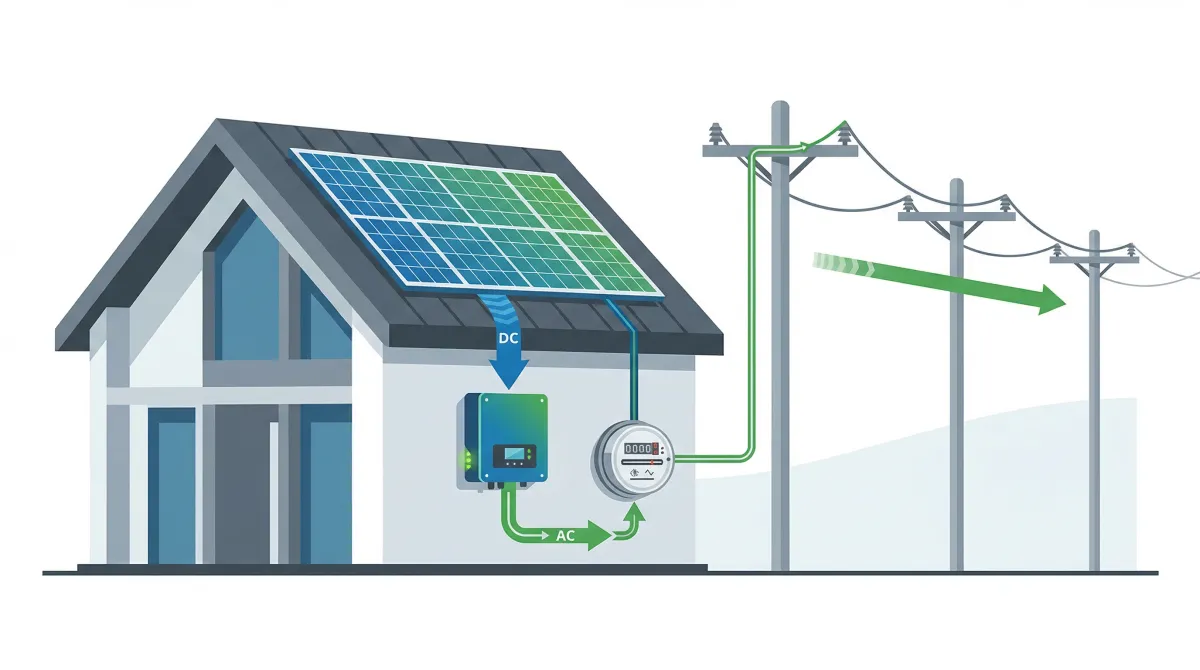
Mounted on your roof (or ground). Each panel contains 60-72 photovoltaic cells that convert sunlight to DC electricity. A typical home system uses 16-24 panels.
Converts DC electricity from the panels to AC electricity your home appliances use. Two types: a single string inverter mounted on a wall, or microinverters (one behind each panel).
A bidirectional meter tracks electricity flowing in both directions -- from the grid to your home AND from your panels to the grid. Your utility installs this.
Your system stays connected to the utility grid. When panels produce more than you use, surplus flows to the grid. When the sun sets, you draw from the grid normally.
A home battery (like Tesla Powerwall) stores surplus solar electricity for use at night or during outages. Batteries add $8,000-$15,000 to the system cost and are not required for most grid-tied installations. If your utility has strong net metering, the grid effectively acts as your battery.
There are three types of solar panels, but in 2026, one dominates the residential market.
| Feature | Monocrystalline | Polycrystalline | Thin-Film |
|---|---|---|---|
| Efficiency | 20-23% | 15-17% | 10-13% |
| Appearance | Black/dark | Blue/speckled | Thin, flexible |
| Cost per watt | $0.30-0.50 | $0.25-0.35 | $0.20-0.30 |
| Best for | Residential rooftops | Budget large-area installs | Commercial flat roofs |
| Market share (2026) | ~90% | ~5% | ~5% |
| Warranty | 25-30 years | 25 years | 10-25 years |
All three of NuWatt's panel options are monocrystalline -- the differences are in wattage, warranty terms, and domestic content eligibility:
Entry Tier
Hyundai 440W
Great efficiency at a lower price point. 25-year warranty.
FEOC Eligible
Silfab 440W
Made in North America. Required for Propel financing. 30-year warranty.
Premium Tier
REC 460W
Highest wattage per panel. Best for space-constrained roofs. 25-year warranty.
Bottom line: unless you have a specific reason to choose otherwise, monocrystalline panels are the standard for residential solar in 2026. The efficiency difference means you need fewer panels to hit the same output, which matters when roof space is limited.
Solar production depends on three factors: how much sun your location gets, your panel efficiency, and how your roof faces. Here is how it breaks down.
"Peak sun hours" is not just daylight hours. It measures the equivalent hours of full-intensity sunlight your panels receive per day, averaged over a year. Higher = more production.
| State | Peak Sun Hours/Day | Annual Production (8 kW system) | Electric Rate |
|---|---|---|---|
| Texas | 5.5 | ~11,700 kWh | $0.12-0.16/kWh |
| New Jersey | 4.4 | ~9,400 kWh | $0.26/kWh |
| Massachusetts | 4.2 | ~9,000 kWh | $0.28+/kWh |
| Connecticut | 4.1 | ~8,700 kWh | $0.27/kWh |
| Rhode Island | 4.0 | ~8,500 kWh | $0.29/kWh |
| New Hampshire | 4.1 | ~8,700 kWh | $0.27/kWh |
| Maine | 4.0 | ~8,500 kWh | $0.27-0.32/kWh |
South-facing roofs produce the most. East and west-facing lose about 15-20%. North-facing roofs are generally not suitable for solar.
Even partial shade from trees or chimneys can reduce output significantly. Microinverters minimize shading losses by optimizing each panel independently.
The ideal roof angle is roughly equal to your latitude (30-45 degrees in the US). Flat roofs work too with tilted racking, but cost slightly more.
Production estimate accuracy matters. NuWatt sizes systems using your actual utility rate and 12 months of energy usage data -- not national averages. This is why our production and payback estimates are typically within 5-10% of your actual first-year results.
Net metering is the billing mechanism that makes residential solar work financially. Without it, you would waste most of your solar production. Here is how it works:
Long sunny days mean your panels produce more than you use. The surplus flows to the grid, and your meter tracks the credits. You are essentially "banking" electricity for later.
Shorter days mean less solar production. You draw more from the grid than your panels produce. But those summer credits offset your winter bill, often bringing your annual net cost close to $0.
Not all states credit you the same rate for exported electricity. This matters a lot for payback:
Want details for your state? See our state-by-state net metering guide.
Here is the honest truth about solar costs in 2026, without sugarcoating the loss of the federal tax credit.
| System Size | Price Range | Federal Tax Credit | Your Net Cost |
|---|---|---|---|
| 6 kW (small home) | $16,200 - $19,200 | $0 (expired) | $16,200 - $19,200 |
| 8 kW (average home) | $21,600 - $25,600 | $0 (expired) | $21,600 - $25,600 |
| 10 kW (large home) | $27,000 - $32,000 | $0 (expired) | $27,000 - $32,000 |
| 12 kW (high usage) | $32,400 - $38,400 | $0 (expired) | $32,400 - $38,400 |
Based on $2.70-$3.20/watt installed price range. Varies by state, roof complexity, and panel tier.
Section 25D, the 30% residential clean energy credit, expired on December 31, 2025. If you buy solar with cash or a loan in 2026, your federal tax credit is $0. If a solar company still quotes a 30% federal credit for a cash or loan purchase, that is a red flag.
The one exception: A Section 48E lease or PPA, where a third-party financing company (not you) owns the system and claims the 30% commercial ITC. July 4, 2026 was the begin-construction safe harbor; new starts still qualify if placed in service by December 31, 2027. Learn about lease/PPA options.
Most solar calculators use national average electricity rates to estimate your payback. That means a homeowner paying $0.28/kWh in Massachusetts gets the same payback estimate as someone paying $0.12/kWh in Texas. Those numbers are useless.
NuWatt's estimates use your actual utility rate, your specific state incentives, and current 2026 pricing -- not outdated national averages. That is why our payback calculations are typically within 5-10% of what you actually experience in year one.
This is one of the most common questions, especially from homeowners in New England. The short answer: yes, and cold weather actually helps.
Panels still produce 10-25% of rated output on cloudy days. Heavy overcast reduces output more, but panels never produce zero during daylight. Annual production estimates already account for your local cloud cover.
Cold improves panel efficiency. Solar panels are semiconductor devices that actually perform better in cooler temperatures. A crisp 35 degree F day with clear sun produces more per hour than a sweltering 95 degree F day.
Melts off tilted panels quickly. Dark panels absorb heat. Snow reflection can boost output on cleared panels.
Reduced production, but rain cleans panels. After rain, expect a slight production bump from cleaner glass.
Modern panels are tested to withstand 1-inch hail at 50+ mph. Hail damage to solar panels is extremely rare.
Germany, which gets less sun than most of the US, is one of the world's top solar-producing countries. Solar works in New England, the Mid-Atlantic, and everywhere in the US. The economics depend on your electricity rate, not your weather. Read our winter solar guide.
Solar panels are remarkably durable. With no moving parts and no consumable components, they quietly produce electricity for decades.
25-30
Years expected lifespan
0.3-0.5%
Annual degradation rate
87-92%
Output after 25 years
Panel production warranty: 25-30 years, guaranteeing 80-84% of original rated output at end of term.
Inverter warranty: 12-15 years for string inverters (may need one replacement over system life), 25+ years for Enphase microinverters.
Workmanship warranty: NuWatt includes a 25-year workmanship warranty covering roof penetrations, wiring, and installation defects.
Learn more about panel longevity: Solar Panel Lifespan: What to Expect After 25 Years
Honest answer: it depends on your electricity rate. In some states, absolutely yes. In others, the math is tighter. Here is a realistic breakdown.
The takeaway: solar is still a strong investment in high-rate states with state-level incentives, even without the federal credit. In lower-rate states, it is a long-term play -- you will still save money over the panel's 25-30 year life, but it takes longer to recoup the upfront cost.
Detailed analysis: Is Solar Worth It Without the Tax Credit in 2026?
You do not need to commit to anything. Start by understanding your specific situation.
See what solar would cost for your specific home, with estimates based on your actual utility rate.
Start hereDetailed pricing data for your state, including available incentives and realistic payback timelines.
View pricingStep-by-step walkthrough of what happens from consultation to activation (6-12 weeks typical).
See the stepsLearn more about solar in your state:
Solar panels contain photovoltaic (PV) cells made from silicon. When sunlight hits these cells, it knocks electrons loose from silicon atoms, creating an electrical current. This is called the photovoltaic effect. The direct current (DC) electricity flows to an inverter, which converts it to alternating current (AC) that your home uses. No moving parts, no combustion, no noise.
Yes. Solar panels produce electricity from daylight, not direct sunlight alone. On a cloudy day, panels still generate 10-25% of their rated output. Heavy overcast or rain reduces production further, but panels never drop to zero during daylight hours. Over a full year, weather is already factored into production estimates for your location.
Yes, and cold weather actually improves panel efficiency. Solar panels are electronic devices that perform better in cooler temperatures. A 35 degree F day with clear sun can produce more electricity per hour than a 95 degree F day. Snow slides off tilted panels quickly, and the reflection off surrounding snow can boost production. Winter days are shorter, but spring and summer more than compensate.
Modern solar panels last 25-30 years with minimal maintenance. They degrade at roughly 0.3-0.5% per year, meaning after 25 years a panel still produces about 87-92% of its original output. The inverter typically lasts 12-15 years for string inverters or 25+ years for microinverters. Most manufacturers offer 25-year production warranties guaranteeing at least 80-84% output.
No. The residential solar tax credit (Section 25D) expired on December 31, 2025. Homeowners who buy solar with cash or a loan in 2026 receive zero federal tax credit. The only federal incentive path is a Section 48E lease or PPA, where a third-party financing company owns the system and claims the 30% commercial ITC. July 4, 2026 was the begin-construction safe harbor for that option; new starts still qualify if placed in service by December 31, 2027.
As of March 2026, residential solar costs $2.70-$3.20 per watt installed, depending on your state, roof complexity, and equipment tier. A typical 8 kW system runs $21,600-$25,600 before state incentives. States like MA, CT, NJ, and RI still offer state-level programs (SMART, ADI, REG, net metering) that offset costs. Without the federal tax credit, payback periods are 8-15 years depending on your electricity rate.
Net metering is a billing arrangement where your utility gives you credit for surplus electricity your panels send to the grid. In summer, when your panels overproduce, you bank credits. In winter, when production drops, you use those credits to offset your bill. The credit rate varies by state: some offer full retail credit (1:1), others offer 80-a utility-specific share of retail value. Net metering is the single biggest factor in solar payback.
There are three main types: monocrystalline (most common, 20-23% efficient, black appearance), polycrystalline (older tech, 15-17% efficient, blue appearance, rarely installed today), and thin-film (flexible, lightweight, 10-13% efficient, used mainly on commercial/industrial flat roofs). For residential rooftops, monocrystalline panels are the standard choice in 2026, offering the best efficiency per square foot.
The number depends on your electricity usage and panel wattage. Divide your annual kWh usage by your local sun hours and panel output. For example, a home using 10,000 kWh/year in Massachusetts (4.2 peak sun hours) with 440W panels needs roughly 16-18 panels. A home in Texas using 15,000 kWh/year (5.5 peak sun hours) with the same panels needs about 18-20 panels.
Not necessarily. Most residential solar systems are grid-tied without a battery. Batteries add $8,000-$15,000 and make sense if you experience frequent power outages, want energy independence, or your utility has unfavorable time-of-use rates. In states with strong net metering (MA, NJ, ME), the grid effectively acts as your battery. In states where net metering is weakening, batteries become more valuable.
Yes, in states with high electricity rates and strong state incentives. In MA ($0.28+/kWh), CT ($0.27/kWh), RI ($0.29/kWh), and NJ ($0.26/kWh), solar still pays back in 8-12 years. In states with lower rates (under $0.15/kWh), payback stretches to 15+ years and the economics are weaker. The key factor is your utility rate, not federal incentives.
A properly sized solar system can offset 100% or more of your annual electricity usage. However, solar produces during the day and your home uses electricity around the clock. With net metering, your utility balances this for you -- you export surplus during the day and import at night, with credits offsetting the imports. Without a battery, solar cannot power your home during a grid outage.
This guide was written by NuWatt Energy's editorial team and reviewed by a NABCEP-certified solar professional. All pricing and incentive data is current as of March 2026. We update this page regularly as state programs and market conditions change.