Loading NuWatt Energy...

We use your location to provide localized solar offers and incentives.
We serve MA, NH, CT, RI, ME, VT, NJ, PA, and TX
Loading NuWatt Energy...
NuWatt designs, installs, and manages solar, battery, heat pump, and EV charger systems across 9 states. One company, one warranty, one point of contact.
Get a Free Quote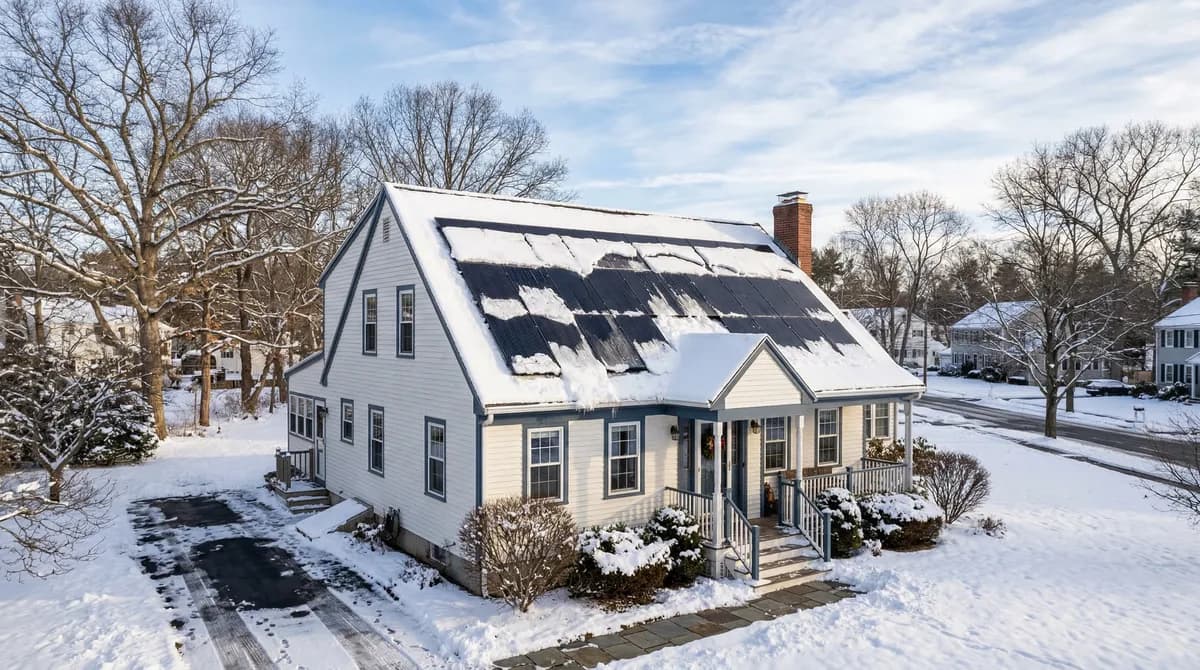
Yes, solar panels work in winter. Cold temperatures actually boost efficiency. Snow causes 10-15% annual production loss in New England, but net metering banks summer credits for winter use. Here is the complete data.
Quick Answer
Yes, solar panels work in winter and cold temperatures actually improve their efficiency by 5-10%. In New England, snow causes 10-15% annual production loss, but panels on pitched roofs self-clear within 1-2 days. Net metering banks excess summer credits to cover winter shortfalls, so your annual bill stays near zero even with shorter winter days.
Cold temperatures boost panel efficiency by 5-10% vs hot summer days
Snow causes 10-15% annual production loss in New England — already factored into installer estimates
Panels self-clear on pitched roofs (25+ degrees) within 1-2 days — no need to remove snow manually
Net metering banks summer overproduction credits to cover winter months
December-January production is 50-65% lower than June-July due to shorter days, not cold
Solar panels can actually reduce ice dams by moderating roof temperature
The most common misconception about solar energy is that panels stop working in winter. In reality, solar panels are semiconductor devices that convert light into electricity, and they work in any temperature where sunlight reaches them. What changes in winter is the amountof sunlight available — not the panels' ability to convert it.
In fact, cold weather is beneficial for solar panel performance. Every solar panel has a temperature coefficient — typically -0.3% to -0.4% per degree Celsius above 25 degrees C (77 degrees F). This means that for every degree the panel cools below the standard test temperature, it produces more electricity than its rated output.
A clear, cold winter day in New England can produce higher per-hour output than a hazy summer afternoon. The trade-off is simply fewer hours of daylight: Boston gets about 9.1 hours of daylight on the winter solstice versus 15.3 hours on the summer solstice.
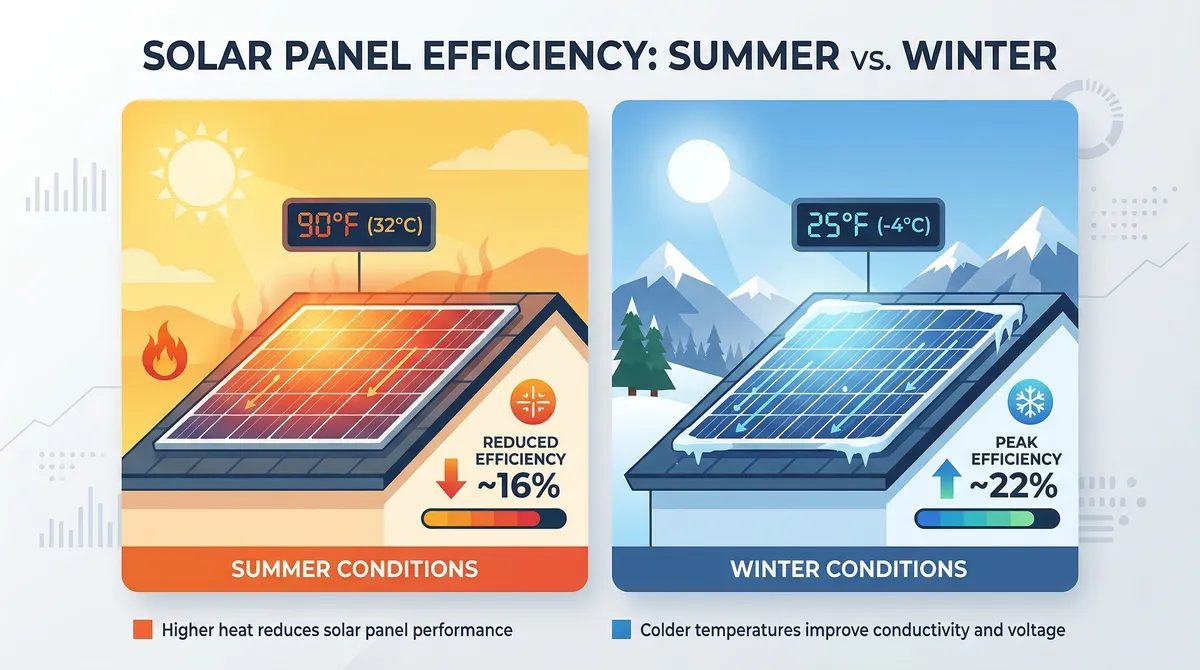
Cold weather improves panel voltage and efficiency. A 440W panel can produce 460-484W on cold winter days.
Snow is the most visible winter concern, but the actual production impact is more modest than most people expect. Research from multiple studies, including work at Northern Vermont and University of Michigan, shows that annual production losses from snow in northern climates range from 5% to 15%, depending on:
Steeper roofs (30-40 deg) shed snow faster. Most NE homes are 25-35 deg — ideal.
Dark-frame/all-black panels absorb more heat, clearing snow 20-30% faster than silver-frame panels.
Light, dry powder slides off quickly. Wet, heavy snow takes longer but still clears within 1-3 days.
South-facing panels with full sun exposure clear fastest. North-facing or shaded panels retain snow longer.
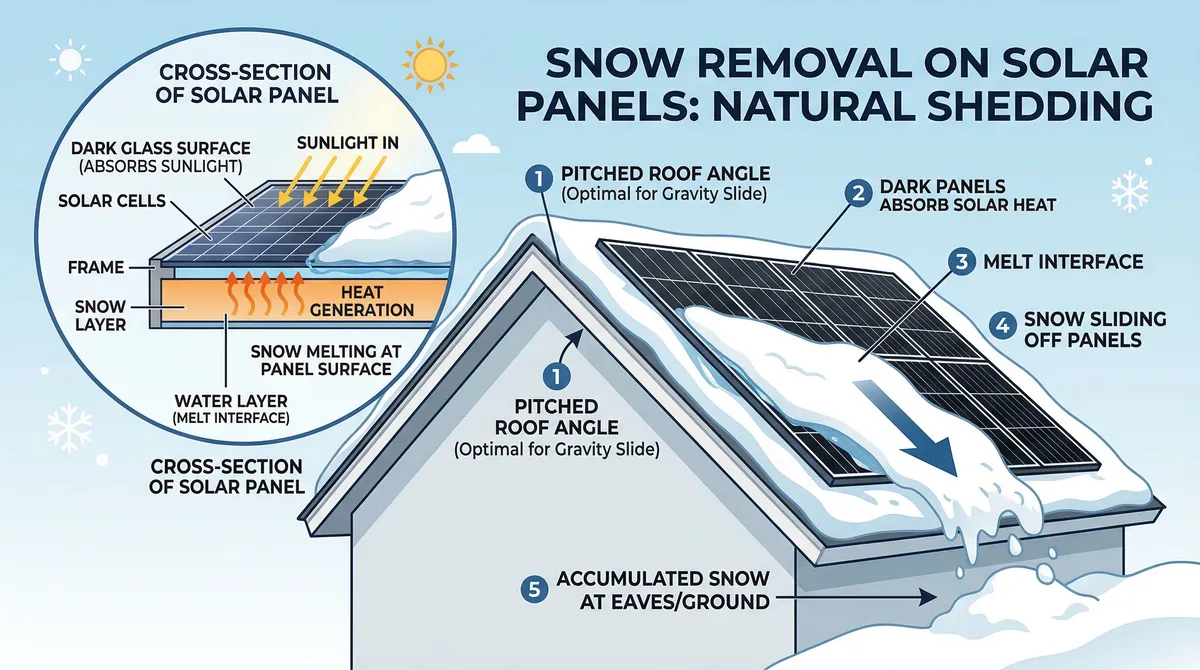
Solar panels self-clear: dark glass absorbs sunlight, melts the snow-panel interface, and gravity pulls snow downward on pitched roofs.
The biggest driver of lower winter production is not snow or cold — it is simply fewer hours of daylight. In Boston, the winter solstice delivers only 9.1 hours of daylight compared to 15.3 hours on the summer solstice. Combined with a lower sun angle (which means sunlight passes through more atmosphere and arrives at a less direct angle), December production is typically 30-35% of peak June production.
This is completely normal and expected. A properly designed solar system accounts for this seasonal variation. Your installer should show you a month-by-month production estimate — if they only quote annual totals, ask for the monthly breakdown.
Net metering is the mechanism that makes solar work financially despite seasonal production swings. Here is how it functions as winter insurance:
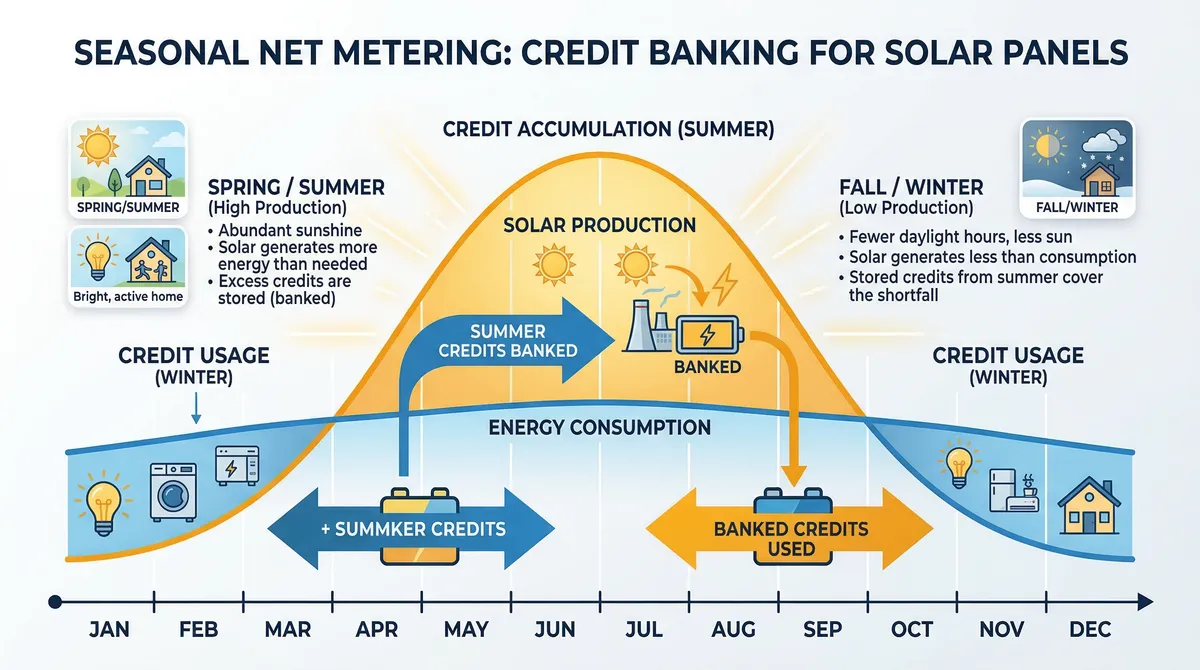
Net metering banks summer surplus credits to cover winter production shortfalls, keeping your annual electricity cost near zero.
Important: Net metering policies vary by state. Massachusetts and Maine offer full 1:1 retail credits. Rhode Island reduced to 80% for new systems after April 2023. New Hampshire credits at a utility-specific share of retail value. See our full net metering state-by-state guide for current rates.
Winter solar performance varies across New England based on snowfall, latitude, and net metering policy. Here is how each state stacks up for winter solar viability:
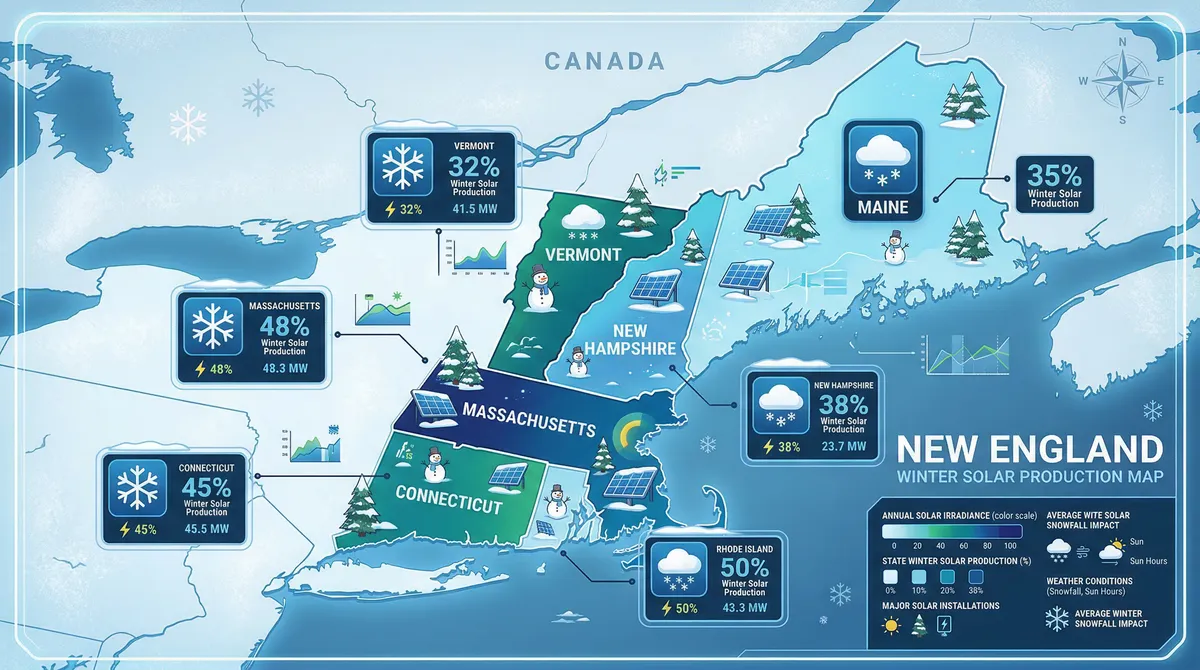
| State | Avg Snowfall | Snow Loss | Winter vs Peak | Net Metering | Electric Rate |
|---|---|---|---|---|---|
| Massachusetts | 48 inches | 10-12% | 55-65% | 1:1 retail rate | $0.28-0.32/kWh |
| Connecticut | 40 inches | 8-10% | 58-68% | 1:1 retail rate | $0.27-0.28/kWh |
| Rhode Island | 35 inches | 8-10% | 58-68% | tariff-specific renewable credit (post-2023) | $0.29/kWh |
| New Hampshire | 60 inches | 12-15% | 50-60% | utility-specific component credit (NEM 2.0) | $0.25-0.27/kWh |
| Maine | 65 inches | 12-15% | 48-58% | 1:1 retail (rooftop) | $0.27-0.32/kWh |
| Vermont | 70 inches | 13-16% | 45-55% | 1:1 retail (residential) | $0.21-0.23/kWh |
Massachusetts and Connecticut have the highest electric rates, 1:1 net metering, and moderate snowfall — making winter solar credits most valuable.
MA solar guideMaine and New Hampshire get the most snow, but high electric rates ($0.27-0.32/kWh) and strong net metering still make solar pay off in 9-15 years.
ME solar guideVermont has the most snowfall and the lowest electric rates in NE ($0.21-0.23/kWh), making the financial case weaker. Still viable with 1:1 net metering.
VT coverage coming soonThe short answer is usually no. Here is why the risks typically outweigh the small production gain:
Math check: A 8 kW system in Massachusetts produces about $4.50-5.50 per day in winter (at $0.30/kWh). Losing 2 days to snow costs $9-11. Damaging a panel could cost $300-600 to replace, plus labor. Voiding a warranty could cost thousands. The economics strongly favor letting panels self-clear.
Ice dams are a major concern for New England homeowners. They form when heat escapes through the roof, melting snow from below. The meltwater runs down to the cold eaves (the roof edge extending past the exterior wall) and refreezes, creating a dam that traps water and causes leaks.
Solar panels can actually reduce ice dam formation. Here is why:
Panels create an air gap between the roof and snow, reducing heat transfer from the attic to the snow layer. This minimizes the uneven melting that causes ice dams.
The panel-covered area has more uniform temperature than exposed roof sections, reducing the temperature differential between the ridge and eaves that drives ice dam formation.
The smooth glass surface and dark color of panels cause snow to slide off before it can melt and refreeze at the eaves. Snow exits the roof surface entirely rather than melting in place.
Note: Solar panels are not a cure-all for ice dams. If your home has poor attic insulation or ventilation, addressing those issues should come first. A home energy audit can identify insulation gaps. If you are planning solar and have ice dam issues, mention it to your installer — panel placement can be optimized to help.
If you live in an area with exceptionally heavy snowfall (northern NH, VT, or inland ME) or your roof pitch is less than 20 degrees, a ground-mount system can offer real advantages for winter performance:
| Factor | Roof-Mount | Ground-Mount |
|---|---|---|
| Tilt angle | Fixed to roof pitch (typically 25-35 deg) | Adjustable 35-45 deg for optimal snow shedding |
| Snow access | Dangerous to reach on icy roof | Accessible from ground level if needed |
| Cost | $2.80-3.20/W | $3.00-3.60/W (+$0.20-0.40/W) |
| Space needed | Uses existing roof | Requires ~400 sq ft per 5 kW |
| Snow clearance | Self-clears 1-2 days on pitched roofs | Self-clears faster at steeper tilt |
| Annual production | Baseline | +3-8% (optimal angle, no shading) |
Bottom line: Ground-mount is worth the extra $0.20-0.40/W if your roof pitch is less than 20 degrees, your roof gets significant shading, or you have adequate yard space. For most New England homes with standard-pitch roofs (25-35 degrees), roof-mount is the more cost-effective choice.
If your home has multiple roof planes, installers can prioritize the steeper south-facing section for better snow shedding and winter sun angle optimization.
All-black panels (dark frames and backsheets) absorb slightly more heat than silver-framed panels, helping snow melt and slide off 20-30% faster.
Deciduous trees that lose leaves in winter still cast shadows from branches. Trimming overhanging branches improves winter sun exposure — even a 5% shading reduction adds up over 4-5 winter months.
Use your solar monitoring app (Enphase, SolarEdge, or Hoymiles) to track daily production. If output drops to zero for more than 3-4 days and you can safely access your panels, it may be worth gentle clearing.
Run pool pumps, charge EVs during peak solar hours, and schedule high-energy tasks during summer to bank maximum net metering credits before winter.
Winter storms cause the most outages in New England. A battery provides backup during multi-day outages when solar alone cannot power your home overnight.
A good installer sizes your system to offset 100-110% of your annual electricity use. Do not oversize to compensate for winter — net metering handles the seasonal balance.
As of March 2026, the residential solar Investment Tax Credit (Section 25D) has expired. Homeowners who purchase solar panels outright receive zero federal tax credit. This changes the economics but does not change the physics of winter solar production.
The key insight: winter production loss is already factored into these payback calculations. When an installer quotes “9,600 kWh annual production,” that number already accounts for shorter winter days and snow losses. You do not need to add an extra winter penalty on top of published estimates.
Full cost-benefit analysis without the federal tax credit
State-by-state policy updates and credit rates
Current pricing for MA, CT, RI, NH, ME, and more
Battery payback math with ConnectedSolutions
How to finance solar after the ITC expired
25-30 year warranty and degradation rates
SMART program, net metering, and state incentives
Efficiency Maine, net billing, and CMP/Versant rates
NEM 2.0, community power, and utility rates
Our production models include month-by-month estimates with snow loss already factored in. See exactly what your system will produce in every season — including the coldest months.