Loading NuWatt Energy...

We use your location to provide localized solar offers and incentives.
We serve MA, NH, CT, RI, ME, VT, NJ, PA, and TX
Loading NuWatt Energy...
NuWatt designs, installs, and manages solar, battery, heat pump, and EV charger systems across 9 states. One company, one warranty, one point of contact.
Get a Free QuoteMaine's dramatic seasonal swings — from 15+ hours of summer daylight to 9 hours in December — make solar monitoring essential. Know exactly how your panels perform, detect snow coverage, track net metering credits with CMP or Versant, and catch issues before they cost you money.
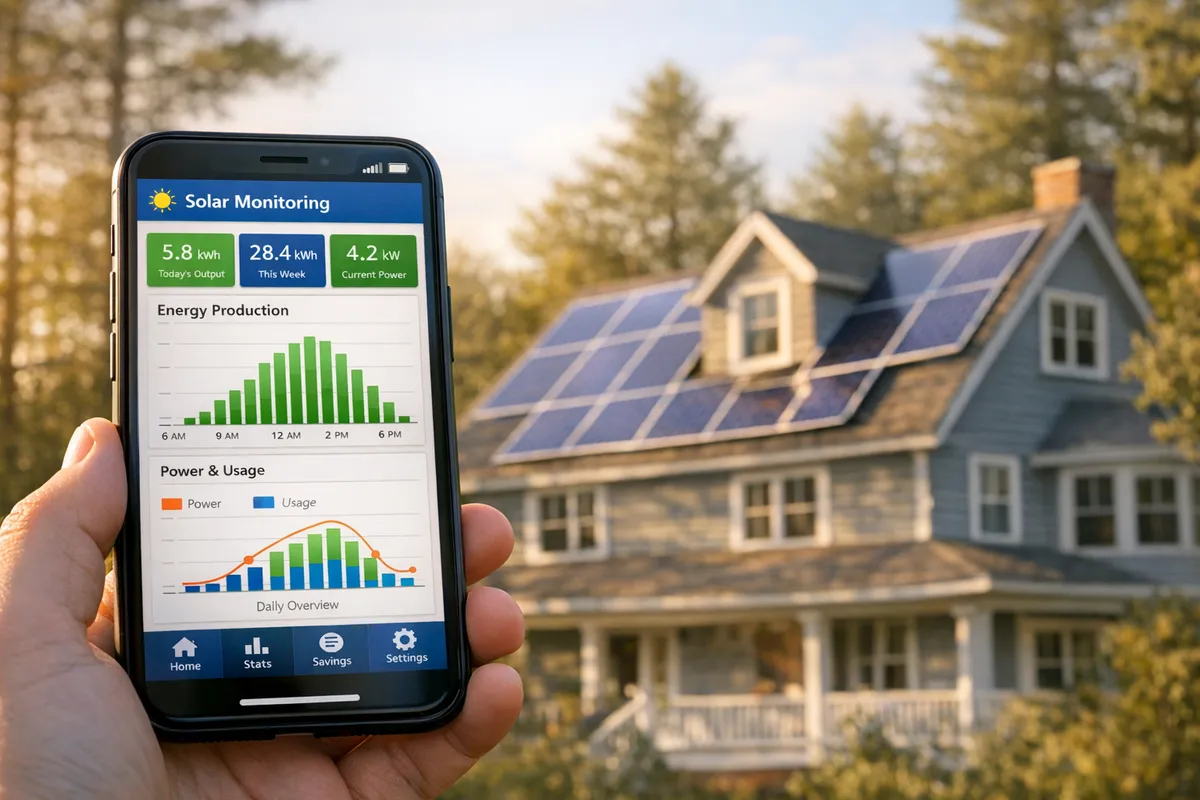
In sunny states like Arizona, solar panels produce consistently day after day. Maine is different. Snow, ice, dramatic seasonal daylight changes, coastal fog, and nor'easters all affect production. Monitoring helps you understand what is normal for Maine and catch real problems before they become expensive.
Panel-level monitoring shows which panels are snow-covered and which are producing. One snowy panel drags down production on string systems — microinverter monitoring catches this.
December-January production is 60-70% lower than summer. Your monitoring app helps you understand what is normal vs. what indicates a problem during short winter days.
Maine's Net Energy Billing gives you 1:1 credits. Track summer overproduction to build credits for winter deficit months. Compare app data against CMP or Versant bills.
After nor'easters, ice storms, or high winds, check your app immediately. A sudden production drop on clear days signals physical damage or inverter failure.
Monitoring apps alert you to inverter failures or communication issues. Catching a failed microinverter early prevents weeks of lost production.
Compare this January to last January. Panel degradation (0.25-0.
Your monitoring app is determined by your inverter hardware. Here is how the three major platforms compare for Maine homeowners.
| Feature | Enphase Enlighten | SolarEdge | Tesla |
|---|---|---|---|
| Panel-level monitoring | Yes | Yes (with optimizers) | No |
| Snow detection | Excellent | Good | Limited |
| Free app | Yes | Yes | Yes |
| Real-time updates | 15-min intervals | 15-min intervals | 5-min intervals |
| Battery integration | IQ Battery | Home Battery | Powerwall (best) |
| Maine installer support | Excellent (70%+) | Limited | Very limited |
| App Store rating | 4.5/5 | 4.3/5 | 4.2/5 |
| Fault alerts | Per-panel | Per-panel | System-level only |
| Storm Watch | No | No | Yes (Powerwall) |
| Consumption tracking | With CT clamps ($) | With meter ($) | Built-in |
Enphase Energy | Most common in ME | 4.5/5 (App Store)
Maine Note: Enphase microinverters are the dominant choice in Maine residential solar. Roughly 70%+ of new installations use Enphase. Panel-level monitoring is especially valuable here because Maine snow can partially cover a roof, and you can see exactly which panels are producing and which are buried.
SolarEdge Technologies | Less common in ME | 4.3/5 (App Store)
Maine Note: SolarEdge is more common in commercial installations in Maine. Some residential installers offer it, but Enphase dominates the Maine residential market. If your installer uses SolarEdge, the monitoring is solid — but verify local service availability.
Tesla Energy | Rare in ME | 4.2/5 (App Store)
Maine Note: Tesla solar installations are uncommon in Maine due to limited installer presence. The app is excellent if you have a Powerwall for storm backup (valuable during Maine ice storms), but the lack of panel-level monitoring is a significant disadvantage for snow detection.
Your solar monitoring app tracks production. Your utility tracks net metering credits. Understanding how CMP and Versant handle solar billing helps you reconcile the two data sources.
~70% of Maine customers
~30% of Maine customers (Bangor area + northern)
Your solar app shows gross production (total kWh generated). Your utility bill shows net consumption (what you pulled from the grid minus what you exported). These numbers will not match because:
What to look for in your solar monitoring app throughout Maine's dramatic four-season cycle.
15-30% of annual production
25-30% of annual production
35-40% of annual production
15-25% of annual production
Common monitoring scenarios and what to do about them.
Likely cause: Inverter or gateway communication failure
Action: Check your home WiFi, then check the inverter/gateway for error lights. Restart the gateway if no lights. Call installer if the issue persists 24+ hours.
Likely cause: Individual microinverter failure or panel damage
Action: Normal with Enphase — one micro can fail without affecting others. Schedule a service call, but the rest of your system keeps producing.
Likely cause: Snow accumulation on upper panels
Action: This is normal in Maine winter. Snow melts from bottom up as heat radiates through panels. Let it melt naturally — do not climb on the roof.
Likely cause: Partial shading from new tree growth or dirty panels
Action: Check for tree branches that have grown into the solar array's sun path. Clean panels if visibly dirty. Compare against same month last year.
Likely cause: WiFi/internet outage at home or gateway power loss
Action: Check your internet connection. The Enphase IQ gateway needs WiFi. If internet is fine, check gateway power supply. System still produces power when offline — it just cannot report data.
Likely cause: Circuit breaker tripped or grid disconnect
Action: Check your solar breaker in the main panel. Also check the rapid shutdown switch and AC disconnect. If breakers are fine, call your installer.
Beyond your inverter's built-in monitoring, these optional tools can provide additional insights for Maine homeowners.
$299 + free app
Clamps onto your electrical panel to track whole-home consumption by device. Shows exactly how much solar you self-consume vs. export. Identifies energy hogs.
Best for: Understanding self-consumption patterns and optimizing when to run appliances.
$150-200 + free app
Budget-friendly energy monitor with per-circuit tracking. Solar production + consumption in one app. 16-circuit monitoring available.
Best for: Cost-conscious homeowners wanting both production and consumption data in one place.
$180 + $6/month
Dedicated solar monitoring add-on that compares your actual production against expected production using local weather data. Flags underperformance automatically.
Best for: Data enthusiasts who want weather-adjusted performance tracking and proactive fault detection.
Enphase Enlighten is the most popular choice in Maine because Enphase microinverters dominate the residential market here. It offers panel-level monitoring, which is especially valuable in Maine where snow can cover individual panels unevenly. SolarEdge MySolarEdge and Tesla are also excellent but less common in Maine residential installations.
Yes. Solar monitoring apps work year-round regardless of weather. In fact, winter monitoring is especially important in Maine. You can track daily production during the shortest days (December-January, when Portland gets only 9 hours of daylight), watch for snow-covered panels reducing output, and verify that panels are producing again after snow melts or slides off.
Most solar monitoring apps show your production (kWh generated) but not your utility credits directly. To track net metering credits, compare your app's monthly production data against your CMP or Versant bill. CMP and Versant both show net metering credits as a line item on your bill. Some third-party apps like Sense or Emporia can track both production and consumption to give you a complete picture.
CMP and Versant do not provide solar monitoring apps. They provide billing portals where you can view your net metering credits and consumption data, but they cannot track your solar production in real time. Your solar monitoring app (Enphase, SolarEdge, or Tesla) handles the production side, while your utility bill shows the net metering math.
Maine solar systems produce roughly 60-70% less in December-January compared to June-July. A typical 9 kW system in Portland produces 25-35 kWh/day in summer but only 8-15 kWh/day in December. Your monitoring app will show these seasonal patterns. The annual average is about 1,100-1,200 kWh/kW/year for southern Maine.
First, check for obvious causes: snow covering panels, heavy cloud cover, or nighttime. If panels are clear and it is daytime with some sunlight, check your inverter status in the app. A red alert or offline status usually means a hardware issue. For Enphase systems, individual microinverter failures show as one dark panel while others produce normally. Contact your installer if an inverter shows offline for more than 24 hours during clear weather.
Yes. Panel-level monitoring (Enphase and SolarEdge optimizers) will show which specific panels are producing and which are not. If your bottom row panels show production but top rows show zero, snow has likely accumulated on the upper panels. Most Maine installers recommend letting snow melt naturally rather than climbing on the roof to clear it.
Basic monitoring is free with all major platforms. Enphase Enlighten, SolarEdge MySolarEdge, and Tesla all provide free apps with production tracking, alerts, and historical data. Some platforms offer premium tiers ($10-15/month) with additional features like detailed consumption monitoring, battery optimization, or advanced analytics, but these are optional.
Every NuWatt solar installation includes professional monitoring setup. Track your production, net metering credits, and system health from day one.