Loading NuWatt Energy...

We use your location to provide localized solar offers and incentives.
We serve MA, NH, CT, RI, ME, VT, NJ, PA, and TX
Loading NuWatt Energy...
NuWatt designs, installs, and manages solar, battery, heat pump, and EV charger systems across 9 states. One company, one warranty, one point of contact.
Get a Free Quote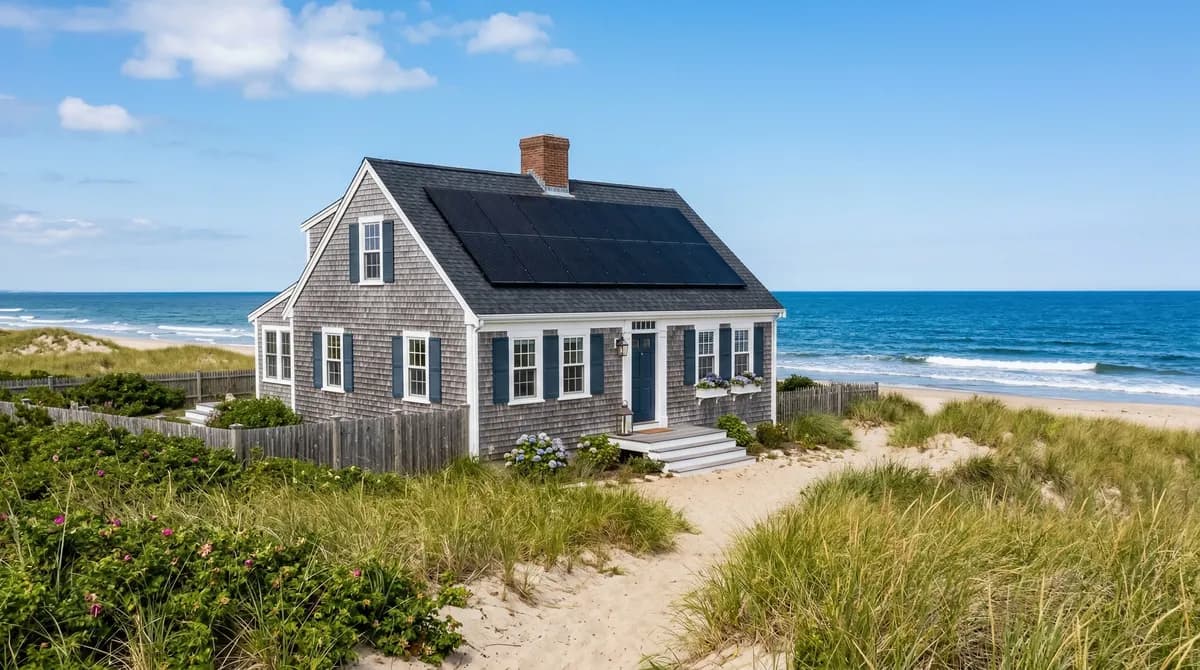
Cape Cod solar is different from the rest of Massachusetts. Salt air corrosion, high winds, historic districts, seasonal homes, and Cape Light Compact billing all require an installer who knows the Cape. Here is what to look for.
Choose a Cape Cod installer with 6 capabilities:marine-grade hardware (316 stainless steel racking), Cape Light Compact billing knowledge, historic commission experience (especially Old King's Highway District), wind engineering for 130-140 mph gusts, SMART 3.0 enrollment, and remote monitoring for seasonal homes. Cape solar costs slightly more ($2.80-$3.40/W vs. $2.60-$3.20/W inland) due to marine-grade hardware, but payback is still 7-9 years with SMART, net metering, and tax exemptions.
Cape Cod homes are exposed to salt-laden ocean air that accelerates corrosion of standard aluminum and steel racking hardware. A Cape-experienced installer uses marine-grade stainless steel or anodized aluminum racking with sealed connections. Standard hardware can show corrosion within 3-5 years; marine-grade racking lasts the full 25-year panel warranty.
Solution: Require marine-grade (316 stainless steel) racking and hardware. All-black panels with anodized frames resist salt better.
Cape Cod experiences sustained winds of 20-30 mph and hurricane-force gusts during nor'easters. Solar racking must be engineered for wind loads exceeding standard inland requirements. Your installer should provide stamped engineering drawings showing wind load calculations specific to your location and roof geometry.
Solution: Require IBC 2021 wind-speed compliance. Cape Cod falls in 130-140 mph 3-second gust zones. Fewer panels per row with wider spacing reduces uplift.
Many Cape Cod towns have Historic District Commissions or Old King's Highway Regional Historic District (Route 6A corridor). These commissions review exterior changes including solar panels. Some require rear-facing only or ground-mount alternatives. The Old King's Highway District covers Sandwich, Barnstable, Yarmouth, Dennis, Brewster, and Orleans.
Solution: All-black panels (REC, Silfab) blend with dark roofs. Ground-mount systems bypass most historic restrictions. Work with an installer who has presented to Cape Cod historic commissions.
Many Cape Cod homes are occupied seasonally (May-October). Solar still works because net metering credits accumulate during unoccupied months and offset bills when you return. SMART payments continue year-round regardless of occupancy. Your monitoring system works remotely via phone app.
Solution: Net metering credits bank for up to 12 months. Size system to offset full annual usage. Remote monitoring handles seasonal absence.
Cape Cod is served by Cape Light Compact, not Eversource or National Grid. Cape Light Compact is a municipal aggregator that buys power on behalf of 21 Cape and Vineyard towns through Eversource's distribution network. Interconnection goes through Eversource, but supply pricing and some programs differ.
Solution: Your installer must understand Cape Light Compact vs Eversource billing. Net metering credits apply to the distribution portion (Eversource), not the supply portion (CLC).
Cape Cod lots tend to be smaller than suburban MA, and pitch pine/scrub oak forests create shading challenges. Some homes have Cape Cod-style roofs with limited south-facing area. A good installer uses detailed shade analysis (drone or satellite with Lidar) to optimize panel placement.
Solution: Microinverters (Enphase) outperform string inverters in partial shade. Ground-mount systems can be placed in open yard areas. Tree trimming may be needed.
Standard racking corrodes in 3-5 years in salt air. Cape-experienced installers use 316 stainless steel bolts, anodized aluminum rails, and sealed wire connections as standard practice — not as an upsell.
Ask: "What racking material do you use for coastal installations?"
Cape Light Compact is a municipal aggregator using Eversource distribution. Not every installer understands the dual-billing structure. Your installer should know how net metering credits apply to the Eversource distribution charges and how CLC supply pricing affects your savings calculation.
Ask: "How does net metering work with Cape Light Compact vs standard Eversource?"
If your home is in the Old King's Highway District or a local historic district, your installer needs to know the approval process, panel aesthetics requirements, and how to present to the commission. An installer who has never worked in a Cape Cod historic district will cost you weeks of delays.
Ask: "Have you installed solar in [your town] historic district before?"
Cape Cod wind loads are significantly higher than inland MA. Your installer should provide stamped engineering drawings showing compliance with local wind speed requirements (130-140 mph 3-second gust). This is not optional — it is a code requirement.
Ask: "Can you provide stamped engineering for Cape Cod wind loads?"
SMART pays $0.03/kWh for 20 years — essential for Cape Cod solar economics. Some installers skip SMART enrollment because it requires additional paperwork. This costs you $300-$400/year for 20 years ($6,000-$8,000 total).
Ask: "Do you handle SMART enrollment as part of every project?"
If your Cape home is seasonal, you need remote monitoring to track system performance while you are away. Your installer should set up monitoring (Enphase, SolarEdge, or Tesla app) and show you how to check production remotely.
Ask: "How will I monitor my system when I am not on the Cape?"
Town of Barnstable has historic commission + Old King's Highway. Hyannis area is less restricted. Mix of year-round and seasonal.
Active historic district. Good solar potential. Year-round population. Woods Hole area has research/institutional installs.
Old King's Highway District covers Route 6A corridor. South-side locations have fewer restrictions. Canal area has good wind exposure.
Strict historic rules in village center. Coastal exposure = marine-grade racking essential. High property values = strong solar ROI.
Historic district covers most of town. Limited roof space on many properties. Ground-mount may be best option where space allows.
Fewer historic restrictions. Newer construction. Good residential solar potential. Mashpee Commons area has commercial opportunities.
Old King's Highway coverage (Brewster). Orleans less restricted. Outer Cape has excellent sun exposure. Popular seasonal home area.
Outer Cape — excellent sun exposure but high wind loads. Small lots. Many seasonal homes. National Seashore regulations may apply nearby.
The best Cape Cod solar company has marine-grade hardware experience, Cape Light Compact billing knowledge, historic district approval experience, and wind engineering capability. They should handle SMART 3.0 enrollment and provide remote monitoring for seasonal homes. NuWatt serves all of Cape Cod with installers experienced in coastal installations, Old King's Highway District approvals, and Cape Light Compact interconnection.
Solar panels themselves are sealed and salt-resistant. The risk is to the racking hardware — standard aluminum and steel bolts can corrode in salt air within 3-5 years. A Cape-experienced installer uses 316 stainless steel fasteners, anodized aluminum rails, and sealed electrical connections. With marine-grade hardware, solar systems last their full 25-year warranty on Cape Cod without corrosion issues.
Cape Light Compact (CLC) is a municipal power aggregator that buys electricity supply for 21 Cape and Vineyard towns. Your distribution is still through Eversource. Net metering credits apply to the Eversource distribution charges on your bill. CLC supply charges are separate. This means your solar savings calculation differs slightly from standard Eversource territory — your installer should know how to model this correctly.
Yes, but you may need Historic District Commission approval. The Old King's Highway Regional Historic District (covering Route 6A in Sandwich through Orleans) reviews exterior changes including solar. Most commissions approve all-black panels on rear-facing roofs. Ground-mount systems typically bypass historic restrictions. Work with an installer who has successfully navigated Cape Cod historic commissions.
Yes. Net metering credits accumulate during months you are not using the home and offset your bills when you return. SMART payments ($0.03/kWh) continue year-round regardless of whether you are there. A typical 8 kW system produces ~9,200 kWh/year — if your annual usage is 6,000-8,000 kWh, solar can offset 100% of your electricity cost. The system monitors itself remotely via smartphone app.
Cape Cod solar costs $2.80-$3.40/W installed in 2026 — slightly higher than inland MA due to marine-grade hardware and wind engineering requirements. A typical 8 kW system costs $22,400-$27,200. There is no federal 25D ITC (expired Dec 2025), but SMART 3.0 ($0.03/kWh for 20 years), net metering, property/sales tax exemptions, and the $1,000 state credit bring payback to 7-9 years.
Yes. Solar panels are rated to IEC 61215 standards (140 mph wind resistance). Cape Cod wind zones require engineering for 130-140 mph 3-second gusts. Properly engineered and installed systems withstand nor'easters, tropical storms, and hurricane-force gusts. Marine-grade racking is essential — not for the panels, but for the mounting hardware that holds them to your roof.
Yes, and ground-mount systems are often the best option on Cape Cod because they bypass historic district roof restrictions, can be oriented at optimal angles, avoid roof shading from surrounding trees, and use marine-grade posts that are more corrosion-resistant than roof-mounted hardware. You need adequate yard space (approximately 400-600 sq ft for a typical residential system). Check local setback requirements with your town building department.
Detailed pricing for Cape Cod installations.
$0.03/kWh for 20 years — enrollment guide.
Solar rules for historic homes in MA.
Alternative to roof-mount for Cape properties.
Battery backup for Cape Cod storms.
NuWatt installs solar across all of Cape Cod — from Sandwich to Provincetown. Marine-grade hardware, historic district expertise, and SMART enrollment included.