Loading NuWatt Energy...

We use your location to provide localized solar offers and incentives.
We serve MA, NH, CT, RI, ME, VT, NJ, PA, and TX
Loading NuWatt Energy...
NuWatt designs, installs, and manages solar, battery, heat pump, and EV charger systems across 9 states. One company, one warranty, one point of contact.
Get a Free QuoteIf you live in a designated Environmental Justice community, you qualify for up to $0.12/kWh in SMART incentives for 20 years — the highest residential solar production incentive in Massachusetts. Here is how to claim every dollar.
$0.06/kWh
SMART EJ Adder
20-year term
$0.12/kWh
Max SMART Rate
EJ + Low-Income
~32%
MA EJ Population
of state residents
$108K+
20-yr Stack Value
all incentives
Massachusetts defines Environmental Justice (EJ) populations at the census block group level based on three criteria, codified into law through the 2021 Climate Roadmap Act and updated with 2020 census data in 2024. A community needs to meet just one criterion to be designated as EJ.
Census block group where annual median household income is at or below 65% of the statewide median
Threshold: 65% of statewide median household income
Census block group where 40% or more of the population identifies as a minority
Threshold: 40%+ minority population
Census block group where 25% or more of households have limited English proficiency
Threshold: 25%+ limited English proficiency households
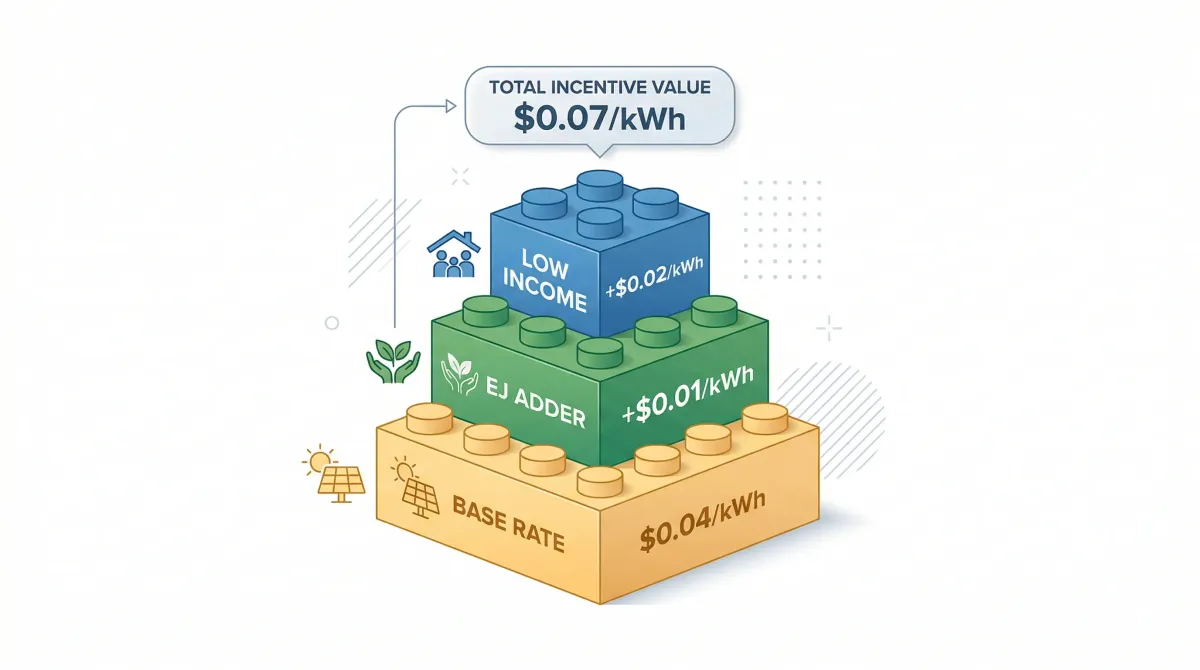
The SMART program offers stackable incentive layers. EJ community residents get a location-based adder that stacks on top of the base rate, and income-eligible residents in EJ communities can reach the maximum $0.12/kWh.
$0.03/kWh
Flat residential rate for all systems up to 25 kW AC
Eligibility: All homeowners in IOU territory
+$0.03/kWh
Additional incentive for projects sited in designated EJ communities
Eligibility: Property located in EJ census block group
$0.06/kWh
Enhanced base rate replacing the $0.03 standard rate for income-eligible households
Eligibility: Household income at or below 80% AMI
+$0.05/kWh
Additional adder on top of low-income base rate
Eligibility: Income-eligible in SMART program
$0.06/kWh
$0.03 base + $0.03 EJ adder
20-year SMART value: $11,520
(8 kW system, 9,600 kWh/yr)
EJ adder is location-based, no income verification needed
$0.11/kWh
$0.06 LMI base + $0.05 LMI adder
20-year SMART value: $21,120
(8 kW system, 9,600 kWh/yr)
Requires income at or below 80% AMI
$0.12/kWh
$0.06 LMI base + $0.03 EJ adder + $0.03 LMI adder
20-year SMART value: $23,040
(8 kW system, 9,600 kWh/yr)
Maximum SMART rate: located in EJ + income at or below 80% AMI
An income-eligible homeowner in an EJ community with an 8 kW system and battery can access over $107,900 in total 20-year value by stacking every available program.
| Program | Type | 20-Year Value |
|---|---|---|
| SMART 3.0 (EJ + LMI max) | Production incentive | $23,040 |
| Net Metering Credits (1:1) | Bill savings | $53,760 |
| ConnectedSolutions (battery) | Demand response | $15,000 |
| MA State Tax Credit | One-time credit | $1,000 |
| Property Tax Exemption | 20-year exemption | $9,400 |
| Sales Tax Exemption | One-time savings | $1,500 |
| Mass Save Weatherization | Upfront subsidy | $4,200 |
| Total 20-Year Value | $107,900 | |
Federal 25D ITC is $0 in 2026
The federal residential solar tax credit (Section 25D) expired December 31, 2025. No federal credit is available for cash or loan purchases. PPA/lease customers can indirectly benefit from the commercial Section 48/48E ITC claimed by the third-party system owner.
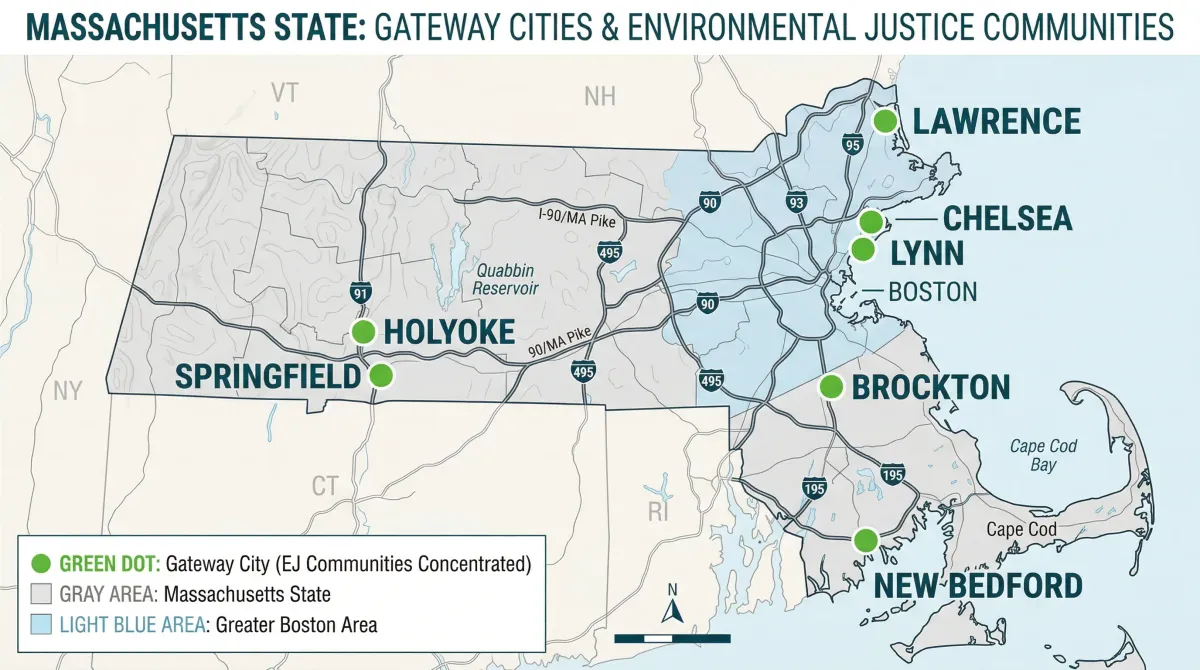
These cities have the highest concentration of EJ-designated census block groups, meaning most or all residential properties qualify for the SMART EJ adder.
Map your address: Use the MA EEA Environmental Justice Viewer to check if your specific address falls in a designated EJ block group.
| City | County | Population | EJ Criteria Met | Utility | SMART Rate |
|---|---|---|---|---|---|
| Lawrence | Essex | 89,143 | Income, Minority, English isolation | National Grid | $0.12/kWh |
| Springfield | Hampden | 155,929 | Income, Minority, English isolation | Eversource | $0.12/kWh |
| New Bedford | Bristol | 101,079 | Income, Minority | Eversource | $0.12/kWh |
| Brockton | Plymouth | 105,643 | Income, Minority | Eversource | $0.12/kWh |
| Chelsea | Suffolk | 40,787 | Income, Minority, English isolation | Eversource | $0.12/kWh |
| Lynn | Essex | 101,253 | Income, Minority, English isolation | National Grid | $0.12/kWh |
| Holyoke | Hampden | 38,070 | Income, Minority | Holyoke G&E (MLP) | N/A (MLP) |
| Fall River | Bristol | 93,885 | Income | Eversource | $0.09/kWh* |
| Lowell | Middlesex | 115,554 | Income, Minority (partial) | National Grid | $0.12/kWh |
| Fitchburg | Worcester | 40,793 | Income, Minority (partial) | Unitil | $0.12/kWh |
* Fall River EJ qualifies on income only. EJ adder applies to all residents; full $0.12/kWh requires separate income verification for LMI rate. Holyoke G&E is a municipal light plant (MLP) and does not participate in SMART.
It takes less than two minutes to determine if your property qualifies for the SMART EJ adder. Follow these four steps.
Go to the Massachusetts Executive Office of Energy and Environmental Affairs (EEA) Environmental Justice Populations viewer at mass.gov/environmental-justice.
Type your street address into the search bar. The map will zoom to your location and display the census block group boundaries.
If your property falls within a shaded EJ block group, you qualify for the SMART EJ adder. The viewer shows which criteria your block group meets (income, minority, English isolation).
Screenshot or print the viewer result. Your solar installer will need this documentation to apply the EJ adder when enrolling your system in the SMART 3.0 program.
Direct link to the MA EJ Viewer
Visit mass.gov/environmental-justice to open the interactive map. The viewer is maintained by the Massachusetts Executive Office of Energy and Environmental Affairs (EEA).
The SMART EJ adder ($0.03/kWh) requires no income verification — it is purely location-based. To unlock the full $0.12/kWh, you also need to qualify as income-eligible at or below 80% of Area Median Income.
You can also qualify through program participation: SNAP, LIHEAP, SSI, TAFDC, or MassHealth.
| County | 1-Person | 2-Person | 4-Person |
|---|---|---|---|
| Suffolk (Boston/Chelsea) | $76,850 | $87,800 | $109,750 |
| Middlesex (Lowell) | $76,850 | $87,800 | $109,750 |
| Essex (Lawrence/Lynn) | $76,850 | $87,800 | $109,750 |
| Worcester (Fitchburg) | $67,500 | $77,100 | $96,400 |
| Hampden (Springfield/Holyoke) | $55,700 | $63,650 | $79,550 |
| Bristol (New Bedford/Fall River) | $55,700 | $63,650 | $79,550 |
| Plymouth (Brockton) | $76,850 | $87,800 | $109,750 |
80% AMI thresholds for 2026. Source: HUD income limits. Thresholds vary by household size and county.
Mass Save provides enhanced weatherization and efficiency programs for income-eligible households. In EJ communities, a higher proportion of residents qualify, making these programs especially impactful when combined with solar.
100% of insulation and air sealing costs covered ($0 out of pocket)
Eligibility: 60% of State Median Income (SMI)
0% interest, 7-year term, up to $25,000 for heat pump + weatherization
Eligibility: All utility customers (no income requirement)
Up to $16,000 for whole-home heat pump conversion (income-eligible tier)
Eligibility: 60% of SMI or participating in SNAP, LIHEAP, SSI
Free removal and disposal of old appliances, $75 bonus for qualifying fridge/freezer
Eligibility: Available to all; income-eligible households get expedited service
Best practice: Complete your Mass Save energy assessment and weatherization before installing solar. Reduced energy usage means you need a smaller, cheaper solar system that still covers 100% of your electricity.
ConnectedSolutions pays battery owners to discharge during peak grid events. The rates are the same statewide, but EJ communities are a priority for adoption outreach because they are disproportionately affected by grid reliability issues and peak-hour pollution.
$275/kW summer + $50/kW winter
A 10 kW battery earns approximately $3,250 per year.
Up to 60 hours of dispatch events per year.
$225/kW summer + $50/kW winter
A 10 kW battery earns approximately $2,750 per year.
Up to 60 hours of dispatch events per year.
Why it matters for EJ communities: Peak grid events are concentrated in summer when fossil-fuel peaker plants fire up, often located in or near EJ communities. When batteries discharge instead, it reduces local air pollution and grid stress while paying homeowners. ConnectedSolutions revenue stacks on top of SMART payments and net metering credits.
Community solar lets renters, condo owners, and homeowners with unsuitable roofs access solar savings. Massachusetts requires new community solar projects to reserve subscriber capacity for EJ community residents.
EJ community subscribers receive a guaranteed minimum 20% bill credit (vs. 10-15% for standard subscribers in many programs).
Many community solar programs waive credit score requirements for subscribers in EJ communities, reducing barriers to enrollment.
New community solar projects in MA must reserve a portion of subscriber capacity for EJ community residents, ensuring access.
EJ subscribers typically face no early cancellation penalties, making community solar a risk-free way to save on electricity.
No installation, no credit check, no upfront cost. Community solar subscribers in EJ communities receive enhanced bill credits applied directly to their utility bill. Only an active Eversource, National Grid, or Unitil account is required.
For PPA or lease customers in EJ communities, the third-party system owner can claim the federal commercial ITC under Section 48/48E. Many EJ communities qualify for additional low-income community adders, increasing the ITC from 30% to 40-50%.
30%
Base ITC
Standard commercial credit
+10%
Low-Income Community
Project in qualifying census tract
+10-20%
Additional Adders
FEOC, energy community, etc.
This only applies to PPA/lease, not cash purchases
The Section 48/48E ITC is claimed by the third-party system owner (the financing company), not the homeowner. The benefit is passed through as lower monthly PPA/lease payments. Projects that began construction by July 4, 2026 locked in the full credit timing; projects that start later still qualify if placed in service by December 31, 2027. Many EJ communities in Lawrence, Springfield, Chelsea, and New Bedford fall in qualifying low-income census tracts.
An Environmental Justice (EJ) community in Massachusetts is a census block group that meets one or more of three criteria established by the 2021 Climate Roadmap Act and updated in 2024: (1) annual median household income at or below 65% of the statewide median, (2) 40% or more of residents identifying as a minority, or (3) 25% or more of households having limited English proficiency. Approximately 32% of the Massachusetts population lives in designated EJ block groups.
The SMART 3.0 Environmental Justice adder provides an additional $0.03/kWh on top of the standard residential rate for solar projects located in designated EJ communities. For an 8 kW system generating about 9,600 kWh per year, the EJ adder alone is worth approximately $288 per year, or $5,760 over the 20-year SMART term. When combined with the standard $0.03/kWh base rate, EJ community residents receive $0.06/kWh total. If also income-eligible, the rate can reach $0.12/kWh.
Yes. The SMART EJ adder is stackable with the low-income base rate. If you live in a designated EJ community AND your household income is at or below 80% of Area Median Income (AMI), you can qualify for up to $0.12/kWh combined: $0.06/kWh low-income base rate + $0.03/kWh EJ adder + $0.03/kWh low-income adder. This is the maximum SMART production incentive available to any residential system in Massachusetts.
Visit the Massachusetts Executive Office of Energy and Environmental Affairs (EEA) Environmental Justice Populations viewer at mass.gov/environmental-justice. Enter your address in the search bar. If your property falls within a shaded EJ census block group, you qualify for location-based incentives. The viewer also shows which specific criteria your block group meets (income, minority, English isolation). Save a screenshot for your solar installer.
No. The SMART EJ adder is location-based, not income-based. If your property is located within a designated EJ census block group, you automatically qualify for the $0.03/kWh EJ adder regardless of your personal income. However, to qualify for the additional low-income rate (which pushes the total to $0.12/kWh), you do need to verify that your household income is at or below 80% of the Area Median Income for your county.
The SMART 3.0 low-income base rate requires household income at or below 80% of Area Median Income (AMI). This varies by county. For example, 80% AMI for a family of four is approximately $109,750 in Suffolk/Middlesex/Essex counties, $96,400 in Worcester County, and $79,550 in Hampden/Bristol counties. You can also qualify if you participate in SNAP, LIHEAP, SSI, TAFDC, or MassHealth.
No. The federal residential solar tax credit (Section 25D) expired on December 31, 2025, for all homeowners regardless of EJ status. There is no federal ITC for residential cash or loan purchases in 2026. However, if you use a PPA or lease, the third-party system owner can claim the Section 48/48E commercial ITC (30% base, plus potential 10-20% low-income community adder). Projects that began construction by July 4, 2026 locked in the full credit timing; projects that start later still qualify if placed in service by December 31, 2027. This benefit is passed through as lower monthly payments.
The Massachusetts cities with the strongest EJ solar incentive stacks are Lawrence, Springfield, Chelsea, Lynn, and New Bedford. These cities meet all or most EJ criteria (income, minority, English isolation), meaning virtually every residential property qualifies for the SMART EJ adder. Additionally, many residents in these cities are income-eligible, enabling the full $0.12/kWh SMART rate. Springfield and Lawrence have active CAP agency solar programs that can further reduce costs.
Yes. Renters in EJ communities can subscribe to community solar programs at no cost. Massachusetts requires new community solar projects to reserve capacity for EJ community subscribers, and these subscribers often receive enhanced guaranteed bill credits of 20% or more. No rooftop installation is required and no credit check is needed. You just need an active utility account with Eversource, National Grid, or Unitil.
Yes. NuWatt Energy serves Environmental Justice communities across Massachusetts. We are experienced with SMART EJ adder enrollment, income-eligible rate verification, and Mass Save program coordination. We help homeowners in Lawrence, Springfield, New Bedford, Chelsea, Lynn, Brockton, and other EJ communities maximize their incentive stacks. Contact us for a free assessment.
How to stack SMART LMI, Mass Save, Section 48, and ConnectedSolutions.
Read guideFull breakdown of SMART rates, adders, eligibility, and enrollment.
Read guideHow to subscribe to community solar with no roof needed.
Read guideTriple-EJ community with maximum SMART LMI benefits.
Read guideEJ community auto-qualification and HAP agency programs.
Read guide100% insulation, 0% HEAT Loan, enhanced rebates for qualifying households.
Read guideWhy MA solar still makes financial sense without 25D ITC.
Read guideHow the commercial ITC works for PPA/lease customers in EJ communities.
Read guideNuWatt Energy helps Environmental Justice community residents in Massachusetts maximize every incentive. We handle SMART EJ adder enrollment, income-eligible verification, and Mass Save coordination.