Loading NuWatt Energy...

We use your location to provide localized solar offers and incentives.
We serve MA, NH, CT, RI, ME, VT, NJ, PA, and TX
Loading NuWatt Energy...
NuWatt designs, installs, and manages solar, battery, heat pump, and EV charger systems across 9 states. One company, one warranty, one point of contact.
Get a Free QuoteSalt air, high humidity, wind exposure, and sandy soil create unique challenges for heat pump installations within miles of the Massachusetts coast. This guide covers the coatings, models, and maintenance that protect your investment.
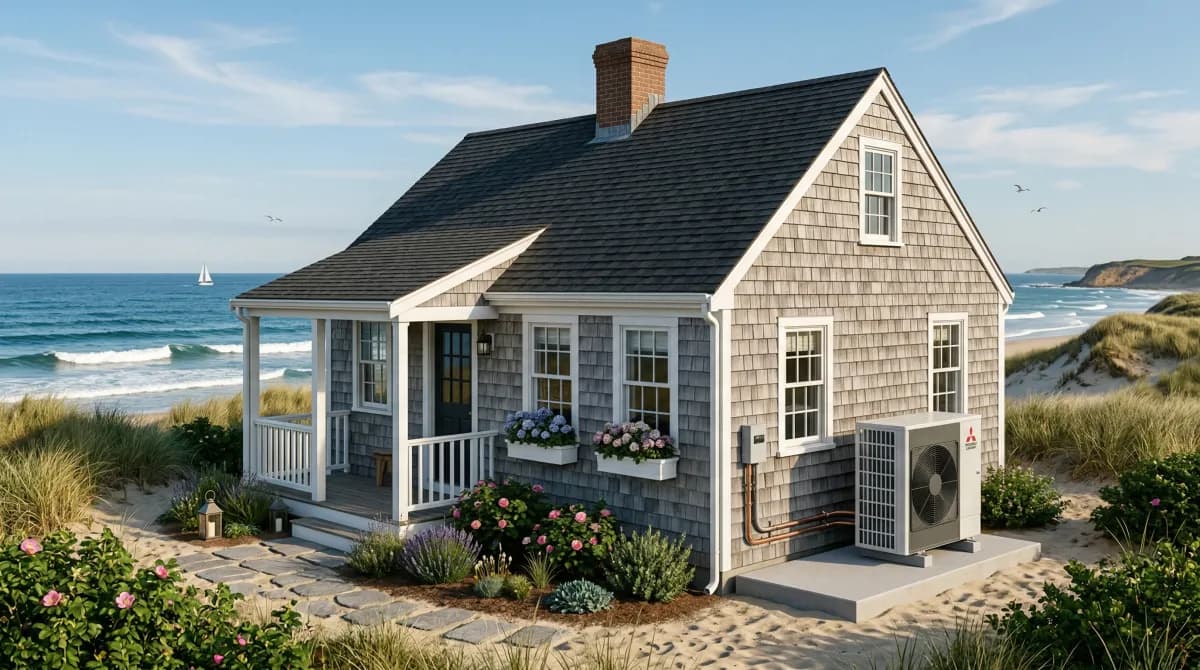
Cape Cod, Martha's Vineyard, Nantucket, and the coastal communities stretching from Plymouth to Newburyport share a common enemy: airborne ocean salt. Within one mile of the shoreline, microscopic salt particles are suspended in the air at concentrations high enough to corrode unprotected metal in months, not years.
A heat pump's outdoor unit is essentially a large aluminum and copper heat exchanger sitting in your yard, pulling thousands of cubic feet of air across its coil fins every hour. In coastal locations, that air carries salt, sand, and moisture that accelerate wear at 3-4x the rate of an identical unit installed 20 miles inland.
The good news: the heat pump industry has solved this problem. Anti-corrosion coatings like Blue Fin (Mitsubishi), Gold Fin (Daikin), and WeatherArmor (Carrier) extend coastal coil life to match inland performance. But you must select the right equipment from the start. Retrofitting a coating after installation is expensive and less effective.
Ocean salt is airborne within 1 mile of the coast and detectable up to 3 miles inland. Salt deposits on the outdoor unit aluminum coil fins and copper refrigerant tubing, accelerating galvanic corrosion.
Impact:
Uncoated outdoor coils lose 30-50% of fin surface area within 5-8 years in coastal environments. Inland units typically last 15-20 years before corrosion becomes an issue. Corroded fins restrict airflow, reduce efficiency, and eventually cause refrigerant leaks.
Solution: Install a heat pump with factory-applied anti-corrosion coating (Blue Fin, Gold Fin, or equivalent). Rinse the outdoor unit with fresh water quarterly. Annual professional coil cleaning.
Cape Cod summers average 70-80% relative humidity due to ocean proximity. Coastal fog adds moisture that penetrates homes and creates persistent dampness, especially in cottages and seasonal homes that may lack modern vapor barriers.
Impact:
Excessive humidity causes mold, musty odors, wood rot, and discomfort even when temperatures are moderate. Standard A/C units often overcool the air without adequately dehumidifying. A properly sized heat pump in cooling mode removes 2-4 pints of moisture per hour.
Solution: Select a heat pump with a dedicated "Dry Mode" that prioritizes dehumidification over cooling. Ensure the system is properly sized (not oversized) so it runs long enough to dehumidify. Consider a standalone dehumidifier for basements.
Cape Cod and the Islands experience prevailing northeast winds averaging 12-18 mph, with nor'easter gusts exceeding 60 mph. Wind increases heat loss through walls and windows and adds windchill to the outdoor unit.
Impact:
Wind-driven heat loss increases the heating load by 10-20% compared to sheltered inland locations. The outdoor unit must work harder and the defrost cycle runs more frequently when wind drives moisture and cold air across the coil.
Solution: Place the outdoor unit on the leeward (southwest) side of the house, sheltered from prevailing northeast winds. Use a windbreak (fence or landscaping) at least 4 feet from the unit. Never completely enclose the unit.
Cape Cod's sandy soil can shift and settle over time, especially after heavy rain or nor'easters. Outdoor units mounted on ground-level pads may tilt as the sand beneath compacts or erodes.
Impact:
A tilted outdoor unit causes improper condensate drainage, increased vibration, and potential refrigerant flow issues. In extreme cases, the refrigerant lines connecting the outdoor and indoor units can strain and develop leaks.
Solution: Mount the outdoor unit on a concrete pad (not just a plastic pad on sand) or a wall-mounted bracket. Check level annually. For sandy areas, a 4-inch gravel bed beneath the pad improves drainage and stability.
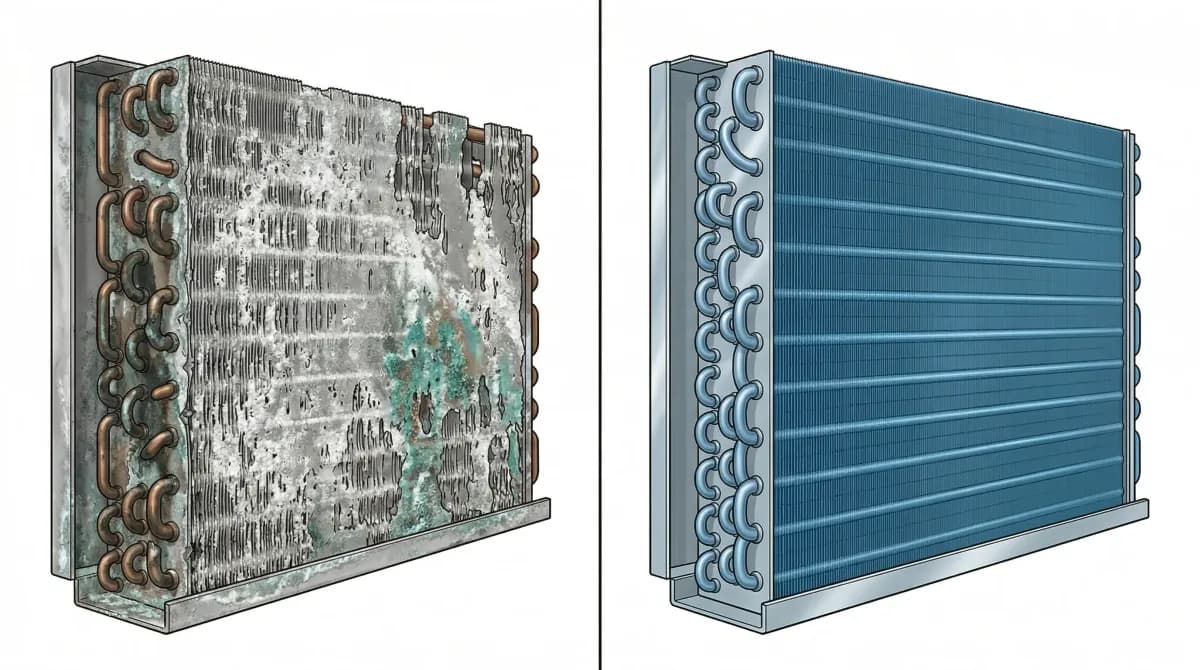
Left: Uncoated aluminum coil fins after 6 years of coastal exposure. Right: Blue Fin coated coil after 8 years in the same environment.
If your home is within 3 miles of the Massachusetts coast, an anti-corrosion coating is not optional. Here is how the major coatings compare.
Mitsubishi Electric | Hydrophilic acrylic resin coating on aluminum fins
Protection
Creates a water-repellent barrier that prevents salt crystals from bonding to the fin surface. Salt washes off more easily during rain or manual rinsing.
Durability
Rated for 15+ years of coastal exposure. Outperforms uncoated aluminum by 3-4x in salt spray testing (ASTM B117).
Cost Premium
$0 extra (standard on Mitsubishi Hyper-Heating models)
Availability
Standard on all MSZ-FH, MSZ-FS, MUZ-FH, and MXZ series outdoor units
Daikin / Multiple brands | Epoxy-based gold coating on condenser coils
Protection
Thick epoxy layer physically separates the aluminum from salt exposure. Gold color makes it easy to visually confirm the coating is intact during maintenance.
Durability
Rated for 10-15 years of coastal exposure. Excellent resistance to both salt and acid rain. Can show wear in high-abrasion environments (sandblasting from beach sand).
Cost Premium
$200-500 (available as factory option or aftermarket)
Availability
Factory option on Daikin Aurora/FIT systems. Available aftermarket for most brands through certified installers.
Carrier | Multi-layer polymer coating on coil and cabinet
Protection
Protects both the coil fins and the sheet metal cabinet/housing. Broader coverage than fin-only coatings, reducing rust on the outer casing.
Durability
Rated for 10+ years. Good all-around protection, though independent testing suggests slightly less salt-specific resistance than Blue Fin.
Cost Premium
$300-600 (included on select Carrier Infinity/Greenspeed models)
Availability
Standard on Carrier Infinity 24/25 series with Greenspeed Intelligence. Not available on entry-level Carrier models.
Most budget brands | Bare aluminum fins, no protective layer
Protection
No corrosion protection. Salt deposits bond directly to aluminum and begin corroding within months of ocean exposure.
Durability
5-8 years before significant fin degradation in coastal environments. 15-20 years inland.
Cost Premium
No extra cost (but much higher long-term replacement cost)
Availability
Default on most entry-level and mid-range units
These three models combine cold-climate performance with corrosion protection. All qualify for Mass Save rebates.
MSZ-FH / MUZ-FH (Hyper-Heating INVERTER)
Min Temp
-13°F
SEER2
22
HSPF2
12.5
Price
$4,500-$7,000/zone
Cape Cod Note:
Blue Fin coating is standard on every outdoor unit at no extra cost. The largest installer network on the Cape. Most Mitsubishi Diamond Dealers in the Cape & Islands region have specific coastal installation experience.
Best for: Year-round Cape Cod homes, multi-zone installations
Aurora (DZ-Series) with Gold Fin
Min Temp
-13°F
SEER2
20
HSPF2
11.5
Price
$3,500-$5,500/zone
Cape Cod Note:
Gold Fin must be specified when ordering. Not all Daikin models come with it by default. Confirm with your installer before signing the contract. Slightly lower price point than Mitsubishi with comparable cold-climate performance.
Best for: Budget-conscious year-round homes, cottages
Halcyon XLTH with aftermarket coating
Min Temp
-15°F
SEER2
20
HSPF2
12
Price
$4,000-$6,500/zone + $200-400 coating
Cape Cod Note:
The XLTH has the lowest rated operating temperature (-15°F) of any mini-split. No factory anti-corrosion coating, but aftermarket options are available. Excellent for outer Cape homes with extreme wind exposure where the extra cold-weather margin matters.
Best for: Coldest Cape locations, Provincetown, outer Cape
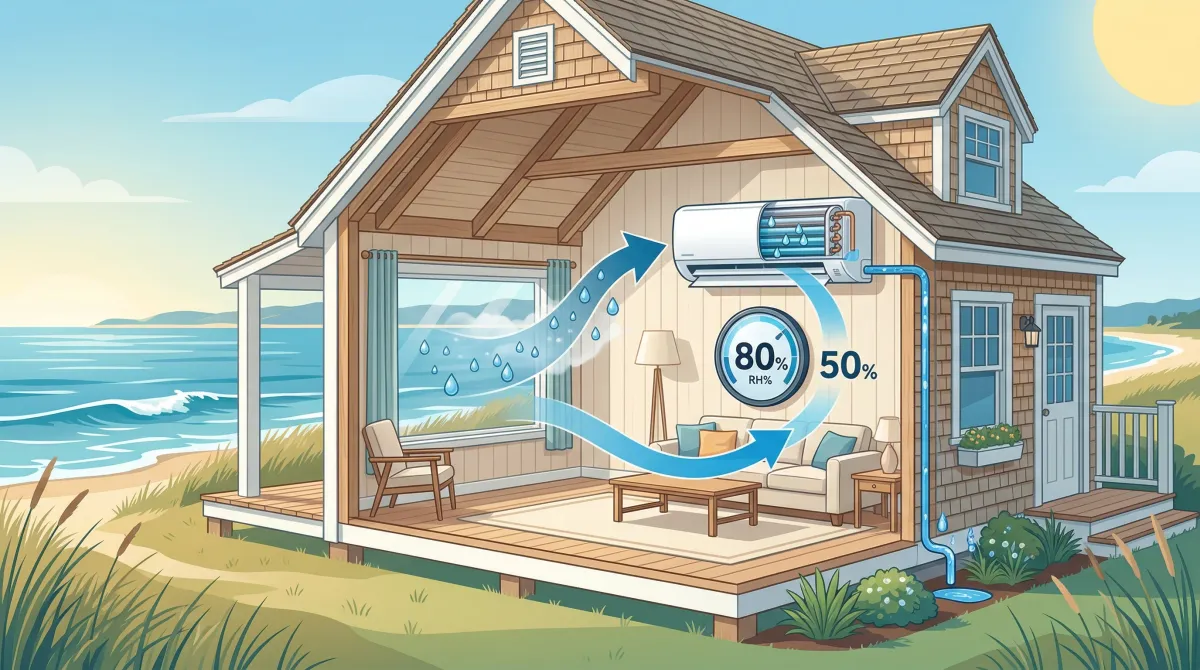
Heat pump Dry Mode prioritizes moisture removal over cooling, ideal for Cape Cod's 70-80% summer humidity.
Cape Cod's housing stock ranges from 600 sq ft summer cottages to modern year-round homes. Each type presents different challenges.
600-1,200 sq ft
Challenge:
Knee walls with little or no insulation. Sloped ceilings reduce usable attic space. Many were built as summer-only homes with minimal insulation.
Recommendation:
Single-zone ductless mini-split (1-1.5 ton). Insulate knee walls and attic floor first via Mass Save. A single wall-mounted head in the main living area can heat/cool the entire first floor.
1,000-1,800 sq ft
Challenge:
Former seasonal home converted to year-round. May have added insulation but often has gaps. Older electrical panels (60-100 amp) may need upgrading.
Recommendation:
Two-zone ductless system (one per floor). Pair with Mass Save insulation upgrades. Verify electrical panel capacity supports the heat pump and any future additions.
1,800-3,000 sq ft
Challenge:
Better insulated but larger. Open floor plans can create uneven temperatures. Multiple floors with varying heat loads.
Recommendation:
Multi-zone ducted or ductless system (3-4 zones). MXZ or multi-split outdoor unit. Consider a ducted air handler for the main floor and ductless heads for bedrooms.
Varies
Challenge:
All equipment and installers must travel by ferry. Limited local HVAC contractors. Nantucket Historic District Commission may restrict outdoor unit placement and visibility.
Recommendation:
Plan 4-8 weeks ahead for scheduling. Budget $500-$1,500 extra for ferry/logistics. Use a mainland installer with island experience. Anti-corrosion coating is non-negotiable on the islands.
Converting Seasonal to Year-Round?
If you are winterizing a seasonal Cape Cod home for year-round use, a heat pump should be part of the conversion plan from day one. Coordinate with your Mass Save Home Energy Assessment to insulate and air-seal first, then size the heat pump for the improved building envelope. This avoids oversizing and saves money on equipment.
Cape Light Compactis the municipal aggregator serving most of Cape Cod and Martha's Vineyard. It is a full Mass Save participant, meaning Cape Cod homeowners qualify for the same heat pump rebates as Eversource or National Grid customers.
Whole-Home Rebate
$8,500
$2,650/ton, max $8,500
Partial Displacement
$8,500
$1,125/ton, max $8,500
HEAT Loan
0% APR
Up to $25,000, 3-7 year terms
Nantucket Electric (National Grid subsidiary) also participates in Mass Save. All Cape Cod towns and islands have full access to heat pump rebates and HEAT Loans.
Many Cape Cod homes were built as summer cottages in the 1940s-1970s with minimal insulation. Even homes converted to year-round use often have critical insulation gaps, particularly in knee walls (the short walls where sloped ceilings meet the floor) and unfinished attic spaces.
These gaps have an outsized impact on heat pump efficiency. An uninsulated knee wall can account for 20-30% of a home's total heat loss. Installing a heat pump without addressing insulation means buying a larger, more expensive system that works harder and costs more to operate.
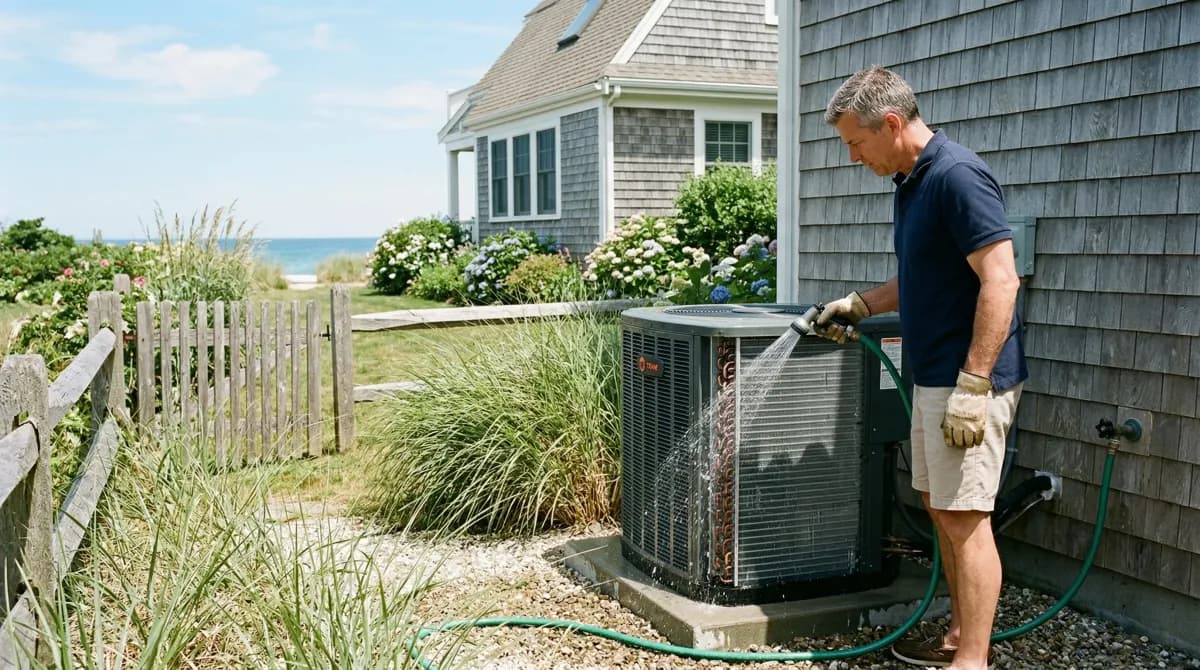
Coastal heat pumps require more frequent maintenance than inland units. Salt deposits must be removed before they bond permanently to the coil.
Check for visible salt buildup (white powdery residue on coil fins). Clear any debris, sand, or vegetation from around the unit.
Use a garden hose at moderate pressure to rinse the outdoor coil from the inside out (remove the fan grille first if accessible). This flushes salt deposits before they bond permanently. Let the unit dry completely before restarting.
A certified technician cleans coils with a non-acidic coil cleaner, checks refrigerant levels, inspects electrical connections for corrosion, and verifies the anti-corrosion coating is intact. Cost: $150-250.
Check the outdoor unit cabinet, mounting hardware, and line set connections for rust and corrosion. Coastal environments corrode screws, brackets, and electrical terminals. Replace any rusted hardware with stainless steel.
Inspect for debris impact, salt caking from storm surge spray, and sand accumulation in the base pan. Rinse thoroughly with fresh water. Check that the unit is still level.
Expect $500-$1,000 more for a coastal installation, plus higher ongoing maintenance costs.
| Item | Inland | Coastal | Note |
|---|---|---|---|
| Base heat pump system (single-zone) | $4,000-$6,500 | $4,500-$7,000 | Anti-corrosion coating adds $0-500 to equipment cost |
| Anti-corrosion coil coating | Not needed | $0-$500 | Free on Mitsubishi (Blue Fin standard). $200-500 on other brands. |
| Elevated mounting / wall bracket | $0-200 | $200-$400 | Recommended for sandy soil areas. Required in flood zones. |
| Stainless steel hardware upgrade | Not needed | $50-$150 | Standard zinc screws corrode in 2-3 years near ocean. |
| Mass Save rebate | Up to $8,500 | Up to $8,500 | Same rebates regardless of location. Cape Light Compact participates. |
| Annual maintenance (coastal) | $150-200/year | $250-350/year | Coastal requires quarterly rinse + annual pro cleaning. |
Salt exposure varies significantly across the Cape. Outer Cape and island locations face extreme conditions. Interior mid-Cape homes may only need moderate protection.
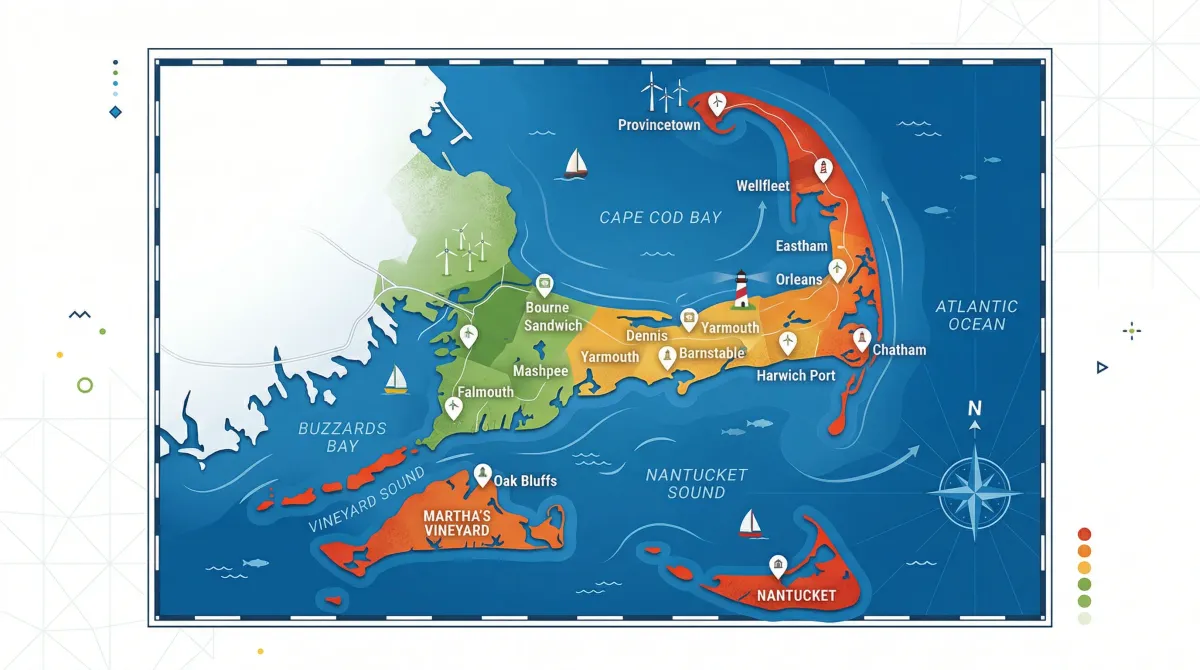
Outer Cape
Surrounded by ocean on three sides. Maximum salt exposure. Anti-corrosion coating is essential.
Outer Cape / Elbow
Exposed to both Atlantic and Nantucket Sound. High wind and salt spray.
Outer Cape
Bay and ocean sides. Seasonal home conversions increasingly common.
Outer Cape
Pleasant Bay side more sheltered than ocean-facing properties.
Mid-Cape
Bay-side exposure. Many older cottages need insulation before heat pump install.
Mid-Cape
Both bay and south-side beaches. Interior homes have moderate exposure.
Mid-Cape
Route 28 corridor homes are moderately exposed. Beach-side is high.
Mid-Cape
Largest Cape town. Interior villages (Centerville, Marstons Mills) have less exposure.
Upper Cape
Canal-side and bay-side. More sheltered than outer Cape locations.
Upper Cape
Long coastline, Vineyard Sound exposure. Woods Hole area is extreme.
Islands
Island-wide salt exposure. Ferry logistics add $500-1,500 to installation cost.
Islands
30 miles offshore. Highest salt exposure in MA. Very limited installer availability. Budget extra for travel.
Research
You just did this
Calculate
See your savings
Save
Lock in your price
Tell us about your Cape Cod or coastal MA home. NuWatt's team will design around salt air, wind exposure, setback constraints, and anti-corrosion equipment needs.
Start My QuoteTalk to an expertNo credit card required. 100% free. Takes about 2 minutes.