Loading NuWatt Energy...

We use your location to provide localized solar offers and incentives.
We serve MA, NH, CT, RI, ME, VT, NJ, PA, and TX
Loading NuWatt Energy...
NuWatt designs, installs, and manages solar, battery, heat pump, and EV charger systems across 9 states. One company, one warranty, one point of contact.
Get a Free QuoteNo carbon monoxide. No fire risk. No propane fumes. A cold-climate mini-split heats your garage to 60°F in January — and cools it in August — for $2,500–$5,000 installed.
$2.5K–$3.5K
1-Car Garage
$3K–$4.5K
2-Car Garage
No Fumes
Zero CO Risk
To -15°F
Cold-Climate
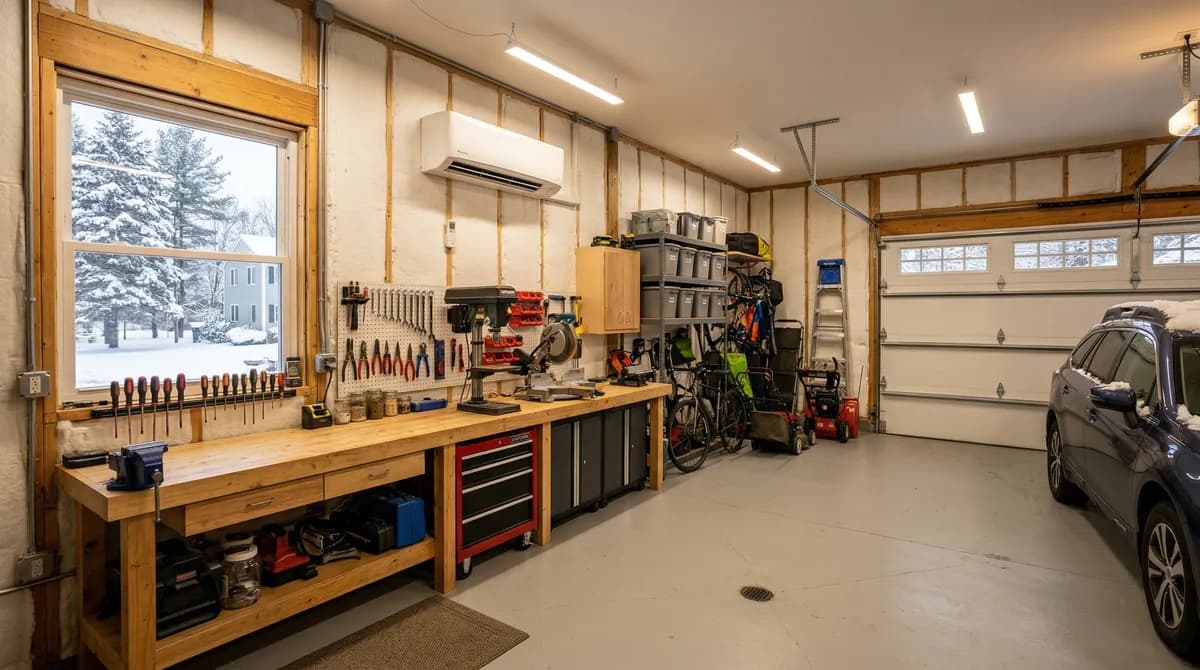
Massachusetts homeowners use garages year-round — for winter car projects, home gyms, woodworking, and EV charging. A mini-split solves every heating and cooling problem without the dangers of combustion heaters.
Unlike propane torpedo heaters and kerosene heaters, a mini-split has no combustion at all. No CO, no open flame, no need for ventilation. This is critical in an enclosed garage where you spend hours working.
A heat pump provides heating in winter and air conditioning in summer from the same unit. Your garage hits 100°F+ in July — having AC makes summer projects comfortable and keeps materials stable.
Mini-splits mount on the wall and connect to an outdoor unit via a small refrigerant line through the wall. No ductwork, no gas line, no flue. Installation takes one day.
Modern inverter-driven mini-splits run at 300-400% efficiency (COP 3-4). A 12,000 BTU unit uses about 1,000 watts — less than a space heater and far more effective.
A heated garage keeps your EV battery warm overnight, improving winter range by 10-20%. Cold batteries lose capacity and waste energy on pre-conditioning before driving.
Garage temperatures can drop well below 0°F. Cold-climate models (Mitsubishi Hyper-Heat, Fujitsu XLTH) maintain heating output down to -15°F — mandatory for MA garages.
Every year, Massachusetts homeowners are hospitalized or killed by carbon monoxide from combustion heaters in enclosed garages. A mini-split eliminates this risk entirely.
| Heater Type | CO Risk | Fire Risk | Ventilation Req. | Fumes | Year-Round | Cost |
|---|---|---|---|---|---|---|
| Propane Torpedo Heater | $150–$500 + fuel | |||||
| Kerosene Heater | $100–$300 + fuel | |||||
| Electric Space Heater | $30–$100 + high bills | |||||
| Infrared Radiant Heater | $200–$800 installed | |||||
| Mini-Split Heat Pump | $2,500–$5,000 installed |
Carbon monoxide is odorless and colorless. In an enclosed garage, CO levels from a propane or kerosene heater can reach lethal concentrations within 30 minutes — especially with the garage door closed. Opening the door defeats the purpose of heating. A mini-split heat pump has zero combustion, zero CO emissions, and works perfectly with the garage door shut.
Proper sizing depends on garage square footage, insulation level, and how warm you want to keep it. These recommendations assume an insulated garage targeting 55–65°F in winter.
| Garage Type | Size | BTU Needed | Recommended Model | Installed Cost | Electrical |
|---|---|---|---|---|---|
| 1-Car Garage | 200–300 sq ft | 9,000 BTU | Mitsubishi MSZ-FH09NA | $2,500–$3,500 | 20A / 240V |
| 2-Car Garage | 400–600 sq ft | 12,000–18,000 BTU | Fujitsu 12LMAS1 / Mitsubishi MSZ-FH15NA | $3,000–$4,500 | 20A–30A / 240V |
| 3-Car / Workshop | 600–900 sq ft | 18,000–24,000 BTU | Mitsubishi MSZ-FH18NA / MUZ-FH24NA | $3,500–$5,000 | 30A / 240V |
If your garage is uninsulated, the heat pump must work 2–3 times harder to maintain temperature. A 9,000 BTU unit rated for 300 sq ft of insulated space may only effectively heat 100–150 sq ft without insulation. Always insulate first — it is the highest-ROI investment you can make.
Garage temperatures in Massachusetts can drop to 0°F or below. A standard mini-split shuts off below 5°F. You must use a cold-climate rated unit (NEEP-listed) that operates to -15°F or lower. Mitsubishi Hyper-Heat and Fujitsu XLTH series are proven in MA garages.
Insulation is the single most important factor for garage heat pump performance. Budget $1,500–$3,000 for wall and ceiling insulation. The garage door is the biggest thermal weak point — replacing or insulating it delivers the highest return.
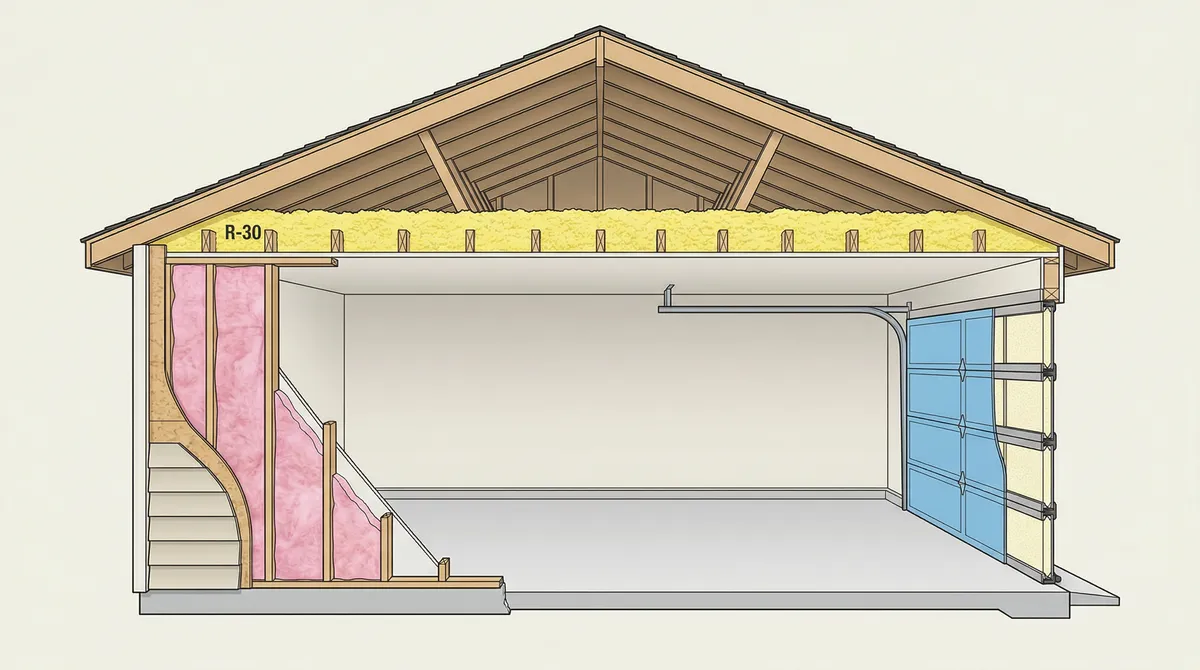
The garage door is typically 40% of the total wall area in a 2-car garage. An uninsulated steel door has almost zero R-value. Replacing it with an R-10+ insulated door ($800–$2,000) is the single biggest thermal improvement you can make. If you cannot replace the door, retrofit insulation kits ($150–$300) add R-4 to R-8.
Uninsulated Steel Door
R-0 to R-1
Retrofit Kit
R-4 to R-8 ($150–$300)
New Insulated Door
R-10 to R-18 ($800–$2,000)
These cold-climate models are proven in New England garages. All are NEEP-listed and rated to operate below -13°F.
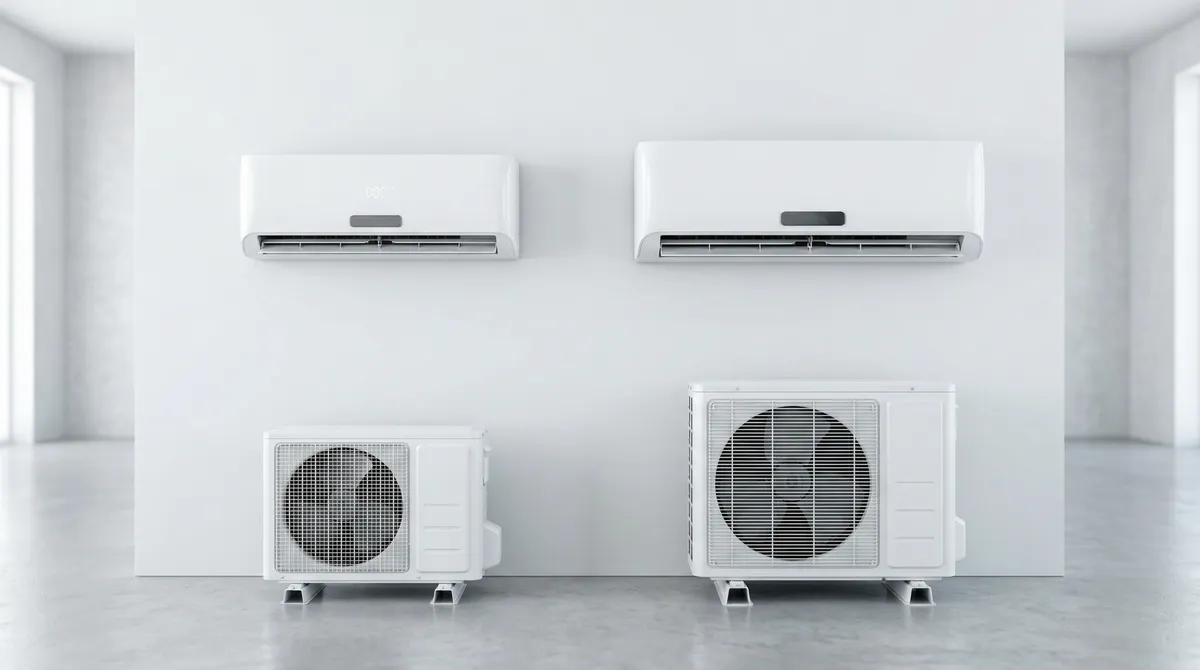
The gold standard for garage mini-splits. Whisper-quiet, Wi-Fi enabled, and maintains 100% heating capacity down to 5°F with usable heat to -15°F.
Excellent cold-climate performer with industry-leading HSPF2 (heating efficiency). Compact outdoor unit fits tight garage setback areas.
Steps up from the 9K for garages with higher ceilings, poor insulation, or larger square footage. Same Hyper-Heat technology.
The workhorse for large garage spaces. Handles 600-900 sq ft of insulated workshop. Requires 30A dedicated circuit.
Mass Save offers generous heat pump rebates, but garage installations have specific eligibility rules you need to understand.
Rebate amount: $2,500 per unit (standard) or $2,650/ton. May count toward the $8.5K whole-home cap if part of full conversion.
Still worth it:Even without Mass Save, a $3,000 garage mini-split pays for itself vs. propane in 3–5 years — and is infinitely safer.
Mass Save eligibility rules for garage installations can be gray areas. The safest approach is to have your Mass Save-participating installer assess the space and confirm rebate eligibility before purchasing equipment. Some installers have successfully qualified attached garages that function as home gyms or offices.
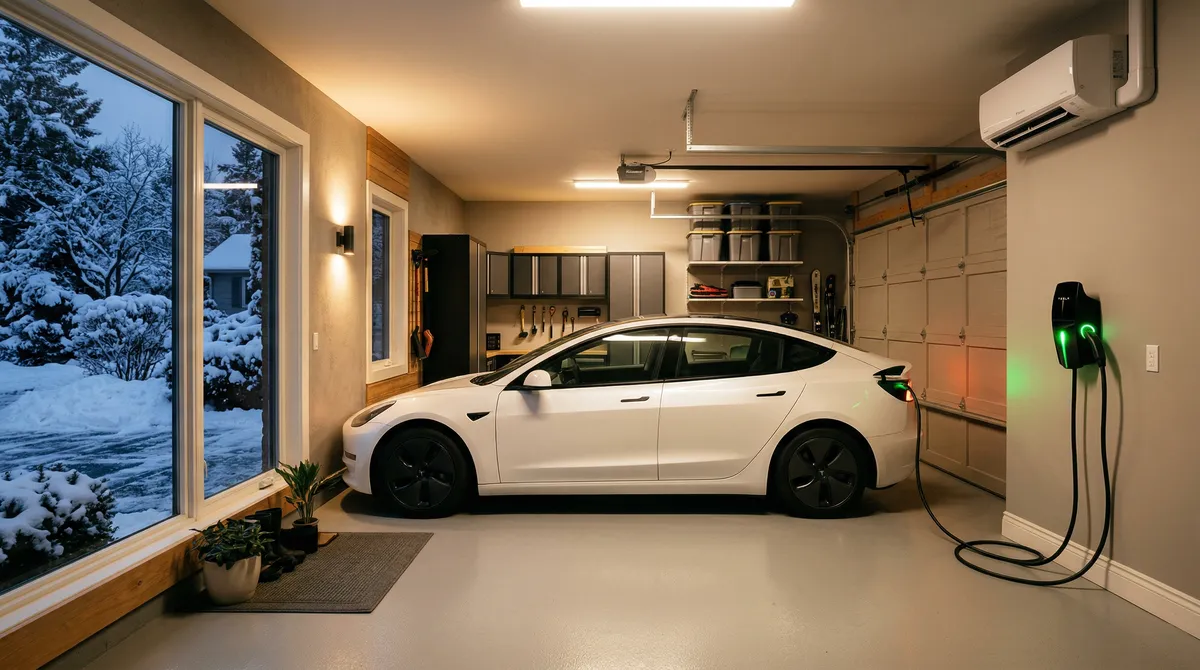
If you own or plan to buy an EV, a heated garage is one of the best investments for preserving winter driving range and charging efficiency.
EV batteries lose 20-40% of their range in cold weather. Parking in a 50-60°F garage means the battery starts warm, requiring less energy for cabin heating and battery pre-conditioning.
Cold batteries charge slower and less efficiently. A warm garage means your Level 2 charger delivers more usable range per kilowatt-hour overnight.
No more unplugging a frozen J1772 connector at 6 AM. No scraping ice off your windshield. Your car is pre-warmed from the garage temperature alone.
Repeated deep-cold cycling stresses EV battery chemistry. A garage kept above freezing reduces thermal stress and can extend battery pack life.
Most garage heat pump installations require electrical work. Here is what to expect in Massachusetts.
A complete garage heating project includes insulation + heat pump + electrical. Here is what a typical 2-car garage project costs in Massachusetts.
Garage Door Insulation (R-10+ replacement)
Biggest thermal improvement
$800–$2,000
Wall Insulation (R-13 fiberglass batt)
70% wall heat loss reduction
$800–$1,500
Ceiling Insulation (R-30 if living space above)
Skip if open rafters with no space above
$500–$1,200
12K-18K BTU Mini-Split (installed)
Cold-climate rated, includes line set
$3,000–$4,500
240V Dedicated Circuit
From main panel to garage
$300–$800
Permits & Inspection
Varies by municipality
$100–$300
Total Project Cost
2-car garage, fully insulated + 12K-18K BTU HP
$5,500–$10,300
If your garage qualifies (attached, conditioned as living space), subtract $2,500 from the heat pump cost. Net HP cost: $500–$2,000.
$3,000–$7,800 total
Even without the rebate, a $5,500–$10,300 investment replaces $500+/year in propane costs while eliminating CO risk and adding AC. ROI in 5–8 years.
$5,500–$10,300 total
MA homeowners heat garages for many reasons beyond parking cars. Here is why each use case benefits from a mini-split.
Target: 55–65°F in winter
Consistent temperature prevents wood warping and glue failure. AC in summer keeps finishes from drying too fast. No combustion fumes near sawdust (fire hazard reduction).
Target: 60–68°F in winter
Year-round comfortable workout space. Cooling in summer prevents heat exhaustion. No propane fumes to breathe during intense exercise. Dehumidification prevents equipment rust.
Target: 55–70°F depending on work
Heated garage makes winter mechanical work possible. Prevents frozen fluids and condensation on metal parts. Paint and body work require temperature-controlled environments.
Target: 45–55°F (battery preservation)
Warm battery = better range + faster charging. No ice on charging connector. Comfortable enough to check charge status without a coat. Combine with Level 2 charger installation.
Target: 65–70°F year-round
Comfortable temperature year-round. Mini-split is quieter than most space heaters (22-28 dB). No combustion smells during long rehearsals. Can also add sound insulation.
Target: 68–72°F year-round
More likely to qualify for Mass Save rebate as conditioned living space. Precise temperature control for all-day comfort. Paired with insulation, creates a genuinely usable room.
Insulate walls (R-13), ceiling (R-30 if applicable), and upgrade the garage door (R-10+). This should be done BEFORE the heat pump installation so the installer can size the unit properly.
Electrician runs a dedicated 240V, 20A or 30A circuit from your main panel to the garage. Detached garages may need a sub-panel. Permit and inspection may be required.
The indoor head unit mounts high on the wall (7–8 feet) for optimal air distribution. A 3-inch hole is drilled through the wall for the refrigerant line set and condensate drain.
The outdoor compressor sits on a concrete pad or wall bracket outside the garage. It should be elevated above snow line (18"+ off ground) and accessible for maintenance.
Refrigerant lines are connected, vacuum-pulled, and charged. The system is tested in both heating and cooling modes. The installer configures settings for garage use (lower setback temperature).
Total installation time: 1 day for the heat pump (after insulation is complete).
Yes — cold-climate mini splits like the Mitsubishi MSZ-FH series and Fujitsu 12LMAS1 are rated to operate down to -15°F, which covers even the coldest MA nights. The key is proper sizing and garage insulation. An insulated 2-car garage with a 12,000-18,000 BTU cold-climate mini split will maintain 55-65°F comfortably in winter.
It depends. If the garage is attached to your home and conditioned as living space (converted garage, home office, home gym), the heat pump MAY qualify for the standard Mass Save rebate of $2,500 per unit. Detached garages used purely as storage or workshop space typically do NOT qualify. Always confirm eligibility with your Mass Save-participating installer before purchasing.
A 9,000 BTU single-zone mini split for a 1-car garage costs $2,500-$3,500 installed in Massachusetts in 2026. A larger 18,000 BTU unit for a 2-3 car garage or workshop runs $3,500-$5,000. These prices include the indoor and outdoor units, line set, electrical work, and installation labor. Budget an additional $1,500-$3,000 for garage insulation if your walls and ceiling are not insulated.
You do not technically need to insulate first, but you absolutely should. An uninsulated garage forces the heat pump to work 2-3 times harder, dramatically increasing electricity costs and reducing comfort. At minimum, insulate the garage door (R-10+, $800-$2,000) and walls (R-13, $800-$1,500). The insulation pays for itself within 2-3 heating seasons through reduced electricity consumption.
Significantly safer. Propane and kerosene heaters produce carbon monoxide (CO), an odorless deadly gas that accumulates in enclosed spaces. They also create fire risk from open flames and require ventilation, defeating the purpose of heating. A mini-split heat pump has zero combustion, zero CO, zero fire risk, and zero fumes. For an enclosed garage where you spend extended time working, this is a critical safety advantage.
A garage mini-split requires a dedicated 240V circuit — typically 20A for 9K-12K BTU units or 30A for 18K-24K BTU units. If your garage only has 120V outlets, an electrician will run a new 240V circuit from your main panel ($300-$800). Detached garages may need a sub-panel ($800-$1,500) if the main panel circuit run is too long. A building permit may be required for new electrical work in MA.
Yes. Keeping your garage at 50-60°F in winter means your EV battery starts at a warmer temperature, which improves winter range by 10-20%. Cold batteries lose capacity and require energy to pre-condition before driving. A heated garage also makes Level 2 charging slightly more efficient and eliminates the discomfort of unplugging a frozen charging cable at 6 AM.
Yes — this is one of the biggest advantages over any combustion heater. A mini-split heat pump provides both heating AND air conditioning from the same unit. Massachusetts garages can reach 100°F+ in summer. Having AC in your garage workshop makes summer projects comfortable and keeps tools, paint, and materials at stable temperatures.
Our Massachusetts-licensed installers will assess your garage, recommend the right size mini-split, and handle insulation, electrical, and installation — with Mass Save rebate assistance if eligible.
Compare configurations and costs for MA homes — from 1-zone to 5-zone.
Read guideWhy cold-climate models are non-negotiable for Massachusetts winters.
Read guideFull breakdown of heat pump costs in Massachusetts after Mass Save rebates.
Read guideComplete guide to all Mass Save rebates including heat pumps and insulation.
Read guideInsulation rebates that may apply to your garage project.
Read guidePair your heated garage with a Level 2 EV charger installation.
Read guide