Loading NuWatt Energy...

We use your location to provide localized solar offers and incentives.
We serve MA, NH, CT, RI, ME, VT, NJ, PA, and TX
Loading NuWatt Energy...
NuWatt designs, installs, and manages solar, battery, heat pump, and EV charger systems across 9 states. One company, one warranty, one point of contact.
Get a Free QuoteSwim May through October instead of June through August. A heat pump pool heater costs $3,000-$6,500 installed and cuts operating costs roughly in half vs gas.
The same technology that heats your home can heat your pool — at a fraction of the cost of gas.
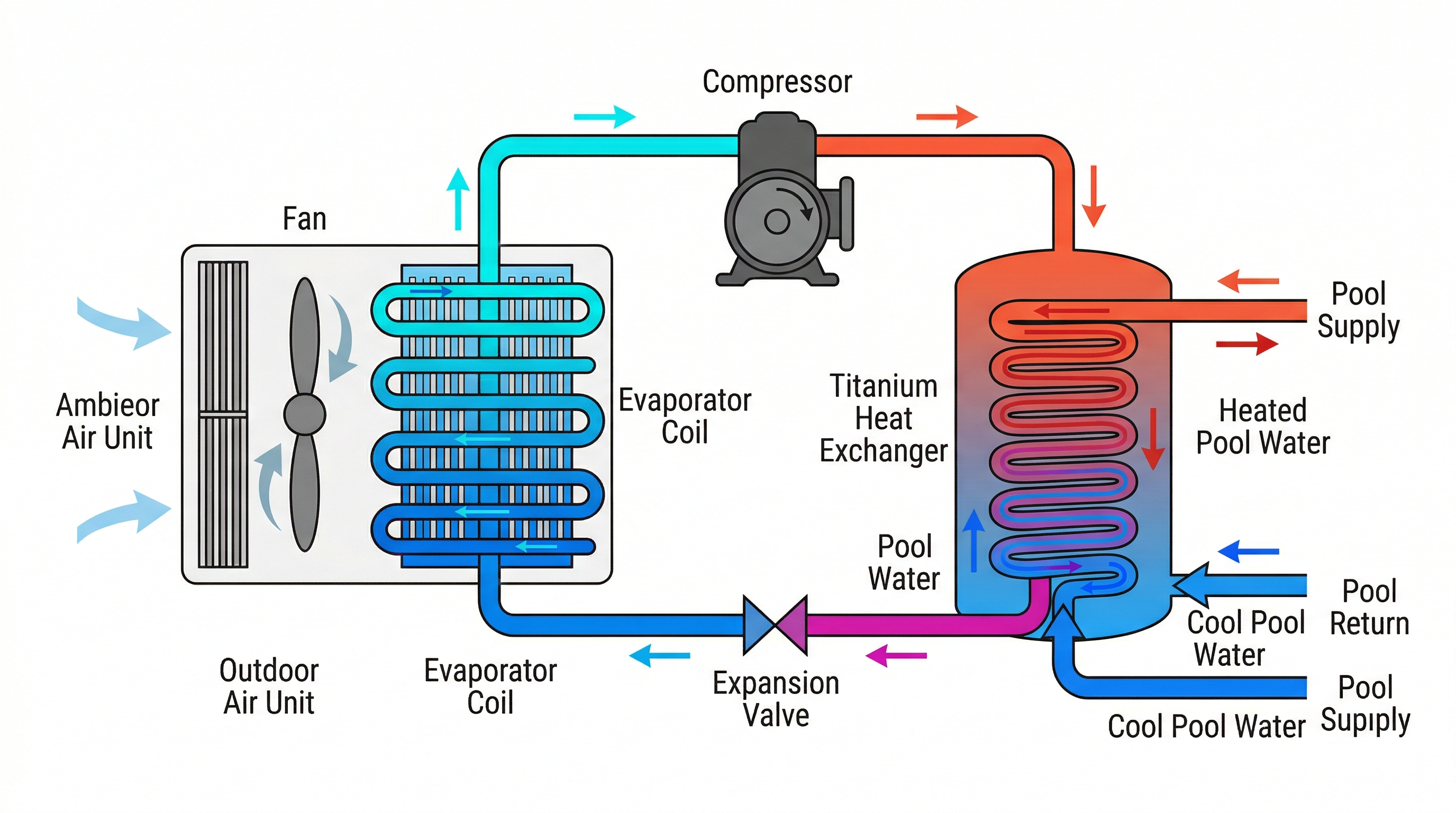
A large fan pulls ambient air across an evaporator coil containing cold refrigerant. Even at 50°F, outdoor air contains usable heat energy.
The liquid refrigerant absorbs heat from the air and turns into a warm gas. A compressor then pressurizes this gas, raising its temperature to 150-200°F.
The hot refrigerant gas passes through a titanium heat exchanger. Pool water flowing through the other side absorbs this heat, typically gaining 1-2°F per hour.
For every 1 kWh of electricity consumed, a heat pump pool heater produces 5-7 kWh of heat energy. A gas heater is only 80-85% efficient — it wastes 15-20% of the fuel.
Without a heater, Massachusetts pools are comfortable for about 3 months (June-August). A heat pump pool heater doubles that to 6 months (May-October).
| Month | Avg High °F | HP Pool Heater? | Notes |
|---|---|---|---|
| April | 56° | Marginal | Marginal — HP output limited below 50°F overnight |
| May | 67° | Yes | Season start — HP reaches 78-82°F by mid-May |
| June | 76° | Yes | Full operation — COP 5-6, pool stays 80-84°F easily |
| July | 82° | Yes | Peak efficiency — COP 6-7, minimal electricity use |
| August | 80° | Yes | Peak efficiency — COP 6-7, minimal electricity use |
| September | 73° | Yes | Great swimming — COP 5-6, comfortable 78-82°F |
| October | 62° | Yes | Season end — HP works harder, pool 74-78°F |
| November | 51° | Marginal | Marginal — close pool, winterize system |
Unheated Massachusetts pools typically reach comfortable temperatures (78°F+) only from mid-June through late August. That is roughly 12-14 weeks of usable swimming — and early/late season days are often too cold for kids.
A heat pump pool heater maintains 78-84°F from May through October — about 24-26 weeks of comfortable swimming. That doubles your return on the pool investment you already made.
Upfront cost is higher than gas, but 10-year total cost is roughly half. No rebates exist for pool heaters — the savings come from operating efficiency.
Depends on BTU output, brand, and features. 100K-140K BTU units (most common for MA in-ground pools) run $3,500-$5,000.
Includes plumbing connections, pad/base, and electrical hookup. A new 30-50A dedicated 240V circuit may add $300-$600 if not already available.
All-in cost. No Mass Save rebates for pool heaters. No federal tax credit (Section 25C expired December 31, 2025).
At the current Eversource MA rate of $0.37/kWh and prevailing gas prices, a heat pump pool heater pays for the upfront cost difference in 2-3 years through operating savings alone.
Mass Save rebates ($1,125-$2,650/ton) apply only to space heating and cooling heat pumps — not pool heaters. The federal Section 25C heat pump tax credit ($2,000) expired December 31, 2025. There are no state or federal incentives for heat pump pool heaters in Massachusetts. The investment case rests entirely on lower operating costs and longer equipment life.
Gas wins on upfront cost. Heat pump wins on everything else.
| Factor | Gas Heater | Heat Pump | Winner |
|---|---|---|---|
| Unit Cost | $1,500-$3,000 | $2,500-$5,500 | Gas |
| Installation | $500-$1,000 | $500-$1,000 | Tie |
| Total Installed | $2,000-$4,000 | $3,000-$6,500 | Gas |
| Monthly Operating | $200-$400 | $110-$190 | HP |
| Season Cost (5 mo) | $1,000-$2,000 | $560-$930 | HP |
| Lifespan | 5-8 years | 10-15 years | HP |
| Heating Speed | 1-2°F/hour | 1-2°F/hour | Tie |
| Works Below 50°F | Yes | Reduced output | Gas |
| Emissions | CO/CO2/NOx | Zero on-site | HP |
| 10-Year Total Cost | $12,000-$24,000 | $8,600-$15,800 | HP |
Bottom line: Gas heaters cost less upfront but roughly twice as much to operate. Over 10 years, a heat pump pool heater saves $3,400-$8,200 compared to gas.
Quick rule: pool volume in gallons ÷ 3 = approximate BTU needed. Then add 10-20% for Massachusetts's cooler shoulder seasons.
| Pool Size (Gallons) | BTU Needed | Model Type | Electrical Req. |
|---|---|---|---|
| 12×24 (7,000 gal) | 50,000-80,000 | Small HP | 30A / 240V |
| 14×28 (10,000 gal) | 80,000-110,000 | Mid HP | 40A / 240V |
| 16×32 (15,000 gal) | 100,000-140,000 | Standard HP | 50A / 240V |
| 18×36 (19,000 gal) | 120,000-140,000 | Large HP | 50A / 240V |
| 20×40 (24,000 gal) | 140,000+ | XL or Dual HP | 50-60A / 240V |
Step 1: Calculate pool volume in gallons.
Step 2: Divide by 3 for base BTU.
Step 3: Add 10-20% for MA climate. Wind exposure, shade, and no pool cover all increase BTU requirements.
Most heat pump pool heaters require a dedicated 240V circuit with 30-50 amp breaker. This is a separate circuit from your pool pump.
Your pool already has a 240V circuit for the pump — the heater needs its own separate circuit.
These models are proven performers in New England climates. All use titanium heat exchangers for durability with chlorinated/salt water.
HeatPro HP21404T
UltraTemp 120
Digital R8450ti-E-HC
HeatPro HP50HA2
TropiCal T115
A solar pool cover reduces heat loss by 50-70% and is the single best upgrade you can pair with a heat pump pool heater. Without a cover, you are literally heating the atmosphere.
$100-$300 for a custom-cut cover. Reduces evaporation by 95%, retains heat overnight, and can raise water temperature 5-10°F on its own from solar gain.
Best Value$50-$100/season. A biodegradable liquid that forms a thin film on the water surface. Reduces heat loss by 20-40%. Convenient but less effective than a physical cover.
Most Convenient$5,000-$15,000 installed. Motorized, push-button convenience. Reduces heat loss by 70%+, adds safety, and meets most local safety codes.
Premium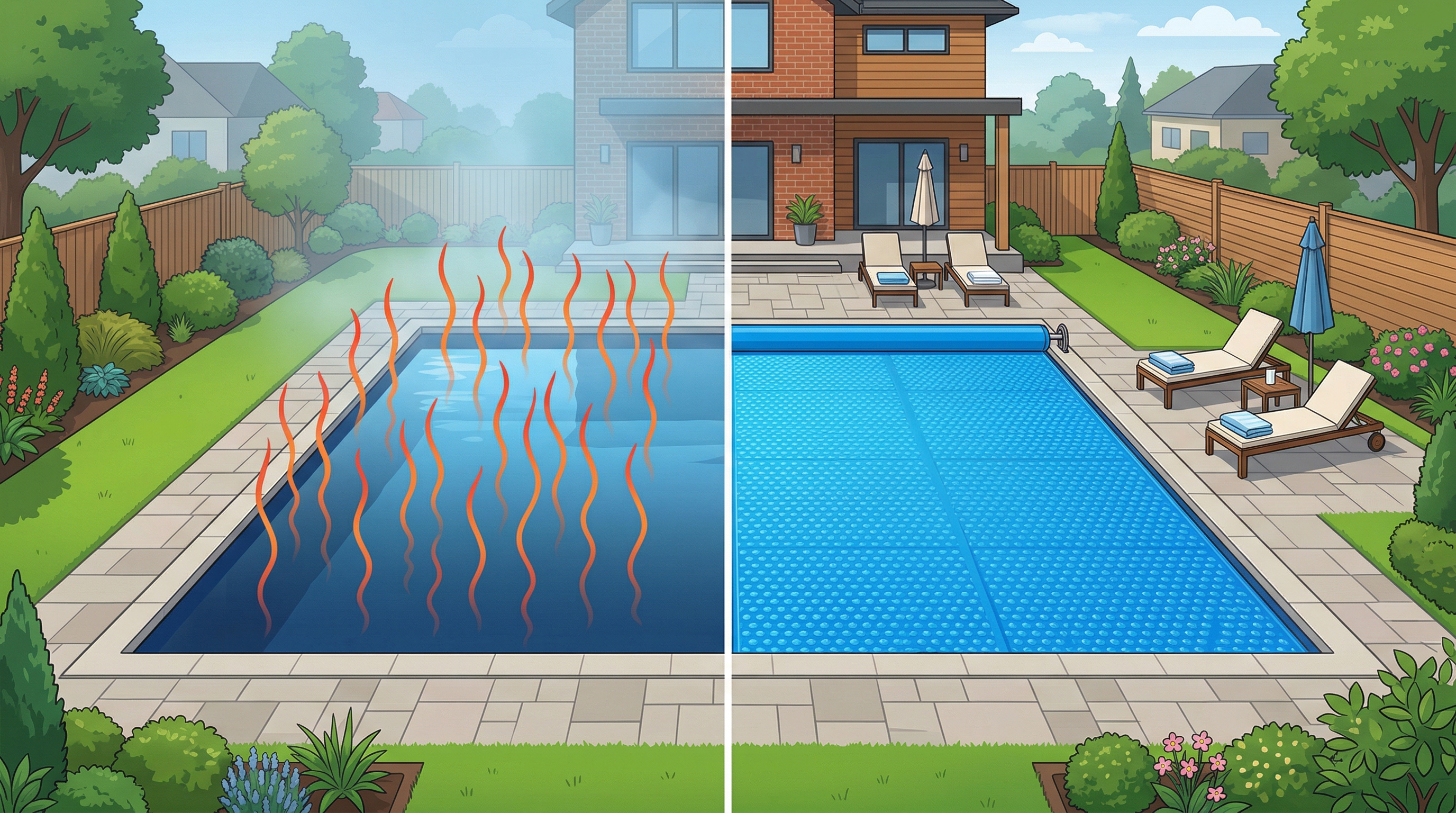
Size your solar array 2-3 kW larger to offset pool heater electricity entirely. Swim for free for 25+ years.
A heat pump pool heater uses approximately 1,500-3,000 kWh per season (May-October). In Massachusetts, a 1 kW solar panel produces about 1,200 kWh/year.
Solar Sizing for Pool Heater
At Massachusetts's current solar cost of ~$3.16/W, adding 2-3 kW costs $6,300-$9,500. This eliminates pool heating electricity costs for 25+ years.
Solar thermal pool heaters (panels on the roof that directly heat water) are another option, but they have significant limitations compared to HP + PV solar:
Solar thermal: Heats water only when the sun is shining. No heating at night, on cloudy days, or in early morning.
Solar thermal: Requires significant roof space (200-400 sq ft). Takes up area that could generate more valuable electricity with PV panels.
HP + PV solar: Heat pump works day and night. Solar panels generate electricity for the whole house, not just the pool. Better ROI.
Our recommendation:
Heat pump pool heater + solar panels to offset electricity. This gives you on-demand heating (day or night, cloudy or sunny) while generating clean energy.
Heat pump pool heaters are louder than HVAC mini-splits. Proper placement prevents neighbor complaints.
Heat pump pool heaters work best when air temperature is 50°F+. Here is what that means for different parts of Massachusetts.
Season: Early May - Late October. Urban heat island effect helps extend the season slightly. Eversource territory — $0.37/kWh bundled residential rate.
Season: Mid-May - Mid-October. Ocean moderation helps fall temperatures, but wind increases heat loss. A pool cover is essential.
Season: Late May - Early October. Cooler temperatures and higher elevation reduce the season by 2-3 weeks. Size heater 20% larger.
A heat pump pool heater in Massachusetts costs $2,500-$5,500 for the unit plus $500-$1,000 for installation, totaling $3,000-$6,500. The exact cost depends on pool size, BTU output needed, and brand. This is more upfront than gas ($2,000-$4,000 installed) but saves $450-$1,050 per year in operating costs at the current Eversource rate of $0.37/kWh.
With a heat pump pool heater, you can reliably swim from May through October in Massachusetts — about 6 months. Without a heater, most pools are only comfortable June through August (3 months). Heat pump pool heaters work best when air temperatures are above 50°F, which makes April and November marginal in MA.
For most Massachusetts pool owners, yes. A heat pump pool heater costs about 50% less to operate ($110-$190/month vs $200-$400/month for gas at the current Eversource rate of $0.37/kWh), lasts nearly twice as long (10-15 years vs 5-8 years), and produces zero on-site emissions. Gas heaters heat faster on the coldest days, but for the May-October MA pool season, heat pumps are the better long-term investment.
A quick sizing rule: divide your pool volume in gallons by 3 to get approximate BTU needed. A typical 15,000-gallon in-ground pool (16×32 ft) needs a 100,000-140,000 BTU heat pump. Factors like wind exposure, shade, and whether you use a pool cover also affect sizing. Oversizing by 10-20% is recommended for Massachusetts's cooler spring and fall temperatures.
No. Mass Save rebates are exclusively for space heating and cooling heat pumps, not pool heaters. There is no state or federal rebate for heat pump pool heaters in Massachusetts as of 2026. The investment pays for itself through lower operating costs — typically $450-$1,050/year in savings vs gas.
Heat pump pool heaters produce 55-65 dB of noise — roughly as loud as a normal conversation or a window air conditioner. They are noticeably louder than HVAC mini-splits (40-50 dB). Position the unit at least 10-15 feet from bedrooms and property lines. Some models like the Pentair UltraTemp have quieter fan designs around 58 dB.
Yes. A heat pump pool heater typically uses 1,500-3,000 kWh per season. Adding 2-3 kW of solar capacity (5-7 panels) offsets the pool heater electricity completely. In Massachusetts, this adds about $6,000-$9,500 to your solar system cost but eliminates pool heating operating costs entirely for 25+ years.
No — heat pump pool heaters are not designed for winter use in Massachusetts. They lose efficiency below 50°F air temperature and stop working effectively below 40°F. The practical MA pool season with a heat pump heater is May through October. You should winterize and cover your pool from November through April.
Get a free quote for a heat pump pool heater, or bundle with solar panels to eliminate pool heating costs entirely.
Current pricing, incentives, and payback for Massachusetts solar.
Read moreCombine solar with heat pump for maximum savings.
Read moreSpace heating/cooling heat pump pricing and Mass Save rebates.
Read moreCompare electricity rates that affect pool heater operating costs.
Read morePool heater pricing: Hayward, Pentair, Raypak manufacturer MSRP and dealer pricing, Q1 2026.
COP ratings: AHRI (Air-Conditioning, Heating, and Refrigeration Institute) certified performance data.
MA electricity rates: per-utility all-in bundled residential rate from each utility's own published tariff (e.g. Eversource MA), maintained in NuWatt's canonical rate database.
MA natural gas rates: EIA Natural Gas Monthly, Massachusetts residential average, January 2026.
Massachusetts climate data: NOAA National Weather Service, Boston Logan station averages (1991-2020).
Mass Save program eligibility: masssave.com — pool heaters explicitly excluded from rebate programs.
Section 25C expiration: One Big Beautiful Bill Act (OBBBA), signed July 4, 2025.