Loading NuWatt Energy...

We use your location to provide localized solar offers and incentives.
We serve MA, NH, CT, RI, ME, VT, NJ, PA, and TX
Loading NuWatt Energy...
NuWatt designs, installs, and manages solar, battery, heat pump, and EV charger systems across 9 states. One company, one warranty, one point of contact.
Get a Free Quote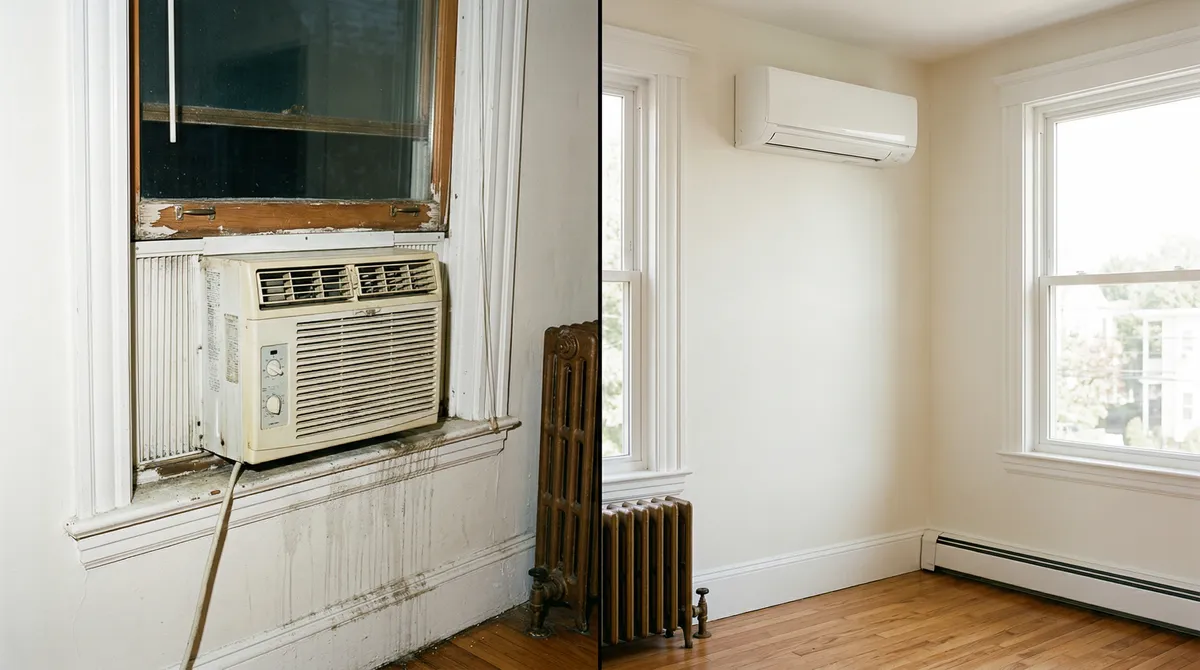
A mini-split heat pump replaces your window AC AND heats your home year-round. One unit does both. It is quieter, more efficient, and Mass Save pays $2,500 toward the installation. Your window AC gets $0.
A mini-split heat pump is a two-in-one system. In summer, it cools your space more efficiently than a window AC (20+ SEER2 vs 8-12 EER). In winter, it heats your space down to -15°F. No window blocking, no winter storage, no 55 dB buzz.
For Massachusetts apartments, triple-deckers, and condos without central HVAC, the mini-split is the upgrade path. It only needs a 3-inch wall hole — no ductwork.
Massachusetts has some of the oldest housing stock in the country. Over 60% of rental units in Boston were built before 1960 — long before central air conditioning was standard. This means millions of MA residents rely on window ACs as their only cooling option.
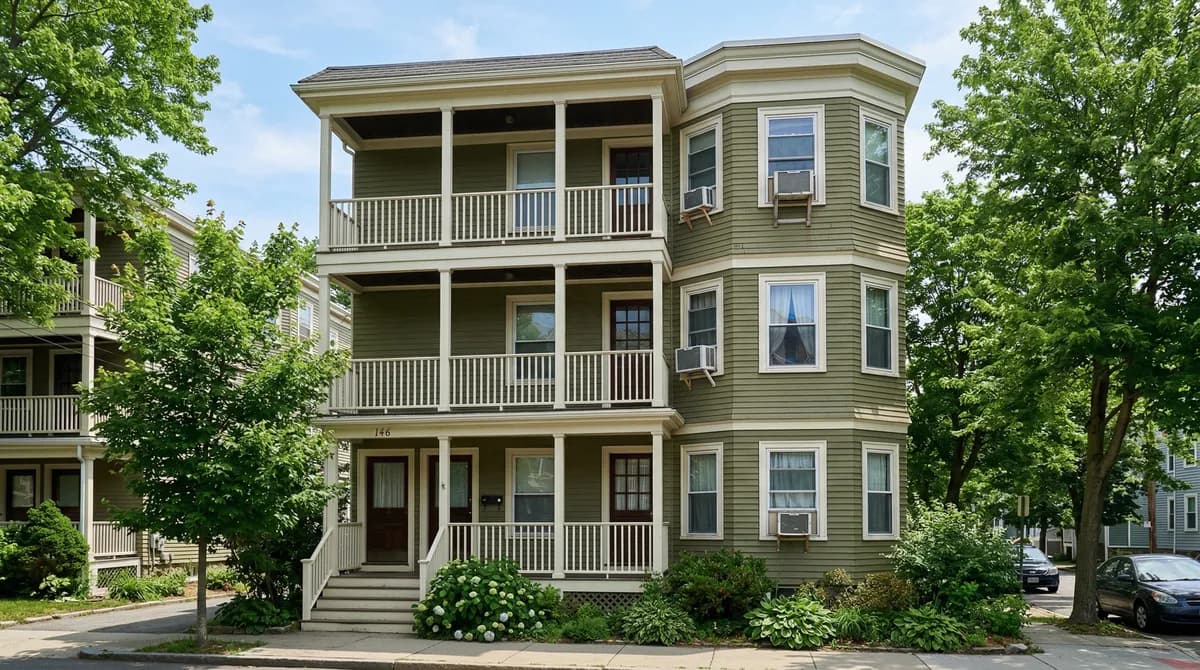
Triple-deckers, Victorian-era apartments, and pre-war condos were built without ductwork. Retrofitting ducts is prohibitively expensive ($10,000-$20,000) and often physically impossible in these buildings. Window AC became the default solution.
Many landlords in the Boston metro area and college towns refuse to install HVAC systems, leaving tenants to buy their own window units. This means renters absorb the full cost with no property improvement.
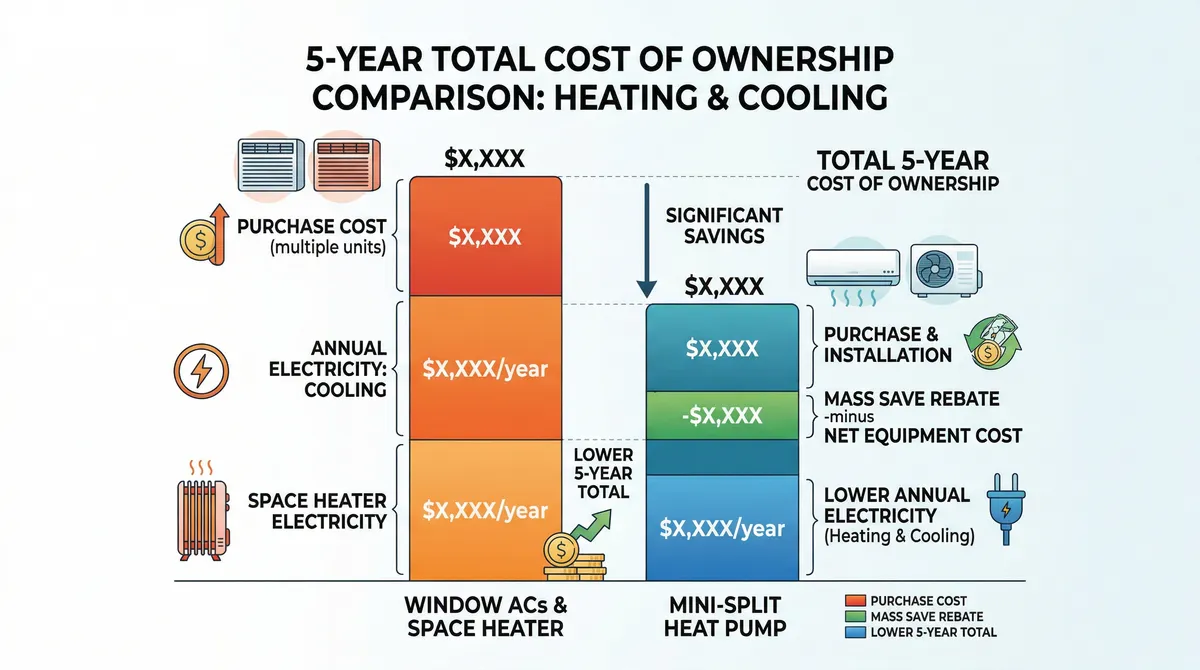
A window AC costs $150-$500, making it the path of least resistance. But 2-3 units per apartment ($500-$1,500) plus space heaters for winter ($50-$100 each) adds up fast — and you replace them every 5-8 years.
Many MA residents do not realize that a mini-split heat pump is a viable option for apartments without ductwork. It requires only a small hole in the wall — no ducts, no major renovation, and Mass Save subsidizes the cost.
Window air conditioners were a 1950s solution. For Massachusetts homes in 2026, a mini-split heat pump eliminates every major drawback.
Window ACs run at 50-60 dB — louder than a normal conversation. Mini-splits whisper at 19-25 dB.
A window AC forces the window to stay partially open. In a first-floor apartment, this is an invitation for break-ins.
You lose an entire window to the AC unit. In older Boston apartments with small windows, that is a significant loss of natural light.
Window ACs rate 8-12 EER. A mini-split at 20+ SEER2 uses 40-60% less electricity for the same cooling.
Every October you wrestle a 60+ lb unit out of the window, store it somewhere, and reinstall it in May. Mini-splits stay put year-round.
The gap around a window AC lets in pollen, dust, bugs, and street noise. A mini-split is a sealed system with multi-stage filtration.
This is the single biggest quality-of-life improvement. The difference is dramatic.
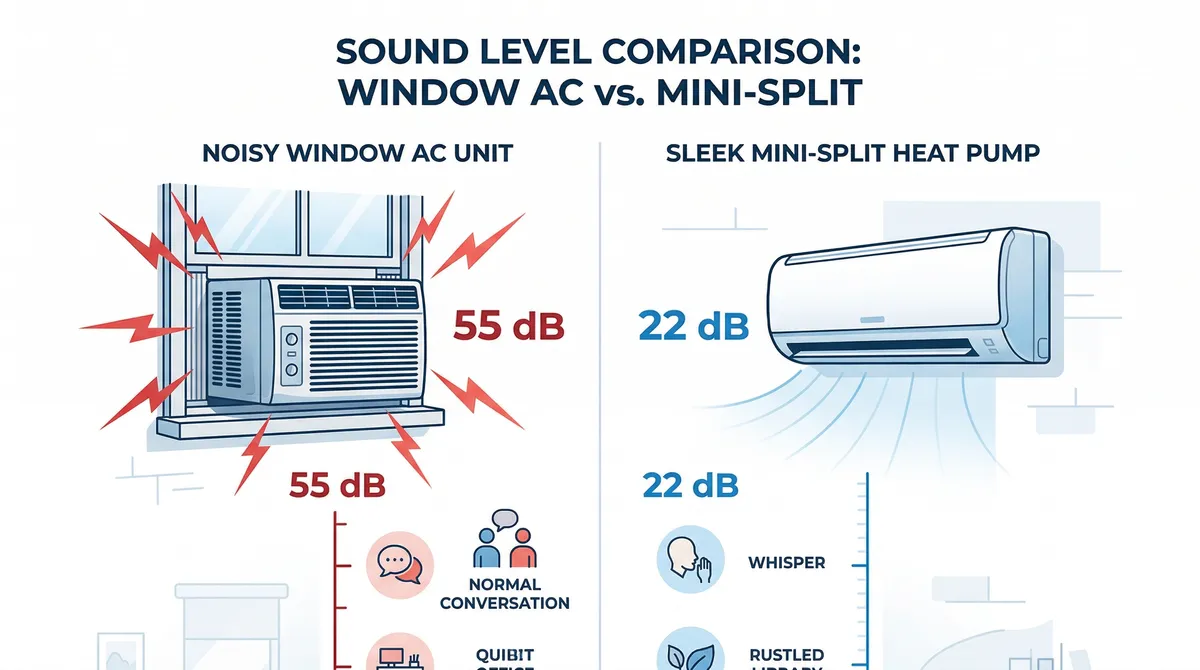
50-60 dB
19-25 dB
Decibel scale is logarithmic: A window AC at 55 dB is approximately 8x louder in perceived volume than a mini-split at 22 dB. It is not a small difference.
Every metric that matters for Massachusetts homeowners, renters, and landlords.
| Feature | Window AC | Mini-Split HP |
|---|---|---|
| Cooling Efficiency | 8-12 EER | 20-22 SEER2 |
| Noise (Indoor) | 50-60 dB (conversation-level) | 19-25 dB (whisper-quiet) |
| Heating Capability | None (need space heater) | Yes, down to -15°F |
| Window Security | Window partially open | No window access needed |
| Air Quality | Brings in outdoor air/pollen | Sealed system with filters |
| Natural Light | Blocks window | Zero window obstruction |
| Upfront Cost | $150-$500 per unit | $3,500-$5,500 installed |
| Mass Save Rebate | $0 | $2,500 basic tier |
| Winter Storage | Must remove & store | Permanent installation |
| Lifespan | 5-10 years | 15-20 years |
Bottom line:The mini-split wins 9 out of 10 categories. The only advantage of a window AC is the lower upfront cost — but after the Mass Save $2,500 rebate, even that gap narrows dramatically.
Most people compare only the purchase price. But when you add operating costs and the fact that window AC users also need space heaters in winter, the picture changes completely.
These calculations use the current all-in bundled Eversource residential rate of $0.38/kWh. National Grid customers pay $0.42/kWh, so their savings run slightly higher — the same rate applies to both the window AC and the mini-split, so the mini-split comes out ahead at every MA utility rate.
payback period
payback period
payback period
Mass Save — the statewide energy efficiency program — offers direct rebates for heat pump installations. Window air conditioners receive nothing because they only cool and do not reduce overall energy consumption.
The federal Section 25C energy efficiency tax credit expired December 31, 2025. There is $0 in federal credits for heat pumps (or any HVAC equipment) in 2026. The Mass Save rebate is your primary incentive. Do not let any installer claim otherwise.
Massachusetts has unique housing that makes mini-splits particularly valuable. Here is how the upgrade works for each property type.
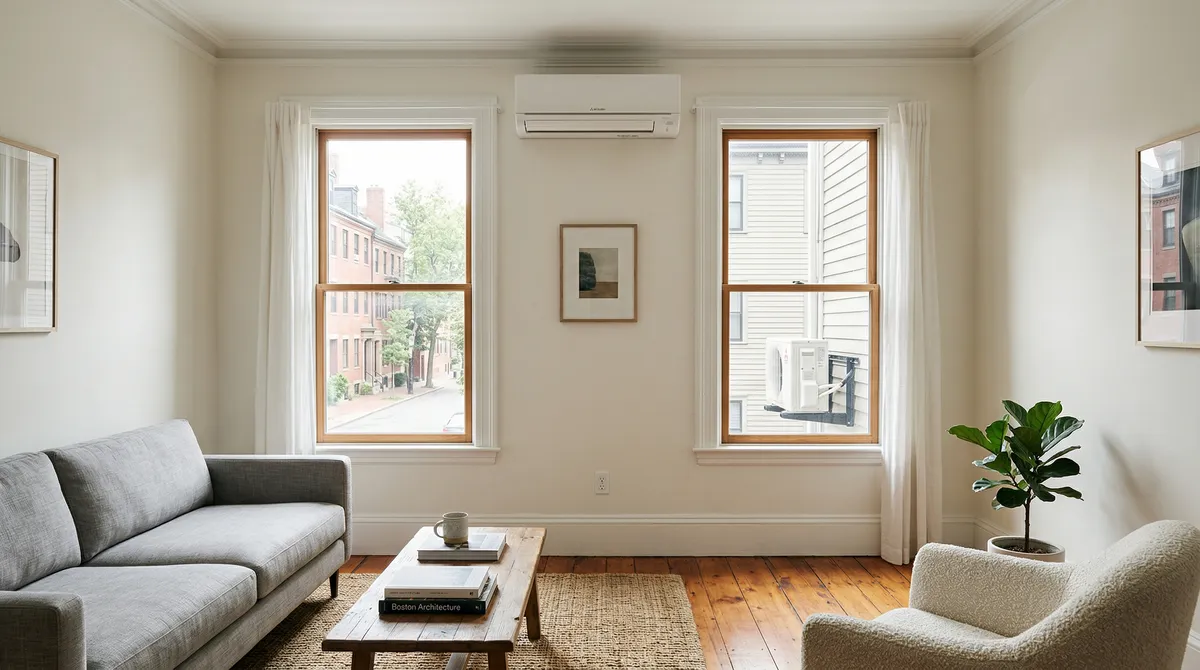
Boston, Somerville, Cambridge, Worcester, and Springfield have thousands of triple-deckers. These 3-story buildings typically have radiator heat and zero cooling infrastructure. Mini-splits are the ideal retrofit:
For renters, the key question is whether the landlord will allow the installation. A mini-split requires a 3-inch hole in the exterior wall and a mounting bracket for the outdoor unit.
Condo associations often have rules about exterior modifications. Mini-split outdoor units are compact (typically 32” × 22”) and can be placed on balconies or mounted on brackets with minimal visual impact.
If you own rental property in Massachusetts, installing mini-split heat pumps is one of the highest-ROI improvements you can make.
Mass Save rebate per unit
rent increase potential/mo
mini-split lifespan
tenant HVAC complaints
The real comparison is not just summer cooling. Massachusetts needs heating for 7 months. Window AC users typically rely on electric space heaters — the most expensive way to heat a home.
A space heater converts electricity to heat at a 1:1 ratio (COP 1.0). A mini-split heat pump moves 3-4x more heat energy than the electricity it consumes (COP 3.0-4.0). This means the mini-split provides the same warmth for one-third of the electricity cost.
We are not going to pretend a mini-split is the right choice for everyone. Here are the situations where a window AC is still the practical option.
If you are in a temporary living situation — graduate school, short work assignment, or just not sure how long you will stay — the mini-split payback may not make sense. A $200 window AC is the pragmatic choice.
Some landlords will not allow any wall penetration. Without the exterior wall hole for the refrigerant line, a mini-split cannot be installed. In this case, consider asking the landlord if they would like to claim the Mass Save rebate themselves.
If you have central air that covers most rooms but need a boost for one hot room (sunroom, attic bedroom), a portable or window unit for occasional use can be the simpler answer.
Even with the $2,500 Mass Save rebate, the remaining $1,000-$3,000 net cost may not be feasible. Check if you qualify as income-eligible — Mass Save covers up to 100% for qualifying households.
This is the key reason mini-splits work for Massachusetts apartments. The installation is minimally invasive compared to any other HVAC system.
Required before qualifying for rebates. A technician evaluates your home and recommends equipment sizing. No cost to you.
Must be a Mass Save-approved installer. Get 2-3 quotes. A single-zone mini-split should cost $3,500-$5,500 installed.
Installer drills a 3-inch hole in the exterior wall, mounts the indoor unit high on the wall, places the outdoor compressor outside, and connects refrigerant lines. No ductwork.
Installer tests cooling and heating modes, checks refrigerant charge, programs the thermostat, and walks you through the remote control.
The $2,500 Mass Save rebate is typically applied directly to your invoice. You pay the net amount. No waiting for a check.
These are the most commonly installed single-zone mini-splits in MA apartments and condos. All are Mass Save-eligible and cold-climate rated.
All models are Mass Save-eligible and eligible for the $2,500 basic-tier rebate. Prices include professional installation. Get multiple quotes — prices vary by installer.
Yes. A single-zone mini-split provides more cooling capacity than a window AC (12,000+ BTU at 20+ SEER2) and also heats your space in winter. It mounts high on a wall, requires no window access, and runs at just 19-25 dB indoors compared to a window AC's 50-60 dB.
A window AC costs $150-$500 per unit, but most apartments need 2-3 units ($500-$1,500 total). A single-zone mini-split costs $3,500-$5,500 installed. However, Mass Save offers a $2,500 rebate for heat pump installations, bringing the net cost to $1,000-$3,000. The mini-split pays for itself in 3-5 years through lower operating costs and eliminated space heater bills.
No. Mass Save provides $0 in rebates for window AC units. However, mini-split heat pumps qualify for a $2,500 basic-tier rebate through Mass Save, and income-eligible households can receive up to 100% of the cost covered. Mass Save also offers a 0% HEAT Loan for any remaining balance.
For tenants planning to stay 3+ years, yes. The mini-split eliminates window AC hassle, provides whisper-quiet heating and cooling, and saves $300-$800 per year in operating costs compared to window ACs plus space heaters. For landlords, installing mini-splits increases property value and reduces tenant complaints.
A window AC runs at 50-60 decibels, which is about as loud as a normal conversation. A mini-split indoor unit runs at just 19-25 decibels, which is quieter than a whisper. The outdoor compressor is also much quieter than a window AC at 45-55 dB vs the window unit's vibrations and rattling.
Yes. That is the main advantage of a mini-split. It only requires a 3-inch hole in the wall for the refrigerant line connecting the indoor and outdoor units. No ductwork needed at all. This makes it ideal for older Massachusetts apartments, triple-deckers, and condos that were built without central HVAC.
No. Modern cold-climate mini-splits heat effectively down to -15 degrees F, which covers even the coldest Massachusetts winters. A single mini-split replaces both your window AC in summer and your space heater in winter. This eliminates the fire risk and high electricity cost of space heaters.
A window AC may still make sense if you are renting for less than 2 years and cannot take the equipment with you, if your landlord refuses to allow wall penetration for the refrigerant line, or if you only need cooling for a single room for a few weeks per year. In all other scenarios, the mini-split is the better investment.
No. The federal Section 25C energy efficiency tax credit expired on December 31, 2025. There is $0 in federal credits for heat pumps in 2026. However, the Massachusetts Mass Save rebate of $2,500 (basic tier) is still available and is a direct discount applied at the time of installation.
If you are still using window ACs in your Massachusetts apartment, triple-decker, or condo, a mini-split heat pump is the upgrade you have been waiting for. It cools better, heats in winter, runs whisper-quiet, and Mass Save pays $2,500 toward the installation.
vs 55 dB window AC
Mass Save rebate
payback period