
Loading NuWatt Energy...
We use your location to provide localized solar offers and incentives.
We serve MA, NH, CT, RI, ME, VT, NJ, PA, and TX
Loading NuWatt Energy...
NuWatt designs, installs, and manages solar, battery, heat pump, and EV charger systems across 9 states. One company, one warranty, one point of contact.
Get a Free QuoteNational Grid charges $0.32/kWh. Eversource charges $0.28/kWh. That $0.04 gap adds up to thousands of dollars in extra solar savings over 25 years. Here is the full breakdown for 8 kW, 10 kW, and 12 kW systems.
$0.32
National Grid rate
$0.28
Eversource rate
14%
Rate difference
~1 yr
Faster NGrid payback
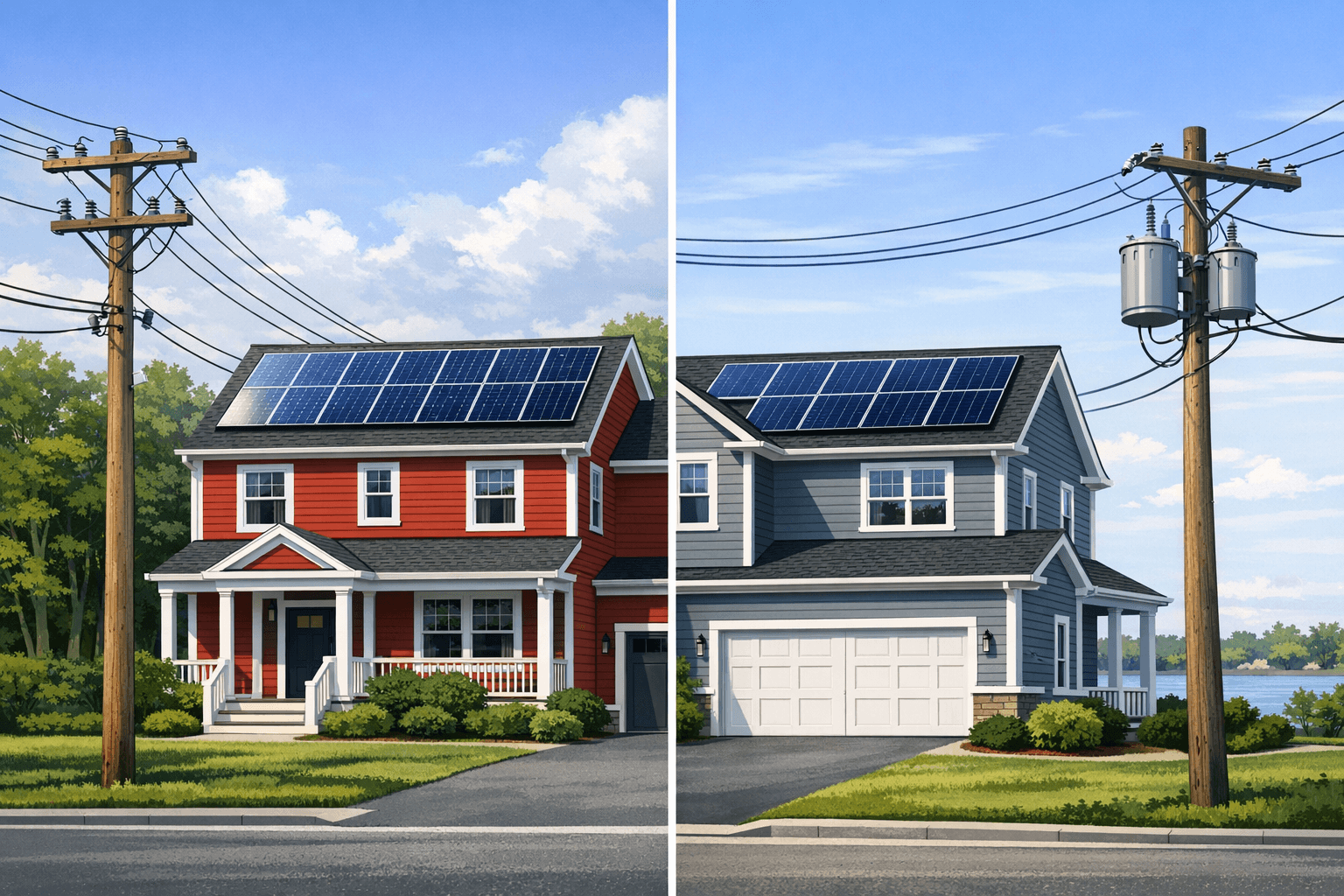
National Grid and Eversource together serve about 85% of Massachusetts residential electricity customers. Your utility determines your rate — and your solar savings.
Here is what each utility's customers save annually with solar, based on Massachusetts average production of 1,250 kWh per installed kW.
| System Size | Annual kWh | NGrid Annual | NGrid Monthly | Eversource Annual | Eversource Monthly | NGrid Advantage |
|---|---|---|---|---|---|---|
| 8 kW | 10,000 | $3,200 | $267/mo | $2,836 | $236/mo | +$364/yr |
| 10 kW | 12,500 | $4,000 | $333/mo | $3,545 | $295/mo | +$455/yr |
| 12 kW | 15,000 | $4,800 | $400/mo | $4,254 | $355/mo | +$546/yr |
Why the gap matters more than you think
The $350-$520/year advantage for National Grid customers compounds with annual rate increases. If rates rise 3.5% per year (the 10-year MA average), the annual gap grows from ~$450 today to ~$850 by year 25. Over the full 25-year panel lifespan, National Grid customers see $12,000-$18,000 more in total savings than Eversource customers with identical systems.
Higher rates mean faster payback. National Grid customers reach break-even approximately 1-1.5 years sooner than Eversource customers on identical systems.
System cost: $27,200 (no federal ITC)
NGrid payback is 1.1 years faster
System cost: $34,000 (no federal ITC)
NGrid payback is 1.1 years faster
System cost: $40,800 (no federal ITC)
NGrid payback is 1.1 years faster
Important: No federal ITC in these calculations
The federal Section 25D residential solar tax credit expired December 31, 2025. These payback calculations reflect 2026 reality — no federal tax credit. Massachusetts state incentives (SMART, net metering, property/sales tax exemptions) still apply for both utilities. Lease/PPA options through Section 48E commercial ITC are still available.
The real story is in the long run. With electricity rates rising 3.5% annually (conservative based on MA history), here is what each utility's customers net over 25 years.
| System | NGrid 25-yr Savings | Eversource 25-yr Savings | NGrid Net Profit | Eversource Net Profit | NGrid Advantage |
|---|---|---|---|---|---|
| 8 kW | $124,640 | $110,462 | $97,440 | $83,262 | +$14,178 |
| 10 kW | $155,799 | $138,077 | $121,799 | $104,077 | +$17,722 |
| 12 kW | $186,959 | $165,693 | $146,159 | $124,893 | +$21,267 |
NGrid Net Profit
$97,440
Eversource Net Profit
$83,262
NGrid customers earn $14,178 more over 25 years
NGrid Net Profit
$121,799
Eversource Net Profit
$104,077
NGrid customers earn $17,722 more over 25 years
NGrid Net Profit
$146,159
Eversource Net Profit
$124,893
NGrid customers earn $21,267 more over 25 years
What does solar actually do to your monthly electric bill? Here is a typical scenario for a home using 750 kWh/month with a 10 kW system.
Rate: $0.3200/kWh | Usage: 750 kWh/mo
Annual: $2,880 | Excess credits roll forward monthly
Rate: $0.2836/kWh | Usage: 750 kWh/mo
Annual: $2,556 | Excess credits roll forward monthly
The most important factor in long-term solar savings is not today's rate — it is the rate trend. Both National Grid and Eversource have raised rates consistently.
6-year CAGR: 6.4% annual increase
6-year CAGR: 5.8% annual increase
Rising rates make solar more valuable every year
Every time your utility raises rates, your solar system becomes more valuable because you are avoiding a higher cost. A system installed today at $0.30/kWh offset saves you $0.30 in year 1. If rates hit $0.50/kWh in year 15 (plausible at 3.5% annual growth), that same system saves you $0.50/kWh — a 67% increase in annual dollar savings with zero additional investment.
If you add a battery, ConnectedSolutions demand response payments differ between the two utilities. Here is the comparison for a typical 10 kWh battery (Tesla Powerwall or equivalent).
Eversource wins on batteries
While National Grid wins on solar savings (higher electric rate), Eversource wins on ConnectedSolutions battery income ($250/year more). This partially offsets the solar savings gap. For a solar + battery system, the total savings gap between utilities narrows to approximately $200-$270/year.
Higher rate = faster payback = more savings
8-9 year payback. $12K-$18K more in 25-year savings vs Eversource. Best solar economics in MA.
Go solar. Higher rate makes the math unbeatable.
Slightly lower rate — still excellent returns
9-10.5 year payback. Higher ConnectedSolutions battery payments partially offset rate gap. Still strong ROI.
Go solar. Add a battery for ConnectedSolutions income.
Both are winners — do not delay for rate changes
Both utilities deliver 8-11 year payback with 25-year net profits of $50K-$100K+ on a 10 kW system. Waiting costs you.
The best time to install is now. Every month without solar is money lost.
Enter your address and we will calculate savings based on your specific utility rate, roof, and usage. Free instant estimate — no commitment.
National Grid customers save approximately $350-$520 more per year than Eversource customers with the same size system, because National Grid's rate ($0.32/kWh) is about 14% higher than Eversource's ($0.28/kWh). On a 10 kW system producing 12,500 kWh/year, a National Grid customer saves ~$4,000/year vs. Eversource at ~$3,500/year. Over 25 years, that $500/year difference compounds to $12,500+ more in total savings.
As of early 2026, National Grid's all-in residential rate in Massachusetts averages $0.32/kWh. This includes supply (about $0.14/kWh), distribution (~$0.11/kWh), transition charges, renewable energy charges, and energy efficiency surcharges. The rate varies by season and rate class. National Grid serves central and western Massachusetts plus parts of greater Boston.
As of early 2026, Eversource's all-in residential rate in Massachusetts averages $0.2836/kWh. Eversource tends to have lower supply charges than National Grid but comparable distribution charges. Eversource serves eastern Massachusetts including much of the greater Boston area, the South Shore, and Cape Cod (through Cape Light Compact, which uses Eversource delivery).
Yes, directly. Solar savings are calculated as: annual production (kWh) x electric rate ($/kWh). A higher rate means each kWh your panels produce offsets a more expensive grid kWh. National Grid customers at $0.32/kWh see a payback of approximately 8-9 years on a cash purchase, while Eversource customers at $0.28/kWh see approximately 9-10.5 years. Both are excellent — but National Grid customers reach break-even roughly 1-1.5 years sooner.
Yes. Both National Grid and Eversource offer net metering under Massachusetts DPU regulations. You receive bill credits for excess solar production at approximately the full retail rate (supply + distribution). Credits carry forward monthly and are "trued up" annually in March/April. The net metering rules are identical for both utilities — the difference is only in the rate those credits are worth.
National Grid territory offers the best solar economics in Massachusetts due to the highest residential rate. But Eversource is still excellent — both utilities produce strong returns. If you are in either territory, solar makes financial sense. The decision to go solar should not depend on which utility you have — both offer 8-11 year payback periods, which is well within the 25-30 year panel lifespan.
Yes. Massachusetts electricity rates have increased an average of 3-5% per year over the past decade, and both National Grid and Eversource have proposed rate increases for 2026-2027. Each rate increase makes existing solar systems more valuable because you are avoiding a higher cost. A system installed today at $0.30/kWh offsets electricity that may cost $0.45-$0.55/kWh in 10 years.
National Grid pays $225/kW for summer demand response plus $50/kW for winter events through ConnectedSolutions. Eversource pays $275/kW for summer plus $50/kW for winter — $50/kW more per summer season than National Grid. Eversource battery owners earn approximately $1,400-$1,600/year from a 10 kWh battery, while National Grid battery owners earn $1,100-$1,300/year. Note: Unitil does not participate in ConnectedSolutions.
Detailed rate structure breakdown
Read guideCurrent MA costs & payback
Read guideHow credits work for both utilities
Read guideEarn $1,000+/yr from your battery
Read guideDetailed payback analysis
Read guideWhere MA rates are heading
Read guide