Loading NuWatt Energy...

We use your location to provide localized solar offers and incentives.
We serve MA, NH, CT, RI, ME, VT, NJ, PA, and TX
Loading NuWatt Energy...
NuWatt designs, installs, and manages solar, battery, heat pump, and EV charger systems across 9 states. One company, one warranty, one point of contact.
Get a Free QuotePigeons in Boston. Seagulls on Cape Cod. Squirrels everywhere. Your solar panels create the perfect sheltered nesting spot — and bird droppings, nesting material, and chewed wiring can cost you thousands in lost production and repairs. Here is what works, what it costs, and what to avoid.
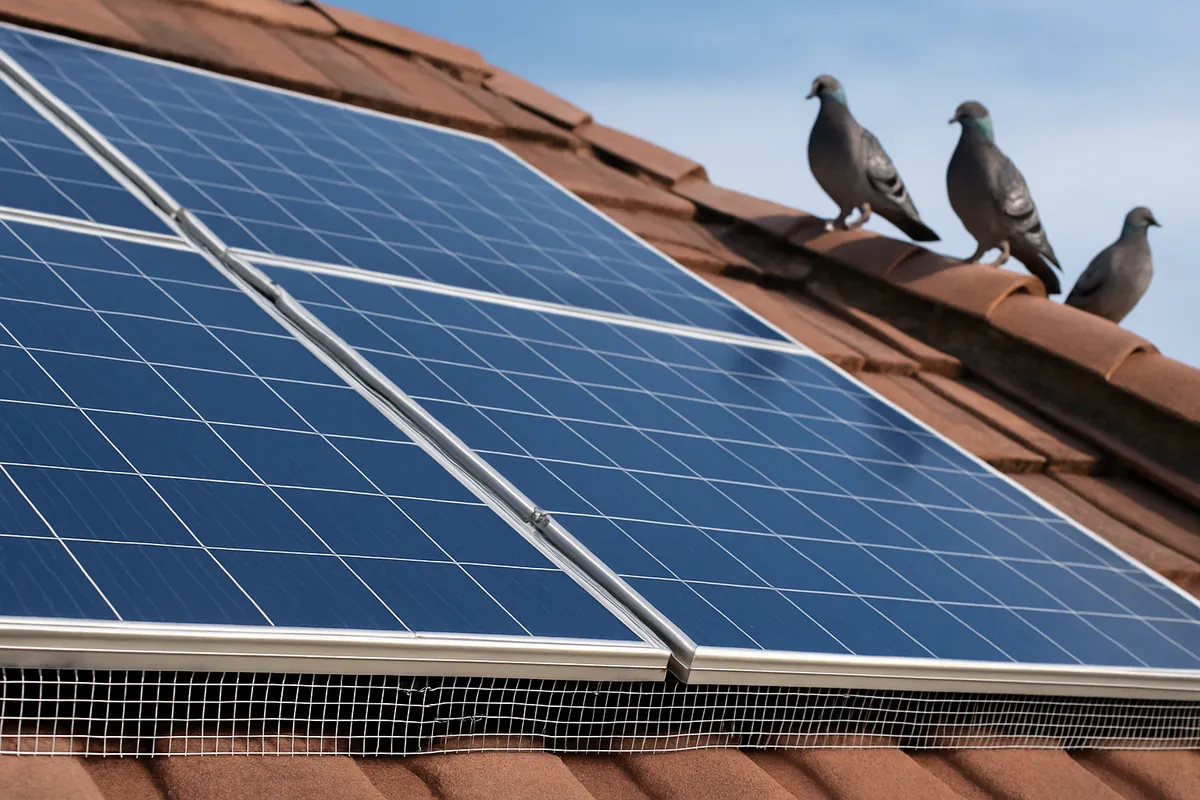
Solar panels create a 3-6 inch gap between the panel and your roof — a warm, dry, sheltered space that is irresistible to birds and squirrels. In Massachusetts, this is not a theoretical risk. It is one of the most common service calls our installers handle.
Birds build nests that block airflow, causing panels to overheat and lose 5-15% production. Nests also trap moisture, leading to roof damage.
Bird droppings create hot spots that reduce production. A single pigeon produces 25+ lbs of droppings/year. Seagull droppings are highly acidic.
Squirrels chew on solar wiring insulation. This can cause system failures, arc faults, and in extreme cases, fire hazards. Costly to repair.
A squirrel-chewed wire run can cost $300-$800 to repair. Pigeon cleanup and panel washing runs $200-$400. Prevention is far cheaper.
Not all protection is equal. Here is a detailed comparison of each method with costs, durability, and when to use each in Massachusetts.
| Method | Cost (installed) | Durability | Effectiveness | Best For |
|---|---|---|---|---|
| Bird Netting (Mesh Enclosure) | $500-$1,200 | 5-10 years | 95% (all pests) | Heavy pigeon or seagull infestations, urban Boston areas |
| Critter Guard (Metal Mesh Clips) | $600-$1,500 | 15-25 years (matches panel life) | 90% (most pests) | General protection, homeowners who want a clean look |
| Bird Spikes / Deterrents | $200-$600 | 10-15 years | 60-75% (birds only) | Rooftop edges and ledges, supplemental protection |
| Ultrasonic / Visual Deterrents | $50-$300 | 2-5 years (battery/unit life) | 30-50% (limited) | Temporary or supplemental use only |
Pros
Cons
Massachusetts Note: Best option for downtown Boston and Cambridge where pigeon populations are heavy. UV-resistant varieties recommended for coastal installations. Stainless steel mesh lasts longer in salt air environments.
Pros
Cons
Massachusetts Note: Our recommended option for most Massachusetts homes. Galvanized steel handles New England weather well. Stainless steel recommended for properties within 5 miles of the coast (salt air corrosion resistance).
Pros
Cons
Massachusetts Note: Useful as supplemental protection on roof edges but NOT sufficient as the sole defense against nesting. In Massachusetts, squirrels are as much of a problem as birds — spikes do nothing against them.
Pros
Cons
Massachusetts Note: We do not recommend ultrasonic or visual deterrents as a primary solution in Massachusetts. Birds in urban areas (Boston pigeons) and coastal areas (seagulls) are habituated to noise and motion. Physical barriers are the only reliable long-term solution.
Different parts of Massachusetts face different wildlife challenges. Here is a regional breakdown of what birds and pests are most common and what protection to use.
Primary Birds
Pigeons (rock doves), starlings, house sparrows
Squirrels / Other
Eastern gray squirrels (heavy tree canopy)
Common Towns
Boston, Cambridge, Somerville, Brookline, Medford, Quincy, Dorchester, Roxbury
Recommendation: Critter guard or bird netting. Pigeons nest in colonies — one pair becomes 20. Install protection during initial solar installation.
Primary Birds
Herring gulls, great black-backed gulls, cormorants
Squirrels / Other
Less common on exposed coastline; chipmunks inland
Common Towns
Cape Cod, Plymouth, Scituate, Marshfield, Gloucester, Newburyport, Salem
Recommendation: Stainless steel critter guard (salt air corrosion resistance). Seagull droppings are highly acidic — regular panel cleaning recommended in addition to physical barriers.
Primary Birds
Sparrows, robins, blue jays, woodpeckers (occasional)
Squirrels / Other
Eastern gray squirrels (highest risk — tree proximity)
Common Towns
Lexington, Concord, Wellesley, Newton, Needham, Natick, Framingham
Recommendation: Critter guard prioritized for squirrel protection. Squirrels chew wiring and can cause fire hazards. Trim tree branches to 8+ feet from panels.
Primary Birds
Sparrows, starlings, occasional raptors (do not interfere)
Squirrels / Other
Gray squirrels, chipmunks, occasional raccoons
Common Towns
Springfield, Northampton, Pittsfield, Greenfield, Amherst
Recommendation: Basic critter guard recommended, especially if trees are within 15 feet. Less pigeon pressure than urban areas. Monitor for squirrel activity — they are the primary threat.
| Item | With Solar Install | Retrofit Later |
|---|---|---|
| Critter guard materials | $300-$600 | $300-$600 |
| Labor | $200-$400 | $400-$800 |
| Truck roll / scaffolding | $0 (included) | $150-$300 |
| Bird removal + cleanup | $0 (no birds yet) | $150-$300 |
| Total | $500-$1,000 | $1,000-$2,000 |
Solar panel bird netting in Massachusetts costs $500-$1,200 for a typical residential system (20-30 panels). This includes materials and professional installation. Mesh critter guards cost $400-$1,000. Spike/deterrent systems cost $200-$600. Costs vary based on roof pitch, system size, and accessibility. Most installers recommend professional installation to avoid voiding your panel warranty.
Bird netting is a flexible mesh that encloses the space under solar panels, blocking all access. Critter guard (also called wildlife guard or mesh guard) is a rigid or semi-rigid metal mesh that clips to the panel frames and covers the gap between panels and roof. Bird netting is cheaper but less durable. Critter guard is more expensive but lasts longer and looks cleaner. Both prevent nesting under panels.
Yes. Solar panels create a sheltered space between the panel and roof that attracts birds for nesting and squirrels for shelter. In Massachusetts, pigeons (especially in urban areas like Boston), seagulls (coastal towns), sparrows, starlings, and squirrels are the most common offenders. The warm, dry space under panels is ideal for nesting, especially in spring and fall.
Yes, in multiple ways. Birds nest under panels, blocking airflow and causing panels to overheat (reducing production 5-15%). Bird droppings on panels reduce production by blocking sunlight. Squirrels chew on wiring, which can cause system failures or fire hazards. Seagull droppings are particularly acidic and can damage panel coatings over time. Nesting material can also block drainage, leading to water damage.
Yes, if possible. Installing critter guard during the initial solar installation is 30-50% cheaper than adding it later because the installers are already on the roof with the right equipment. If your home is near trees, in an urban area (pigeons), or on the coast (seagulls), we strongly recommend including critter guard in your initial installation quote.
No, as long as it is installed correctly by a professional. The key is that the guard or netting must not penetrate the panel frame, roof membrane, or flashing. Clip-on systems that attach to the panel frame edges are warranty-safe. Avoid any system that requires drilling into panels or roof penetrations beyond what the solar mounting system already uses.
Pigeons are the primary problem in Greater Boston, Cambridge, Somerville, and other urban areas — they nest in colonies and produce large amounts of corrosive droppings. Seagulls and herring gulls are the main issue on Cape Cod, the South Shore, North Shore, and coastal communities — their droppings are highly acidic. Squirrels cause problems statewide, especially near trees, by chewing wiring and nesting under panels.
Every NuWatt solar installation includes an optional critter guard add-on. We install it with your panels — same visit, same crew, no extra truck roll. Ask about critter guard pricing when you get your quote.