Loading NuWatt Energy...

We use your location to provide localized solar offers and incentives.
We serve MA, NH, CT, RI, ME, VT, NJ, PA, and TX
Loading NuWatt Energy...
NuWatt designs, installs, and manages solar, battery, heat pump, and EV charger systems across 9 states. One company, one warranty, one point of contact.
Get a Free Quote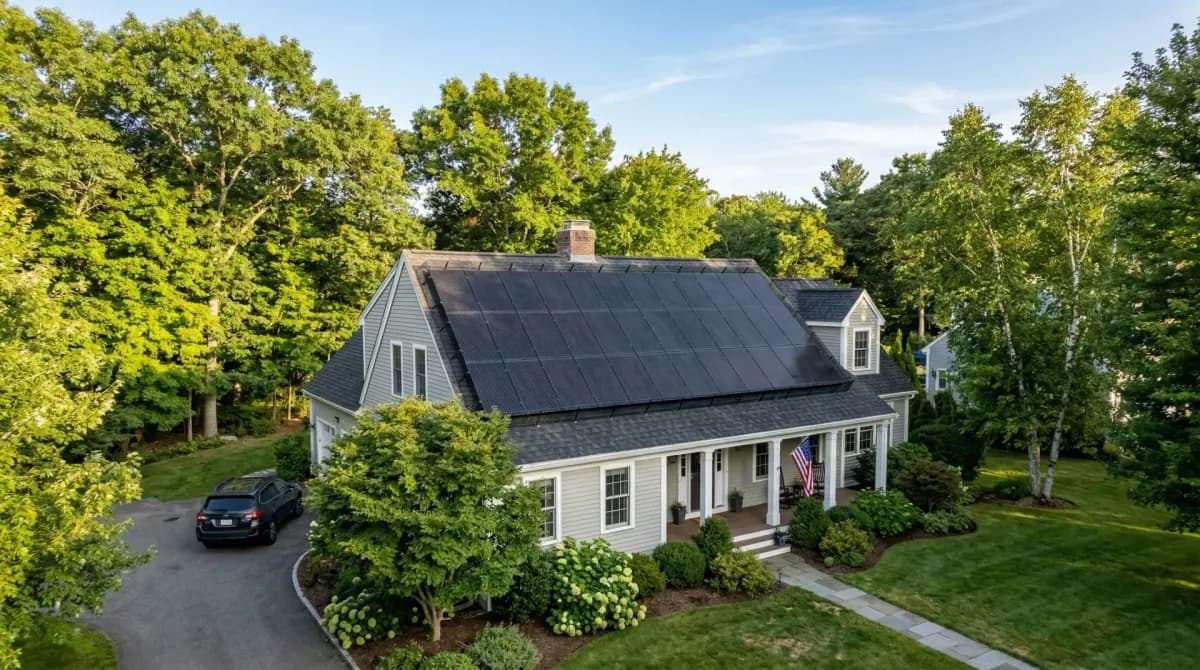
Gray squirrels are the #1 threat to Massachusetts solar panels. They chew MC4 connectors, gnaw wire insulation, and cause thousands in damage. A $500-$1,200 critter guard at install time saves 10x versus post-damage repair.
#1 Threat
Gray squirrels in wooded suburbs
$8-$15/ft
Critter guard mesh installed
10x
Prevention vs. repair savings
$0
Warranty coverage for animal damage
Do you need critter guards on your solar panels in Massachusetts? Yes, if your home is near trees or in a suburban neighborhood. Gray squirrels cause the most damage to MA solar systems by chewing wiring and connectors. Critter guard mesh costs $8-$15 per linear foot installed ($500-$1,200 total for a typical system). Installing during your original solar installation saves 40-60% versus a retrofit.
Most solar panel warranties do not cover animal damage. A single squirrel chewing through an MC4 connector costs $150-$400 to repair, and a full rewire can run $2,000-$5,000. Prevention is dramatically cheaper than cure.
Massachusetts has a dense population of tree-dwelling rodents and urban birds. Wooded suburbs west of Boston are especially vulnerable. Here are the specific threats ranked by severity and frequency.
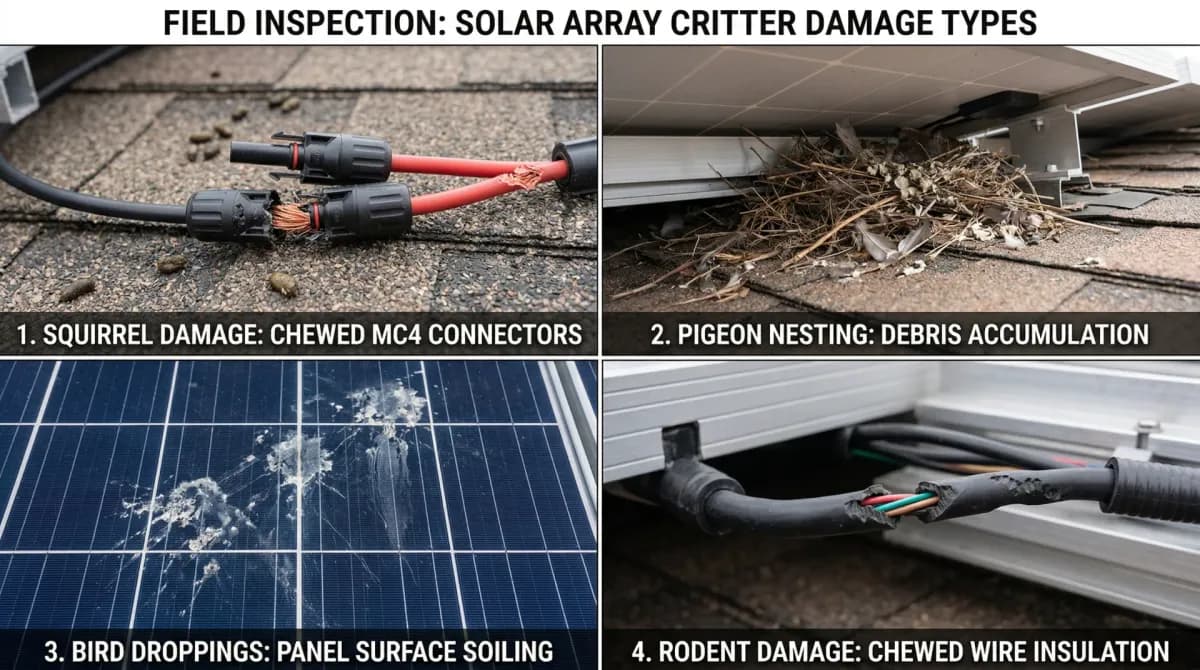
Chew MC4 connectors, wire insulation, and conduit. Can cause electrical arcing and fire risk.
Year-round (peak: fall food storage, spring nesting)
Newton, Lexington, Concord, Wellesley, Brookline, Weston, Lincoln, Dover
Most common cause of solar panel critter damage in MA
Nest under panels, block ventilation airflow, deposit corrosive droppings that etch glass coating.
Spring through fall (breeding season)
Boston, Cambridge, Somerville, Worcester, Springfield — urban/suburban rooftops
Second most common. Especially problematic on flat or low-tilt roofs.
Store food caches under panels, chew smaller wires. Less destructive than squirrels but persistent.
Spring through fall (hibernate in winter)
Suburban homes with stone walls, gardens, or wooded borders
Common in wooded suburbs. Often found alongside squirrel damage.
Heavy enough to dislodge mounting hardware. Can crack panel glass by stepping on cells. Pull at wiring.
Year-round (peak: spring with kits)
Homes near wooded areas, rivers, wetlands — Concord, Lincoln, Cape Cod
Less common but costly. Single incident can damage multiple panels.
Nest on flat arrays. Acidic droppings degrade anti-reflective coating over time.
Spring nesting season (April-July)
Cape Cod, North Shore, South Shore, coastal communities within 2 miles of shore
Coastal-specific. Primarily a nuisance on flat or ballasted commercial arrays.
Animal damage to solar panels is not covered by manufacturer warranties. Here is what Massachusetts homeowners actually pay for repairs when critters get to their system.
| Damage Type | Repair Cost | Downtime | Typical Cause |
|---|---|---|---|
| Single MC4 Connector Replacement | $150-$400 | 1-2 days | Squirrel chewing through connector housing |
| Wire Insulation Repair (1-3 runs) | $500-$1,500 | 1-3 days | Rodent chewing wire insulation, exposing conductors |
| Full Array Rewire | $2,000-$5,000 | 3-7 days | Extensive gnawing across multiple wire runs |
| Nesting Debris Removal + Clean | $300-$800 | 1 day | Pigeon/squirrel nesting blocking airflow under panels |
| Panel Replacement (cracked by raccoon) | $400-$800 + labor | 1-2 weeks (parts) | Large animal stepping on or dislodging panel |
| Production Loss (undetected damage) | $200-$600/year | Ongoing until found | Partial string failure from chewed wire not immediately noticed |
Most solar panel warranties explicitly exclude animal damage. Silfab, REC, and Hyundai product warranties do not cover chewing, nesting, or physical damage from wildlife. Your installer workmanship warranty also typically excludes pest damage. Homeowners insurance may cover repairs but deductibles ($500-$1,000) often exceed the cost of smaller fixes. Critter guards are the only reliable solution.
Catching animal damage early prevents small problems from becoming expensive repairs. Check for these warning signs, especially if you live in a wooded Massachusetts suburb.
Check your Enphase or monitoring app. If one panel or string suddenly drops while others are normal, a chewed wire is the likely cause.
During a roof inspection or from a ladder, look for gnaw marks, exposed copper, or damaged MC4 connector housings. This is a fire risk — call your installer immediately.
Twigs, leaves, fabric scraps, or insulation material poking out from under panel edges indicates active nesting. This blocks critical airflow cooling.
Heavy droppings on specific panels (not scattered) indicate pigeons are roosting directly above or nesting underneath. Acidic droppings etch the glass coating over time.
Squirrels and raccoons are most active early morning and evening. Sounds coming from the roof near your array suggest animals are accessing the space under panels.
Damaged wire insulation can cause arcing, producing a burning smell. This is the most dangerous sign — shut off your system and call your installer or fire department immediately.
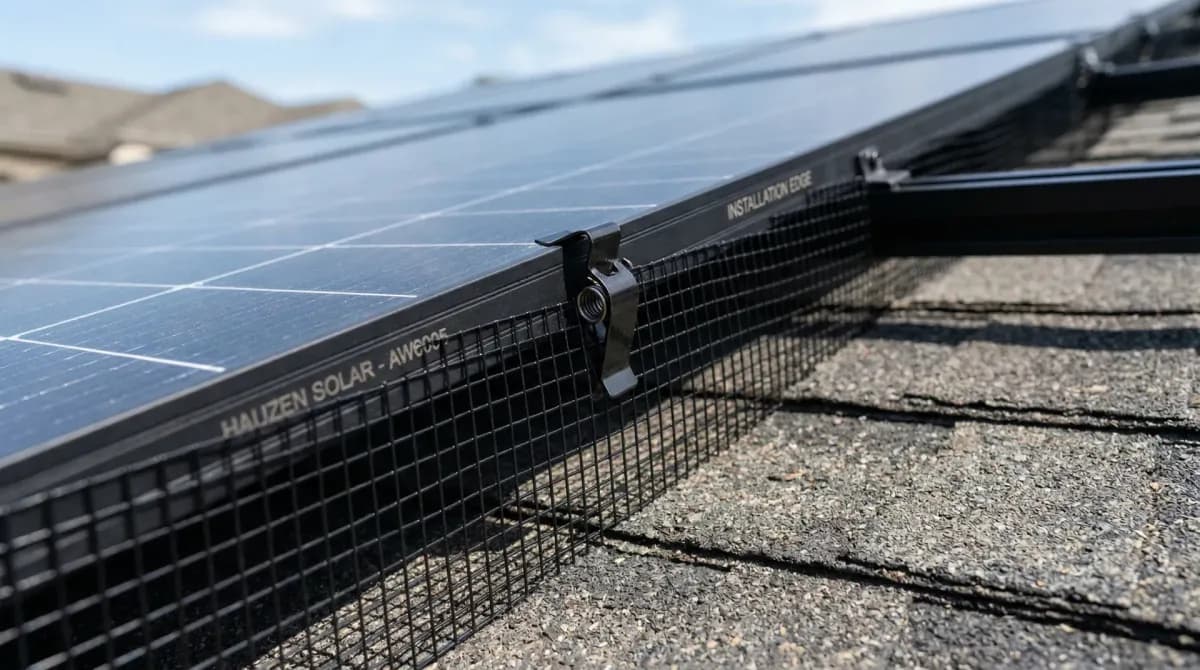
Critter guard mesh clips to the perimeter of your solar panel array, sealing the gap between panels and roof where animals enter. It requires no drilling into your roof and does not affect panel performance or warranty.
$10-$15/ft installed
Industry leader. UV-resistant. Most commonly installed by MA solar companies.
$8-$12/ft installed
Cost-effective option. Slightly more visible than SolaTrim. Good squirrel protection.
$12-$18/ft installed
Best for unusual panel layouts or complex roof geometries. Higher labor cost.
Bird Spikes — Limited
Deter pigeons from landing on panel tops, but do nothing to prevent nesting underneath or protect wiring from squirrels.
Reflective Tape / Flash Tape — Temporary
Birds habituate within 2-4 weeks. No effect on squirrels, chipmunks, or raccoons. Not a long-term solution.
Predator Decoys (Owls, Hawks) — Minimal
Animals quickly learn decoys are not real, especially if they do not move. Require constant repositioning to maintain any effect.
Perimeter Mesh Guard — Excellent
Physical barrier blocks all animal types. Lasts 15-25 years. The only method recommended by solar installers and manufacturers.
The single most important decision is whether to add critter guards during your original solar installation or wait until after. The cost difference is significant.
$500-$1,200
$800-$2,000
A $700 critter guard installed with your solar system prevents a single wire-chewing incident that costs $500-$1,500 to repair — plus days of lost production. Over 25 years of panel life in a state with heavy squirrel populations, the question is not if critters will find your panels, but when. Install critter guards at solar installation time. It is the most cost-effective add-on you can choose.
Professional critter guard installation is a clip-on process — no drilling into your roof. The mesh attaches to the panel frame edges, creating a sealed perimeter. Here is the step-by-step process.
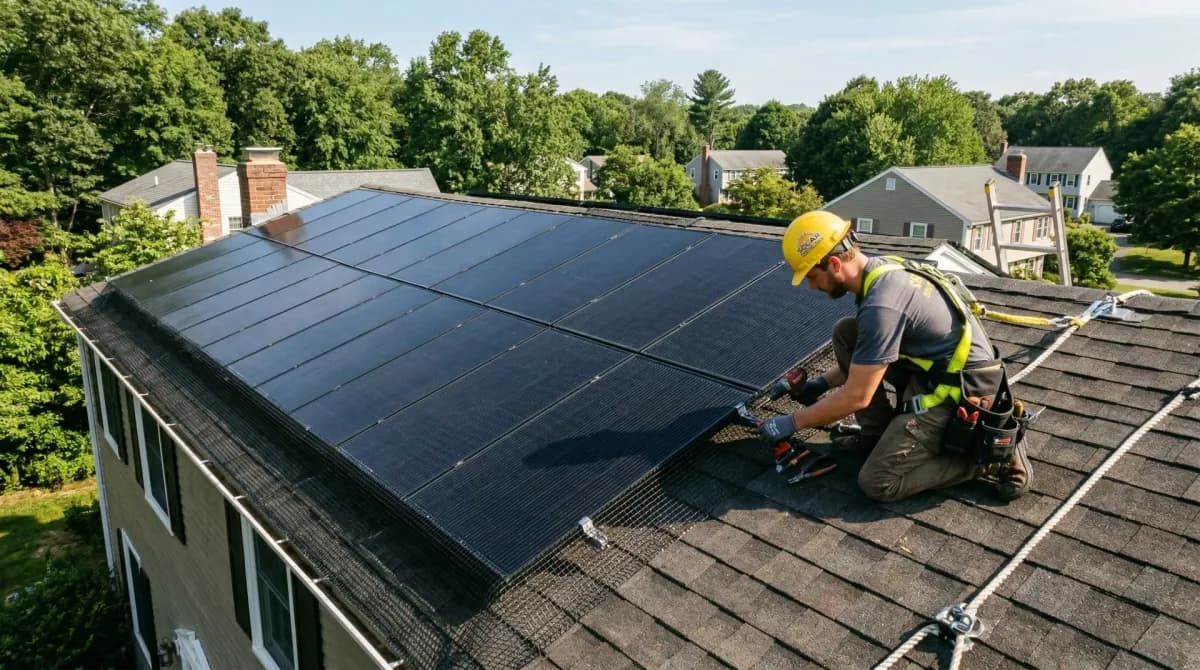
Installer inspects the array perimeter, measures linear footage needed, and checks for existing animal activity or nesting. Any current nests are safely removed.
The gap between panels and roof is cleaned of debris, leaves, and any nesting material. Wiring is inspected for existing damage that needs repair first.
Mesh strips are measured and cut to fit each panel edge section. Corners and transitions are custom-fitted. Material is either aluminum or galvanized steel.
Spring-loaded clips or S-hooks attach the mesh to the bottom edge of each panel frame. No screws penetrate the roof. The mesh tucks under the panel lip.
All corners, transitions between panels, and any gaps wider than 1/2 inch are sealed with additional mesh or fitted clips. Animals can squeeze through surprisingly small gaps.
Complete perimeter walk-around to verify all edges are secured, no clips are loose, and no gaps remain. Production is checked to confirm nothing was disturbed during installation.
Total installation time: 2-4 hours for a typical 20-panel residential system. When done during original solar installation, there is no additional roof access required — the crew handles it the same day.
Wooded suburbs with mature oak, maple, and hickory trees have the densest gray squirrel populations. These MA communities see the most solar critter damage calls.
Dense tree canopy, large lots with mature oaks/maples, high squirrel population
Suburban wooded neighborhoods, squirrels and chipmunks common
Mix of urban and suburban, pigeons more common than squirrels in denser areas
Seagull nesting on flat arrays, raccoon activity near coastal wetlands
If your home has trees within 100 feet of your roof — especially oak, maple, hickory, or walnut trees — squirrels can reach your panels by jumping from branches. Even one nearby tree is enough. When in doubt, include critter guards in your solar proposal. The $500-$1,200 investment is trivial compared to a $25,000-$45,000 solar system.
Over a 25-year solar panel lifespan in Massachusetts, the average homeowner without critter guards will experience at least one significant animal damage incident. Here is the total cost comparison.
$700
One-time cost at solar installation
$3,000-$8,000+
Likely cost over 25 years in wooded MA suburb
NuWatt offers critter guard installation as an included option in every Massachusetts solar proposal. Here is what to expect when you add this protection to your project.
Every NuWatt solar proposal includes a critter guard line item. We recommend it for all wooded suburb installations and include the cost transparently — no surprise add-ons.
When ordered with your solar system, critter guards are installed the same day as your panels. Our crew measures, cuts, and clips the mesh as the final step before leaving your roof.
We use SolaTrim or equivalent premium mesh with 25-year UV resistance and corrosion protection. Black color matches panel frames for a clean appearance. Clip-on attachment — no roof drilling.
NuWatt can retrofit critter guard mesh on existing solar installations — even systems installed by other companies. We will inspect for existing damage, clean out any nesting material, and install a full perimeter guard. Contact us for a free assessment.
Gray squirrels are the #1 threat to MA solar panels — they chew MC4 connectors and wire insulation, causing system shutdowns and fire risk. Pigeons nest under panels, blocking airflow and depositing corrosive droppings. Chipmunks store food under panel arrays, and raccoons can dislodge mounting hardware. In coastal towns (Cape Cod, North Shore), seagulls also nest on flat or low-tilt arrays.
Solar critter guard mesh costs $8-$15 per linear foot installed in Massachusetts, or about $500-$1,200 for a typical 20-panel residential system. If installed during original solar installation, add-on cost is $500-$1,200. Retrofit installation after solar is already up costs $800-$2,000 due to additional labor. The investment pays for itself by preventing a single wire-damage incident ($500-$5,000 repair).
Yes, especially in Massachusetts. If your home is within 100 feet of mature trees, has existing squirrel or pigeon activity, or is in a wooded suburb (Newton, Lexington, Concord, Wellesley, Brookline), critter guards are strongly recommended. Installing at the same time as solar adds only $500-$1,200 vs. $800-$2,000 for a retrofit. Prevention costs 10x less than repairing chewed wiring.
No. Most panel manufacturer warranties (Silfab, REC, Hyundai) explicitly exclude damage caused by animals, rodents, or pests. Workmanship warranties from installers also typically do not cover critter damage. Homeowners insurance may cover the repair if you file a claim, but deductibles often exceed the repair cost. Critter guards are the only reliable prevention.
SolaTrim is a leading solar critter guard product. It consists of aluminum or galvanized steel mesh strips with integrated clips that attach to the panel frame edges — no drilling into the roof required. The mesh blocks the gap between panels and the roof surface where animals enter. It is UV-resistant, weather-rated for New England conditions, and comes in black to match most panel frames. A full perimeter installation takes 2-4 hours.
Watch for these signs: (1) Sudden production drop on one string or individual panel in your monitoring app; (2) Visible chew marks on wires or MC4 connectors; (3) Nesting material (twigs, leaves, insulation) visible under panel edges; (4) Bird droppings concentrated on specific panels; (5) Scratching or scurrying sounds on the roof, especially at dawn/dusk; (6) A burning smell near the array (from damaged wire insulation arcing).
While DIY critter guard kits are available ($3-$6/ft for materials), professional installation is recommended. Working at roof height is dangerous, and improper installation can void your panel warranty if clips damage the frame seal or wiring. Professional installers have the correct tools, safety equipment, and experience to ensure the mesh is secured without damaging panels or roof materials. NuWatt installs critter guards as an add-on option.
Bird spikes provide limited protection. They can deter pigeons from landing on panel tops but do nothing to prevent nesting underneath panels or protect wiring from squirrels. Reflective tape and predator decoys lose effectiveness within weeks as birds habituate. For Massachusetts, perimeter mesh guards are the only solution that reliably blocks all pest types — squirrels, pigeons, chipmunks, and raccoons.
Understand what is and is not covered — including animal damage exclusions
Read GuideKeep your panels clean and productive through every MA season
Read GuideSpot critter damage early with panel-level production monitoring
Read GuideReplace your roof first — critter guards protect both investments
Read GuideDoes homeowners insurance cover animal damage to solar panels?
Read GuideWhat to expect during installation — including add-on options like critter guards
Read GuideNuWatt includes critter guard mesh as an option in every solar proposal. Get a free quote that includes pest protection, or schedule a retrofit for your existing system.