
Loading NuWatt Energy...
We use your location to provide localized solar offers and incentives.
We serve MA, NH, CT, RI, ME, VT, NJ, PA, and TX
Loading NuWatt Energy...
NuWatt designs, installs, and manages solar, battery, heat pump, and EV charger systems across 9 states. One company, one warranty, one point of contact.
Get a Free Quote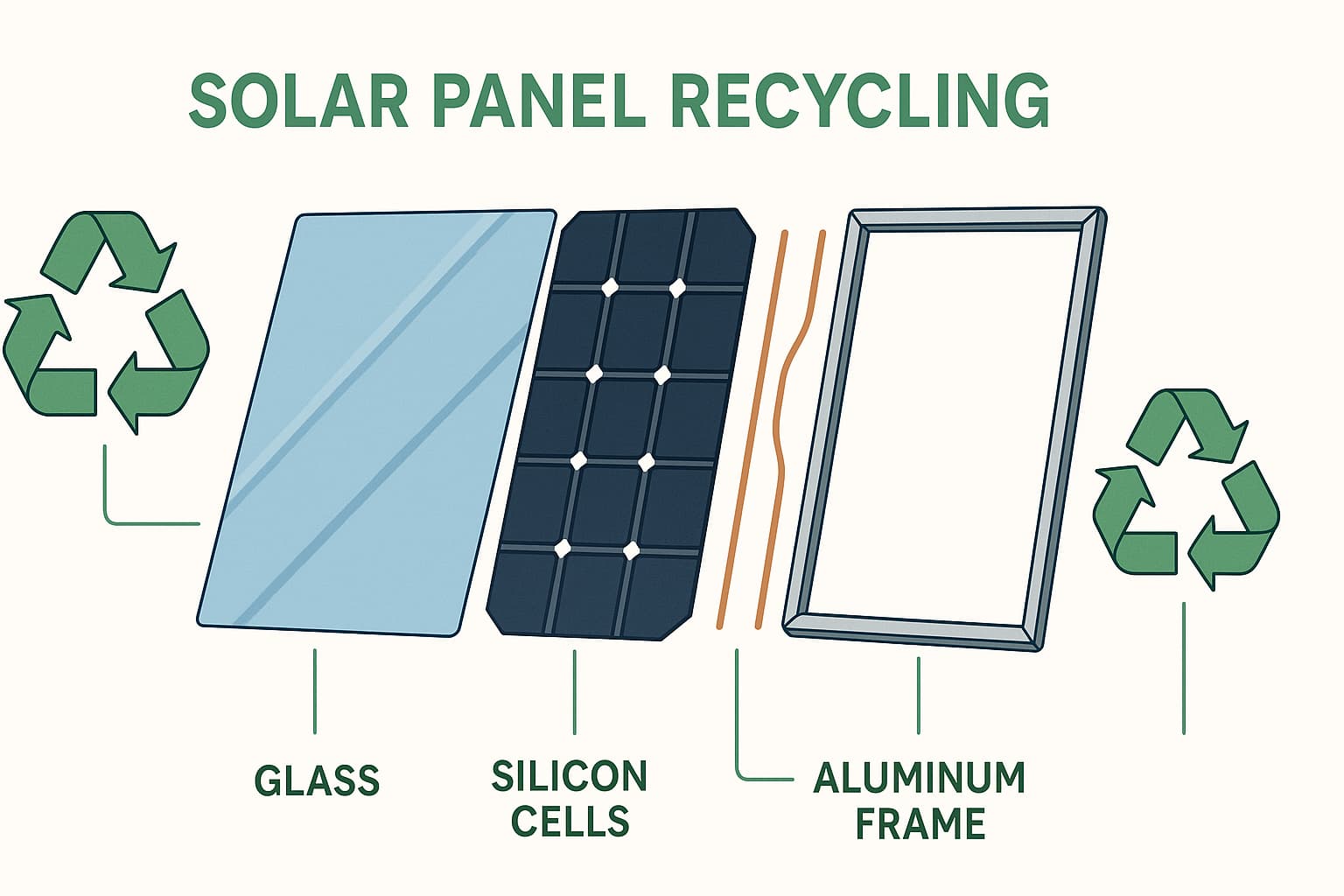
Solar panels last 25-40+ years, but what happens when they reach end of life? 95% of materials are recyclable. This guide covers MA DEP guidelines, recycling programs, material recovery, and costs for responsible disposal.

95%
Materials recyclable by weight
25-40+
Year panel lifespan
$15-$25
Recycling cost per panel
80%+
Output at year 25
Solar panels are 95% recyclable. After 25-30 years, panels still produce 80%+ of original capacity. You have three options: keep them running (they still work), repower with newer panels, or recycle them. Recycling recovers glass, aluminum, silicon, silver, and copper. Cost is $15-$25 per panel through certified recyclers. MA DEP classifies standard panels as non-hazardous waste.
A standard crystalline silicon solar panel weighs about 45 pounds and contains valuable recoverable materials. Here is what gets recycled.
| Material | % of Panel | Recoverable? | Value | Reuse |
|---|---|---|---|---|
| Glass | 75% | Yes | Low-moderate | New glass products, fiberglass insulation, construction aggregate |
| Aluminum (frame) | 10% | Yes | High | New aluminum products — most valuable component by weight |
| Silicon (cells) | 5% | Yes | High | New solar cells, semiconductor industry, metallurgical grade silicon |
| Copper (wiring) | 1% | Yes | High | New copper wiring, electronics, plumbing |
| Silver (contacts) | 0.06% | Yes | Very high | New solar cells, electronics, jewelry — precious metal recovery |
| Plastics (backsheet, encapsulant) | 8% | Partial | Low | Currently difficult to recycle — thermal processing or landfill |
| Other (tin, lead solder) | 0.94% | Yes | Moderate | Smelting and metal recovery. Lead requires hazardous material handling |
Total recoverable material value: $130-$245 per 20-panel system. Recycling cost: $300-$500. Net cost to homeowner: ~$55-$370 for responsible disposal of a 25+ year investment.
Modern solar panel recycling achieves 95%+ material recovery through a combination of mechanical, thermal, and chemical processes.
Panels removed from roof by certified installer. Transported to recycling facility or collection point. Most MA installers handle removal during system decommissioning or repowering.
Aluminum frames mechanically separated. This is the easiest and most valuable step — aluminum is infinitely recyclable. Frames go directly to aluminum smelters.
Tempered glass front layer separated from the cell laminate. Thermal or mechanical processes break the EVA encapsulant bond. Glass is crushed and sorted for reuse.
Silicon cells etched with chemical solution to recover high-purity silicon wafer material. Silver contact lines dissolved and precipitated for recovery. Chemical process recovers 95%+ of silicon.
Copper wiring, tin solder, and trace metals separated through shredding and magnetic/eddy current separation. Lead solder handled as hazardous material per MA DEP requirements.
EVA encapsulant and backsheet plastics are the hardest to recycle. Currently processed through thermal decomposition or sent to specialty plastic recyclers. This is where the industry is improving.
The Massachusetts Department of Environmental Protection provides guidance on solar panel end-of-life handling. Here are the key rules.
Solar panels are NOT hazardous waste (in most cases)
Standard crystalline silicon panels pass the Toxicity Characteristic Leaching Procedure (TCLP) test and are classified as non-hazardous solid waste in Massachusetts. Some older thin-film panels containing cadmium may be classified as hazardous.
Panels cannot go to municipal curbside pickup
Solar panels are too large for regular waste collection and require specialized handling. Contact your local transfer station or recycling coordinator for proper disposal.
MA encourages recycling over landfill
The Massachusetts DEP waste ban regulations prohibit disposal of recyclable materials in landfills when recycling options exist. As panel recycling infrastructure grows, landfill disposal may become restricted.
Manufacturer take-back programs
Some manufacturers (SunPower, First Solar) offer take-back programs. Check your panel warranty and manufacturer for end-of-life options before hiring a third-party recycler.
Commercial installations need a waste management plan
MA DEP requires commercial solar projects to include end-of-life decommissioning plans. Residential projects do not currently have this requirement, but planning ahead is recommended.
Solar panels degrade slowly over time. Most panels still produce 80%+ at year 25. Here is what to expect decade by decade.
Years 1-5
Degradation
1-2%
Production
98-99%
Peak production. No maintenance needed beyond monitoring.
Years 5-15
Degradation
3-7%
Production
93-97%
Slight degradation. Inverter warranty check at year 12-15. Clean panels annually.
Years 15-25
Degradation
7-15%
Production
85-93%
Still strong production. May need inverter replacement (microinverters last 25 yrs). Consider battery addition.
Years 25-30
Degradation
15-20%
Production
80-85%
Warranty period ends. Panels still produce 80%+. Decision: keep running or repower with new panels.
Years 30-40+
Degradation
20-30%
Production
70-80%
Panels still work. Many 40-year-old panels produce 70%+. Repower or recycle when economics favor it.
Several certified recyclers accept solar panels from Massachusetts. Your installer can typically coordinate recycling as part of panel removal or system repowering.
Full panel recycling, BoL testing, resale of functional panels
High-purity silicon and silver recovery, glass recycling
E-waste recycling including solar panels, batteries, inverters
Certified e-waste recycling, data destruction, material recovery
Some critics raise solar panel waste as an environmental concern. Here is the honest math.
10+ tons per panel
A single MA solar panel prevents over 10 tons of CO₂ emissions over its 25-30 year lifetime. The panel weighs 45 lbs. The ratio of environmental benefit to waste is overwhelming.
1-3 years
A solar panel generates more energy in 1-3 years than was used to manufacture it. The remaining 22-37+ years is pure clean energy surplus.
95%+
Modern recycling recovers 95% of panel materials by weight. The remaining 5% (plastics) is improving as recycling technology advances.
A typical coal power plant produces 3.5 million tons of waste per year (ash, sludge, CO\u2082). The entire global solar industry produces about 78,000 tons of panel waste per year. Solar panel waste is a rounding error compared to fossil fuel waste. And unlike coal ash, solar panel materials are recoverable and reusable.
Solar panels last 25-40+ years. At end of life, they can be recycled to recover 95% of their materials (glass, aluminum, silicon, silver, copper) or repowered with new panels. Most panels still produce 70-80% of their rated capacity at age 30+, so "end of life" is an economic decision rather than a hard cutoff. Recycling costs $15-$25 per panel through certified recyclers.
Yes. While Massachusetts does not have a dedicated solar panel recycling facility yet, several national recyclers (We Recycle Solar, SOLARCYCLE, Cleanlites) accept panels from MA. Your installer can coordinate pickup and recycling. The MA DEP classifies standard silicon panels as non-hazardous solid waste, and the state encourages recycling over landfill disposal.
Solar panel recycling costs $15-$25 per panel through certified recyclers. This covers transportation, processing, and material recovery. Some recyclers may pay you for functional used panels that can be resold. For a typical 20-panel MA system, recycling costs $300-$500 total. Many installers include decommissioning services as part of repowering to new panels.
Solar panels are 95% recyclable by weight. Materials recovered include: tempered glass (75% of panel weight), aluminum frames (10%), silicon cells (5%), copper wiring (1%), silver contacts (0.06%), and other metals. Aluminum and silver are the most valuable recoverable materials. Glass is recycled into new glass products or construction materials.
Standard crystalline silicon solar panels (which represent 95%+ of residential installations) are NOT hazardous waste in Massachusetts. They pass the Toxicity Characteristic Leaching Procedure (TCLP) test. Some older thin-film panels containing cadmium telluride may be classified as hazardous. Check with MA DEP if you have thin-film panels.
If your panels still produce 80%+ of rated capacity (typical at 25 years), they still have economic value. Consider repowering with newer, higher-wattage panels if your roof space is limited and you want to increase production. Recycle when panels drop below 70% or when the cost of keeping them running exceeds the value of their production. Your installer can test panel output and advise.
Solar panels produce clean energy for 25-40+ years before needing recycling. The total waste from a panel's lifetime is tiny compared to the fossil fuel emissions it prevented. A typical MA panel prevents 10+ tons of CO2 over its lifetime while weighing only 45 pounds. The recycling industry is rapidly growing, with 95% material recovery rates improving annually. Solar panel waste is not an environmental concern when properly recycled.
NuWatt installs high-quality panels with 25-year warranties and provides lifetime support including end-of-life recycling coordination. Get your free solar assessment today.
Understand product, performance, and workmanship warranties for MA solar.
Read GuideLFP vs NMC chemistry, MA fire codes, and proper installation standards.
Read GuideKeep your system running at peak performance throughout its lifetime.
Read Guide