Loading NuWatt Energy...

We use your location to provide localized solar offers and incentives.
We serve MA, NH, CT, RI, ME, VT, NJ, PA, and TX
Loading NuWatt Energy...
NuWatt designs, installs, and manages solar, battery, heat pump, and EV charger systems across 9 states. One company, one warranty, one point of contact.
Get a Free QuoteHow the Massachusetts Stretch Energy Code, Specialized Opt-in Code, and BERDO affect commercial solar requirements, new construction, and building compliance.
Stretch Code Towns
300+
MA municipalities
Specialized Code
All-Electric
New construction
BERDO Covers
20K sq ft
or 15+ units, in Boston
Solar-Ready
Required
New commercial bldgs
The Massachusetts Stretch Energy Code, adopted by 300+ municipalities, requires solar-ready roofs on new commercial buildings — including structural capacity, conduit pathways, and electrical panel space for future solar. The Specialized Opt-in Code (50+ towns) goes further, requiring all-electric new construction with no fossil fuel connections, making solar essential for managing electricity costs. In Boston, BERDO requires covered buildings to meet declining emissions standards — buildings of 35,000+ sq ft since 2025, the 20,000-34,999 sq ft tier from 2030 — with a $234 per metric ton Alternative Compliance Payment on any excess and per-day fines beyond that, making solar the most cost-effective compliance strategy. For existing commercial buildings, solar paired with the 30-70% federal ITC, MACRS depreciation, and SMART 3.0 incentives provides both code compliance and strong financial returns.
Massachusetts operates a three-tier building energy code system that gives municipalities the choice of which energy standard to adopt. The three tiers — Base Code, Stretch Energy Code, and Specialized Opt-in Code — represent progressively stricter energy performance requirements. Each tier has different implications for commercial solar, ranging from no solar requirements to effectively making solar a practical necessity.
Understanding which code applies to your municipality is the first step in planning a commercial solar project or a new commercial construction project. The code tier determines solar-ready requirements for new buildings, EV infrastructure mandates, heating system options, and the overall energy performance standard that must be met. For a broader overview of the Stretch Code's impact on residential and commercial buildings, see our MA Net Zero Stretch Energy Code guide.
~50 municipalities
Requirements
Minimum state energy code (IECC 2021 with amendments). No additional solar or EV requirements beyond state minimums.
Solar Impact
No solar-ready requirements. Solar is optional but strongly incentivized through federal ITC, SMART, and MACRS.
New Construction
Standard energy efficiency requirements. Fossil fuel heating permitted.
300+ municipalities
Requirements
Enhanced energy performance standards approximately 10-20% above base code. Includes solar-ready roof requirements for new commercial construction and EV-ready parking mandates.
Solar Impact
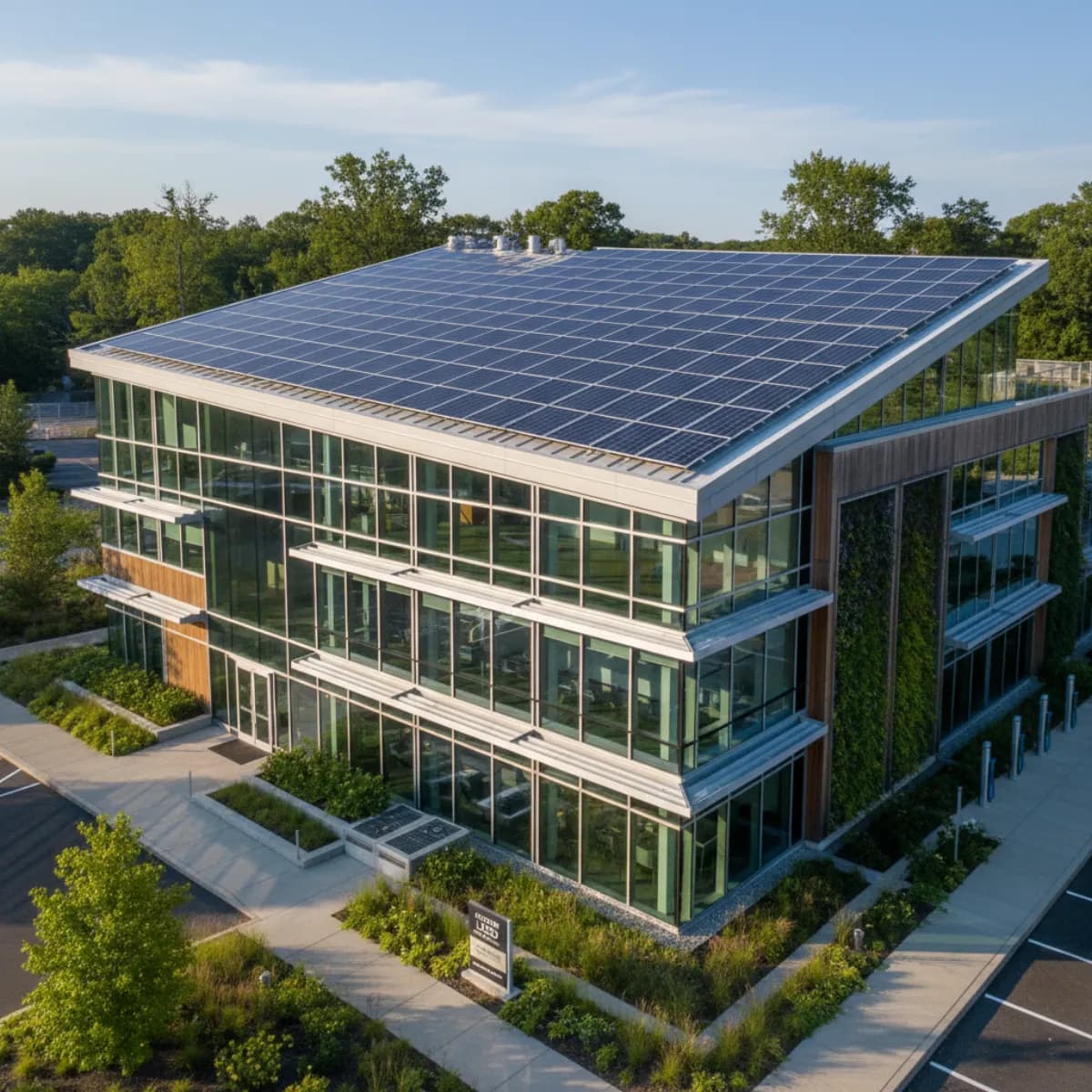
Solar-ready roofs required on new commercial buildings. Structural capacity, conduit pathways, and electrical panel space must be pre-installed. Significantly reduces future solar installation costs.
New Construction
Higher insulation values, better windows, more efficient HVAC. Fossil fuel heating still permitted but must meet higher efficiency standards.
Growing list (50+ municipalities)
Requirements
Most stringent energy code in Massachusetts. Requires all-electric new construction (no fossil fuel hookups), solar-ready roofs, EV-ready parking, and enhanced building envelope performance.
Solar Impact
All-electric requirements make solar essential for managing electricity costs. Heat pumps + solar is the standard pathway. Solar-ready requirements are mandatory and more comprehensive than Stretch Code.
New Construction
All-electric HVAC (heat pumps), electric water heating, induction cooking, no gas lines. Solar and EV infrastructure pre-wired.
Both the Stretch Code and Specialized Code require new commercial buildings to be solar-ready. This does not mean solar panels must be installed at construction — it means the building must be designed and built to accommodate a future solar installation with minimal additional cost and disruption. The solar-ready requirements are detailed and specific.
Structural Capacity
Roof structure must support the dead load of a solar array (typically 3-5 pounds per square foot for ballasted systems). Structural engineering calculations must demonstrate this capacity during the design phase.
Conduit Pathway
A minimum 1-inch conduit must be installed from the roof area designated for solar to the main electrical service panel or a designated solar sub-panel location. This eliminates the need to core through floors and walls during future solar installation.
Electrical Panel Space
The main electrical panel must include reserved space (typically 2-4 breaker positions) for a future solar inverter connection. Panel bus rating must accommodate the additional solar generation capacity.
Solar Zone Designation
A designated "solar zone" on the roof must be identified on construction drawings, free from HVAC equipment, vents, skylights, and other obstructions. The solar zone must have unobstructed solar access.
Roof Penetration Minimization
Roof design should minimize penetrations and equipment in the designated solar zone. HVAC equipment and other rooftop installations should be consolidated outside the solar zone.
Documentation
Construction documents must include a solar-ready plan showing the solar zone, conduit routing, panel space reservation, and structural capacity verification.
Building solar-ready during initial construction adds approximately $0.50-$1.50 per square foot of building area to construction costs. However, it saves $0.10-$0.20 per watt on the eventual solar installation (approximately $10,000-$20,000 on a 100 kW system) by eliminating structural reinforcement, conduit installation through finished spaces, and electrical panel upgrades. The net impact is overwhelmingly positive — the solar-ready investment pays for itself many times over when solar is eventually installed.
The Specialized Opt-in Code represents Massachusetts' most aggressive building decarbonization standard. Its signature requirement — all-electric new construction — eliminates fossil fuel connections from new buildings. No gas lines. No oil tanks. No propane connections. All heating, cooling, water heating, and cooking must be electric.
This fundamentally changes the economics of commercial solar in Specialized Code municipalities. An all-electric commercial building consumes significantly more electricity than a comparable building with gas heating and cooking. Where a traditional commercial building might pay $0.22-$0.30/kWh for a portion of its energy (with the rest coming from cheaper natural gas at $1.50-$2.00/therm), an all-electric building pays the higher electric rate for all of its energy needs. This makes the solar value proposition even stronger — every kWh of solar production offsets expensive electricity rather than cheap gas.
The standard technology stack for Specialized Code compliance is: heat pumps for heating and cooling, heat pump water heaters, induction cooktops, and solar + battery storage to manage the increased electrical load. The combination of all-electric operation with on-site solar can achieve near-net-zero energy performance. For commercial buildings, this means a properly sized solar system can offset 80-100% of annual electricity consumption, providing decades of energy independence.
For energy audit and solar sizing in the context of all-electric buildings, see our Commercial Energy Audit & Solar Sizing Guide. For project timeline planning, see our Commercial Solar Project Timeline.
The Specialized Code includes limited exemptions for laboratories, hospitals, and industrial processes that require combustion. Additionally, existing buildings undergoing renovation are generally subject to the Stretch Code rather than the Specialized Code, regardless of municipality. Always verify the specific code requirements with your local building department before beginning design work.
The Boston Building Emissions Reduction and Disclosure Ordinance (BERDO) is a separate regulatory framework that applies to non-residential buildings of 20,000 gross square feet or larger and to residential buildings with 15 or more units in Boston. BERDO sets a greenhouse gas emissions intensity standard for each of 13 building uses and tightens it every five years until every use reaches zero in 2050. A building over its standard can make an Alternative Compliance Payment of $234 per metric ton of excess CO2e; a building that neither reduces nor pays is fined per day.
For Boston commercial building owners, solar is one of the most effective BERDO compliance strategies. On-site solar generation reduces a building's operational emissions by offsetting grid electricity, which carries an emissions factor in Massachusetts (approximately 0.35 metric tons CO2 per MWh for the New England grid). A 200 kW solar system producing 240,000 kWh per year reduces building emissions by approximately 84 metric tons of CO2 annually — which, for a building over its BERDO limit, displaces about $19,656 a year in Alternative Compliance Payments at the ordinance's $234 per metric ton. For the full standards table, the fine schedule and a calculator that prices your own building's gap, see our BERDO 2.0 compliance hub.
Office standard 5.3 kgCO2e/sq ft/yr — buildings 35,000+ sq ft (or 35+ units) measured from 2025
$234/metric ton ACP, or $1,000/day fine
Office standard 3.2 — the 20,000-34,999 sq ft tier is first measured on 2030 emissions
$234/metric ton ACP, or $1,000/day fine
Office standard 2.4 kgCO2e/sq ft/yr
$234/metric ton ACP, or $1,000/day fine
Office standard 1.6 kgCO2e/sq ft/yr
$234/metric ton ACP, or $1,000/day fine
Every building use reaches a standard of zero
Full compliance required
Both the Stretch Code and Specialized Code offer two pathways to demonstrate compliance. Understanding these pathways is important because solar plays a different role in each.
How It Works
Meet specific requirements for each building component: insulation R-values, window U-factors, HVAC efficiency ratings, lighting power density, etc.
Solar's Role
Solar is not required under prescriptive pathway but significantly reduces energy costs in all-electric Specialized Code buildings.
Best For
Simple, straightforward projects with standard building designs.
How It Works
Demonstrate that the total building energy use intensity (EUI) meets or exceeds the code target. Allows tradeoffs between building components — a less efficient envelope can be offset by more efficient HVAC or on-site solar.
Solar's Role
Solar directly reduces site EUI, providing compliance margin. A 100 kW solar system producing 120,000 kWh/year on a 50,000 sq ft building reduces EUI by approximately 2.4 kBtu/sq ft/year.
Best For
Complex projects, renovations, buildings with design constraints.
The Massachusetts Green Communities program is closely linked to the Stretch Code. To achieve Green Communities designation, a municipality must adopt the Stretch Code as a minimum energy standard. Over 280 communities have earned this designation, gaining access to state grants, technical assistance, and priority funding for clean energy projects.
One of the most important requirements for Green Communities designation is providing as-of-right siting for renewable energy installations, including solar. This means solar projects that meet zoning requirements cannot be denied through discretionary permitting decisions — a significant advantage for commercial solar developers who might otherwise face opposition during special permit or site plan review processes.
The energy code tier directly impacts commercial solar economics in two ways: (1) solar-ready construction reduces future installation costs, and (2) all-electric requirements increase electricity consumption, making the solar value proposition stronger. Here is how the numbers play out for a typical 50,000 sq ft commercial building.
*After ITC, MACRS, SMART
*Lower install cost (solar-ready)
*Higher savings offset higher cost
The key insight is that all three code tiers produce similar payback periods for commercial solar because the higher electricity consumption in all-electric buildings is offset by higher annual savings. The federal incentive stack (30-70% ITC, MACRS, SMART) remains the dominant economic driver regardless of code tier. For detailed financial modeling, use our Commercial Solar IRR Calculator.
The Massachusetts Stretch Energy Code is an optional, more stringent building energy code that municipalities can adopt in place of the base state energy code. Over 300 Massachusetts cities and towns have adopted the Stretch Code, covering the majority of new construction in the state. The Stretch Code requires approximately 10-20% better energy performance than the base code, includes solar-ready roof requirements for new commercial buildings, and mandates EV-ready parking infrastructure. It is a prerequisite for Green Communities designation.
We design solar systems that meet Stretch Code, Specialized Code, and BERDO requirements for Massachusetts commercial buildings.