Loading NuWatt Energy...

We use your location to provide localized solar offers and incentives.
We serve MA, NH, CT, RI, ME, VT, NJ, PA, and TX
Loading NuWatt Energy...
NuWatt designs, installs, and manages solar, battery, heat pump, and EV charger systems across 9 states. One company, one warranty, one point of contact.
Get a Free QuoteEvery new home built in Rhode Island after August 2025 must include dedicated circuits for heat pumps, EV chargers, induction cooking, and heat pump water heaters. Here is what the code requires and why it matters.
Last updated April 2026 | Source: RI Building Code Commission, 2024 IECC
2024 IECC
Code version adopted
Aug 14, 2025
Electric-ready mandatory
5 Circuits
Required in new homes
1st in Region
Northeast leadership
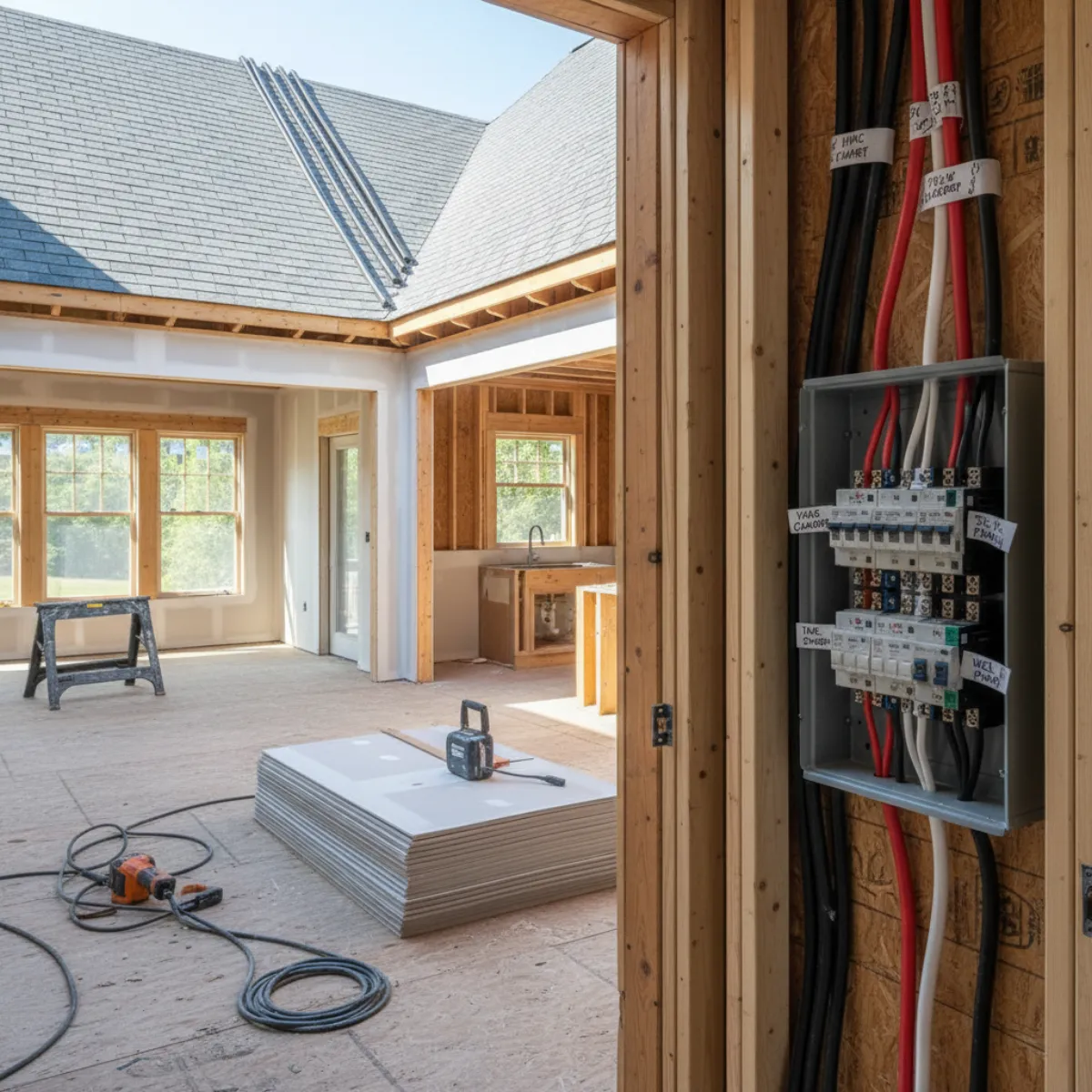
Rhode Island is the first state in the Northeast to adopt the 2024 International Energy Conservation Code (IECC) with its groundbreaking electric-ready provisions. Starting August 14, 2025, every new residential and commercial building must include pre-installed wiring for electric appliances — even if gas appliances are initially installed.
For homebuyers, this means your new home will come pre-wired for a heat pump, EV charger, induction range, and heat pump water heater— saving $4,000-$8,000 in future retrofit costs. For the state, it is the foundation of Rhode Island's clean energy transition and its path to 100% renewable electricity by 2033.
August 14, 2025
Electric-ready provisions become mandatory for all new residential and commercial construction in Rhode Island.
December 1, 2025
Full 2024 IECC adoption — all energy code provisions (insulation, air sealing, window performance, HVAC efficiency) take effect.
March 1, 2026
Grace period deadline: permits filed under 2018 codes must be submitted before this date. After March 1, 2026, all new permits fall under the 2024 IECC.
Grace Period for In-Progress Projects
Projects with building permits issued under the existing 2018 codes are grandfathered, but only if the permit was filed before March 1, 2026. After that cutoff, all new permit applications must comply with the 2024 IECC regardless of when the project was designed. Builders should plan accordingly — especially for projects in the pre-design phase.
The 2024 IECC requires the following dedicated electrical circuits in all new residential construction. These circuits must include the wiring, circuit breaker, and appropriate outlet or junction box — ready for the appliance to be plugged in or hardwired without any additional electrical work.
Enables direct plug-in of induction range without rewiring. Eliminates gas range dependency.
Supports heat pump dryer (50-60% more efficient than conventional). Standard dryer outlet also works.
Replaces gas or electric resistance water heater. HPWH uses 65% less electricity than standard electric.
Supports Level 2 EVSE (up to 40A continuous, ~30 miles of range per hour of charging).
Pre-wired for air-source heat pump outdoor condenser unit. Eliminates need for gas furnace connection.
New construction cost: $1,000-$2,500 total vs. $4,300-$8,600 to retrofit
Adding these circuits during new construction when walls are open and electricians are already on-site costs a fraction of retrofitting later. The 2024 IECC eliminates this future cost barrier for every new home built in Rhode Island.
For builders, electricians, and technically-minded homebuyers, here is exactly what the 2024 IECC electric-ready provisions require in a new home:
An electric-ready home must have sufficient electrical panel capacity to support all required circuits simultaneously. While the 2024 IECC does not mandate a specific panel amperage, the required circuits effectively necessitate a minimum 200A main panel. Many builders in Rhode Island are now installing 200A panels with 400A bus ratings or dual 200A panels to future-proof for full electrification.
The math is straightforward: a heat pump HVAC system (40A), heat pump water heater (30A), induction range (50A), heat pump dryer (30A), and EV charger (50A) total 200A of potential load. With load management and the reality that not all circuits draw peak simultaneously, a 200A panel with proper load calculation works, but leaves little room for growth. Forward-thinking builders should consider 320A or 400A service.
Each required circuit must include:
For commercial buildings, the 2024 IECC takes a different approach. Rather than prescribing specific circuits, it requires:
| State | Energy Code | Electric-Ready | Status |
|---|---|---|---|
| Rhode Island | 2024 IECC | Yes — Aug 2025 | Adopted |
| Massachusetts | 2021 IECC + Stretch | Opt-in (Stretch Code) | Partial |
| Connecticut | 2021 IECC | No | Not adopted |
| Vermont | 2021 IECC (modified) | No | Not adopted |
| Maine | 2015 IECC | No | Not adopted |
| New Hampshire | 2018 IECC | No | Not adopted |
Rhode Island's leadership here is significant. While Massachusetts has similar provisions available through its Specialized Opt-In Code, municipalities must voluntarily adopt it — and many have not. Rhode Island's approach makes electric-ready provisions mandatory statewide, ensuring consistent standards across all 39 cities and towns.
If you are buying a new-construction home in Rhode Island after August 2025, your home will arrive electric-ready out of the box. This has several immediate benefits:
When your gas furnace reaches end of life (12-15 years), switching to a heat pump will cost $3,000-$5,000 less because the wiring is already in place. Same for switching from a gas range to induction, or adding an EV charger.
Electric-ready homes are positioned for the future. As EV adoption grows and heat pump mandates expand, a home that is already wired for electrification will command a premium over older homes that need expensive retrofits.
An electric-ready home with heat pump + EV + induction uses 15,000-20,000 kWh/year — ideal for a 10-14 kW solar system. Net metering credits at $0.232/kWh make this a $3,500-$4,600/year savings opportunity.
No more dependence on volatile gas or oil prices. Once you switch to all-electric, pair with solar, and your energy costs become predictable for 25+ years.
If you are renovating an existing Rhode Island home, the 2024 IECC does not mandate electric-ready circuits for renovation projects (unless the scope triggers full code compliance). However, this is a once-in-a-decade opportunity to future-proof your home:
The 2024 IECC is not just a building code — it is the infrastructure foundation for Rhode Island's clean energy economy. By requiring electric-ready wiring in every new home, the state is removing the single biggest barrier to residential electrification: the cost and disruption of retrofitting electrical systems.
Home built with dedicated circuits for all major appliances (2024 IECC compliant)
Switch to heat pump HVAC, HPWH, induction, EV charger as gas appliances reach end of life
Install solar to offset all-electric consumption. Net metering credits cover most or all electricity costs.
This three-step pathway — electric-ready, electrify, solarize — is the most cost-effective path to zero energy bills. And with Rhode Island's strong net metering program (80% of retail, protected through 2039), Clean Heat RI rebates (up to $11,500 for heat pumps), and REG program income ($0.27/kWh for 15 years), the economics have never been stronger.
Marcus has designed and overseen 500+ residential solar installations across the Northeast. He specializes in system sizing, panel performance analysis, and production modeling.
Sources: 2024 International Energy Conservation Code (ICC); RI Building Code Commission adoption resolution; RI Office of Energy Resources; NEC 2023 Article 210 & 220.
Whether you are building new or renovating, NuWatt can design a solar + electrification package that takes full advantage of Rhode Island's electric-ready infrastructure and incentive stack.