Loading NuWatt Energy...

We use your location to provide localized solar offers and incentives.
We serve MA, NH, CT, RI, ME, VT, NJ, PA, and TX
Loading NuWatt Energy...
NuWatt designs, installs, and manages solar, battery, heat pump, and EV charger systems across 9 states. One company, one warranty, one point of contact.
Get a Free Quote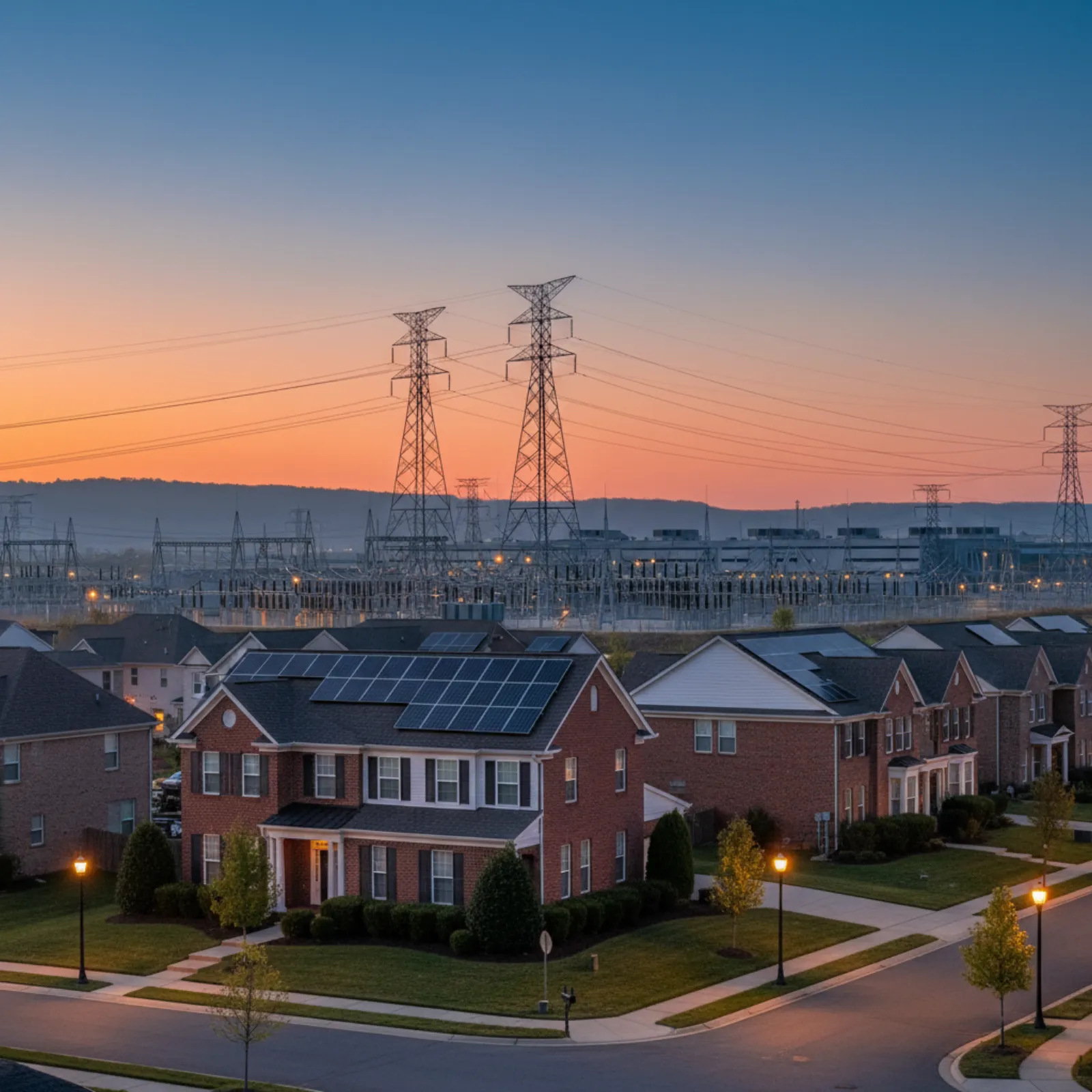
The consumer-facing story is “AI is expensive.” The real mechanism is more specific: capacity auctions, transmission cost allocation, and a pipeline of distribution rate cases filed through 2028. Here's how it actually flows from hyperscaler buildouts to the line items on your monthly bill — and why solar economics strengthen the faster grid rates climb.
US data center electricity use has grown roughly 20% per year, driven mainly by generative-AI training and inference workloads. Data centers consumed about 4% of US power in 2023 and are projected to reach 8-10% of US electricity by 2030, according to Lawrence Berkeley National Laboratory and the IEA. That demand flows to residential bills through three channels: regional capacity-auction clearing prices (PJM's 2025/26 auction cleared roughly 9x the prior year), utility distribution rate cases tied to substation and transmission upgrades, and FERC Order 1000 transmission cost allocation — which socializes 30-40% of grid-upgrade costs to residential ratepayers. The practical consumer hedge is locking in energy cost: an owned solar system produces electricity at a fixed ~$0.08-$0.11/kWh levelized cost for 25+ years, while grid rates climb.
Before getting into market mechanics, it's worth grounding the demand projections in primary sources. The most-cited figure in the debate — that data centers will roughly double their share of US electricity by the end of the decade — is not marketing language. It's the consensus of three independent analyses that use different methods and still land in the same range.
US data center electricity use: ~4.4% of national demand in 2023, projected 6.7-12% by 2028.
Primary peer-reviewed dataset used by DOE.
Global data center electricity demand could more than double by 2026, driven by AI and cryptocurrency.
International baseline covering both AI and non-AI workloads.
Commercial sector electricity sales grow ~2% per year through 2030 — with data centers cited as the single largest driver of the acceleration.
Official US federal projection; conservative on upper bound.
The ranges matter. LBNL's 2028 projection spans 6.7% to 12% because data center efficiency, GPU utilization, and workload mix all have large error bars. What's not in dispute is the direction and pace: annual electricity demand from data centers has grown around 20% year-over-year since 2023, with AI training and inference workloads as the accelerant. The rest of the US economy grows electricity demand by roughly 1% annually.
One way to anchor the scale: a single 200 MW AI training campus draws as much continuous power as roughly 160,000 typical US homes. Hyperscalers currently have more than a dozen campuses of that size operating or under construction in the Mid-Atlantic alone.
Residential electric bills look simple — a supply charge and a delivery charge — but both of those numbers are the product of distinct regulatory processes. Data center load growth shows up in each one, through different mechanisms and on different timelines.
In PJM and ISO-NE, grid operators run forward auctions that pay power plants to commit future capacity. When projected peak demand rises — because hyperscalers have filed interconnection requests for hundreds of MW of new load — auction models show tighter supply and clearing prices jump. Those clearing prices pass through into your supply charge through your utility's wholesale procurement. PJM's 2025/26 BRA clearing price roughly 9x the prior year is the single largest piece of the recent Mid-Atlantic residential rate move.
The high-voltage bulk transmission system is paid for by a cost-allocation formula that FERC approves. When regions approve large long-range transmission plans — PJM and MISO have collectively approved more than $30 billion in recent cycles — a portion of those costs are allocated to the zone that benefits. In practice, 30-40% of that allocation ends up on residential bills as the transmission line item, which has grown roughly 10% annually across New England for the past decade.
Every 1-3 years, your utility files a rate case at the state public utility commission to recover distribution investments: new substations, feeder upgrades, storm-hardening, and grid modernization. Data-center-adjacent projects — a new substation to serve a colocation campus, reconductoring to handle higher load — get bundled into these filings. Even if the data center pays some interconnection cost directly, the downstream distribution reinforcement is socialized.
Not every dollar of rate increase is attributable to data centers. Natural gas price volatility, offshore-wind transmission buildouts, storm hardening, and straightforward inflation all push rates higher. The best-documented data-center-specific moves are the PJM 2025/26 capacity clearing price spike (where PJM itself cited data center load as a primary driver) and utility integrated resource plans that explicitly model incremental data center load. Everything else is a blended effect.
The region you live in determines which market mechanism you experience first. Each regional grid operator uses a different set of rules to balance supply and demand, and those rules dictate how quickly hyperscaler buildouts translate into residential bill increases.
The 2025/26 BRA cleared at roughly $269.92/MW-day — around 9x the previous auction — with data-center-heavy zones clearing even higher. Supply tightness driven by generator retirements colliding with data-center interconnection requests.
Capacity line item on residential bills; shows up as higher supply charges starting June 1, 2025.
FCA clearing prices have risen more modestly than PJM, but the region faces the highest retail rates in the continental US due to pipeline constraints and the same underlying data-center load growth in edge-compute and AI-inference facilities across MA and CT.
Embedded in supply charges and distribution rate cases. ISO-NE transmission charges roughly doubled over the past 5 years.
ERCOT's reserve margin has tightened as data-center load applications (20+ GW in queue) outpace new dispatchable generation. Wholesale prices can spike to $5,000/MWh during peak stress events, and that flows straight to variable-rate retail plans.
Direct pass-through on variable and indexed retail plans; fixed-rate plans reset 15-25% higher at renewal.
NuWatt serves nine states across three regional grid operators. The capacity-market channel is the most visible in PJM territories (NJ, PA). The transmission and distribution channels dominate in New England. Texas is in a category of its own because its market is deregulated, and there's no capacity auction to spread the stress across all ratepayers.
New England already has the highest retail rates in the continental US. Pipeline constraints, an aging fleet, and offshore-wind transmission buildouts all contribute — but data-center-adjacent substation upgrades and edge-compute facility interconnections are the newest line item. Eversource and National Grid distribution rate cases filed in 2024-2025 cite grid-modernization investments that include capacity reinforcement tied directly to commercial-data-center load growth.
What to expect: Distribution charges rising 3-7% annually through 2028, transmission charges rising roughly 8-12%, supply charges tracking fuel and FCA results.
PJM is the most acute case. Northern Virginia drives the demand curve (it hosts roughly 70% of US hyperscale capacity), but the capacity auction price is zonal — and NJ and PA zones have cleared at some of the highest levels in the auction. PSE&G and JCP&L customers saw noticeable supply-charge increases starting June 2025 as the 2025/26 BRA results took effect.
What to expect: The 2026/27 BRA (held late 2025) will be priced into bills starting June 2026. FERC-approved market reforms may soften future spikes, but 2026-2028 residential rates in PJM zones are largely baked in.
Texas is different because it's deregulated and has no forward capacity auction. Supply stress shows up as wholesale price volatility, which flows directly to variable-rate and indexed-rate retail plans. Fixed-rate plans absorb the volatility at renewal. ERCOT has 20+ GW of data-center load applications in its interconnection queue, competing with 300+ GW of (mostly solar and battery) generation queue projects.
What to expect: Fixed-rate retail plans resetting 15-25% higher at renewal through 2027; increased incentive to pair solar with battery storage because peak wholesale prices align with hot summer afternoons when solar produces.
Pennsylvania's deregulated generation market lets customers shop for supply, but the Price-to-Compare (PTC) default rates set by PECO, PPL, and the FirstEnergy utilities track PJM wholesale trends closely. Customers who haven't shopped are paying the PTC — and seeing the full capacity-auction pass-through. Act 129 energy-efficiency programs offset some of that, but not enough to flatten the trajectory.
The most important thing for planning purposes is that most 2026-2027 rate moves are already scheduled. Capacity auctions clear 3 years ahead. Distribution rate cases are filed 12-24 months before new rates take effect. Here's the pipeline from here through 2028.
BRA results from July 2024 took effect June 1, 2025. Residential customers in NJ, PA, and surrounding PJM states are paying the higher capacity rate in every bill since.
Eversource, National Grid, United Illuminating, and PSEG all have pending or recently-decided distribution rate cases with explicit grid-modernization components. Expect 3-7% phased residential increases tied to substation upgrades and capacity reinforcement.
Forward Capacity Auctions clear roughly 3 years ahead of delivery. Prices for the 2027-28 and 2028-29 commitment periods are being priced into supply charges now and will appear on bills as those commitment years take effect.
FERC approved PJM market reforms in late 2025 intended to soften future price spikes, including capacity supply obligations for large loads. The first auction under the reformed rules lands in 2027 — results will shape residential rates through the late 2020s.
MISO and PJM have approved more than $30 billion in long-range transmission plans under FERC Order 1000 cost-allocation formulas. Residential ratepayers absorb 30-40% of these costs through transmission line items that grow ~10% annually through the decade.
Most people think of solar as an investment that generates a fixed return. The more useful framing is that solar is an avoided-cost investment: the value each kilowatt-hour delivers equals whatever the utility would have charged for that same kilowatt-hour. When grid rates climb, every kWh your system produces becomes more valuable, even though you paid for the system once at year-zero dollars.
| Year | Projected grid rate (NE avg.) | Owned solar LCOE* | Gap per kWh |
|---|---|---|---|
| 2026 | $0.30/kWh | $0.10/kWh | $0.20/kWh |
| 2028 | $0.33/kWh | $0.10/kWh | $0.23/kWh |
| 2030 | $0.36/kWh | $0.10/kWh | $0.26/kWh |
| 2035 | $0.46/kWh | $0.10/kWh | $0.36/kWh |
| 2045 | $0.75/kWh | $0.11/kWh | $0.64/kWh |
*Solar LCOE (levelized cost of energy) assumes an owned ~8 kW system at roughly $24,000-$28,000 cash cost, 25-year life, 0.5% annual panel degradation, no federal residential tax credit (Section 25D expired Dec 31, 2025). Grid rate projections assume a ~4% annual compound growth rate — conservative relative to recent Northeast and PJM trajectories. Actual LCOE and payback depend on system specifics, utility, net metering rules, and any state rebates (MA SMART 3.0, NJ Successor Solar Incentive, CT ESS, etc.).
There's no individual action that changes capacity-auction clearing prices or the federal transmission cost-allocation formula. But there are several ways to insulate your own household from the trajectory, ranked roughly by the size of the impact they deliver.
Largest impact. Sets your marginal cost of electricity for the system-produced share of your usage at the LCOE of the system, typically $0.08-$0.11/kWh in the Northeast with 2026 pricing. That rate does not change when PJM's capacity auction clears 9x higher or when your utility files its next distribution case.
Get a solar quoteSecond-largest impact in TOU markets or states with active demand-response programs. A 10-13 kWh battery enrolled in MA ConnectedSolutions can earn ~$1,000-$1,500 per year in dispatch revenue while also shifting your own consumption off the peak rate window.
Learn about battery storageSmaller impact, and only worth it if you can actually shift load away from the 4-9 PM window. For most households without solar or battery, TOU offers modest savings and risks larger bills if you can't shift load. Worth modeling with your actual hourly usage data before opting in.
See demand-response programsMass Save in Massachusetts, Energize CT in Connecticut, and NJ Clean Energy's Whole Home rebate all offer rebates for heat pumps, insulation, and whole-home electrification. These reduce how much electricity you need in the first place — worthwhile regardless of rate trajectory, and especially useful if you're planning to go all-electric.
Explore electrificationThe impact varies by region. In PJM (NJ, PA, parts of the Mid-Atlantic), the 2025/26 Base Residual Auction cleared around 9x higher than the prior year, translating to roughly $10-$25 per month on a typical residential bill through the capacity charge alone. In ISO-NE territories (MA, CT, NH, RI, VT, ME), capacity prices rose more modestly, but grid-modernization surcharges tied to data-center-adjacent upgrades add another 2-5%. These are line items on your bill, not abstractions.
The broader picture: infrastructure, fuel, electrification demand.
Current MA / CT / NH rates and scheduled changes.
NJ-specific supply and delivery trends in PJM territory.
How export-credit rules shape solar ROI state by state.
The hyperscaler buildout and consumer impact at a glance.
How batteries stack with solar and demand-response revenue.
NuWatt designs residential solar and battery systems for the rate environment you'll actually see in 2028 — not today's rate. Get a free system design and payback estimate built on your real usage and utility.
This article describes regulatory and market mechanisms as of April 2026. Specific auction clearing prices and rate-case outcomes are subject to ongoing regulatory proceedings and future decisions. NuWatt does not proactively monitor utility bills or grid rates on behalf of individual customers; for real-time rate data, consult your utility's published tariffs or the state public utility commission docket.