Loading NuWatt Energy...

We use your location to provide localized solar offers and incentives.
We serve MA, NH, CT, RI, ME, VT, NJ, PA, and TX
Loading NuWatt Energy...
NuWatt designs, installs, and manages solar, battery, heat pump, and EV charger systems across 9 states. One company, one warranty, one point of contact.
Get a Free Quote
Your roof is the foundation of every rooftop solar project. Before you get quotes, make sure your roof can support 25+ years of solar panels without costly surprises.
Quick Answer
Your roof is ready for solar if it has at least 10-15 years of life remaining, is in good structural condition with no active leaks or sagging, and has a south-, east-, or west-facing section with minimal shade. Asphalt shingles and standing seam metal are the easiest materials to install on. If your roof needs replacement soon, bundle the reroof with solar installation to save $2,000-5,000.
The single most important factor in roof readiness
Solar panels are designed to produce electricity for 25-30 years. Your roof needs to last at least that long — or close to it — without requiring a replacement that would force you to remove and reinstall the entire solar array at a cost of $3,000-6,000.
The general rule: if your roof has fewer than 10-15 years of life remaining, address the roof first. Here is how that breaks down by material:
| Roof Material | Typical Lifespan | Replace Before Solar If... |
|---|---|---|
| Asphalt Shingle (3-tab) | 15-20 years | Older than 8-10 years |
| Asphalt Shingle (Architectural) | 25-30 years | Older than 15-18 years |
| Standing Seam Metal | 40-70 years | Rarely needed — outlasts solar |
| Clay/Concrete Tile | 50-100 years | Only if tiles are cracking or shifting |
| Flat (TPO/EPDM) | 20-30 years | Older than 10-15 years |
| Slate | 75-150 years | Only if slates are delaminating |
| Wood Shake | 15-25 years | Always — replace with shingle or metal |
Pro tip:If you are unsure of your roof's age, check your home inspection report, building permits (usually on file with your town), or ask your roofer. Most roofing companies can estimate remaining life from a visual inspection at no charge.
Not all roofing materials are equal when it comes to solar
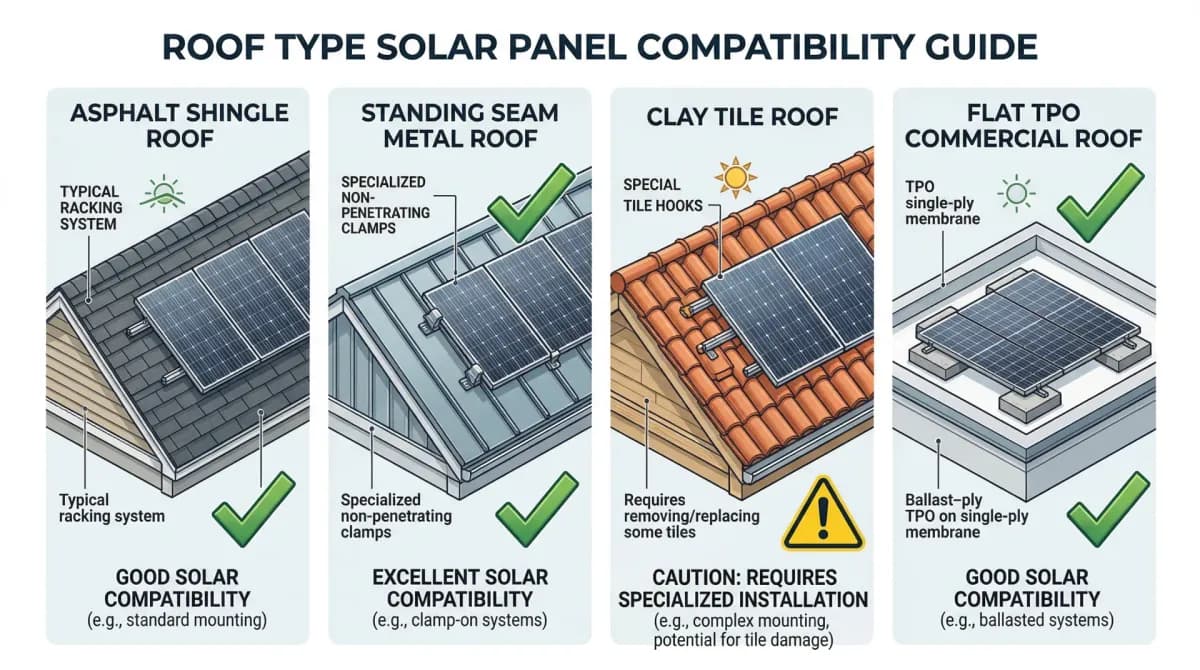
How solar attaches: Standard rail mounting with flashing. Most common and cheapest to install on.
Cost impact: No premium — baseline solar install cost
About 80% of U.S. homes have asphalt shingles. Solar racking attaches with lag bolts through the shingle into the roof deck, sealed with aluminum flashing under the shingle course above.
How solar attaches: S-5! clamps attach to seams — zero roof penetrations. Fastest install.
Cost impact: +$0-200 for clamps (saves on flashing)
The best roof for solar. S-5! or similar clamps grip the standing seams without drilling. No holes means zero leak risk. Metal roofs also last 2x longer than shingles, so you will never need to remove panels for reroofing.
How solar attaches: Tiles must be removed around each mount point, then replaced or cut. Fragile.
Cost impact: +$500-1,500 premium for tile work
Tile roofs are durable, but installing solar requires carefully removing tiles, mounting the rail, then replacing or trimming tiles around the attachment. Tile breakage during install is common. Use a solar installer experienced with tile.
How solar attaches: Ballasted racking (no penetrations) or attached mounts. Panels tilted 10-15 degrees.
Cost impact: +$0.10-0.20/W for tilt racking
Flat roofs use either ballasted (weighted) racking that sits on the membrane without holes, or attached mounts with proper membrane boots. Panels must be tilted, so row spacing is needed to avoid self-shading — you lose about 30% of roof area.
How solar attaches: Specialty hooks slide under slate tiles. Experienced installer required.
Cost impact: +$1,000-2,500 premium
Slate is beautiful and incredibly long-lasting, but also extremely fragile under foot traffic. Solar can be installed using specialty slate hooks that slide between courses without drilling into the slate itself. Only use an installer with documented slate roof experience.
How solar attaches: Fire risk. Many codes prohibit solar on wood roofs. Insurance may deny coverage.
Cost impact: Replace roof first ($15K-30K)
Wood shake and shingle roofs are a fire hazard, and many building codes and insurance companies prohibit or heavily restrict solar panel installation on wood roofing. If you have wood shake, plan to replace with asphalt or metal before going solar.
Red flags that mean your roof needs work before solar
Even a relatively young roof can have problems that make it unsuitable for solar. A qualified solar installer (or independent roofer) will check for these issues during the site survey. Here is what they are looking for and what each issue means for your solar project:
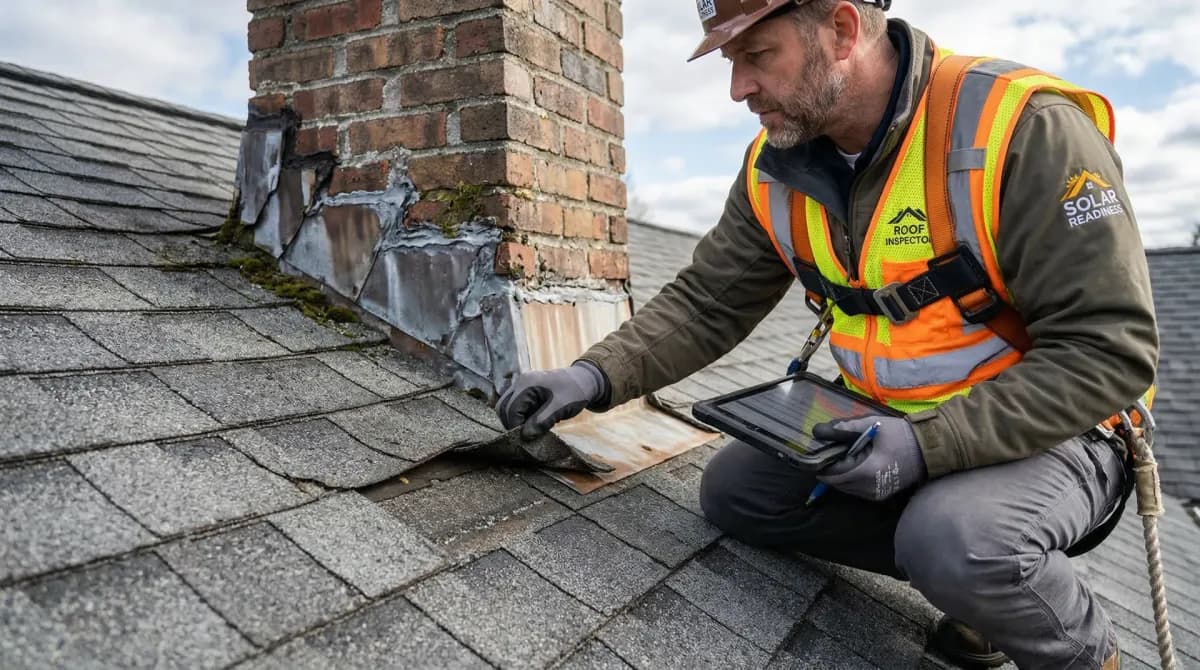
Curled or cupped shingles indicate the roof is near end-of-life. Solar mounting points need flat, intact shingles to seal properly.
Missing shingles expose the underlayment and deck to water. Any gaps near mount points will leak once racking is installed.
Sagging indicates structural failure in the decking or rafters. Solar panels add 3-5 lbs/sqft — a compromised roof cannot safely bear the additional load.
Damaged flashing around chimneys, vents, and valleys allows water intrusion. Must be repaired before adding solar penetrations.
Heavy granule accumulation in gutters means shingles are degrading. The roof may still have 5-8 years left but a solar system needs 25+ years.
Any active leak must be repaired before solar. Adding panel mounts to a leaking roof will make the problem worse and void most solar warranties.
Moss traps moisture and accelerates deterioration, but can be cleaned. If the underlying shingles are still in good shape, this is cosmetic.
If your roof has 2+ layers of shingles, it likely needs a full tear-off before solar. Extra weight from layered shingles plus solar panels may exceed structural limits.
Bottom line:Any "Critical" issue means the roof must be repaired or replaced before solar installation. "High" severity issues should be addressed. "Medium" and "Low" issues can often be handled during the solar installation process.
South is ideal, but east and west work well too
In the northern hemisphere, south-facing roofs receive the most direct sunlight throughout the day. But a south-facing roof is not required — east and west-facing surfaces still produce 80-85% of the energy a south-facing roof generates, which is often enough for a strong financial return.
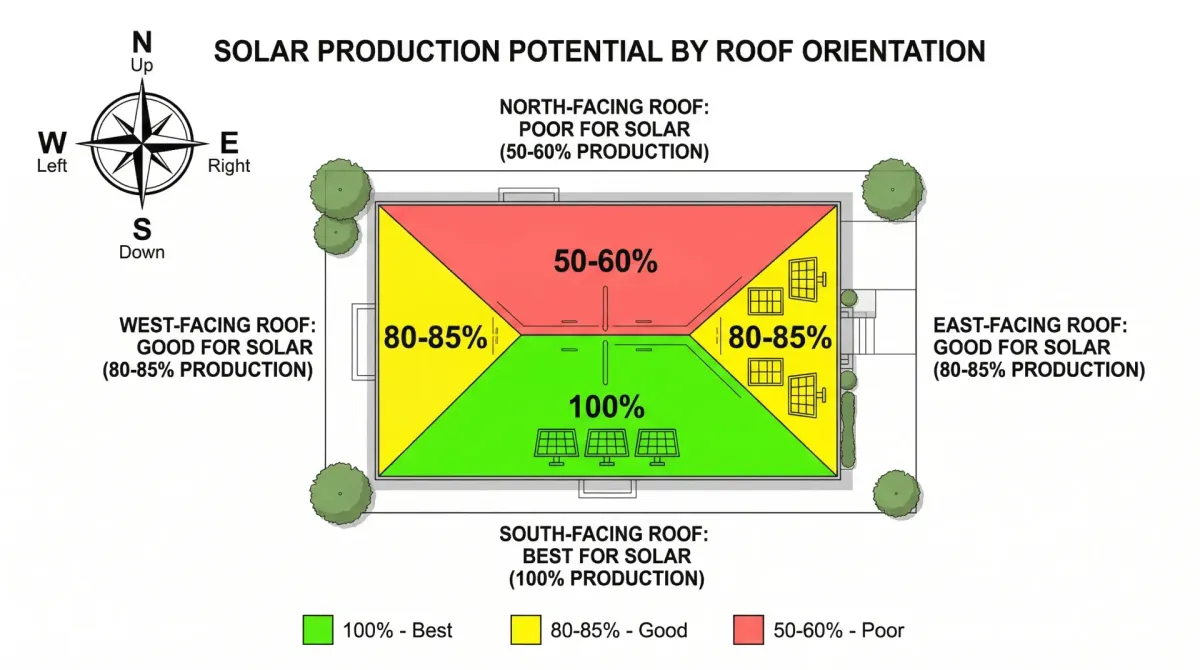
South
100%
Best
Southwest
95%
Excellent
Southeast
95%
Excellent
West
80-85%
Good
East
80-85%
Good
Northwest
60-65%
Poor
Northeast
60-65%
Poor
North
50-55%
Not Viable
Real-world nuance: Many homes have roof sections facing multiple directions. A good solar designer will place panels on the best-available surfaces and may split the array across two roof planes. An east/west split is actually useful because it spreads production across morning and afternoon, better matching typical home energy usage patterns.
Trees, chimneys, and dormers all reduce production
Shade is the silent killer of solar ROI. Even a small shadow falling on a panel during peak sun hours can reduce the output of that panel — and sometimes the entire string — by 50% or more. Modern microinverters (like Enphase IQ8) mitigate this by allowing each panel to operate independently, but shade still reduces total production.
Less than 10% of roof shaded during 9am-3pm
0-5% production loss
Excellent for solar
10-25% of roof shaded during 9am-3pm
10-20% production loss
Still viable with microinverters
More than 25% of roof shaded during 9am-3pm
25-50%+ production loss
Likely not viable on roof
Mature deciduous trees
Worst in summer when leaves are full. Can be trimmed or removed. Bare branches in winter still cause 10-15% loss.
Evergreen trees (pines, spruce)
Year-round shade. Consider removal if they shade the best roof section — a $2,000 tree removal can add $10,000+ in lifetime solar production.
Chimneys
Cast shadows that move throughout the day. Panels are placed around the shadow path. Rarely a deal-breaker.
Dormers and roof features
Reduce usable roof area and cast shadows. More of a design constraint than a disqualifier.
Neighboring buildings
Multi-story neighbors to the south can shade a significant portion of your roof, especially in winter when the sun is low.
Power lines and poles
Thin but consistent shade lines. Usually minor unless the line runs directly over the array area.
Short answer: almost certainly yes
This is one of the most common concerns homeowners have, but it is rarely an actual issue. A typical solar panel system adds 3-5 pounds per square foot to your roof — panels, racking, and all hardware included. To put that in perspective:
Solar Panel System
3-5 lbs/sqft
Panels + racking + wiring
Snow Load (Building Code)
20-50 lbs/sqft
What your roof is designed for
Wind Load (Building Code)
15-30 lbs/sqft
Uplift resistance required
Any roof built to modern building codes (post-1980) can handle solar panels without structural modification. The only situations where a structural evaluation may be needed:
Engineering fact: A 2,000 sq ft roof designed for a 30 lbs/sqft snow load is engineered to hold 60,000 pounds of snow. A typical 10 kW solar system weighs about 1,200 poundstotal — less than 2% of the roof's designed capacity.
Combine projects to avoid double labor costs
If your roof is within 10 years of needing replacement, the smartest financial move is to bundle the reroof and solar installation into a single project. Here is why:
Skip the separate panel removal/reinstall cost. Solar crew installs mounts during roofing, not after.
Reroofing + solar takes 1-2 weeks combined. Separately, it is two disruptions months apart.
One company oversees the entire roof/solar system. No finger-pointing between roofer and solar installer.
Solar racking can be integrated during roof installation, with flashing built into the new roof layers.
| Scenario | Cost Range | Notes |
|---|---|---|
| New roof alone | $12,000-25,000 | Average 30-year architectural shingle, 2,000 sq ft |
| Solar alone (after roof) | $24,000-32,000 | 8-12 kW system at $2.85-3.35/W, no federal credit |
| Panel removal + reinstall | $3,000-6,000 | If reroofing after solar is already installed |
| Bundled roof + solar | $33,000-50,000 | Save $2,000-5,000 vs doing them separately |
The costly scenario you want to avoid
This is the situation every solar installer warns about — and the primary reason roof age matters so much. If your roof fails 5-10 years after solar installation, here is what happens:
A licensed solar electrician disconnects your system from the grid, removes all panels, dismounts the racking, and seals every penetration point. Panels are stored on-site or at a warehouse.
A roofing crew tears off the old roof, inspects and repairs the deck, and installs new shingles or metal roofing. This takes 2-5 days depending on home size and weather.
The solar crew returns, reinstalls all racking (new flashing and sealant), remounts every panel, reconnects wiring, and schedules a re-inspection with your utility.
Your solar system produces zero electricity during the entire process. In summer, that is $100-200+ of lost production. Your battery backup, if any, is also offline.
Total unexpected cost: $3,000-6,000+ on top of the roof replacement itself. This is money you could have avoided entirely by addressing the roof before installing solar. For more details on panel removal specifically, see our solar panel removal cost guide.
What happens when you request a solar quote
Every NuWatt solar project starts with a thorough roof evaluation — included at no charge with your quote. Here is our process:
We pull high-resolution satellite and aerial imagery of your property. Using tools like Google Project Sunroof and proprietary shade modeling, we assess roof orientation, approximate shade patterns, and usable roof area — all before setting foot on your property.
Our solar surveyor inspects your roof in person. They check shingle/material condition, flashing integrity, structural soundness, attic ventilation, and identify any problem areas. If concerns arise, we recommend a licensed roofer evaluate before proceeding.
Using on-site shade measurement tools and Aurora solar design software, we model exactly how much sun each section of your roof receives hour by hour, month by month. This determines the optimal panel layout and accurate production estimate.
For standard homes (post-1980 construction with typical roof framing), solar panels are well within structural limits. For older homes or unusual configurations, we partner with a licensed structural engineer to certify load capacity before design.
Based on all assessment data, our engineering team designs a system optimized for your specific roof — maximizing production while avoiding shade zones, vents, chimneys, and problem areas. You receive a detailed proposal with production estimates and pricing.
Bundled roof + solar: If our assessment reveals your roof needs replacement, NuWatt can coordinate the entire project — new roof and solar installation together — through our roofing partners. One project manager, one timeline, one warranty.
Answer these questions to quickly assess whether your roof is ready for solar:
1. Is your roof less than 15 years old (shingle) or 30 years (metal/tile)?
2. Are shingles lying flat with no curling, cracking, or missing pieces?
3. Is there any visible sagging, soft spots, or structural concern?
4. Does your roof have a south, east, or west-facing section?
5. Is the majority of your roof unshaded between 9am and 3pm?
6. Is your roof free of active leaks or water damage?
Start with NuWatt's free solar assessment. We evaluate your roof condition, orientation, shade, and structural readiness — all included with your personalized solar quote.
Solar Panel Removal Cost
What it costs to remove panels for reroofing
Solar + Home Renovation
When to add solar during a home renovation
Ground-Mount Solar
Alternative when your roof is not suitable
Solar Panel Lifespan
25-year warranties and degradation rates
Compare Solar Quotes
What to look for in solar proposals
Questions for Installers
15+ questions to ask before signing