Loading NuWatt Energy...

We use your location to provide localized solar offers and incentives.
We serve MA, NH, CT, RI, ME, VT, NJ, PA, and TX
Loading NuWatt Energy...
NuWatt designs, installs, and manages solar, battery, heat pump, and EV charger systems across 9 states. One company, one warranty, one point of contact.
Get a Free Quote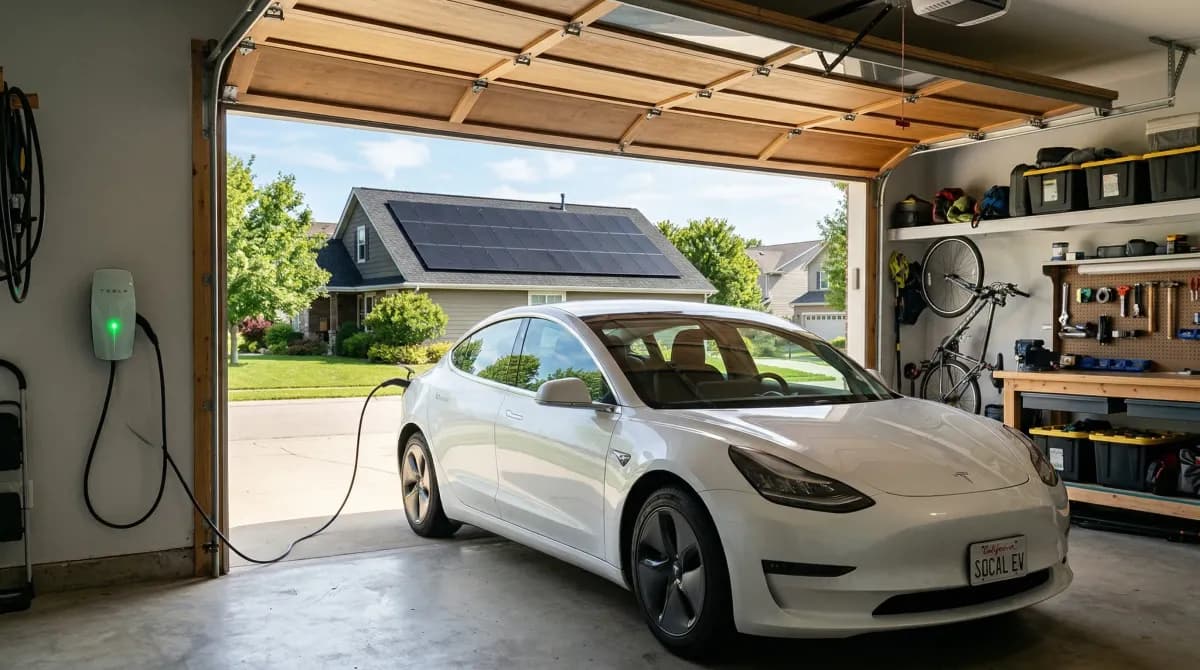
Power your EV with sunshine. Add 7-13 solar panels and save $1,200-$2,400/year vs. gas. The federal residential Section 30C EV charger credit expired June 30, 2026, but state and utility rebates plus off-peak rates still help.
Quick Answer
An EV adds 3,000-4,500 kWh/year to your electricity usage. That's 7-10 additional solar panels. At New England rates ($0.25-$0.32/kWh), solar-powered driving saves $840-$1,260/year vs. grid charging and $1,200-$2,400/year vs. gasoline. The federal residential Section 30C EV charger tax credit (up to $1,000) expired June 30, 2026 and is no longer available — but state and utility EV charger rebates and off-peak charging rates still help.
The number of additional panels depends on your EV type and driving habits. These estimates assume 12,000 miles/year and New England solar production (~450 kWh per 440W panel per year).
| EV Type | Examples | kWh/Year | Efficiency | Panels Needed | Additional Cost |
|---|---|---|---|---|---|
| Sedan | Tesla Model 3, Chevy Equinox EV, Hyundai Ioniq 6 | 3,000-3,600 | 3.5-4.0 mi/kWh | 7-9 | $4,000-$6,000 |
| SUV/Crossover | Tesla Model Y, Ford Mustang Mach-E, VW ID.4 | 3,600-4,500 | 2.7-3.5 mi/kWh | 9-11 | $5,500-$7,500 |
| Truck | Ford F-150 Lightning, Rivian R1T, Tesla Cybertruck | 4,500-5,500 | 2.0-2.7 mi/kWh | 11-13 | $7,000-$9,000 |
Important: These panels are in addition to the panels needed for your home electricity. A typical NE home uses 7,000-9,000 kWh/year (16-20 panels). Adding an EV brings the total to 10,000-14,000 kWh/year (23-32 panels). Many roofs can accommodate this; some cannot. NuWatt evaluates roof space during design.
With Section 25D (solar), 25C (heat pumps), and now the residential Section 30C EV charger credit all expired, there is no remaining federal tax credit for residential clean energy equipment. The good news: state and utility EV charger rebates still help.
State & Utility Rebates
Often $300-$700 for a Level 2 charger — check your area
Expired June 30, 2026
Federal residential 30C credit — no longer available
Off-Peak Rates
Utility TOU rates cut EV charging costs 50%+
What happened: The federal residential Section 30C credit (30% of Level 2 EV charging equipment and installation, capped at $1,000) expired June 30, 2026 and is no longer available for home installations. The commercial Section 30C credit (up to $100,000 per item) also expired the same date for property placed in service after June 30, 2026.
See our detailed guide: Section 30C Deadline Guide
What does it cost to drive 12,000 miles per year with each fuel source?
Solar + EV
$240-$360/year
$0.02-$0.03/mile
Grid charging (NE rates)
$840-$1,200/year
$0.07-$0.10/mile
Grid charging (off-peak TOU)
$480-$720/year
$0.04-$0.06/mile
Gasoline ($3.50/gal, 30 MPG)
$1,400/year
$0.12/mile
Gasoline ($3.50/gal, 25 MPG)
$1,680/year
$0.14/mile
Bottom line: Solar-powered EV charging saves $1,000-$1,400/year vs. gasoline and $500-$900/yearvs. grid charging at New England rates. Over 10 years, that's $10,000-$14,000 in fuel savings alone — not counting the solar system's savings on your home electricity.
Even without solar, smart charging strategy saves money. With solar, it maximizes the percentage of free, sun-powered miles.
If you work from home or have a smart charger, charge during peak solar production (10 AM - 3 PM). Your panels power the car directly — no grid electricity used.
Best with: Solar + smart charger
If your utility offers TOU rates, charge overnight (midnight - 6 AM) at $0.08-$0.14/kWh instead of $0.25-$0.32 peak rates. Solar net metering credits offset the cost.
Best with: TOU rate plan
Solar charges your home battery during the day. Battery charges your EV overnight. This shifts solar energy to nighttime EV charging without grid dependence.
Best with: Solar + battery + EV
Smart chargers from Emporia, Wallbox, and Tesla can adjust charging rate based on real-time solar production, automatically maximizing solar-powered miles.
Best with: Smart charger + solar monitoring
Not all Level 2 chargers are equal. If you have solar panels, these features maximize the value of your combined system.
Charger adjusts power draw based on real-time solar output. When clouds pass, it dials back; when sun returns, it ramps up.
Available in: Emporia, Wallbox Pulsar Plus, Tesla UWC
Set charging windows to match peak solar hours (midday) or off-peak TOU rates (overnight). Basic feature but essential.
Available in: All smart chargers
Prevents the EV charger from overloading your panel by automatically reducing charge speed when other large loads are running.
Available in: Tesla UWC, Emporia, ChargePoint Flex
Remote start/stop, energy usage tracking, and charging history. See exactly how much solar energy goes into your EV each month.
Available in: All smart chargers
Browse EV charger options by state: EV Charger Guide | Charger Comparison Tool
When your solar installer designs your system, make sure they account for your EV. Here's what to discuss:
Tell your installer you have an EV (or plan to get one). They should size the system for your total annual kWh, not just your current utility bill. Adding an EV typically increases system size by 30-50%.
South-facing panels produce the most energy during midday hours when home consumption is often low. This surplus can charge your EV directly (if parked at home) or bank as net metering credits for overnight charging.
An EV charger (40-50A circuit) plus a solar system may require upgrading from a 100A or 150A electrical panel to 200A. Planning this during solar installation saves $1,000-$2,000 vs. doing it separately.
If you have two cars and might get a second EV, or plan to add a heat pump, size your solar system 10-20% larger than current needs. The marginal cost of a few extra panels during initial installation is much lower than adding them later.
A typical EV (sedan like Tesla Model 3 or Chevy Equinox EV) driven 12,000 miles/year uses about 3,000-3,600 kWh of electricity annually. In New England, that requires 7-9 additional 440W solar panels (producing ~450 kWh per panel per year). An SUV or truck (F-150 Lightning, Tesla Model X) uses 4,000-5,500 kWh/year, requiring 10-13 additional panels. These are additions to your base home consumption system.
No. The federal residential Section 30C credit (up to $1,000, 30% of costs) expired June 30, 2026 and is no longer available. Home EV charger installations placed in service after that date receive $0 federal credit. State and utility EV charger rebates remain available in many areas, and off-peak charging rates continue to lower ongoing costs.
Solar-powered EV charging effectively costs $0.04-$0.06/kWh (the amortized cost of solar electricity over 25 years). Grid charging in New England costs $0.25-$0.32/kWh. Gas for a comparable ICE vehicle costs the equivalent of $0.12-$0.18/kWh based on $3.50/gallon and 30 MPG. Over a year, solar EV charging costs $150-$200, grid charging costs $750-$1,100, and gas costs $1,400-$1,800.
Yes, but it requires careful planning. Level 2 EV chargers draw 7.2-9.6 kW — nearly the full output of a Tesla Powerwall 3 (11.5 kW). During an outage, you would need to pause other loads while charging the EV. Most battery systems allow you to set the EV charger as a lower-priority load. A more practical approach: charge the EV during sunny hours when solar production exceeds home loads.
Install both at the same time if possible — it saves on electrical work (shared panel upgrade, single permit). If you must choose, install solar first because it takes longer (permitting, utility interconnection) and the electricity savings apply immediately to your existing usage. The EV charger installation is faster (1 day) and can be added anytime.
Smart chargers with solar tracking capability are ideal. The Tesla Universal Wall Connector, Emporia Energy Smart Charger, and Wallbox Pulsar Plus can adjust charging speed based on available solar production. These chargers increase charging rate when solar production is high and reduce it when production drops, maximizing the amount of solar energy that goes directly into your EV.
Get a custom solar + EV charger design. We size for your home consumption, EV usage, and future plans. Free assessment includes a state and utility EV charger rebate check.