
Loading NuWatt Energy...
We use your location to provide localized solar offers and incentives.
We serve MA, NH, CT, RI, ME, VT, NJ, PA, and TX
Loading NuWatt Energy...
NuWatt designs, installs, and manages solar, battery, heat pump, and EV charger systems across 9 states. One company, one warranty, one point of contact.
Get a Free QuoteString inverters vs microinverters. Two fundamentally different approaches to converting your solar panels' DC power to usable AC. We break down architecture, specs, pricing, reliability, and tell you which one NuWatt installs and why.

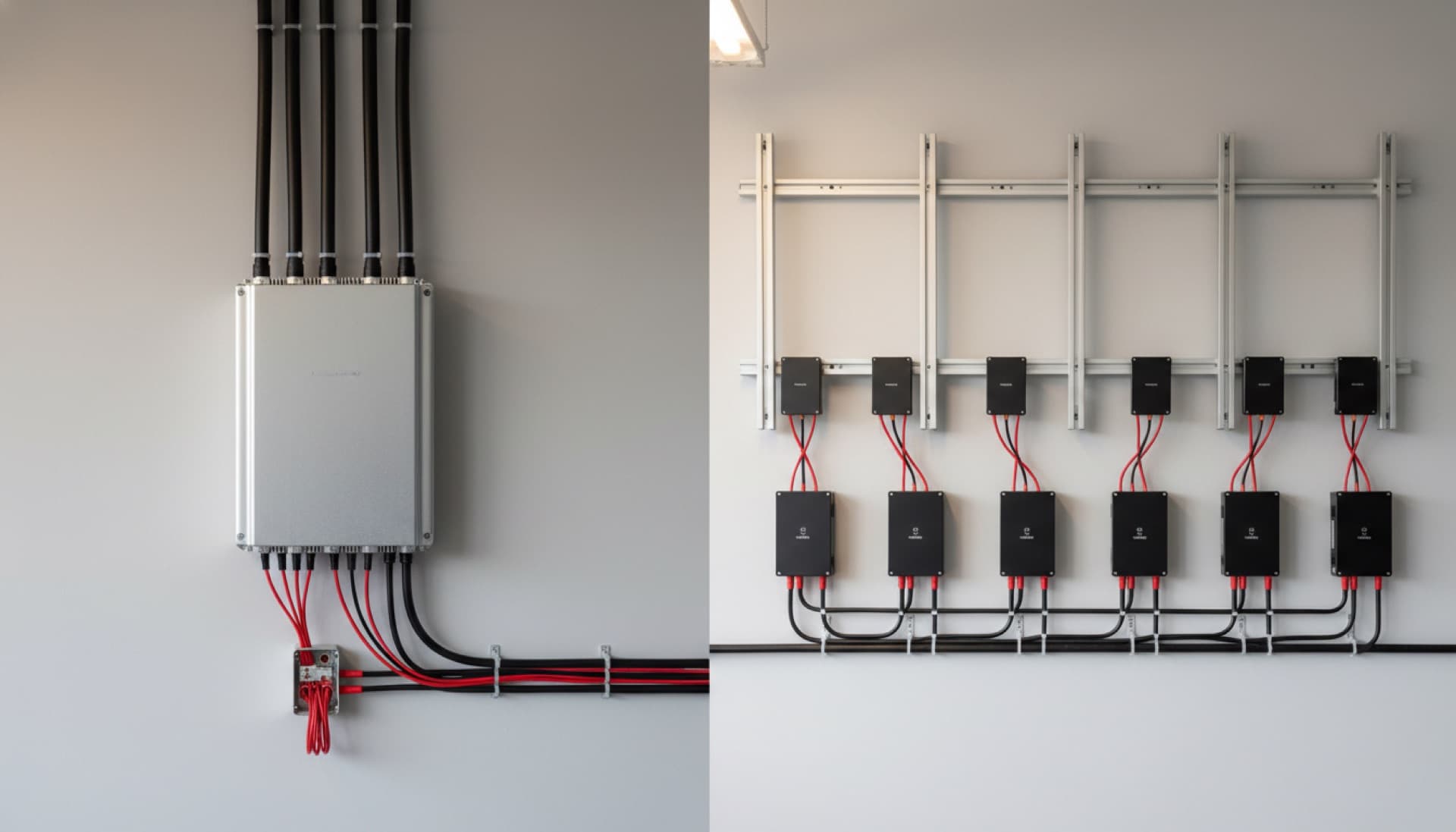
Enphase microinverters are the better choice for most residential solar installations in 2026. The 25-year standard warranty, no single point of failure, and superior shade handling outweigh the $1,500-$2,500 price premium over SolarEdge on a typical 8 kW system. SolarEdge remains a viable option for large, unshaded roofs where budget is the top priority. NuWatt installs Enphase IQ8+ on every residential project.
Understanding the architectural difference is key to choosing the right inverter. SolarEdge and Enphase take fundamentally different approaches to converting DC solar power to AC power for your home.
Centralized conversion with per-panel optimization
Solar panels generate DC power
Power optimizers condition DC at each panel (MPPT)
High-voltage DC (400-600V) travels through strings to central inverter
Central HD-Wave inverter converts all DC to AC
AC power feeds your electrical panel and the grid
Key point: All power flows through one central inverter. If it fails, the entire system stops producing power.
Distributed conversion at each panel
Solar panels generate DC power
Each panel has its own microinverter (IQ8HC)
Microinverter converts DC to AC right at the panel
Safe AC power (240V) travels through trunk cable
AC power feeds your electrical panel and the grid
Key point: Each panel operates independently. If one microinverter fails, only that one panel stops. The rest keep producing.
Side-by-side comparison of every specification that matters for residential solar. The highlighted column is NuWatt's default recommendation.
| Specification | SolarEdgeHD-Wave + Optimizers | EnphaseIQ8HC / NuWatt Default |
|---|---|---|
| Architecture | String inverter + power optimizers | Microinverters (per-panel) |
| Max System Efficiency | 99.2% (inverter) | 97.3% (IQ8HC) |
| Panel-Level MPPT | Via optimizers | Built-in per panel |
| Shade Performance | Good (optimizer mitigates) | Excellent (fully independent) |
| Standard Warranty | 12 years (extendable to 25) | 25 years standard |
| Monitoring | Panel-level via app | Panel-level via app |
| Rapid Shutdown | Via optimizers | Built-in (AC at panel) |
| Single Point of Failure | Yes (central inverter) | No (distributed) |
| Cost per Watt | $0.30-$0.45/W installed | $0.50-$0.70/W installed |
| Battery Compatibility | SolarEdge Energy Bank | Enphase IQ Battery 5P/10C |
| Expansion Flexibility | Must match inverter capacity | Add panels + micros anytime |
| Failure Impact | Entire system down | Single panel only |
SolarEdge's system pairs a central HD-Wave string inverter with per-panel power optimizers. The optimizers handle per-panel MPPT while the central inverter does the DC-to-AC conversion. This hybrid approach costs less than full microinverters but retains a single point of failure.
Higher raw inverter efficiency at 99.2% (SolarEdge HD-Wave)
Lower cost per watt ($0.30-$0.45/W vs $0.50-$0.70/W)
Power optimizers provide panel-level optimization at lower cost than full microinverters
Better suited for large, unshaded roof planes with consistent orientation
SolarEdge monitoring platform is mature and feature-rich
Integrated EV charger option (SolarEdge Energy Hub)
Central inverter is a single point of failure; if it dies, the whole system stops
Inverter failures require a service call and potentially weeks of downtime
Base warranty is only 12 years (must pay extra for 25-year extension)
High-voltage DC runs across the roof (600V+) despite optimizers
Optimizer + inverter combination is more complex to troubleshoot
Adding panels later requires checking inverter capacity headroom
SolarEdge has had well-documented reliability issues in recent years
Enphase places a small microinverter behind each solar panel. Each unit performs independent maximum power point tracking (MPPT) and converts DC to AC at the panel. No high-voltage DC runs across your roof, and no single failure takes down the system.
No single point of failure: if one microinverter fails, only one panel is affected
Standard 25-year warranty (longest in the industry, no upgrade needed)
AC power at the panel level means no high-voltage DC on the roof
Superior shade handling with fully independent per-panel MPPT
Easy system expansion: add panels + microinverters anytime
Built-in rapid shutdown compliance (NEC 2020)
Lower failure rate than string inverters based on field data
Burst Mode enables limited solar backup without a battery
Higher cost per watt ($0.50-$0.70/W vs $0.30-$0.45/W for SolarEdge)
Slightly lower peak efficiency (97.3% vs 99.2%) at the inverter level
More individual components on the roof (one per panel)
Requires IQ Gateway (formerly Envoy) for monitoring and communication
Battery options limited to Enphase ecosystem (IQ Battery 5P, 10C)
Enphase costs more upfront, but the gap narrows when you factor in warranty costs and long-term reliability. Here is how the numbers break down for a typical 8 kW system.
| Cost Component | SolarEdge (8 kW) | Enphase (8 kW) |
|---|---|---|
| Inverter/Microinverter Hardware | $2,400 - $3,600 | $4,000 - $5,600 |
| 25-Year Warranty | +$300 (upgrade required) | Included |
| Total Inverter Cost | $2,700 - $3,900 | $4,000 - $5,600 |
| Premium Over SolarEdge | -- | +$1,300 - $1,700 |
| Cost per Watt | $0.34 - $0.49/W | $0.50 - $0.70/W |
If a SolarEdge inverter fails outside warranty (after year 12), replacement costs $1,500-$2,500 plus labor. During the 1-4 weeks of downtime, an 8 kW system loses roughly $50-$150 in production (depending on season). Over a 25-year system life, the probability of at least one inverter replacement is significant. Factor this into your total cost comparison.
Your best choice depends on your specific situation. Here is our recommendation for each common scenario.
When every panel sees identical sunlight, the per-panel optimization of Enphase adds less value. SolarEdge costs less per watt here.
Each panel operates independently. Shade on one panel does not affect the rest. SolarEdge optimizers help, but microinverters handle partial shade better.
East/west/south-facing panels on different roof planes perform optimally with independent microinverters. String systems require careful string sizing.
At $0.30-$0.45/W vs $0.50-$0.70/W, SolarEdge saves $1,500-$2,500 on a typical 8-10 kW system. Upgrade to 25-year warranty for ~$300.
No single point of failure. One microinverter failing means losing 400W, not 8,000W. The 25-year standard warranty is unmatched.
Enphase IQ Battery 5P integrates seamlessly with IQ8 microinverters through the IQ System Controller 3. SolarEdge requires their own battery ecosystem.
Enphase IQ Battery is fully certified for ConnectedSolutions in MA, CT, RI, and VT. SolarEdge Energy Bank has more limited DR program support.
After installing both SolarEdge and Enphase systems for years, NuWatt made the decision to standardize on Enphase IQ8+ microinverters for all residential projects. Here is the reasoning behind that choice.
Our service records show significantly fewer warranty callbacks on Enphase installations compared to SolarEdge systems. When an Enphase microinverter does fail, the homeowner loses one panel (400-460W) instead of their entire system. Most homeowners do not even notice until they check their app.
Every Enphase IQ8 microinverter ships with a 25-year warranty at no extra cost. SolarEdge requires a paid upgrade from 12 to 25 years. This simplifies our quoting process and gives homeowners peace of mind without upselling.
The Enphase IQ Battery 5P is fully certified for ConnectedSolutions demand response in MA, CT, RI, and VT. The entire Enphase ecosystem (microinverters + battery + IQ System Controller 3) works seamlessly for energy management and DR revenue. This is a major value-add for our Northeast customers.
Enphase converts DC to AC at each panel, so only safe 240V AC travels through the trunk cable. SolarEdge systems run 400-600V DC across the roof to the central inverter. While SolarEdge optimizers provide rapid shutdown capability, we prefer eliminating high-voltage DC on the roof entirely.
NuWatt installs Enphase IQ8HC microinverters on every residential project, paired with premium panels from REC, Silfab, and Hyundai. Get a free quote with transparent pricing. Serving MA, CT, RI, NH, ME, VT, NJ, PA, and TX.