
Loading NuWatt Energy...
We use your location to provide localized solar offers and incentives.
We serve MA, NH, CT, RI, ME, VT, NJ, PA, and TX
Loading NuWatt Energy...
NuWatt designs, installs, and manages solar, battery, heat pump, and EV charger systems across 9 states. One company, one warranty, one point of contact.
Get a Free QuoteOil prices hit $4.30–$4.80 per gallon across New England this winter. A cold-climate heat pump heats the same home for 50–65% less — and adds air conditioning you never had. Here's the full comparison, state by state.
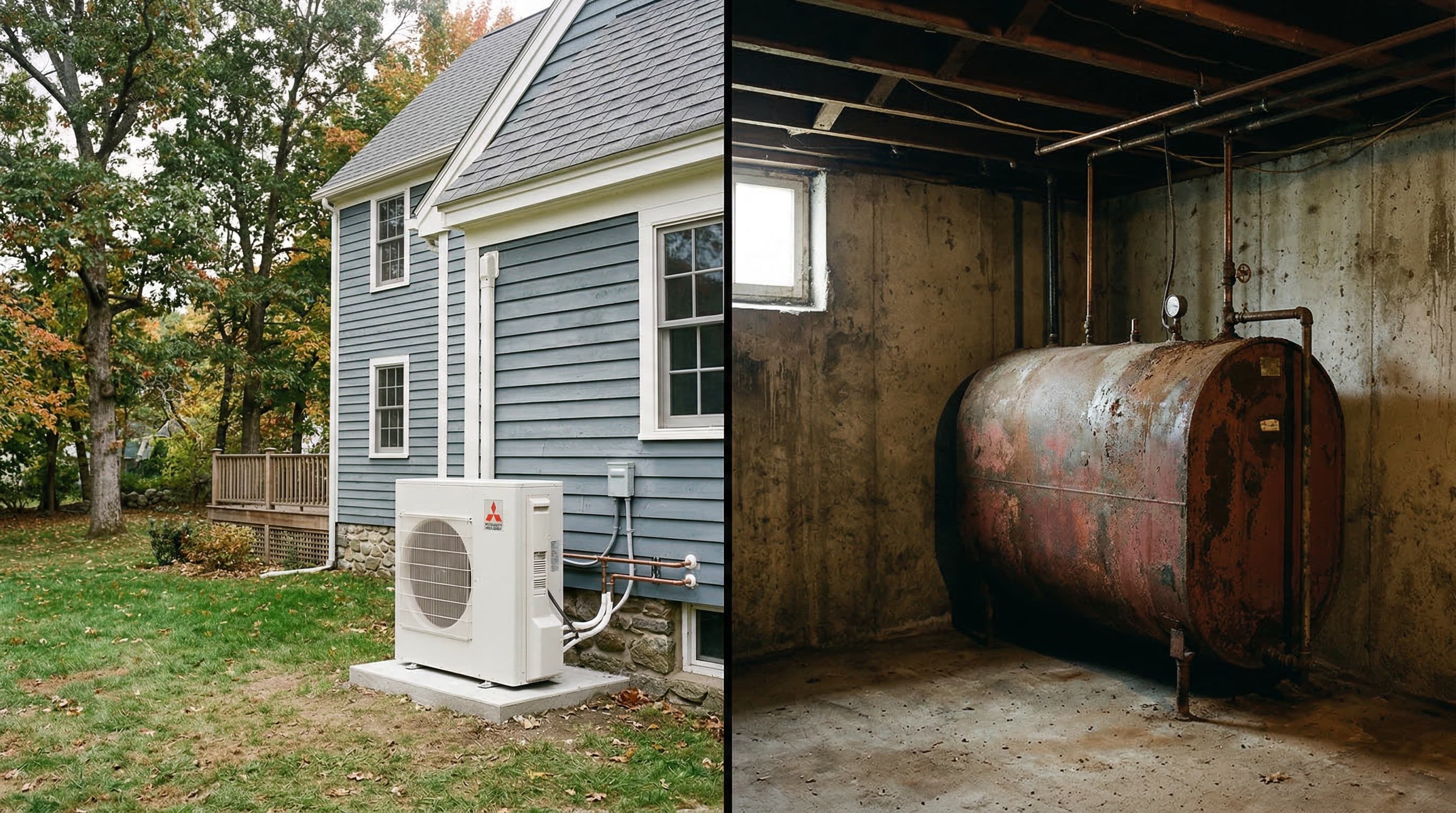
At current oil prices ($4.30–$4.80/gal in New England), a cold-climate heat pump saves the average homeowner $800–$1,500 per year in heating costs while eliminating oil delivery, tank maintenance, and carbon emissions. Heat pumps also provide air conditioning — something most oil-heated homes lack — making them a year-round upgrade, not just a winter replacement.
Based on $4.50/gal oil with an 80% AFUE furnace vs. a cold-climate heat pump (HSPF2 10.5) at each state's average electric rate.
| State | Electric Rate | Oil Cost/Year | Heat Pump/Year | Annual Savings |
|---|---|---|---|---|
| Massachusetts | $0.28/kWh | $1,808 | $356 | $1,452/yr |
| Connecticut | $0.27/kWh | $1,808 | $339 | $1,469/yr |
| Rhode Island | $0.29/kWh | $1,808 | $364 | $1,444/yr |
| New Hampshire | $0.27/kWh | $1,808 | $339 | $1,469/yr |
| Maine | $0.22/kWh | $1,808 | $276 | $1,532/yr |
| Vermont | $0.21/kWh | $1,808 | $264 | $1,544/yr |
| State | Electric Rate | Oil Cost/Year | Heat Pump/Year | Annual Savings |
|---|---|---|---|---|
| Massachusetts | $0.28/kWh | $2,411 | $475 | $1,936/yr |
| Connecticut | $0.27/kWh | $2,411 | $452 | $1,959/yr |
| Rhode Island | $0.29/kWh | $2,411 | $486 | $1,925/yr |
| New Hampshire | $0.27/kWh | $2,411 | $452 | $1,959/yr |
| Maine | $0.22/kWh | $2,411 | $368 | $2,043/yr |
| Vermont | $0.21/kWh | $2,411 | $352 | $2,059/yr |
| State | Electric Rate | Oil Cost/Year | Heat Pump/Year | Annual Savings |
|---|---|---|---|---|
| Massachusetts | $0.28/kWh | $3,013 | $594 | $2,419/yr |
| Connecticut | $0.27/kWh | $3,013 | $565 | $2,448/yr |
| Rhode Island | $0.29/kWh | $3,013 | $607 | $2,406/yr |
| New Hampshire | $0.27/kWh | $3,013 | $565 | $2,448/yr |
| Maine | $0.22/kWh | $3,013 | $461 | $2,552/yr |
| Vermont | $0.21/kWh | $3,013 | $440 | $2,573/yr |
Beyond high fuel costs, oil heating comes with risks that most homeowners underestimate until they try to sell their home or file an insurance claim.
A leaking underground oil tank can contaminate soil and groundwater. Cleanup costs range from $10,000 to $50,000+, and the homeowner is responsible. Massachusetts alone reports 1,000+ oil tank leaks per year. Underground tanks older than 25 years are especially high-risk.
Heating oil prices have swung from $2.50 to $5.50 per gallon in the last five years, driven by global crude markets, refinery outages, and geopolitical events. You cannot budget reliably when your fuel cost can double in a single winter. Electricity rates are regulated and change gradually.
Above-ground tank removal: $500–$1,500. Underground tank removal: $1,500–$3,000 (excavation required). If soil testing reveals contamination, remediation is additional. Many homebuyers now require tank removal as a condition of sale.
Some homeowners insurance policies exclude oil tank leaks or require separate pollution liability coverage ($200–$500/year). Older underground tanks may make your home harder to insure. Switching to electric heating eliminates this risk category entirely.
Oil heat requires regular delivery — typically every 3–6 weeks in winter. Run out during a cold snap and you are waiting for emergency delivery at premium rates. A heat pump runs on electricity that is always available through your utility connection. No deliveries, no running out.
Steel oil tanks have a typical lifespan of 15–20 years. Many NE homes have tanks that are 25–40+ years old. Internal corrosion is invisible until the tank fails. A proactive switch to a heat pump eliminates the risk before it becomes an emergency.
Here is what happens step by step when you switch from oil heat to a cold-climate heat pump. The entire process typically takes 2–4 days of on-site work.
A licensed oil tank removal company drains remaining oil, disconnects the supply line, and removes the tank. Above-ground takes a few hours; underground requires excavation (1 day). Soil testing may be required.
Many older oil-heated homes have 100A or 150A panels. A heat pump typically needs a 200A panel. If an upgrade is needed, a licensed electrician handles this in 4-8 hours. Cost: $1,500-$3,000.
The outdoor condenser unit is placed on a concrete pad or wall-mounted bracket. Location is chosen for airflow, noise distance from bedrooms, snow clearance, and service access. Line sets run to indoor units.
Ductless: wall-mounted heads in each zone (1-2 hours per head). Ducted: air handler replaces the furnace and connects to existing ductwork. Most homes need 3-5 indoor zones for whole-home coverage.
Each zone gets its own controller or connects to a central smart thermostat. Programming includes setback schedules, defrost cycles, and fan speed preferences. Wi-Fi connectivity enables remote monitoring.
Technician verifies refrigerant charge, airflow, and heating/cooling output at each head. You receive training on controls, filter maintenance, and seasonal settings. System is registered for warranty.
Total On-Site Timeline
Ductless system: 1–2 days for installation + 1 day for tank removal. Ducted system: 2–3 days for installation + 1 day for tank removal. Panel upgrade (if needed) adds 4–8 hours, often done the same day.
These five models are NEEP cold-climate listed and proven in New England winters. All operate at or below -13 degrees F and deliver whole-home heating.
The most-installed cold-climate heat pump in New England. New FX series with R-454B refrigerant, -22 degrees F operation, and up to 8-zone capacity. 12-year compressor warranty. The #1 choice of NE HVAC contractors.
Highest verified heating efficiency (HSPF2 14.0) of any mini split. Retains 90% capacity at -15 degrees F. Outdoor noise just 44 dB — quieter than a library. Ideal for bedrooms and close-neighbor lots.
The top choice for homes with existing ductwork. Drops right into your furnace location and uses existing ducts. Variable-speed inverter, -15 degrees F rated, and backed by Carrier dealer network. 10-year warranty.
Genuine cold-climate performance at 40-50% lower cost than Japanese brands. R-32 refrigerant, -22 degrees F rated, NEEP listed. Great for budget-conscious homeowners who want to maximize ROI on the oil-to-HP switch.
Indoor noise as low as 17 dB — essentially inaudible. -13 degrees F operation covers most NE winter nights. Strong efficiency and the LG ThinQ smart app for remote monitoring. Excellent for bedroom and living room installations.
New England states offer some of the strongest heat pump rebates in the country. Maine, Massachusetts, Rhode Island, and Vermont provide enhanced rebates specifically for homeowners switching from oil.
No federal tax credit in 2026. The residential energy tax credits (Section 25C and 25D) expired December 31, 2025. State rebates listed below are the primary incentives available for heat pump installations.
| State | Program | Max Rebate | Details | Oil-Switching Bonus |
|---|---|---|---|---|
| Massachusetts | Mass Save Whole-Home | Up to $8,500 | $2,650/ton capped. $500 sizing + $500 weatherization bonuses. HEAT Loan 0% APR up to $25K. | Enhanced |
| Connecticut | Energize CT | $250-$1,000/ton | Standard $250/ton (max $2,500). Energy Optimization $1,000/ton (max $10K). Smart-E Loan 0.99% APR. | Standard |
| Rhode Island | Clean Heat RI | Up to $11,500 | 60% of cost (standard). 100% income-eligible (max $18K). | Enhanced |
| Maine | Efficiency Maine | $1,000-$3,000/unit | Standard $1K, moderate $2K, low-income $3K per unit. Max 3 units. | Enhanced |
| New Hampshire | NHSaves | $250-$1,250/ton | Standard $250/ton. Enhanced $1,250/ton (replacing electric resistance). | Standard |
| Vermont | Efficiency Vermont | $475-$2,200/unit | Ductless $475/head, ducted $2,200. GMP income bonus $2K. Cold-climate models only. | Enhanced |
From initial site survey to final commissioning, here is a realistic week-by-week timeline for a complete oil-to-heat-pump conversion.
A certified technician visits your home for a Manual J load calculation. They assess insulation, window area, duct condition (if ducted), electrical panel capacity, and optimal outdoor unit placement. You receive a detailed proposal with equipment recommendations and total pricing.
What you do: Schedule the visit, share recent oil bills for baseline comparison.
Once you approve the proposal, equipment is ordered. Most cold-climate models (Mitsubishi, Carrier, Fujitsu) have 1-2 week lead times from regional distributors. Permits are pulled in parallel.
What you do: Sign contract, confirm rebate pre-approval with your utility.
Heat pump installation takes 1-2 days for ductless (3-5 zones) or 2-3 days for ducted. Oil tank removal is typically handled by a separate licensed contractor on a different day. Electrical panel upgrade (if needed) is coordinated to happen before heat pump installation.
What you do: Ensure access to all zones, clear outdoor unit area.
The technician verifies system performance: refrigerant charge, airflow per zone, heating output at each head, defrost cycle operation. You receive hands-on training with thermostats and the manufacturer app. System is registered for warranty and rebate documentation is submitted.
What you do: Learn controls, set zone schedules, submit rebate paperwork.
Answers to the most common questions about switching from oil to a heat pump.
A whole-home cold-climate heat pump system costs $12,000-$22,000 installed before state rebates. After incentives (Mass Save up to $8,500, Clean Heat RI up to $11,500, Efficiency Maine $1,000-$3,000/unit), net cost ranges from $4,000-$15,000. Oil tank removal adds $1,000-$3,000. The typical payback period is 4-8 years based on annual savings of $800-$1,500 over oil heating.
Yes. Modern cold-climate heat pumps operate efficiently down to -13 to -22 degrees Fahrenheit. The Mitsubishi Hyper-Heat FX and Fujitsu Orion XLTH+ both maintain heating output at -22 degrees F. These are not the heat pumps from the 1990s. Inverter-driven compressors maintain 60-80% of rated capacity at 5 degrees F. For 95%+ of winter hours, the heat pump handles all heating needs without backup.
You are not legally required to remove the tank immediately in most states, but it is strongly recommended. Underground tanks pose environmental liability risks — soil contamination cleanup costs $10,000-$50,000+. Above-ground tanks are easier to remove ($500-$1,500) and eliminate insurance concerns. Many state rebate programs require oil system decommissioning to qualify for fuel-switching bonuses.
You have three options: (1) Keep it as dual-fuel backup for the first winter while you build confidence in the heat pump — this is what we recommend most often. (2) Decommission it immediately and rely fully on the heat pump, which may qualify you for higher fuel-switching rebates. (3) Remove it entirely along with the oil tank to reclaim space. Most homeowners choose option 1 and decommission within 1-2 years.
Yes, and many homeowners do for the first 1-2 winters. A dual-fuel or hybrid setup uses the heat pump for 95%+ of heating and the oil furnace only during the coldest hours. This eliminates range anxiety while you verify the heat pump performs. Over time, most homeowners find they never use the oil backup and eventually decommission it. A good thermostat can automate the switchover based on outdoor temperature.
The full process takes 3-5 weeks. Week 1: site survey, Manual J load calculation, and equipment sizing. Week 2: equipment ordering (1-2 week lead time for most models). Weeks 3-4: installation (1-2 days for the heat pump, 1 day for oil tank removal if included). Week 5: system commissioning, thermostat setup, and homeowner training. The heat pump installation itself is typically completed in a single day for ductless systems.
A proper Manual J load calculation is required, but general guidelines: a 1,500 sq ft well-insulated NE home needs 36,000-48,000 BTU (3-4 tons). A 2,000 sq ft home needs 48,000-60,000 BTU (4-5 tons). A 2,500 sq ft home needs 60,000-72,000 BTU (5-6 tons). Cold-climate models are sized slightly larger than cooling-only calculations because heating demand exceeds cooling demand in New England. Never rely on square footage alone — insulation quality, window area, and air sealing matter more.
Yes, multiple New England states offer enhanced rebates specifically for fuel-switching from oil. Massachusetts Mass Save offers up to $8,500 for whole-home heat pump conversion. Rhode Island Clean Heat RI provides up to $11,500 (standard) or $18,000 (income-eligible). Maine Efficiency Maine offers $1,000-$3,000 per unit (up to 3 units). Connecticut Energize CT provides $250-$1,000 per ton. Vermont Efficiency Vermont offers $475-$2,200 per unit plus income-eligible bonuses. There is no federal residential tax credit for heat pumps in 2026.
Every month you wait costs $200–$400 in excess oil heating. Summer is the best time to install — shorter wait times, no heating interruption, and your system is ready for the first cold snap.
Free site survey. No-pressure proposal. State rebate assistance included.