
Loading NuWatt Energy...
We use your location to provide localized solar offers and incentives.
We serve MA, NH, CT, RI, ME, VT, NJ, PA, and TX
Loading NuWatt Energy...
NuWatt designs, installs, and manages solar, battery, heat pump, and EV charger systems across 9 states. One company, one warranty, one point of contact.
Get a Free QuoteStep-by-step guide from initial site assessment to permission to operate. Navigate permitting, interconnection queues, and construction phases for your MA commercial solar project.

Total Timeline
6-18 mo
Assessment to PTO
Interconnection
4-16 wk
Longest bottleneck
Permitting
4-12 wk
Building + electrical
Construction
4-12 wk
Depends on system size
A typical MA commercial solar project takes 6-18 months from initial site assessment to permission to operate (PTO). The timeline includes 8 phases: site assessment (2-4 weeks), engineering and design (3-6 weeks), permitting (4-12 weeks), utility interconnection (4-16 weeks — the longest bottleneck), SMART program application (2-4 weeks), equipment procurement (4-12 weeks), construction (4-12 weeks), and inspection to PTO (2-6 weeks). Running phases in parallel can compress the timeline to 8-10 months. To capture 2026 incentives including the 30% ITC and 20% MACRS bonus depreciation, projects should begin no later than Q1 2026.
Commercial solar projects in Massachusetts are fundamentally different from residential installations in terms of complexity, timeline, and stakeholder coordination. While a residential rooftop system might take 2-4 months from contract to operation, a commercial project involves multiple permitting authorities, utility interconnection studies, state incentive program registration, and significantly larger construction scopes.
The total timeline for a Massachusetts commercial solar project ranges from 6 to 18 months, with the wide range reflecting differences in system size, site complexity, utility territory, and whether infrastructure upgrades are required. A straightforward 50 kW rooftop system on a modern commercial building in an Eversource territory might be completed in 6-8 months. A 500 kW ground-mount system in a National Grid territory that requires a transformer upgrade and historical commission review could easily take 14-18 months.
Understanding each phase of the timeline is critical for capturing 2026 incentives. The Section 48/48E Investment Tax Credit requires construction to begin before July 4, 2026. The 20% MACRS bonus depreciation requires the system to be placed in service before December 31, 2026. Missing either deadline can cost your business tens of thousands of dollars in lost tax benefits. This guide walks through every phase so you can plan accordingly.
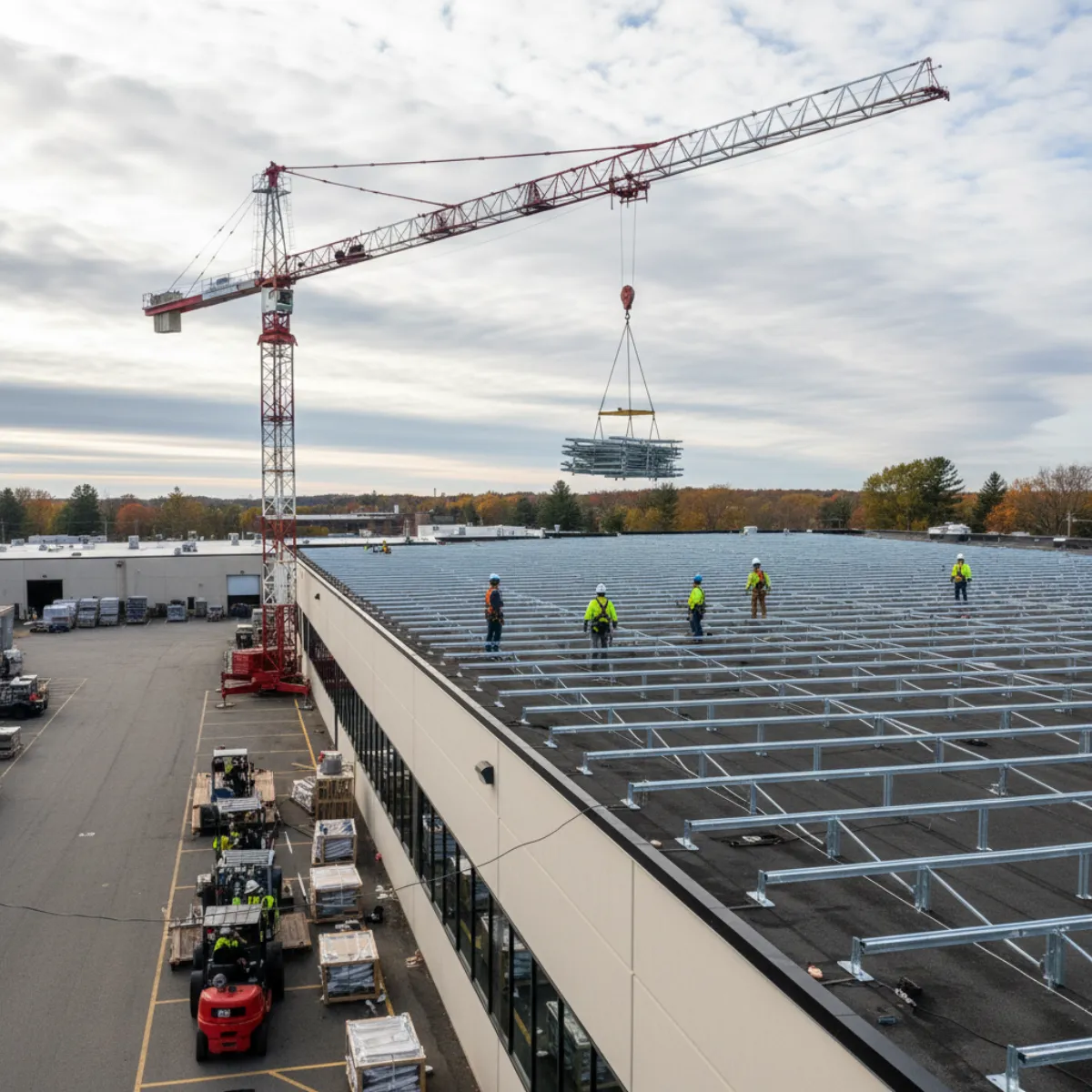
A commercial solar installation in progress on a MA warehouse. Construction is just one of eight project phases.
Every commercial solar project in Massachusetts follows a predictable sequence of eight phases. While the durations vary by project size and complexity, the order remains consistent. Here is what to expect at each stage.
Initial site visit, roof/ground survey, shading analysis, structural assessment, and preliminary financial modeling.
Detailed engineering drawings, electrical single-line diagrams, structural calculations, and equipment specifications.
Building permits, electrical permits, zoning review, and historical commission review if applicable.
The longest bottleneck. National Grid and Eversource interconnection study and approval process.
Register with the SMART 3.0 program to lock in 20-year production-based incentive rates.
Order panels, inverters, racking, and electrical equipment. Lead times vary with tariff conditions.
Physical installation including racking, panels, inverters, electrical connections, and commissioning.
Final inspections, utility witness test, meter installation, and permission to operate.
Every commercial solar project begins with a comprehensive site assessment. An experienced solar engineer visits the property to evaluate roof condition, structural capacity, available area, electrical infrastructure, and shading. For rooftop installations, the engineer assesses roof age, material, pitch, and orientation. For ground-mount systems, the assessment includes soil conditions, topography, and setback requirements.
The feasibility analysis also includes a detailed review of your commercial electric bills — at least 12 months of usage data, including demand charges, usage charges, load factor, and power factor. This data drives the initial system sizing. In Massachusetts, where commercial rates range from $0.22 to $0.30 per kWh, the financial case for solar is typically strong. The feasibility report includes a preliminary financial pro forma showing estimated costs ($2.10-$2.55/W for small systems, $1.60-$1.90/W for mid-size, and $1.20-$1.50/W for large-scale), projected savings, ITC value, MACRS depreciation benefit, SMART program revenue, and payback period.
This is also when you should request interval data from your utility — 15-minute or hourly load data that reveals your facility's consumption patterns. This data is critical for optimal system sizing, especially if you are considering battery storage for demand charge management. See our Commercial Energy Audit & Solar Sizing Guide for a detailed walkthrough of this process.
Once the feasibility assessment confirms a viable project, the engineering team produces detailed construction documents. These include PE-stamped (Professional Engineer) structural calculations confirming the building can support the solar array, electrical single-line diagrams showing the interconnection path from panels to inverters to the main switchboard, and a detailed panel layout optimizing production while meeting code setback requirements.
For projects exceeding 1 MW, the engineering phase also includes prevailing wage and apprenticeship compliance documentation required to maintain the full 30% ITC base rate. The design must also account for NEC 2020 rapid shutdown requirements, Massachusetts fire department setback rules, and any utility-specific interconnection requirements. Equipment selection is finalized during this phase, including panel wattage and manufacturer, inverter type (string, central, or microinverters), and monitoring system specifications.
Massachusetts permitting for commercial solar involves multiple municipal departments. The building department reviews structural plans and code compliance. The electrical inspector reviews the electrical design and inverter specifications. The zoning board verifies that the installation complies with local solar bylaws — some municipalities have specific height restrictions, setback requirements, or screening requirements for ground-mount systems.
The permitting timeline varies dramatically by municipality. Progressive cities like Cambridge and Boston have streamlined solar permitting processes that can issue permits within 2-3 weeks. Smaller towns with part-time building departments may take 6-8 weeks. Properties in historical districts face the most significant delays — the local Historical Commission must review and approve the installation, and many commissions meet only monthly. A project submitted just after a meeting may wait 4-6 weeks for the next review opportunity.
For comprehensive permitting guidance, see our MA Solar Permitting Guide. The key strategy is to submit permit applications as early as possible, ideally concurrent with the interconnection application, to run these two lengthy processes in parallel.
Utility interconnection is the most time-consuming and unpredictable phase of any commercial solar project in Massachusetts. The process begins with submitting an interconnection application to the host utility — National Grid, Eversource, or Unitil. The utility then determines whether the project qualifies for simplified (expedited) review or requires a detailed interconnection study.
Systems under 25 kW on dedicated commercial circuits typically qualify for simplified review, which takes 4-8 weeks. Systems over 25 kW, or those on circuits with existing solar penetration, trigger a detailed impact study. This study evaluates the effect of the proposed solar system on the local distribution grid, including transformer loading, voltage regulation, fault current contribution, and anti-islanding protection.
The detailed study alone can take 8-16 weeks. If the study identifies required infrastructure upgrades — most commonly a transformer upgrade — the timeline extends further while the utility designs, procures, and installs the new equipment. Transformer upgrades can add 8-20 weeks and cost the developer $15,000 to $150,000 or more. This is why experienced developers submit interconnection applications at the earliest possible stage and consider strategic system sizing to avoid triggering costly upgrade requirements.
Each Massachusetts investor-owned utility has its own interconnection process, queue management, and typical timelines. The following comparison reflects current 2026 conditions based on recent project data.
Simplified Review
4-8 weeks
Detailed Study
8-16 weeks
Study Threshold
>25 kW
Simplified process for systems under 25 kW on dedicated commercial circuits. Detailed study required for larger systems.
Simplified Review
4-6 weeks
Detailed Study
8-14 weeks
Study Threshold
>25 kW
Generally faster simplified process. Detailed studies can extend significantly if distribution upgrades are required.
Simplified Review
3-6 weeks
Detailed Study
6-12 weeks
Study Threshold
>25 kW
Smaller service territory means shorter queues. Fewer interconnection applications overall.
Even well-planned commercial solar projects encounter delays. Knowing the most common delay sources — and their mitigation strategies — can save weeks or months on your project timeline.
National Grid and Eversource interconnection queues are backed up, especially for systems >25 kW that require impact studies. Large projects (>500 kW) can face 6+ month delays if transformer upgrades are needed.
Mitigation Strategy
Submit interconnection application as early as possible. Consider sizing the system just under utility study thresholds. Work with an experienced interconnection consultant.
If the local distribution transformer cannot handle the solar export, the utility may require an upgrade at the developer's expense. Costs range from $15,000 to $150,000+ depending on the scope.
Mitigation Strategy
Run a pre-application screening with the utility before finalizing system size. Consider battery storage to limit export and avoid transformer triggers.
Properties in Massachusetts historical districts may require approval from the local Historical Commission. Some commissions meet monthly, adding significant delays.
Mitigation Strategy
Check historical district status early. Engage the historical commission during the feasibility phase. Ground-mount or non-visible rooftop installations may avoid review.
Older commercial buildings may not have adequate structural capacity for rooftop solar. A structural engineer may require roof reinforcement before installation.
Mitigation Strategy
Commission a structural assessment during Phase 1. Consider lighter panel options or reduced system density to minimize structural load.
Tariff impacts and high demand can create equipment shortages, especially for US-manufactured panels needed for the domestic content ITC bonus.
Mitigation Strategy
Place equipment orders early. Work with distributors who maintain buffer inventory. Consider multiple panel manufacturer options in the design phase.
The single most effective strategy for reducing your commercial solar project timeline is running independent phases in parallel rather than sequentially. If you execute each phase one after another, the total timeline can stretch to 15-18 months. With strategic parallel processing, you can compress that to 8-10 months.
For a detailed financial analysis of your project, including how timeline affects incentive capture, see our Commercial Solar IRR Calculator. Projects that miss the December 31, 2026 placed-in-service deadline for MACRS lose the 20% bonus depreciation entirely, which can represent $20,000-$60,000 in lost tax benefit for a typical mid-size commercial system.
Massachusetts commercial solar projects in 2026 face several critical deadlines that directly affect project economics. Missing any of these deadlines can cost tens of thousands of dollars in lost incentives. Here is your deadline map and the timeline implications of each.
Commercial solar projects must demonstrate that construction has begun before this date. The IRS recognizes two safe harbor methods: (1) the 5% Physical Work Test — physical work of a significant nature has begun at the project site, or (2) the 5% Safe Harbor — at least 5% of the total project cost has been paid or incurred. Most developers use the 5% safe harbor method, which requires paying at least 5% of the total installed cost to a qualified equipment supplier or contractor. This preserves the full 30% base ITC plus potential bonus adders up to 70%.
The 20% first-year bonus depreciation is available only for systems placed in service (receiving PTO) in 2026. In 2027, bonus depreciation drops to 0%. For a $500,000 commercial solar system with a 30% ITC, the depreciable basis is $425,000, and the 20% bonus represents an $85,000 first-year deduction worth approximately $24,650 in tax savings at a 29% combined federal/state rate. This benefit is permanently lost if PTO is not received by December 31, 2026.
After this date, projects using components from Foreign Entities of Concern may lose eligibility for the 10% domestic content ITC bonus adder. Projects aiming for the domestic content bonus should verify supply chains and secure US-manufactured equipment well before this deadline. The 10% bonus on a $500,000 system is worth $50,000 — significant enough to justify premium domestic equipment costs.
To receive PTO by December 31, 2026, you need to start construction no later than September-October 2026 (for a small system) or July-August 2026 (for a mid-size system). Working backward from a 4-12 week construction phase, permits must be in hand by summer 2026. This means the engineering, permitting, and interconnection processes should be initiated by Q1 2026 at the latest. For comprehensive financial planning, use our MA Commercial Solar 2026 guide and IRR calculator.
Cost Range
$2.10-$2.55/W
Interconnection
Simplified (4-8 weeks)
Construction
4-6 weeks
Most straightforward projects. Usually qualify for simplified interconnection. Standard rooftop permitting. Equipment readily available.
Cost Range
$1.60-$1.90/W
Interconnection
Detailed study likely (8-14 weeks)
Construction
6-10 weeks
Detailed interconnection study almost always required. May require transformer assessment. Larger permitting packages. Equipment procurement may be longer for domestic content panels.
Cost Range
$1.20-$1.50/W
Interconnection
Detailed study required (10-16+ weeks)
Construction
8-12 weeks
Complex interconnection with potential infrastructure upgrades. Site plan review often required. Ground-mount projects may need conservation commission approval. Prevailing wage compliance for >1 MW.
The SMART 3.0 program (Solar Massachusetts Renewable Target) provides 20-year production-based incentive payments for qualifying commercial solar projects. Registration can begin during the project development phase, but final enrollment occurs after PTO is received. The SMART program application process takes 2-4 weeks and involves submitting a Statement of Qualification (SQ) that documents the system specifications, interconnection status, and any applicable adder eligibility.
For commercial systems, SMART adders can significantly increase the incentive rate. The building-mounted adder, canopy/carport adder ($0.06/kWh), battery storage adder, and community solar adder ($0.07/kWh) all stack on top of the base rate. For a detailed walkthrough of the SMART program enrollment process, see our SMART Program Enrollment Guide.
After PTO and SMART enrollment, there are a few remaining administrative steps: filing for the Section 48/48E ITC on your next federal tax return, starting MACRS depreciation in the tax year the system is placed in service, and setting up solar production monitoring to track system performance against projections. Your installer should provide as-built drawings and a commissioning report documenting the completed installation.
A typical MA commercial solar project takes 6-18 months from initial site assessment to permission to operate (PTO). Smaller systems (25-100 kW) on straightforward sites can be completed in 6-9 months. Mid-size projects (100-500 kW) typically take 9-14 months. Large-scale projects (500 kW+) or those requiring utility infrastructure upgrades can take 12-18 months. The single biggest variable is the utility interconnection process, which can range from 4 weeks (simplified) to 16+ weeks (detailed study with upgrades).
Our team manages the entire timeline — from site assessment through PTO. Start now to capture 2026 incentives.