Loading NuWatt Energy...

We use your location to provide localized solar offers and incentives.
We serve MA, NH, CT, RI, ME, VT, NJ, PA, and TX
Loading NuWatt Energy...
NuWatt designs, installs, and manages solar, battery, heat pump, and EV charger systems across 9 states. One company, one warranty, one point of contact.
Get a Free Quote
The federal residential solar tax credit is gone. In Texas's deregulated ERCOT market with no statewide net metering, the installer you choose determines whether you maximize battery storage value, secure competitive financing, and get honest pricing. We compared five companies actively installing across the Lone Star State.
The best solar companies in Texas in 2026 are NuWatt Energy (best overall value with Propel financing), Freedom Solar Power (best for Austin/Central TX and Tesla Powerwall), and Sunrun (best for $0-down lease/PPA). With the federal residential ITC expired and no statewide net metering, choosing an installer who understands ERCOT, battery storage optimization, and the deregulated market is critical for maximizing your solar investment.
Texas is the #2 solar market in the US with unique characteristics that most national installers overlook. Here are the key numbers every TX homeowner needs to know.
$2.75/W
Avg Cost/Watt
$2.60–$2.90 typical range
$0.14–$0.16
Avg Electric Rate
Per kWh, varies by REP/metro
5.0–5.5
Peak Sun Hours
Hours/day annual avg (excellent)
None
Net Metering
No statewide program; varies by utility
Exempt
Property Tax
SB 760 statewide exemption
Deregulated
ERCOT Market
~85% of TX choose their REP
Texas is not one solar market — it is four very different ones. Your metro area determines your utility type, rate structure, export credits, and payback timeline.
Deregulated (Oncor distribution)
Largest TX metro, choose your REP, battery storage recommended
Deregulated (CenterPoint distribution)
Sunnova HQ, high cooling demand, battery critical for backup
Municipal (Austin Energy)
Best export rate in TX, Freedom Solar HQ, lower utility rate
Municipal (CPS Energy)
Low base rates, limited buyback, strong solar irradiance
Deregulated vs. Municipal
About 85% of Texas customers are in deregulated ERCOT areas (DFW, Houston) where you choose your Retail Electric Provider (REP). Austin and San Antonio are municipal utility territories with fixed rates and their own solar programs. Your installer should understand this distinction and design your system accordingly — it fundamentally changes the solar economics.
We evaluated each installer on eight criteria that matter most for Texas homeowners in the post-ITC landscape. Companies that understand ERCOT, battery storage, and the deregulated market ranked higher because those factors now drive the difference between a good and bad solar investment.
Critical in TX without net metering — TOU arbitrage, backup, self-consumption
REP switching, export credits, TOU rate optimization
Clear $/W breakdown with no hidden dealer fees or adders
Tier-1 panels, quality inverters, workmanship coverage
BBB rating, Google reviews, complaint patterns
Own TX crews vs subcontracted, local office presence
Cash, loan, Propel, lease/PPA availability and terms
DFW, Houston, Austin, SA presence and installation capacity
Detailed profiles with honest pros and cons. We call out weaknesses for every company, including NuWatt, because you deserve an unbiased comparison.
Propel financing, FEOC Silfab panels, and deep ERCOT market expertise
2008, Chelmsford MA
$2.60–$2.90/W cash; competitive Propel lease/PPA
DFW, Houston, Austin, SA
Best for: Homeowners who want transparent pricing, Propel financing with FEOC panels, and an installer that understands ERCOT
Largest Texas-only installer with strong Austin roots and Tesla Powerwall certification
2007, Austin TX
$2.85–$3.20/W cash
Austin (HQ), DFW, Houston, SA
Best for: Austin and Central TX homeowners who want a proven local installer with Tesla Powerwall expertise
Largest US residential solar company with strong lease/PPA options in TX
2007, San Francisco CA
$3.00–$3.40/W cash equivalent; lease/PPA competitive
Statewide
Best for: Homeowners prioritizing $0-down financing with a national brand
Houston-headquartered lease/PPA specialist with strong TX roots and service plans
2012, Houston TX
$2.80–$3.10/W
Houston (HQ), DFW, Austin, SA
Best for: Houston metro homeowners who want a Texas-headquartered company with flexible financing and service plans
Powerwall bundling, Solar Roof option, and online ordering with standardized pricing
2006, Palo Alto CA (solar division from SolarCity acquisition)
$2.50–$2.85/W (online pricing, often excludes complexity adders)
Statewide (online)
Best for: Tech enthusiasts who want the Tesla ecosystem, Powerwall integration, and app experience
How the five companies stack up on the features that matter most in Texas.
| Feature | NuWatt | Freedom | Sunrun | Sunnova | Tesla |
|---|---|---|---|---|---|
| Local Crews | Yes | Yes | No (subcontracted) | No (dealer network) | No (subcontracted) |
| ERCOT Knowledge | Yes | Yes | Limited | Yes | No |
| Battery Expertise | Yes | Yes | Limited | Limited | Yes (Powerwall only) |
| TX Metro Coverage | DFW, Houston, Austin, SA | Austin (HQ), DFW, Houston, SA | Statewide | Houston (HQ), DFW, Austin, SA | Statewide (online) |
| $0-Down Option | Yes (Propel) | Limited | Yes | Yes | Yes |
| Avg Price/Watt | $2.60–$2.90/W cash | $2.85–$3.20/W cash | $3.00–$3.40/W cash equivalent | $2.80–$3.10/W | $2.50–$2.85/W (online pricing, often excludes complexity adders) |
| Warranty | 25 yr | 25 yr | 25 yr | 25 yr | 25 yr |
| BBB Rating | A+ | A+ | A+ | A- | B |
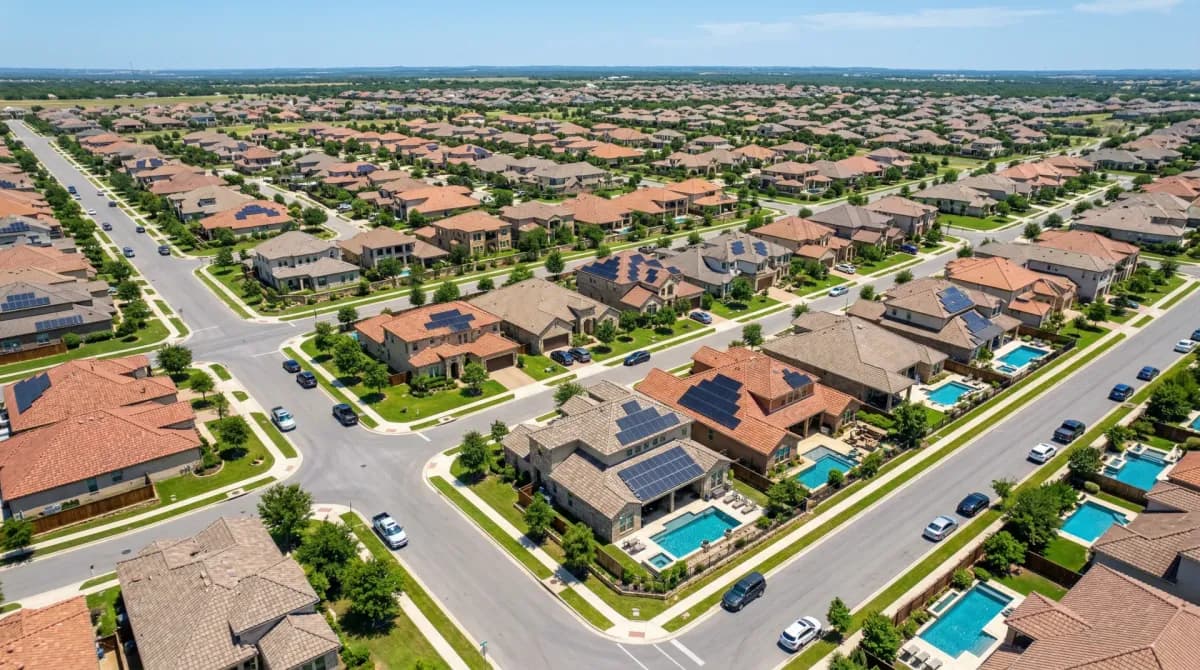
Solar installations vary across Texas — from DFW suburban rooftops to Houston sprawl to Austin hill country properties.
Texas is one of the few states where battery storage is not just a nice-to-have — it is a financial and safety necessity for solar homeowners. Here is why.
Without statewide net metering, excess solar energy exported to the grid earns only $0.02–$0.06/kWh from most ERCOT REPs. Your self-consumed solar is worth $0.12–$0.16/kWh (your retail rate). A battery lets you store daytime solar production and use it during expensive evening hours, capturing 3–8x more value per kWh than exporting to the grid.
Many Texas REPs offer time-of-use (TOU) plans with dramatically different rates between peak and off-peak hours. Solar charges your battery during cheap midday hours, and the battery discharges during expensive evening peaks (4–9 PM). This arbitrage can save an additional $200–$500 per year depending on your REP and usage pattern.
After Winter Storm Uri in 2021 exposed ERCOT grid vulnerabilities, battery backup has become essential for Texas homeowners. The ERCOT grid operates independently from the two major US interconnects, meaning Texas cannot easily import power during emergencies. A solar-plus-battery system keeps your lights on, your refrigerator running, and your family safe during grid events.
Some Texas REPs and grid operators are beginning to offer demand response programs where battery owners receive payments for reducing grid load during peak stress events. As ERCOT continues to evolve, battery owners will be positioned to earn revenue from grid services — turning your battery from a cost center into a potential profit center.
Battery Bottom Line
In most Northeast states, battery storage is optional because strong net metering gives you full credit for exported solar. In Texas, battery storage is the difference between a mediocre solar investment and a great one. Any TX solar installer who does not discuss battery options is not designing a system optimized for the Texas market.
The solar landscape in Texas shifted dramatically when the One Big Beautiful Bill Act let the Section 25D residential tax credit expire on December 31, 2025. Here is what that means for your installer decision.
The 30% federal tax credit for homeowner-owned solar (Section 25D) expired. For a typical 10 kW system at $27,500, that means there is no longer an $8,250 credit to offset your upfront cost on cash or loan purchases. Every other savings lever — battery self-consumption, TOU optimization, property tax exemption — matters more than ever.
Without the ITC to pad your savings, maximizing the value of every kWh matters more. Battery storage lets you capture 3–8x more value from your solar production compared to exporting to the grid. In 2026, the most successful Texas solar installations pair panels with battery storage for self-consumption, TOU arbitrage, and grid backup.
NuWatt's Propel $0-down lease program is available in Texas. Under Propel, the third-party system owner installs Silfab FEOC panels and claims the Section 48/48E commercial ITC. This is one of the few paths for TX homeowners to still benefit from federal tax incentives in 2026. The savings pass through as lower monthly lease payments.
Under any lease or PPA arrangement, the third-party system owner claims the Section 48/48E commercial ITC and passes savings to you through lower monthly payments. For Texas homeowners who want $0-down solar, this is now the primary way to benefit from federal tax incentives. Sunrun, Sunnova, and NuWatt (via Propel) all offer this option in Texas.
Bottom Line
In 2025, the 30% tax credit could mask a mediocre installation. In 2026, your installer's knowledge of ERCOT, battery storage, REP optimization, and Propel/lease economics directly determines whether your solar investment delivers strong returns or underperforms. Texas homeowners who choose the right installer can still achieve 10–14 year payback even without the residential ITC.
Protect yourself from bad deals. If you encounter any of these warning signs during the sales process, proceed with caution.
Texas has a unique deregulated electricity market where ~85% of customers choose their Retail Electric Provider (REP). Your REP determines your rate structure, export credit for solar, and TOU pricing. An installer who cannot explain how ERCOT works, how solar interacts with your REP plan, or when it makes sense to switch REPs after going solar is not equipped to optimize your system for Texas.
Texas does not have statewide net metering. Only municipal utilities like Austin Energy and CPS Energy offer structured solar compensation programs. Most ERCOT REPs provide minimal export credits ($0.02–$0.06/kWh). An installer who promises 1:1 net metering in a deregulated ERCOT area is either uninformed or misleading you. Ask specifically what export rate you will receive.
The residential solar tax credit (Section 25D) expired on December 31, 2025. Any installer still quoting a 30% federal tax credit for a homeowner-owned system is either uninformed or dishonest. The only way to access the ITC in 2026 is through a lease or PPA where the third-party system owner claims Section 48/48E.
In Texas, battery storage is not optional — it is essential for maximizing solar value. Without net metering, your excess solar production is worth pennies on the dollar if exported to the grid. An installer who does not offer battery storage solutions, cannot explain TOU arbitrage, or dismisses battery backup as unnecessary does not understand the Texas solar market.
Texas is a massive state with unique permitting processes, utility interconnection requirements, and weather conditions. An installer without a physical Texas presence, dedicated TX-licensed electricians, and experience with local jurisdictions will likely face delays and quality issues. Ask where their nearest TX office is located.
Legitimate solar companies encourage you to get multiple quotes. A company that pressures you to sign a contract the same day — especially by claiming a "limited-time discount" that expires today — is using a high-pressure sales tactic. Texas law allows you to cancel a home solicitation transaction within 3 business days.
City-specific guides with local pricing, utility rates, and installer recommendations.
The average cost of solar panels in Texas in 2026 is approximately $2.75/W before any incentives. For a typical 10 kW system, that translates to roughly $27,500 before property tax exemptions. Pricing varies by installer and metro: NuWatt quotes $2.60–$2.90/W with Propel financing available, Freedom Solar $2.85–$3.20/W, and Tesla $2.50–$2.85/W (though Tesla pricing often excludes complexity adders). Texas benefits from strong competition and high installation volume, keeping prices among the lowest in the US.
Texas does not have statewide net metering. Solar export credits vary dramatically by utility and Retail Electric Provider (REP). Austin Energy offers a value-of-solar tariff that provides reasonable compensation. CPS Energy in San Antonio has a limited buyback program. In deregulated ERCOT areas (most of TX), REPs typically offer minimal export credits of $0.02–$0.06/kWh, which is far below retail rates. This is why battery storage is so important in Texas — storing excess energy for your own use is often worth more than exporting it to the grid.
Propel is a $0-down solar lease/PPA program available through NuWatt Energy in Texas. Under Propel, the third-party system owner installs solar using Silfab FEOC (Fully Eligible for Original Credit) panels and claims the Section 48/48E commercial investment tax credit. The savings are passed to you through lower monthly payments. Because the ITC is no longer available for homeowner-owned systems (Section 25D expired December 31, 2025), Propel is one of the few ways Texas homeowners can still benefit from federal solar tax incentives in 2026.
Yes, solar is still a strong investment in Texas in 2026. Texas has excellent solar irradiance (5.0–5.5 peak sun hours/day), relatively low installation costs ($2.60–$2.90/W), statewide property tax exemption for solar (SB 760), no state income tax to worry about, and high summer electricity demand that aligns perfectly with solar production. For homeowners who want $0-down options, lease/PPA programs like Propel let the third-party owner claim the Section 48/48E commercial ITC. Battery storage adds significant value by capturing energy for evening use when rates are highest and providing backup during ERCOT grid events.
Solar payback in Texas typically ranges from 10 to 14 years for cash purchases, depending on your metro area, electric rate, and whether you add battery storage. Houston homeowners paying $0.16/kWh see payback around 11–13 years. DFW homeowners at $0.15/kWh are similar at 11–14 years. Austin Energy customers at $0.12/kWh (municipal) see longer payback of 13–15 years but benefit from the value-of-solar tariff. Adding battery storage can improve payback by capturing TOU rate differentials and avoiding peak demand charges. After payback, your system generates essentially free electricity for 15+ additional years.
Battery storage is highly recommended for Texas solar installations in 2026. Without statewide net metering, most ERCOT customers receive only $0.02–$0.06/kWh for excess solar energy exported to the grid. A battery lets you store that energy and use it during expensive evening hours when rates are highest. Additionally, after the 2021 Winter Storm Uri and ongoing ERCOT grid reliability concerns, battery backup provides critical home resilience during extreme weather events. Battery storage also enables TOU arbitrage — charging from solar during the day and discharging during peak-rate evenings — which can significantly improve your solar ROI.
Compare against any competitor. We show you the full breakdown including battery storage ROI, ERCOT rate optimization, Propel lease economics, and honest cash vs. lease pricing for your specific TX metro.
No high-pressure sales. No hidden dealer fees. Just transparent pricing from a company that understands Texas's deregulated ERCOT market and the critical role of battery storage.