Loading NuWatt Energy...

We use your location to provide localized solar offers and incentives.
We serve MA, NH, CT, RI, ME, VT, NJ, PA, and TX
Loading NuWatt Energy...
NuWatt designs, installs, and manages solar, battery, heat pump, and EV charger systems across 9 states. One company, one warranty, one point of contact.
Get a Free Quote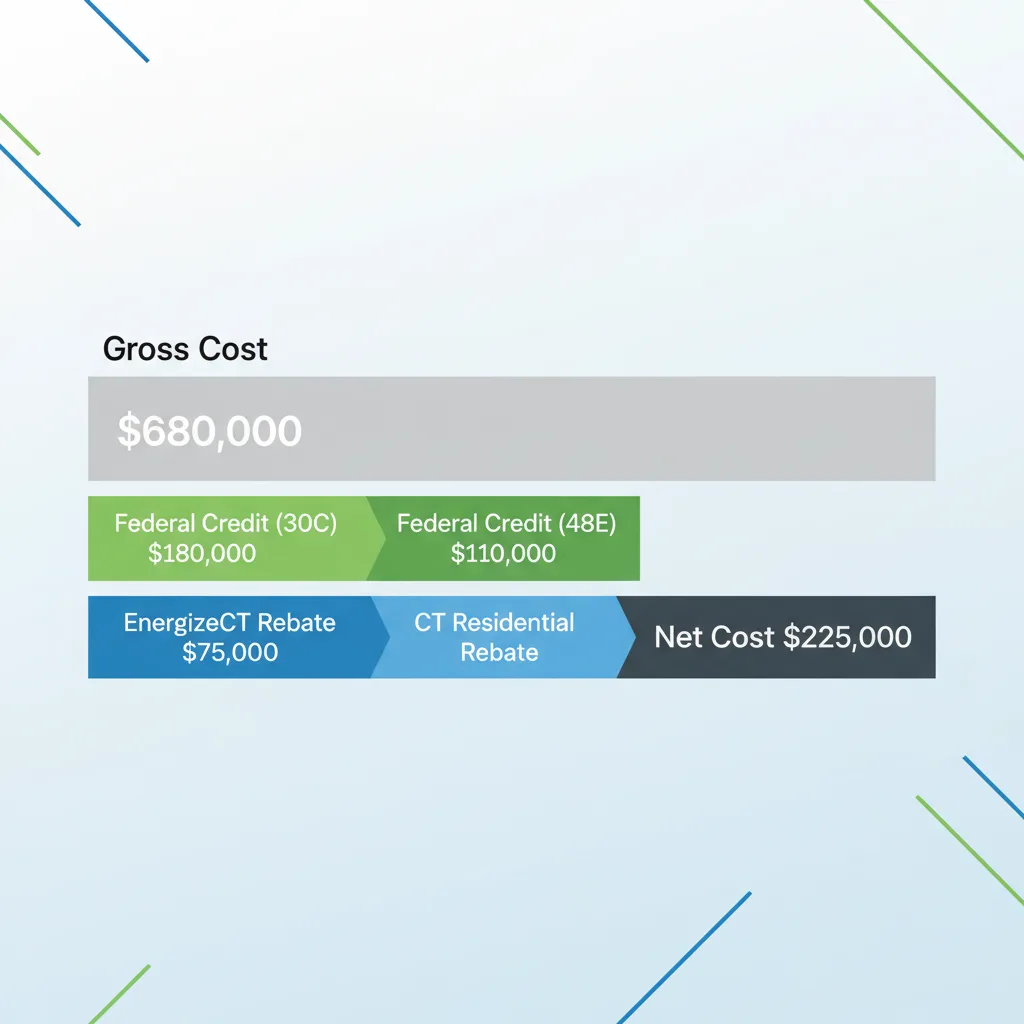
Line-item cost ranges, the full incentive waterfall, a battery vs transformer-upgrade comparison, and a 5-year operating cash flow — all on the same Connecticut benchmark project.
$730K
Gross project cost
$320K
Stacked savings
$410K
Net cost
5–7 yr
Ops payback
Illustrative example. This sample project shows representative numbers based on NuWatt benchmark data and 2026 CT incentive programs. Your actual project depends on site conditions and incentive availability at the time of install.
In Connecticut, the all-in gross ranges from $620K to $815K with a $730K benchmark. Section 48E (−$90K), Section 30C with PWA (−$70K, for chargers placed in service by June 30, 2026, when the credit expired), and EnergizeCT EVSE + make-ready (−$160K) cut that down to roughly $410K net.
Each line is a category NuWatt’s 2026 CT project database quotes against. The benchmark column is the midpoint used in the $730K hero number.
Solar carport — steel + bifacial panels + inverters + interconnection
Range
$250K–$320K
Benchmark
$300K
Battery storage — 200 kWh / 100 kW outdoor lithium cabinet
Range
$130K–$170K
Benchmark
$150K
4× ChargePoint CP6000 hardware (22 kW networked L2)
Range
$20K–$24K
Benchmark
$22K
4× CP6000 install (labor + make-ready)
Range
$14K–$20K
Benchmark
$18K
2× DCFC hardware (Tritium PKM150 or Kempower C-Series class 150 kW)
Range
$100K–$120K
Benchmark
$110K
2× DCFC install + switchgear (DC bus, conduit, transformer, coordination)
Range
$80K–$100K
Benchmark
$90K
480V 3-phase service upgrade — avoided via battery buffering on this site
Range
$0 (would be $25K–$50K)
Benchmark
$0
Permits + utility coordination + EnergizeCT filing labor
Range
$5K–$12K
Benchmark
$10K
Total gross (benchmark)
Range
$620K–$815K
Benchmark
$730K
Gross project
$730K
Canopy + battery + chargers + install.
− Section 48E
−$90K
30% of $300K canopy basis. Form 3468.
− Section 30C
−$70K
30% × $232K PWA charger basis. Form 8911.
− EnergizeCT EVSE
−$120K
50% of $240K charger hardware + install.
− EnergizeCT make-ready
−$40K
100% of approved utility-side make-ready.
= Net out-of-pocket
$410,000
That is roughly $68K per port blended across four L2 and two DCFC dispensers — before any operating savings.
If the car wash had accepted a service upgrade instead of battery buffering, it would have paid more and waited longer.
Battery-buffered path wins by $150K in capex + 8 months of calendar time.
The transformer alternative also introduces a 12-month Eversource utility-engineering queue, during which the operator cannot monetize DCFC at all. Even if the capex delta were zero, the lost revenue window would tilt the decision toward buffering.
Demand-charge avoidance and solar offsets carry years 1–2. DCFC session revenue ramps with local EV adoption. O&M modeled at ~1% of net capex, escalating 3% annually.
| Year | Demand charge | Solar offset | Managed charging | DCFC sessions | O&M | Net cash flow |
|---|---|---|---|---|---|---|
| Year 1 | $19,200 | $26,400 | $600 | $4,800 | − $3,500 | $47,500 |
| Year 2 | $19,700 | $27,100 | $620 | $8,500 | − $3,600 | $52,320 |
| Year 3 | $20,200 | $27,800 | $640 | $14,000 | − $3,800 | $58,840 |
| Year 4 | $20,700 | $28,500 | $660 | $20,500 | − $4,000 | $66,360 |
| Year 5 | $21,200 | $29,300 | $680 | $26,000 | − $4,200 | $72,980 |
| 5-yr total | $101,000 | $139,100 | $3,200 | $73,800 | −$19,100 | $298,000 |
$298K of 5-year cash flow on $410K net capex → roughly 68% of capex recovered in the first five years.
30% clean-electricity investment credit on the solar canopy generation asset.
July 4, 2026 construction-start deadline. PWA is mandatory for the 30% rate on projects over 1 MW and effectively standard practice at any commercial scale.
30% credit on qualified alternative fuel refueling property (EV chargers and their make-ready). Expired June 30, 2026 — claimable only for chargers placed in service by that date.
The site had to sit in a qualifying low-income or non-urban census tract. The GEOID record substantiates the Form 8911 claim.
Connecticut commercial EV rebate — Eversource CT and United Illuminating co-administered.
Funds committed when the utility signs the incentive agreement. File in parallel with design, not after.
Geotech, stormwater, and subgrade remediation move carport footing costs by $20K–$60K.
Existing 480V 3-phase headroom decides whether battery buffering avoids a $25K–$50K service upgrade.
30C tract status was binary — qualify and keep the $70K credit, miss and lose it entirely.
CT PWA labor runs 20–30% above non-PWA. Factors into CP6000 and DCFC install line items.
All-in gross sits between $620K and $815K depending on site complexity. Our CT benchmark comes in at $730K. After stacking Section 48E, Section 30C (PWA — the charger credit expired June 30, 2026, so this line reflects chargers placed in service by that date), and EnergizeCT EVSE + make-ready rebates, the net cost lands near $410K — roughly $68K per port blended across four L2 and two DCFC dispensers.
IRS Form 8911 Instructions — Section 30C
Per-item cap of $100K/port on qualified refueling property for commercial use.
IRS Form 3468 — Investment Credit (Section 48E)
Filing form for the 30% clean electricity ITC on the solar canopy asset.
EnergizeCT — EVSE and Make-Ready Commercial Program
Rebate tables, eligibility rules, and program cycle status for Eversource CT and UI.
Eversource CT — Rate 30 / G-3 Tariff Schedule
Demand charge schedule used in the 5-year cash flow projection.
NREL PVWatts — Connecticut Solar Resource Baseline
1,150 kWh/kW-DC/yr figure for the 132 MWh/yr solar production estimate.
NuWatt Engineering — Commercial Project Benchmark Data 2026
Internal installed-cost dataset across carport, BESS, and DCFC deployments.
Send us the site — we return a line-item cost, incentive-stack status, and a net-cost target you can take to finance.
Last verified by NuWatt Engineering Team on 2026-04-14. Cost ranges are illustrative and based on NuWatt's 2026 commercial project database. Actual pricing depends on site-specific conditions and program availability at the time of install.