Loading NuWatt Energy...

We use your location to provide localized solar offers and incentives.
We serve MA, NH, CT, RI, ME, VT, NJ, PA, and TX
Loading NuWatt Energy...
NuWatt designs, installs, and manages solar, battery, heat pump, and EV charger systems across 9 states. One company, one warranty, one point of contact.
Get a Free QuoteChoose Span if you need a full panel upgrade anyway or want complete 32-circuit control with the best app experience. Choose Lumin (ABB ReliaHome) if your existing panel is in good shape and you want to add smart load management to your solar + battery system at a lower cost. Span costs $6,500-$10,000 installed; Lumin costs $3,500-$5,500. Both integrate with Tesla, Enphase, and FranklinWH batteries. Many homeowners with a recent panel in good condition do not need either — a standard critical load subpanel with a transfer switch is sufficient for basic battery backup.
Full panel replacement vs retrofit add-on. Two approaches to making your electrical panel smarter. We compare Span and Lumin (ABB ReliaHome) on cost, features, battery compatibility, and help you decide which — if either — you actually need.
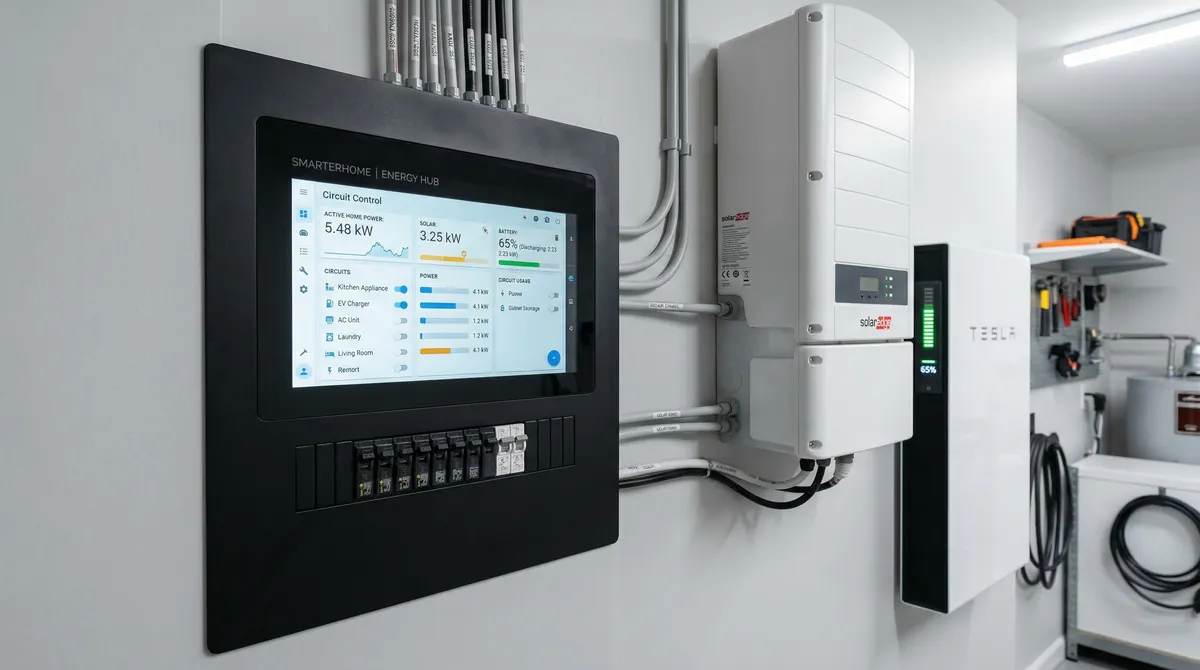
Your electrical panel is the central hub of your home's power system. Every circuit — lights, HVAC, kitchen appliances, EV charger — flows through it. A traditional breaker panel is essentially a dumb switch: it distributes power and trips breakers when circuits overload. That is all it does.
A smart electrical panel adds intelligence to this hub. It monitors energy usage per circuit in real time, lets you control circuits remotely from a smartphone app, prioritizes which circuits get power during battery backup, and automates load management for time-of-use rate optimization. For solar + battery homeowners, this intelligence is increasingly valuable as electricity gets more complex to manage.
See exactly how much power each circuit draws in real time — identify energy hogs instantly
Turn circuits on or off from your phone. Manage your home's power from anywhere
Decide which circuits run during outages. Extend battery life by shedding non-essential loads
Schedule circuits, respond to TOU pricing, and optimize demand response participation
As homes add solar, batteries, EV chargers, heat pumps, and induction cooktops, the electrical panel becomes the bottleneck. Many homes have 100A or 200A panels that are already at capacity. A smart panel can manage loads intelligently — running the EV charger at lower power when the heat pump is active, for example — avoiding a costly service upgrade from your utility. This load management capability is often more valuable than the monitoring features.
The Span Panel replaces your entire electrical panel with a modern, connected unit. Every circuit gets individual monitoring and control. It is the premium option — the most capable smart panel on the market, but also the most expensive.
Controllable Circuits
32
Standard 1-in residential breakers
Main Breaker
100A - 200A
225A bus capacity
Energy Metering
±0.5% accuracy
Per-circuit, real-time
Connectivity
Wi-Fi + Ethernet + BT + 4G LTE
Cellular fallback included
Installation
Full panel replacement
6-10 hours, licensed electrician
Cost Installed
$6,500 - $10,000
Panel ~$4,500 + labor + permit
Warranty
10 years
Hardware and software
Certifications
UL 67, UL 916, UL 869A
NEC 2025 compliant
Mounting
Indoor or outdoor
NEMA 3R rated enclosure
32 individually controllable circuits with per-circuit energy monitoring for complete home visibility
Full panel replacement means modernized wiring and NEC 2025 compliance in one project
Best-in-class app with intuitive circuit naming, real-time power flow, and usage history
Per-circuit backup priority levels let you decide exactly which circuits run during an outage
Built-in 4G LTE cellular fallback keeps monitoring active even when Wi-Fi and internet are down
Direct compatibility with Tesla Powerwall 3, FranklinWH, and Enphase IQ batteries
Supports whole-home electrification by eliminating panel upgrade bottlenecks for EV chargers, heat pumps, and induction cooktops
Requires full panel replacement ($6,500-$10,000 installed) — most expensive smart panel option
Installation takes 6-10 hours and requires a licensed electrician, often with permit and inspection
Enphase battery integration requires a separate Remote Meter Kit (additional cost and complexity)
Overkill for homeowners who only need to manage a few circuits during backup events
Limited availability in some regions — must use a Span-authorized installer
Panel hardware cost alone is approximately $4,500 before installation labor
The Lumin Smart Panel — now rebranded as ABB ReliaHome after ABB's January 2025 acquisition — takes a different approach. Instead of replacing your panel, Lumin installs alongside it and adds smart control to up to 12 selected circuits. It is the practical, budget-friendly option for homeowners with an existing panel in good condition.
Controllable Circuits
12 total
6 x 60A loads + 6 x 30A loads
Installation Type
Retrofit add-on
Installs next to existing panel
Installation Time
3-4 hours
Licensed electrician required
Connectivity
Wi-Fi + Ethernet
Local network backup for outages
Load Management
Automatic shedding
Non-essential loads shed during backup
Cost Installed
$3,500 - $5,500
Hardware ~$2,100-$2,900 + labor
Warranty
10 years
Product warranty (ABB-backed)
Certifications
UL listed
NEC compliant
Ownership
ABB (acquired Jan 2025)
Rebranded as ReliaHome
Retrofit-friendly: installs alongside your existing panel in 3-4 hours with no panel swap
Lower cost ($3,500-$5,500 installed) makes it the budget-friendly smart panel option
Automatic load shedding extends battery backup duration during outages without manual intervention
Compatible with most major battery brands including Tesla, Enphase, SolarEdge, and FranklinWH
Local network backup keeps the app working even when internet goes down during outages
Now backed by ABB (acquired January 2025), one of the largest electrical companies in the world
Ideal for homeowners adding smart control to an existing solar + battery system
Only 12 controllable circuits (6 x 60A + 6 x 30A) vs Span’s 32 — limited whole-home visibility
Does not replace your panel — if your existing panel is old or at capacity, you still need an upgrade
Energy monitoring is limited to managed circuits, not whole-home like Span
App is functional but not as polished or feature-rich as the Span app
No built-in cellular backup — relies on Wi-Fi or Ethernet for connectivity
Rebranded as ABB ReliaHome — transitional period may cause confusion about product support
Side-by-side comparison of every specification that matters when choosing between Span and Lumin for your solar + battery system.
| Specification | Span PanelFull Replacement | Lumin (ABB ReliaHome)Retrofit Add-On |
|---|---|---|
| Installation Type | Full panel replacement | Retrofit (installs alongside existing panel) |
| Cost (Installed) | $6,500 - $10,000 | $3,500 - $5,500 |
| Controllable Circuits | 32 individually controllable | Up to 12 (6 x 60A + 6 x 30A) |
| Energy Monitoring | Per-circuit, real-time (all 32) | Per-circuit (managed circuits only) |
| App Quality | Excellent (iOS/Android, intuitive) | Good (iOS/Android, functional) |
| Voice Assistant | Alexa, Google Home | Alexa, Google Home |
| Connectivity | Wi-Fi, Ethernet, Bluetooth, 4G LTE | Wi-Fi, Ethernet, local backup |
| Tesla Powerwall | Fully compatible (wired Ethernet) | Fully compatible |
| Enphase IQ Battery | Compatible (Remote Meter Kit required) | Fully compatible |
| FranklinWH | Fully compatible (wired Ethernet) | Compatible |
| SolarEdge Battery | Compatible | Compatible |
| Solar Integration | Direct CT monitoring, production tracking | Battery-side integration |
| Backup Prioritization | Per-circuit priority levels via app | Automatic load shedding |
| NEC 2025 Compliance | Yes (UL 67, UL 916, UL 869A) | Yes (UL listed) |
| Warranty | 10 years | 10 years |
| Made In | San Francisco, CA | Charlottesville, VA (now ABB/ReliaHome) |
| Panel Form Factor | 225A bus, 100-200A main breaker | Add-on module (no main breaker) |
| TOU Arbitrage | Yes (schedule-based automation) | Yes (automated load shifting) |
Span is the right choice when the investment in a full panel replacement is justified by your situation.
If your existing panel is old (Federal Pacific, Zinsco, or 30+ year-old breakers), out of capacity, or does not meet current code, you need a panel upgrade regardless. Spending the premium for Span makes sense because you are already paying for the panel swap.
If you are building or doing a major electrical renovation, the incremental cost of Span over a standard panel is much smaller than the retrofit-plus-Span cost on an existing home. This is the most cost-effective time to install Span.
Span monitors all 32 circuits in real time. If you want to see exactly how much your HVAC, EV charger, kitchen, and every other circuit draws — and trend that data over time — Span is the only option that provides this level of detail.
Span lets you set per-circuit backup priority levels through the app. During an outage, you can decide in real time which circuits to keep powered and which to shed. Lumin manages 12 circuits; Span manages all 32.
Span and Tesla Powerwall 3 pair seamlessly via wired Ethernet. The combination provides whole-home backup with per-circuit prioritization and excellent app integration. This is one of the best smart panel + battery combinations available.
If you are adding an EV charger, heat pump, induction cooktop, and heat pump water heater, Span can manage the loads intelligently — charging the EV at lower power when the heat pump is running, for example — potentially avoiding a costly service upgrade from 100A to 200A.
Lumin makes sense when you want smart load management without the cost and disruption of a full panel replacement.
If your panel is modern, has capacity headroom, and meets current code, there is no reason to tear it out. Lumin installs alongside it in 3-4 hours and adds smart control to the 12 circuits that matter most.
At $3,500-$5,500 installed vs $6,500-$10,000 for Span, Lumin saves $3,000-$4,500. That difference could fund a second battery module or offset other project costs. For many homeowners, 12 managed circuits is enough.
If you already have a Tesla Powerwall, Enphase IQ, or FranklinWH battery and want to extend backup runtime through automated load shedding, Lumin is the most practical add-on. It optimizes what you already have without replacing anything.
Lumin installation takes 3-4 hours. Span installation takes 6-10 hours and your home has no power during most of it. If you cannot afford a full day without electricity, Lumin is the less disruptive option.
Lumin excels at automatic load shedding — it detects when battery is in backup mode and sheds non-essential loads without you touching the app. If you want set-it-and-forget-it load management, Lumin is a strong fit.
Honest answer: many homeowners do not. A smart panel is a premium upgrade, not a requirement for solar + battery to work well. Here is when a standard setup is perfectly adequate.
You just want basic backup for essentials (fridge, lights, internet, a few outlets) during outages
Your existing panel is modern, has capacity, and meets current code
You are not adding major new electrical loads (EV charger, heat pump, induction cooktop)
You do not need real-time per-circuit energy monitoring — whole-home monitoring from your inverter is sufficient
Budget is a priority and you would rather invest in more battery capacity or panels
Your battery system already has its own app for backup management (Tesla, Enphase, FranklinWH all do)
| Option | Installed Cost | Circuits Managed |
|---|---|---|
| Critical load subpanel + transfer switch | $500 - $1,500 | 6-10 essential |
| Lumin Smart Panel (ABB ReliaHome) | $3,500 - $5,500 | 12 selected |
| Span Panel (full replacement) | $6,500 - $10,000 | 32 (all circuits) |
A standard critical load subpanel provides basic backup at a fraction of the cost. Smart panels add monitoring, automation, and app control — valuable features, but not essential for every homeowner.
The real value of a smart panel emerges when paired with solar and battery storage. Here are four ways the combination creates value beyond what either system can do alone.
Smart panels can automatically shift high-power loads (EV charging, water heating, pool pumps) to midday when your solar panels are producing excess power. This maximizes self-consumption and minimizes grid imports, especially valuable in states where net metering credits are below retail rate.
During demand response events (ConnectedSolutions in MA, CT, RI, VT), your smart panel automatically sheds non-essential loads so your battery can discharge maximum power to the grid. More discharged energy means higher incentive payments — up to $275/kW/year with Eversource.
When the grid goes down, a smart panel takes over load management instantly. It sheds non-essential circuits (pool pump, workshop, guest room) and preserves battery for critical loads (fridge, medical equipment, internet, security). A 10 kWh battery that lasts 8 hours with the whole home might last 24+ hours with smart load shedding.
In states with time-of-use rates (or for customers who choose TOU plans), smart panels can pre-charge batteries during off-peak hours and discharge during peak, while simultaneously shifting discretionary loads to cheaper time periods. The savings compound monthly.
Not sure if you need a Span, Lumin, or a standard critical load panel? Our solar engineers evaluate your existing panel, electrical loads, battery system, and goals to recommend the right solution. No upselling — we will tell you if a standard setup is all you need.