
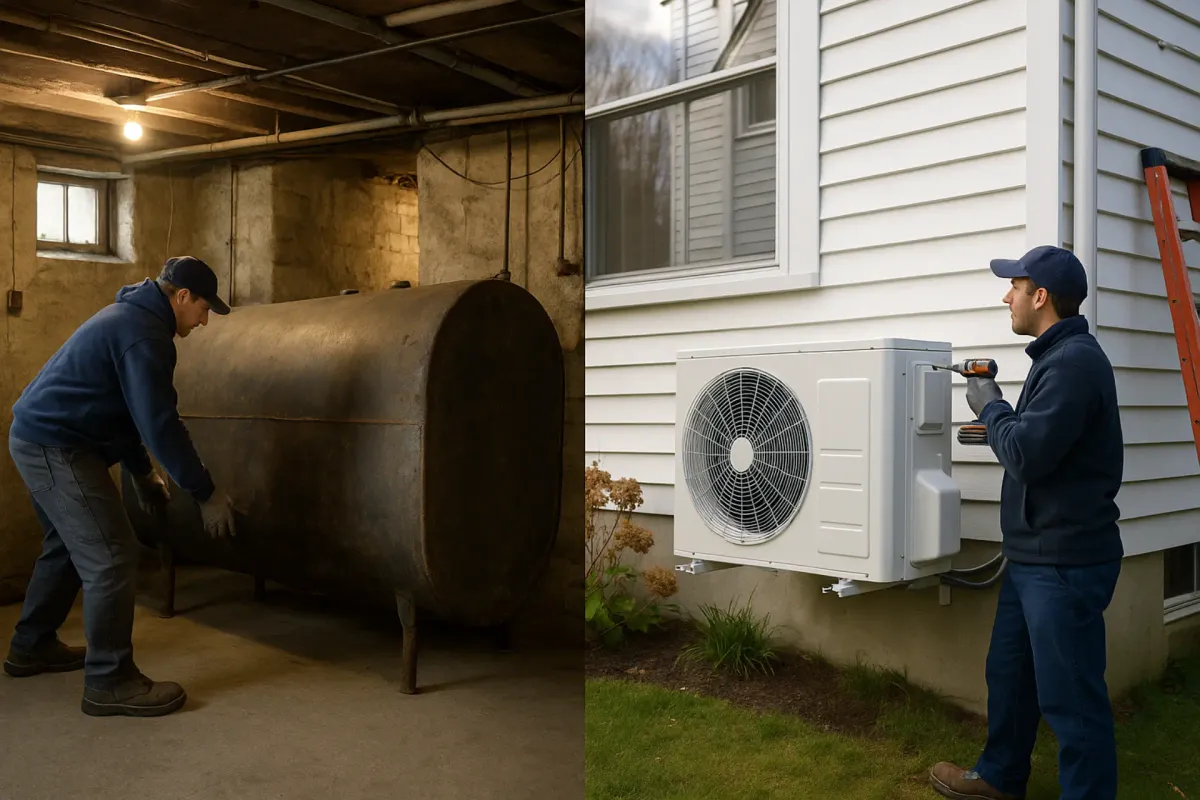

At current fuel prices, switching from oil to a heat pump saves $1,500-$2,600 per year in New England. Break-even ranges from 2-5 years after state rebates, depending on your oil consumption and electricity rate.
Home Electrification Experts — Full-Service Design to Install, 9 States
Oil Price (Feb 2026)
$4.20/gal
MA average
Electric Rate
$0.33/kWh
MA average
Annual Savings
$2,300+
typical MA home
Break-Even
5–8 years
after rebates
Break-Even by State (Current EIA Data)
The economics of switching from oil heat to a heat pump depend on three variables: your state's oil prices, your electricity rate, and the rebates available in your area. The following table uses current Energy Information Administration (EIA) heating oil prices and state-average electricity rates to calculate break-even periods for each state in our coverage area.
| State | Oil $/gal | Electric $/kWh | Annual Oil Cost | Annual HP Cost | Annual Savings | Break-Even* |
|---|---|---|---|---|---|---|
| Massachusetts | $3.80 | $0.33 | $3,200 | $1,100 | $2,100 | 2.6 yrs |
| Connecticut | $3.50 | $0.27 | $2,700 | $1,200 | $1,500 | 3.0 yrs |
| Rhode Island | $3.45 | $0.28 | $2,650 | $1,240 | $1,410 | 1.4 yrs |
| New Hampshire | $3.69 | $0.25 | $2,800 | $850 | $1,950 | 6.0 yrs |
| Vermont | $3.96 | $0.22 | $3,200 | $850 | $2,350 | 4.8 yrs |
| Maine | $3.80 | $0.26 | $2,900 | $820 | $2,080 | 4.6 yrs |
| New Jersey | $3.70 | $0.26 | $2,200 | $850 | $1,350 | 4.1 yrs |
| Pennsylvania | $3.40 | $0.20 | $2,100 | $900 | $1,200 | 10.0 yrs |
| Texas | $3.50 | $0.14 | $2,200 | $1,240 | $960 | 9.6 yrs |
* Break-even calculated after state rebates. Based on 800 gallons/year oil consumption for a typical 2,000 sqft home.
How We Calculate Break-Even
The break-even formula is straightforward: divide the net cost of the heat pump system (after rebates) by the annual fuel savings. Here is the formula broken down with Massachusetts as a worked example:
- Installation cost: $14,000 for a whole-home cold-climate heat pump system (Mitsubishi Hyper-Heat, 3-ton multi-zone with 4 indoor heads)
- State rebate: $8,500 (Mass Save whole-home heat pump rebate at $2,650/ton)
- Net cost after rebates: $5,500
- Annual oil heating cost: $3,400 (800 gallons at $4.20/gal, including delivery fees and annual boiler maintenance of $300-$400)
- Annual heat pump heating cost: $1,100 (at $0.33/kWh, COP 3.0 average)
- Annual savings: $2,300
- Break-even: $5,500 ÷ $2,300 = 2.4 years
This calculation is conservative. It assumes stable oil prices and electricity rates. In reality, oil prices have increased an average of 4-6% annually over the past decade, while New England electricity rates have been more stable. Every year oil prices rise, your actual savings exceed this baseline estimate.
Calculate Your Personal Break-Even
Enter your oil consumption for a custom break-even analysis.
Oil Price Projections and Long-Term Savings
The EIA projects heating oil prices to remain volatile and trend upward through 2030. Using a conservative 3% annual increase from current prices, here is what a Massachusetts homeowner burning 800 gallons per year can expect:
Oil Heating Costs
Heat Pump Costs
15-Year Cumulative Savings
$46,800+
$2,300
savings year 1
$4,012
savings year 15
$41,000+
net profit after system cost
Over 15 years — the typical lifespan of a heat pump — a Massachusetts homeowner switching from oil saves over $46,000 in cumulative fuel costs. After subtracting the $5,500 net system cost, the net financial benefit is over $41,000.
Real Conversion Example: 1960s Colonial in Framingham, MA
Here is a breakdown of an actual oil-to-heat-pump conversion we see regularly for a typical 2,200-square-foot Colonial in the MetroWest area. This home had a 30-year-old oil boiler with baseboard radiators and an underground oil tank:
| Item | Cost Range |
|---|---|
| Old system removal (oil boiler + tank) | $800–$2,000 |
| Mitsubishi MXZ-4C36NA multi-zone (3-ton, 4 heads) | $16,000–$19,000 |
| Electrical panel upgrade (if needed) | $1,500–$2,500 |
| Underground oil tank decommissioning | $2,000–$3,500 |
| Total before rebates | $20,300–$27,000 |
After the Mass Save rebate of $8,500, the net cost ranges from $11,800 to $18,500. With annual oil savings of $2,300+, the payback period is 5.1-8.0 years. Income-eligible households can receive up to $16,000 in enhanced Mass Save rebates, bringing the net cost as low as $4,300 — a 1.9-year payback.
What About the Oil Tank?
Oil tank decommissioning is an often-overlooked cost in the conversion equation. The cost varies significantly based on tank type and location:
Above-ground (basement)
Above-ground (outdoor)
Underground (clean)
Underground (contaminated)
Some state programs help cover oil tank removal costs. Massachusetts' Mass Save program includes oil tank removal coordination and can connect you with licensed tank removal contractors. If you suspect your underground tank may have leaked, get a soil test before starting the conversion process — it is better to discover contamination early and plan for it than to encounter it during excavation.
Hidden Savings Most Homeowners Miss
The break-even calculation above only accounts for the direct fuel cost difference. Several additional savings improve the real-world economics of switching from oil:
Eliminated Boiler Maintenance
$300–$400/yr
Annual oil boiler tune-ups. Heat pumps need only filter changes — $50-$100/yr.
Eliminated Delivery Fees
$150–$400/yr
3-4 oil deliveries per winter at $50-$100 per delivery beyond the per-gallon price.
Free Air Conditioning
$200–$600/yr
Heat pumps cool in summer. Replaces window AC or provides comfort you didn't have.
Increased Home Value
$10k–$15k
Modern heat pump adds resale value. Buyers avoid oil-heated homes due to tank liability.
Insurance Savings
$100–$300/yr
Some insurers reduce premiums when oil heating and storage is removed.
Common Mistakes in Oil-to-Heat-Pump Conversions
The oil-to-heat-pump conversion is one of the highest-ROI home improvements available in New England, but these common mistakes can significantly reduce your savings or increase your costs:
- Keeping the oil boiler as backup:Some homeowners want to keep the old oil boiler “just in case.” This means continued oil tank insurance, annual boiler maintenance ($300-$400), and a minimum oil delivery requirement. A properly sized cold-climate heat pump with electric backup strips is a better and less expensive safety net.
- Not addressing the oil tank at the time of conversion: Deferring tank removal only increases the cost and risk. Underground tanks continue to deteriorate, and a leak discovered later triggers expensive remediation. Handle the tank during the conversion while contractors are already on-site.
- Assuming the federal tax credit applies: The residential federal ITC (Section 25D) and the energy efficiency credit (Section 25C) both expired at the end of 2025. There is $0 in federal tax credits for homeowner heat pump purchases in 2026. State rebates are your primary incentive — make sure your installer applies for every available program.
- Choosing the cheapest installer rather than the most experienced: Oil-to-heat-pump conversions involve electrical work, refrigerant piping, potential ductwork modifications, and oil system decommissioning. An experienced installer who has completed 50+ conversions will avoid the pitfalls that add cost and reduce performance.
- Ignoring the electrical panel: Many homes with oil heat have 100-amp or 150-amp electrical panels that are already near capacity. A heat pump adds 20-40 amps of load. Budget $1,500-$2,500 for a panel upgrade if your panel is undersized. Your installer should assess panel capacity during the initial site visit.
No Federal Tax Credits in 2026
The residential ITC (Section 25D) expired December 31, 2025. There is $0 in federal tax credits for homeowner heat pump purchases in 2026. State rebates (Mass Save, Efficiency Maine, etc.) are your primary incentive. Do not rely on outdated information about 30% federal tax credits — they no longer exist for residential heat pumps.
Read our full oil-to-heat-pump conversion guide →
Ready to Get a Heat Pump Quote?
Get a free, no-obligation quote from NuWatt Energy. We handle design, permits, and installation.
Frequently Asked Questions
How much can I save switching from oil to a heat pump?▼
What do I do with my old oil tank?▼
Continue Reading
Heat Pump ROI: Cost, Incentives, and Payback by State
Heat pump payback ranges from 2 years in Rhode Island (thanks to $11,500 in rebates) to 8+ years in Pennsylvania. This state-by-state breakdown shows exact costs, incentives, and timelines.
Heat Pump Electricity Usage: kWh by Home Size
A heat pump heating a 2,000 sqft New England home uses 8,000-12,000 kWh per year for heating. At Massachusetts rates ($0.33/kWh), that's $220-$330/month during winter — still 40-50% less than oil or propane.
When to Add Backup Heat (Electric, Gas, Oil) and Why
A properly sized cold-climate heat pump handles 95%+ of heating hours without backup in most of New England. Backup heat makes sense for homes in northern VT/NH/ME where temperatures regularly drop below -10°F, or as a safety net during the first winter.