Loading NuWatt Energy...

We use your location to provide localized solar offers and incentives.
We serve MA, NH, CT, RI, ME, VT, NJ, PA, and TX
Loading NuWatt Energy...
NuWatt designs, installs, and manages solar, battery, heat pump, and EV charger systems across 9 states. One company, one warranty, one point of contact.
Get a Free Quote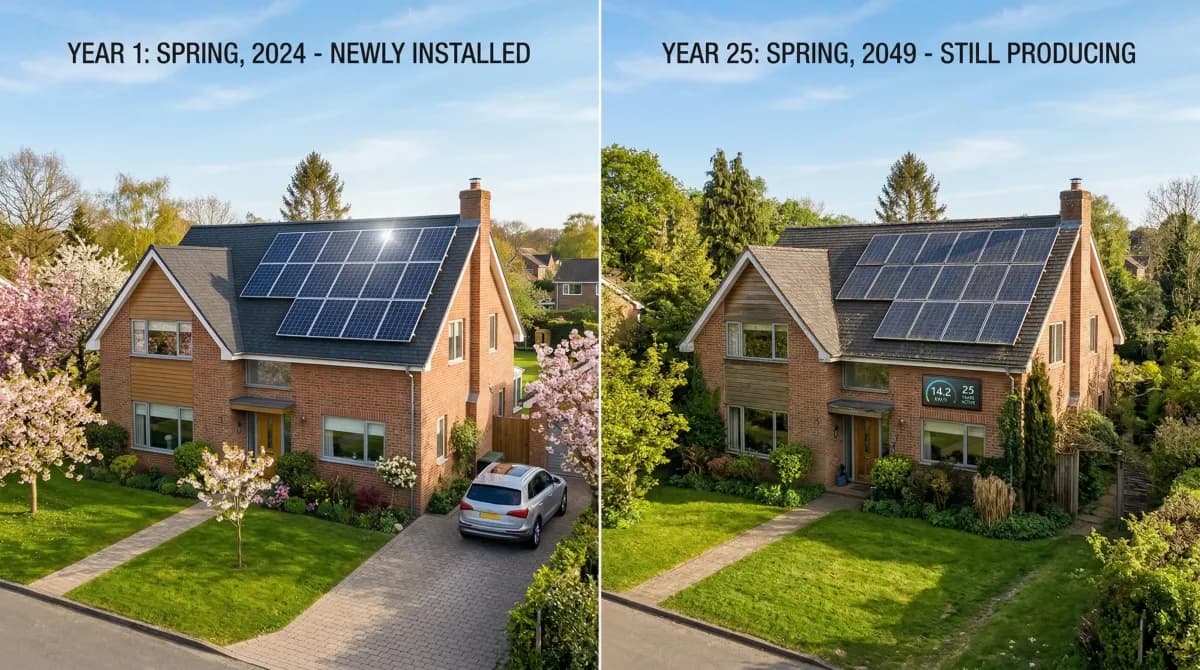
Solar panels last 25-30+ years. At year 25, they still produce 87%+ of original output. Many panels from the 1980s are still running today. Here is the real degradation data, what actually kills panels, and when to replace vs. repair.
25-40 yrs
Panel Lifespan
Many last 35+ years
87.5%+
Year 25 Output
Of original production
0.3-0.5%
Annual Degradation
Barely noticeable
Zero
Moving Parts
Nothing to wear out
Solar panels are among the most durable consumer products ever made. They are solid-state semiconductors sealed behind tempered glass with no moving parts. There is nothing to wear out, nothing to lubricate, nothing to replace.
Every major panel manufacturer warranties their products for 25-30 years. But the warranty period is not the same as the lifespan. Research from the National Renewable Energy Laboratory (NREL) shows that panels degrade at about 0.5% per year on average — meaning at year 25, they still produce 87.5% of their original output.
The first residential solar panels installed in the early 1980s are still generating electricity today — over 40 years later. They are producing less than they used to, but they are still working. Solar panels do not suddenly stop working. They slowly produce slightly less each year, like a battery that holds a little less charge over time.
A 10 kW system installed in 2026 produces about 12,000 kWh per year. At 0.5% annual degradation, in 2051 (year 25) it will produce about 10,500 kWh. That is still enough to cover most of a typical New England home electricity bill. At year 40, it would still produce about 9,600 kWh — 80% of its original output.
This table shows the expected output of a standard mono PERC solar panel over its lifetime, assuming 0.5% annual degradation after the first-year LID adjustment.
| Year | Output (%) | kWh/yr (10kW system) | Notes |
|---|---|---|---|
| Year 0 | 100% | 12,000 kWh | Day-one rated output |
| Year 1 | 98% | 11,760 kWh | Year-1 LID (light-induced degradation) — normal for all panels |
| Year 5 | 97.5% | 11,700 kWh | Negligible visual change |
| Year 10 | 95% | 11,400 kWh | Still within all warranty thresholds |
| Year 15 | 92.5% | 11,100 kWh | Mid-life — inverter may need attention (string type only) |
| Year 20 | 90% | 10,800 kWh | Still generating significant savings |
| Year 25 | 87.5% | 10,500 kWh | End of most performance warranties — but panels keep going |
| Year 30 | 85% | 10,200 kWh | Panels continue producing economically viable power |
| Year 35 | 82.5% | 9,900 kWh | Many 35-year-old panels still in service worldwide |
| Year 40 | 80% | 9,600 kWh | End of expected useful life — still producing 80% of Day 1 |
Not all solar panels degrade at the same rate. Newer cell technologies like TOPCon and HJT degrade more slowly than traditional PERC, which means more production over 25 years.
Annual degradation
0.40-0.55%/yr
Year 25 output
86-90%
Examples: Hyundai HiE-S440VG, Silfab SIL-440-BG
Workhorse of the residential industry. Proven track record.
Annual degradation
0.35-0.45%/yr
Year 25 output
88-91%
Examples: Jinko Tiger Neo, Canadian Solar TOPBiHiKu7
Lower degradation due to passivated contacts. Becoming standard by 2027.
Annual degradation
0.25-0.35%/yr
Year 25 output
91-94%
Examples: REC Alpha Pure-R 460, Meyer Burger White
Lowest degradation. Premium price. Best for maximizing 25-year output.
Annual degradation
0.30-0.40%/yr
Year 25 output
89-92%
Examples: Trina Vertex S+, LONGi Hi-MO 7
Captures reflected light from ground. Best for ground-mount installs.
Solar panels almost never die of old age. When panels fail prematurely, it is almost always one of these five causes — and most are preventable.
Falling branches, severe hail (1.5"+ diameter), flying debris in storms
Prevention: Insurance covers it. Trim nearby trees. NuWatt designs for wind exposure.
Micro-cracks, delamination, junction box failure, defective solder joints
Prevention: Covered by 25-year product warranty. Caught early by monitoring.
Persistent shading on one cell causes overheating and localized degradation
Prevention: Microinverters eliminate hot spots. Proper system design avoids shading.
High voltage differential in humid conditions causes power loss
Prevention: Modern panels are PID-resistant by design. Proper grounding prevents it.
Squirrels, birds, raccoons chewing wiring or nesting under panels
Prevention: Critter guards (NuWatt includes them). Annual inspection catches early.
Our calculator shows year-by-year production, savings, and payback based on your specific roof and location.
Calculate My Solar SavingsA solar system is more than just panels. Here is how long each component lasts and what replacement costs look like.
Lifespan
25-40 years
Warranty
25-30 years
Replacement
$200-$400/panel
Panels rarely fail completely. They degrade slowly and keep producing.
Lifespan
25-30 years
Warranty
25 years
Replacement
$150-$250/unit
One per panel. If one fails, the rest keep working. NuWatt standard.
Lifespan
10-15 years
Warranty
10-12 years
Replacement
$1,200-$2,500
Single point of failure. Plan for 1-2 replacements over system life.
Lifespan
30-40 years
Warranty
25 years
Replacement
$500-$1,500
Aluminum does not rust. Stainless steel hardware. Outlasts the panels.
Lifespan
30-40 years
Warranty
Part of workmanship
Replacement
$200-$600
UV-rated outdoor cable. Conduit protects from weather and rodents.
Lifespan
15-25 years
Warranty
Included with inverter
Replacement
$100-$300
Wi-Fi gateway. May need firmware updates or hardware refresh.
All three panel tiers NuWatt offers carry 25-30 year warranties. Here is how they compare.
| Panel | Tier | Product | Performance | Yr 25 | Degradation |
|---|---|---|---|---|---|
| Hyundai HiE-S440VG | Entry | 25 years | 25 years | 86.5% | 0.50%/yr |
| Silfab SIL-440-BG | FEOC | 30 years | 30 years | 87.6% | 0.40%/yr |
| REC Alpha Pure-R 460 | Premium | 25 years | 25 years | 92.0% | 0.25%/yr |
On top of manufacturer panel and inverter warranties, NuWatt backs every installation with a 25-year workmanship warranty. Roof leaks, wiring issues, mounting problems — we cover it. This is among the longest workmanship warranties in the solar industry.
Read Full Warranty GuideSolar panels last 25-40 years in real-world conditions. Most manufacturers warranty panels for 25-30 years, but many panels from the 1980s and 1990s are still producing electricity today. The panels do not suddenly stop working — they slowly produce slightly less each year (about 0.3-0.5% less annually).
The average degradation rate for modern solar panels is 0.3-0.5% per year after the first-year light-induced degradation (LID) of about 2%. At this rate, a panel will still produce 87-90% of its original output at year 25. Premium panels like REC Alpha (HJT technology) degrade at only 0.25%/year.
Yes, all solar panels lose a small amount of efficiency each year — this is called degradation. However, the rate is very slow: about 0.3-0.5% per year for modern panels. A 10 kW system at year 25 will still produce about 8.75-9.0 kW. This gradual decline is factored into your original savings projections.
Most homeowners never need to replace their solar panels. Panels are only worth replacing if: (1) they are physically damaged beyond repair, (2) production has dropped well below warranty guarantees (below 80% of rated output), or (3) you are re-roofing and the panels are 20+ years old — in which case upgrading to newer, more efficient panels during the re-roof makes sense.
Microinverters (like Enphase IQ8, NuWatt standard) last 25-30 years with a 25-year warranty. String inverters last 10-15 years with a 10-12 year warranty. If you have a string inverter, budget $1,200-$2,500 for replacement at year 10-15. This is the main ongoing cost with a string inverter system.
Absolutely. The 25-year mark is the standard warranty period, not the end of a panel life. Panels installed in the 1990s are still working today. At year 25, you can expect panels to produce 85-92% of their original output depending on the technology. Many panels will continue producing useful power for 35-40+ years.
The leading causes of early panel failure are: physical damage (branches, severe hail), manufacturing defects (caught by warranty), hot spots from persistent shading, and rodent damage to wiring. Age alone almost never kills a solar panel. With Enphase microinverters and critter guards, most of these risks are eliminated or minimized.
Yes. NuWatt offers a 25-year workmanship warranty covering the quality of installation — roof penetrations, wiring, mounting, and labor. This is on top of the manufacturer panel warranty (25-30 years) and inverter warranty (25 years for Enphase). Our workmanship warranty is among the longest in the industry.
Research
You just did this
Calculate
See your savings
Save
Lock in your price
See exactly how much you will save over the 25-30+ year lifespan of a NuWatt solar system — tailored to your zip code, roof, and utility rate.
Calculate My SavingsTalk to an expertNo credit card required. 100% free. Takes about 2 minutes.