Loading NuWatt Energy...

We use your location to provide localized solar offers and incentives.
We serve MA, NH, CT, RI, ME, VT, NJ, PA, and TX
Loading NuWatt Energy...
NuWatt designs, installs, and manages solar, battery, heat pump, and EV charger systems across 9 states. One company, one warranty, one point of contact.
Get a Free Quote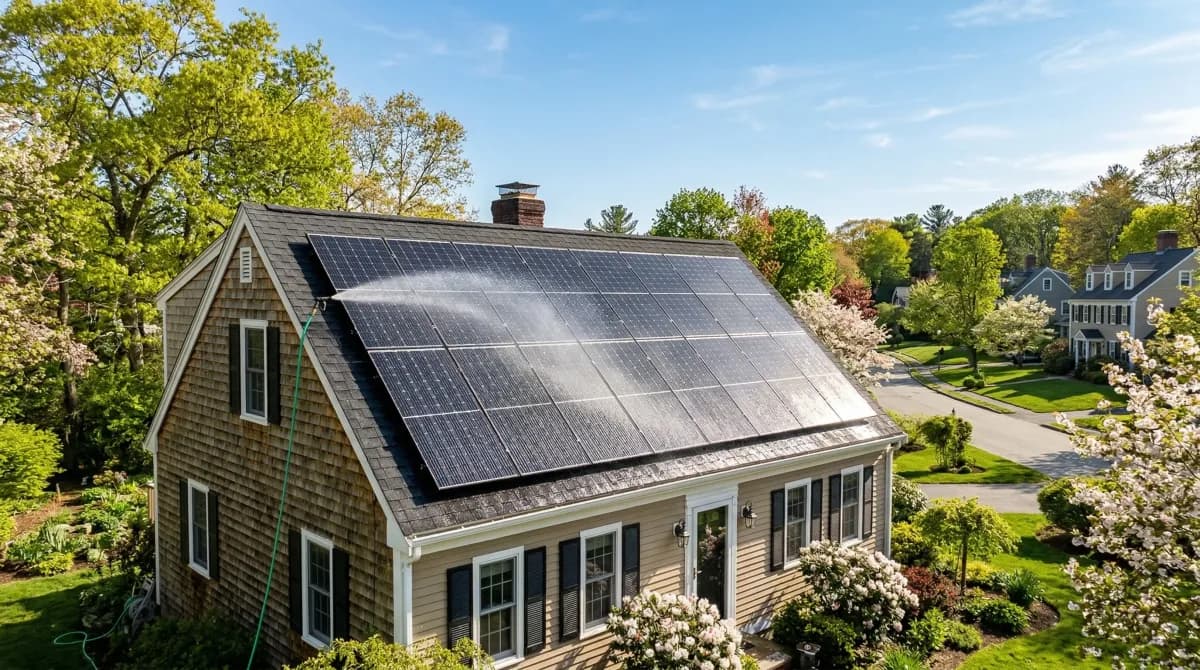
Solar panels have no moving parts. They sit on your roof and produce electricity for 25-30+ years with minimal attention. Here is exactly what maintenance they actually need, what it costs, and what you can safely skip.
The short answer: barely. Solar panels are solid-state devices with no moving parts. Unlike your car, HVAC system, or even your lawn mower, solar panels do not require scheduled maintenance to function properly.
A typical residential solar system will produce electricity reliably for 25-30+ years with just a few simple tasks: occasional cleaning, annual visual inspection, and monitoring your production data. That is it. The total annual time investment is about 1-2 hours for most homeowners.
The solar industry sometimes oversells maintenance plans because it is a profit center. The truth is that your panels will produce 85-90% of their rated output at year 25 whether you baby them or largely ignore them. The maintenance tasks below are about optimizing that last 5-10% and catching the rare actual problem early.
1-2 hours
Annual maintenance time
Mostly just looking at your panels and checking your app
$150-$350
Professional cleaning cost
For a typical 20-30 panel residential system
Zero
Moving parts to maintain
Solid-state electronics. No oil, no filters, no belts.
Rain handles most of the cleaning for you. But pollen, bird droppings, and road dust can accumulate — especially in spring. Here is how the cleaning options compare.
| Method | Cost | Effectiveness | Frequency | Notes |
|---|---|---|---|---|
| DIY — Garden Hose | $0 | 80-90% | 2-4x/year | Never use hot water on cold panels. Spray from ground if possible. |
| DIY — Soft Brush + Hose | $20-$50 (brush kit) | 90-95% | 2-4x/year | Telescoping soft-bristle brush. No abrasive pads. No dish soap. |
| Professional Cleaning | $150-$350 | 95-100% | 1-2x/year | Includes inspection. Deionized water. Insurance if they damage anything. |
| Automated Sprinkler System | $500-$1,500 installed | 85-90% | Weekly/timer-based | Overkill for residential. More common on commercial ground-mounts. |
New England seasons each bring different challenges. Follow this calendar to keep your system running at peak efficiency year-round.
Once per year — ideally in spring after winter weather — walk around your property and check these 8 items. Takes 15-20 minutes.
Visual panel condition
Look for cracks, discoloration, hot spots
Racking and mounts
Check for loose bolts, corrosion, movement
Wiring and conduit
No exposed wires, cracked conduit, rodent damage
Roof penetrations
Flashing intact, no leaks around mounts
Critter guards/mesh
Intact, no gaps where birds or squirrels can enter
Vegetation/shading
No new tree growth blocking panels
Monitoring data
Production matches expected output for season
Inverter status
Green lights, no error codes, fans working
Modern solar systems include real-time monitoring through apps like Enphase Enlighten or SolarEdge Monitoring. These apps are your first line of defense — they catch problems days or weeks before a visual inspection would.
What to watch for in your monitoring:
With Enphase microinverters (NuWatt standard), you get panel-level monitoring. Each panel reports its production individually. This means you can pinpoint exactly which panel has an issue — whether it is shading, dirt, or a defect.
With string inverters, you only see total system output. A single underperforming panel is much harder to detect because its production is averaged across the entire string.
Maintenance: None
Expected life: 25+ years
Warranty: 25 years
No moving parts, no fans, sealed units. If one fails, the rest keep working. Replacement is a simple swap.
Maintenance: Minimal
Expected life: 12-20 years
Warranty: 12 years (extendable)
Central inverter may need replacement at 12-15 years (~$1,500-$2,500). Optimizers at each panel rarely fail.
Maintenance: Plan for replacement
Expected life: 10-15 years
Warranty: 10 years (varies)
Budget $1,200-$2,000 for replacement at year 10-15. Has fans that can fail. Check ventilation annually.
Most solar panel issues are inexpensive and infrequent. Here is what you might encounter over 25 years of ownership.
| Issue | Frequency | DIY Fix | Pro Cost | Urgency |
|---|---|---|---|---|
| Dirty/dusty panels | Seasonal | Garden hose spray (no pressure washer) | $150-$350 | Low |
| Bird nesting under panels | 1-2x in system life | Install critter guards ($200-$600) | $300-$800 installed | Medium |
| Tree shading growth | Annual | Trim branches yourself | $200-$800 arborist | High |
| Cracked panel | Rare (hail, debris) | Contact installer — warranty claim | $0 (warranty) | High |
| Production drop (no visible cause) | Rare | Check monitoring app, reboot inverter | $150-$250 diagnostic | Medium |
| Inverter error/offline | Rare | Power cycle (off 30s, back on) | $0 if under warranty | High |
This is the number one maintenance question from New England homeowners. The answer surprises most people: you usually do not need to remove snow from solar panels.
Solar panels are dark-colored and absorb heat even on overcast days. They are installed at a 20-40 degree angle. Snow slides off panels significantly faster than off surrounding shingles. Even a light dusting on panels usually clears within 1-2 days — heavy snow takes 2-4 days.
The economics are simple: a few days of lost winter production costs you $5-$15. A trip to the ER from falling off an icy roof costs you $5,000-$50,000. The math is clear.
Normal wear and weathering will never void your warranty. However, willful neglect or improper maintenance can. Here is the line between normal and warranty-voiding.
NuWatt systems include Enphase microinverters (25yr warranty), critter guards, and lifetime monitoring support.
Get a Custom QuoteCoastal installations get salt spray that dries as a film. Rinse panels 3-4x/year. NuWatt uses marine-grade aluminum racking in coastal installs.
New England pollen can coat panels in yellow dust. A quick hose-down in May/June restores full production. Most impactful maintenance task all year.
If you have deciduous trees near your roof, leaves can pile on panels. Clear them or wait for wind. NuWatt designs systems to avoid tree-shaded areas.
In heavy snow years, ice dams can form at panel edges. This is cosmetic — panels handle it fine. If ice damages flashing, contact your installer.
Almost none. Solar panels have no moving parts. The main maintenance is occasional cleaning (2-4 times per year) and an annual visual inspection. Most homeowners spend less than 2 hours per year on solar panel maintenance.
Professional cleaning costs $150-$350 for a typical residential system (20-30 panels). This usually includes a basic inspection. Many homeowners clean panels themselves with a garden hose for free.
Usually no. Solar panels are dark and installed at an angle, so they shed snow faster than the surrounding roof. The risk of injury or panel damage from climbing an icy roof far outweighs the few days of lost production. If accumulation is extreme, use a soft roof rake from the ground only.
Never use a pressure washer on solar panels. High-pressure water can crack the glass, damage seals, and void your warranty. Use a regular garden hose with a standard nozzle, or a soft brush with gentle water flow.
Check your monitoring app. If production drops 10-15% compared to the same period last year (accounting for weather), dirty panels could be the cause. Visible dirt, bird droppings, or pollen buildup are also signs.
Panel product and performance warranties do not cover cleaning or general maintenance. However, the workmanship warranty from your installer covers installation-related issues like leaks, loose wiring, or mounting problems. NuWatt offers a 25-year workmanship warranty.
Common warranty-voiding actions include: using a pressure washer, drilling into panels, walking on panels, using abrasive cleaners, unauthorized modifications, and neglecting obvious damage (like leaving a fallen branch on panels). Normal dirt and weathering do not void warranties.
Once per year is sufficient for most systems. Many installers include an annual inspection in their maintenance packages. If your system is under 5 years old and has monitoring, you can often skip professional inspections and rely on monitoring data.
Research
You just did this
Calculate
See your savings
Save
Lock in your price
NuWatt installs Enphase microinverters, critter guards, and includes monitoring setup — so your maintenance burden stays close to zero.
Calculate My SavingsTalk to an expertNo credit card required. 100% free. Takes about 2 minutes.