Loading NuWatt Energy...

We use your location to provide localized solar offers and incentives.
We serve MA, NH, CT, RI, ME, VT, NJ, PA, and TX
Loading NuWatt Energy...
NuWatt designs, installs, and manages solar, battery, heat pump, and EV charger systems across 9 states. One company, one warranty, one point of contact.
Get a Free QuoteYour inverter converts DC power from solar panels into AC power your home can use. The wrong choice can cost you 15-30% of your production over 25 years. Here is an honest, data-backed comparison of all three types as of March 2026.

Quick Answer
For most homes in 2026, microinverters (like the Enphase IQ8HC) are the best choice. They offer panel-level monitoring, a 25-year warranty, shade tolerance, and no single point of failure. String inverters save $1,200-$2,000 upfront but typically need $2,000-$3,500 replacement at year 10-15. Power optimizers (SolarEdge) are the best option when integrated battery storage is your priority.
Micro Warranty
25 yr
Enphase IQ8HC
String Warranty
12 yr
typical brand
Cost Diff (8kW)
$1.2-$2K
micro vs string
Shade Loss
25-50%
string per shaded panel
Solar panels produce direct current (DC) electricity, but your home, appliances, and the electrical grid all run on alternating current (AC). The inverter is the device that bridges this gap, converting DC into usable AC power. Without it, your panels generate electricity you cannot use.
Beyond basic power conversion, your inverter handles several critical functions. Maximum power point tracking (MPPT) continuously adjusts the electrical load to extract peak power from each panel. The inverter also monitors system performance, reports production data to your monitoring app, and manages safety features like rapid shutdown (required by NEC 2020 for firefighter safety).
The inverter is the most failure-prone component in a solar system
Solar panels are solid-state with no moving parts and routinely last 30+ years. Inverters contain capacitors and electronics that degrade with heat cycling. String inverters typically last 10-15 years. Microinverters, being smaller and distributed, experience less thermal stress and carry 25-year warranties.
There are three main types of residential solar inverters: string inverters, microinverters, and power optimizers (paired with a central inverter). Each handles the DC-to-AC conversion differently, with major implications for cost, performance, monitoring, and reliability over 25+ years.
A string inverter is the oldest and simplest solar inverter technology. Your panels are wired in series (like Christmas lights) into “strings” of 8-12 panels. All strings connect to a single inverter box, typically mounted on your exterior wall or in your garage. This single device converts the combined DC power from all panels into AC power for your home.
Advantages
Disadvantages
The “Christmas Light” Problem
Because panels in a string are wired in series, the weakest panel dictates the current for the entire string. One panel shaded by a chimney, vent pipe, or tree branch can reduce output from 10+ other panels. This is the single biggest performance drawback of string inverters and why they are not recommended for roofs with any partial shading.
A microinverter is a small inverter (about the size of a paperback book) mounted directly behind each solar panel. Instead of one large box converting all your system’s DC power, each panel has its own dedicated inverter converting DC to AC right at the source. This is the architecture NuWatt uses as standard on every residential installation.
Advantages
Disadvantages

Shade impact comparison: String inverters lose production across the entire string when even one panel is shaded. Microinverters isolate each panel, limiting losses to only the shaded panels.
Why NuWatt Standardizes on Microinverters
After installing 2,500+ residential solar systems, we chose Enphase IQ8HC microinverters as our standard because they deliver the best long-term value. The 25-year warranty eliminates the most common post-installation cost (inverter replacement), and panel-level monitoring lets both homeowners and our service team identify issues remotely before they become expensive problems.
Power optimizers (most commonly SolarEdge) represent a middle ground. Like microinverters, each panel gets its own device. But instead of converting DC to AC at the panel, optimizers condition the DC power and feed it to a central string inverter for the final conversion. This gives you panel-level monitoring and shade mitigation while still relying on a central inverter.
Advantages
Disadvantages
Every spec, side by side. All costs are as of March 2026 and reflect residential installations in the Northeast US. The highlighted column shows the advantage for each feature.
| Feature | Microinverter | String Inverter | Power Optimizer |
|---|---|---|---|
| How It Works | One inverter per panel converts DC to AC at the panel | Panels wired in series; one central box converts all DC to AC | DC optimizer per panel feeds conditioned DC to a central inverter |
| Cost (Inverter Only) | $0.30-$0.45/W | $0.10-$0.20/W | $0.25-$0.35/W |
| Total Premium (8 kW) | +$0 (baseline) | -$1,200 to -$2,000 savings | -$400 to -$800 savings |
| Warranty | 25 years | 12 years | 25 yr optimizer + 12 yr inverter |
| Panel-Level Monitoring | Yes (per panel) | No (system level only) | Yes (per panel) |
| Shade Performance | Excellent (isolated per panel) | Poor (one shaded panel affects string) | Good (mitigated, but central inverter limits) |
| System Expansion | Easy (add panels + microinverters) | Hard (may need new inverter) | Moderate (add optimizers if inverter supports) |
| Single Point of Failure | No (one failure = one panel) | Yes (inverter fails = system down) | Yes (central inverter fails = system down) |
| Battery Integration | Separate battery inverter (Enphase IQ Battery) | Separate battery inverter | Built-in with SolarEdge Home Hub |
| Peak Efficiency | 97.5% (IQ8HC) | 98-99% | 99.5% (optimizer) + 97.5% (inverter) |
| Monitoring App | Enphase Enlighten | Varies by brand | mySolarEdge |
| Rapid Shutdown (NEC 2020) | Built-in | Requires add-on ($200-$400) | Built-in |
Costs reflect 8 kW residential system, inverter/optimizer hardware only. Total installed cost varies by location, roof complexity, and installer. All prices as of March 2026.
Enter your address and energy bill to see a custom solar design with the right inverter for your home.
Get My Free DesignThe upfront price tag does not tell the full story. When you factor in inverter replacement, monitoring costs, and warranty coverage over a 25-year solar system life, microinverters often cost the same or less than string inverters.
Upfront
$800-$1,600
Replacement
$2,000-$3,500 at year 12
Monitoring
$0-$300 (basic)
25-Year Total
$2,800-$5,400
Upfront
$2,400-$3,600
Replacement
$0 (25-yr warranty)
Monitoring
$0 (Enlighten included)
25-Year Total
$2,400-$3,600
Upfront
$2,000-$2,800
Replacement
$1,500-$2,500 at year 12 (inverter only)
Monitoring
$0-$120 (mySolarEdge)
25-Year Total
$3,500-$5,440
Bottom line: Microinverters cost less over 25 years
The “savings” from choosing a string inverter disappear when you replace it at year 10-15. A microinverter system with a 25-year warranty avoids this cost entirely. For an 8 kW system, the 25-year total cost of ownership for microinverters ($2,400-$3,600) is typically lower than string inverters ($2,800-$5,400 including replacement).
NuWatt offers two inverter options. We chose these after evaluating dozens of brands based on warranty reliability, monitoring quality, and long-term field performance across 2,500+ installations.
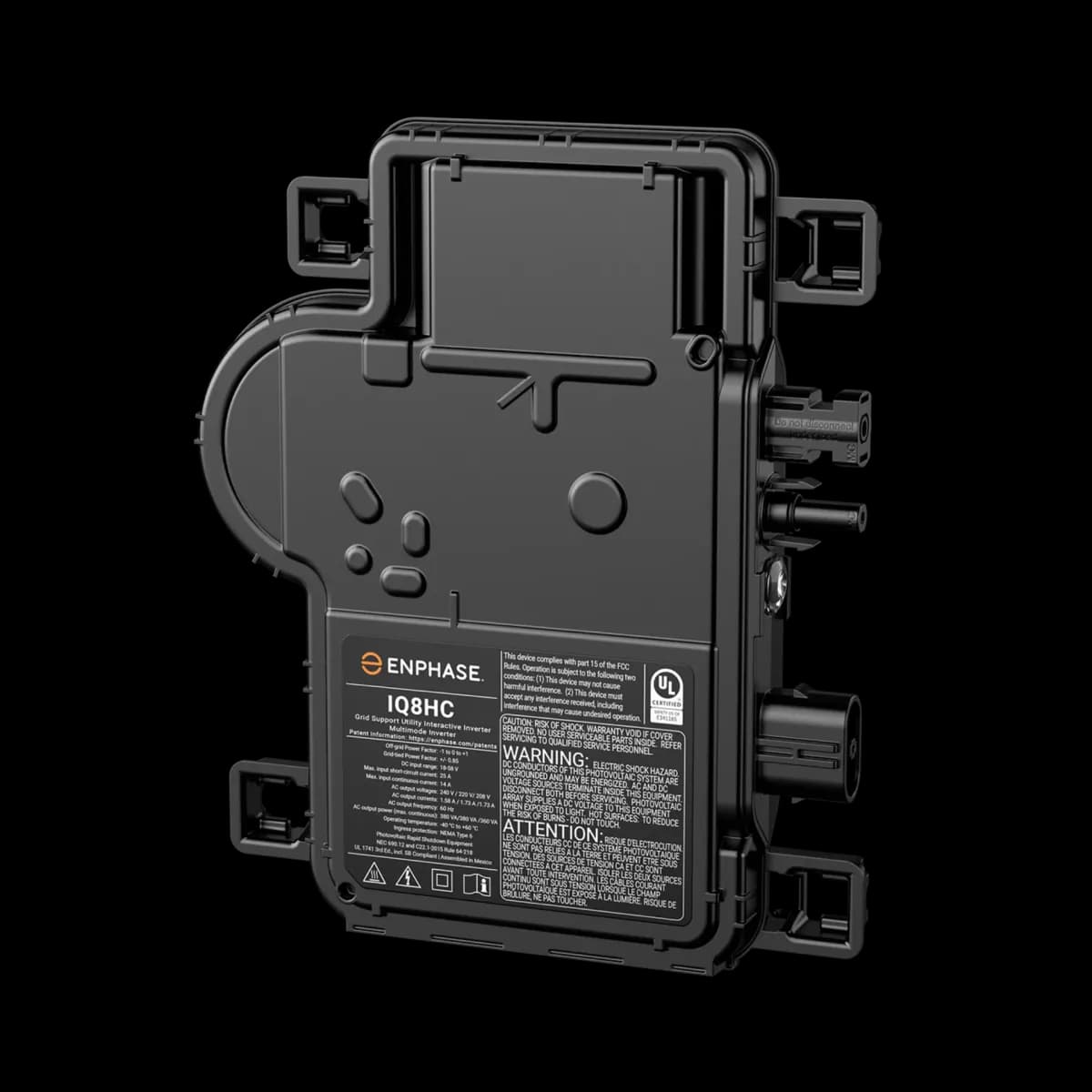
Microinverter
Max AC Output
384 VA
Peak Efficiency
97.5%
Warranty
25 years
Max Panel
460W
Comms
Envoy + Wi-Fi
Monitoring
Per-panel via Enlighten
NuWatt installs Enphase IQ8HC microinverters as standard on every residential system. The 25-year warranty means your inverter will likely never need replacement. Panel-level monitoring through the Enphase Enlighten app lets you see exactly which panels are producing and catch issues immediately.
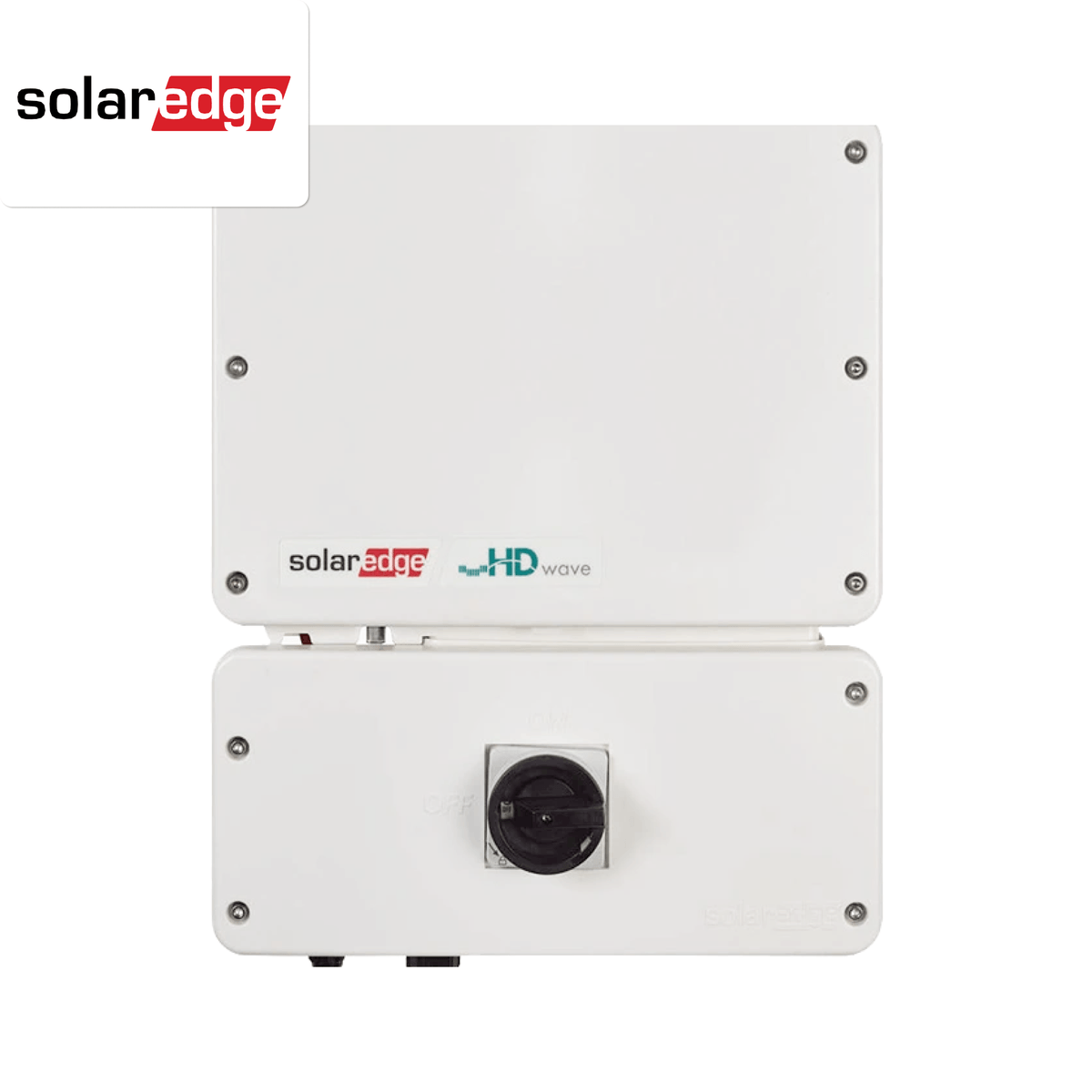
String + Power Optimizer
Power Rating
3.8-11.4 kW
Peak Efficiency
99.2%
Inverter Warranty
12 yr (ext. to 25)
Optimizer Warranty
25 years
Battery Ready
Yes (integrated)
Monitoring
Per-panel via mySolarEdge
NuWatt offers the SolarEdge Home Hub for homeowners who want integrated battery storage. The Home Hub combines solar inverter, battery inverter, and energy management in one unit. Each panel gets a power optimizer for panel-level monitoring and shade mitigation.
There is no single “best” inverter for every home. Your roof layout, shading, budget, and battery plans all affect the right choice. Here are the most common scenarios we see and our recommendation for each.
Shading on part of your roof
Recommendation: Microinverter (Enphase IQ8HC)
Each panel produces independently. A tree shading 3 panels loses only those 3 panels of production. With a string inverter, those 3 shaded panels could reduce the entire 20-panel string by 30-50%.
Complex roof with multiple orientations
Recommendation: Microinverter (Enphase IQ8HC)
Panels on south, east, and west roof faces receive sunlight at different times. Microinverters let each panel operate at its own optimal point. String inverters require matching orientations on each string.
Simple south-facing roof, no shade, tight budget
Recommendation: String inverter (budget option)
If your roof is simple, unshaded, and all south-facing, a string inverter saves $1,200-$2,000. However, you lose panel-level monitoring, the 25-year warranty, and need to budget for a replacement at year 10-15.
Planning to add a battery within 1-3 years
Recommendation: SolarEdge Home Hub
The Home Hub has a built-in battery inverter. Adding a SolarEdge battery later requires no additional hardware, saving $2,500+ vs. adding a separate battery inverter to a microinverter system.
Want to expand your system later
Recommendation: Microinverter (Enphase IQ8HC)
Adding panels to a microinverter system is simple: new panels + new microinverters. With a string inverter, expanding may require upsizing the central inverter or adding a second one.
Want the longest warranty and least maintenance
Recommendation: Microinverter (Enphase IQ8HC)
The 25-year microinverter warranty matches or exceeds panel warranty. String inverters typically need replacement at year 10-15 ($2,000-$3,500). Over 25 years, the microinverter premium often pays for itself.
Both Enphase and SolarEdge offer free monitoring apps with panel-level production tracking. Your monitoring app is your daily window into system performance, so app quality matters. Here is how they compare.

Works with: Enphase IQ8HC
Note: Requires Envoy gateway device (~$350 included in system)
Works with: SolarEdge Home Hub
Note: Requires internet connection for full functionality; some features need SolarEdge One subscription
Why Panel-Level Monitoring Matters
With system-level monitoring (string inverters only), you see total production but cannot tell which panel is underperforming. A cracked panel, dirty panel, or failed connection could reduce output by 5-10% for months before you notice. With panel-level monitoring, the app immediately flags which panel dropped below expected output, enabling fast diagnosis and repair.
A microinverter is a small device mounted behind each solar panel that converts DC to AC power at the panel level. A string inverter is a single large box (usually wall-mounted in your garage) that converts DC to AC for the entire system. Microinverters allow each panel to operate independently, while string inverters require panels to work as a connected group where the weakest panel limits the entire string.
For most homeowners, yes. Microinverters add $1,200-$2,000 to an 8 kW system but offer a 25-year warranty vs. 12 years for string inverters, panel-level monitoring, better shade performance, and no single point of failure. When you factor in replacing a string inverter at year 10-15 ($2,000-$3,500), microinverters often cost less over the 25-year system life.
Power optimizers (like SolarEdge) are DC-to-DC converters mounted on each panel. They condition DC power before sending it to a central inverter for DC-to-AC conversion. Unlike microinverters, they do not convert to AC at the panel. They offer panel-level monitoring and shade mitigation like microinverters, but still rely on a central inverter creating a single point of failure.
NuWatt installs Enphase IQ8HC microinverters as standard on all residential systems. We also offer the SolarEdge Home Hub (string inverter with power optimizers) for homeowners who want integrated battery storage. We do not install basic string inverters without optimizers because the monitoring and safety limitations do not meet our quality standards.
Both are excellent. Enphase microinverters are better for shade tolerance, system expansion, and long-term warranty (25 years with no central inverter to replace). SolarEdge is better when integrated battery storage is the priority because the Home Hub combines solar and battery inverter in one unit. NuWatt recommends Enphase for most installations and SolarEdge when battery integration is the main goal.
With a string inverter, panels are wired in series. When one panel is shaded, it restricts current flow through the entire string, reducing output from all panels by 25-50%. With microinverters, each panel operates independently. A shaded panel loses its own production but does not affect the other panels. For a 20-panel system with 3 shaded panels, microinverters can produce 15-30% more annually.
If one microinverter fails, only that one panel stops producing. The rest of your system continues normally. You will see the failure immediately in the Enphase Enlighten monitoring app. Under the 25-year warranty, Enphase ships a free replacement and your installer handles the swap. With a string inverter failure, your entire system goes down until it is repaired.
Yes. Enphase offers the IQ Battery 5P (3.84 kWh per unit, stackable) that integrates directly with IQ8 microinverter systems through the Enphase IQ System Controller. No separate battery inverter is needed. The SolarEdge Home Hub has a built-in battery inverter, which can be simpler if you are installing solar and battery at the same time.
As of March 2026, microinverters cost approximately $0.30-$0.45/W while string inverters cost $0.10-$0.20/W. For an 8 kW system, that is roughly $2,400-$3,600 for microinverters vs. $800-$1,600 for a string inverter. Power optimizers with a SolarEdge inverter fall in between at $0.25-$0.35/W ($2,000-$2,800 for 8 kW).
With microinverters, no. Each new panel gets its own microinverter, so you can add panels without changing any existing equipment. With a string inverter, you may need a larger inverter if additional panels exceed its capacity. With SolarEdge, you can add optimizers but the central inverter must support the additional capacity.
NEC 2020 rapid shutdown requirements mandate that solar panel voltage drops to safe levels within 30 seconds when the system is shut down, for firefighter safety. Microinverters and SolarEdge power optimizers have built-in rapid shutdown compliance. Basic string inverters require add-on rapid shutdown modules ($200-$400). All NuWatt installations meet NEC 2020 rapid shutdown requirements.
String inverters typically last 10-15 years, with most manufacturers offering a 12-year warranty. Replacing a string inverter costs $2,000-$3,500 including labor. Over a 25-year solar system life, you should budget for at least one inverter replacement. Microinverters carry a 25-year warranty and are designed to last the full life of the system.
Solar Panel Types Explained (2026)
Monocrystalline, polycrystalline, thin-film: which panel technology is best?
Read guideLFP vs NMC vs Lead-Acid Battery Comparison
Compare battery chemistries for home solar storage systems.
Read guideHow Much Do Solar Panels Save?
Real savings calculations with current 2026 utility rates.
Read guideSolar IQ Quiz
Get a personalized solar design with the right inverter for your home.
Read guideSolar Buyers Guide Hub
Everything you need to know before going solar in 2026.
Read guideEquipment We Install
Explore the panels, inverters, and batteries NuWatt installs.
Read guideResearch
You just did this
Calculate
See your savings
Save
Lock in your price
You now know the difference between inverter types. See which one makes sense for your roof, shading, and energy goals with a free custom solar design.
Get My Free Solar DesignTalk to an expertNo credit card required. 100% free. Takes about 2 minutes.
Marcus has designed and overseen 500+ residential solar installations across the Northeast. He specializes in system sizing, panel performance analysis, and production modeling.