Loading NuWatt Energy...

We use your location to provide localized solar offers and incentives.
We serve MA, NH, CT, RI, ME, VT, NJ, PA, and TX
Loading NuWatt Energy...
NuWatt designs, installs, and manages solar, battery, heat pump, and EV charger systems across 9 states. One company, one warranty, one point of contact.
Get a Free Quote
National averages say solar saves $1,500/year. But if you live in Massachusetts, the real number is $3,875 — or just $1,414 in Texas. Here are the actual savings for 8 states using verified 2026 utility rates.
Quick Answer
Solar panel savings depend on three things: your electric rate, your state's incentive programs, and your system size. An 8 kW system saves $1,414/year in Texas (at $0.136/kWh on a typical REP plan with no incentives) vs. $3,875/year in Massachusetts (Eversource at $0.3736/kWh plus SMART payments) vs. $5,264/year in Rhode Island (REG production payments plus net metering). National averages of $1,500/year are meaningless because they blend vastly different utility rates and ignore state-specific production incentives that can double your savings.
Every solar website quotes a national average: “Solar panels save the average homeowner $1,500 per year.” This number is technically correct and practically useless. It blends utility rates from 50 states with wildly different electricity costs, producing a middle number that is accurate for almost nobody.
Here is what actually happens when you install the same 8 kW solar system in three different states:
Annual electricity savings only — before incentives
Based on 8 kW system producing ~9,600 kWh/year (Northeast) or ~10,400 kWh/year (TX). Rates verified June 2026 from each utility's published tariff (CT Standard Service resets Jul 1; NH supply resets Aug 1; PECO PTC holds to Nov 30).
The Rate Is Everything
A Massachusetts homeowner paying $0.3736/kWh earns more than 2.5x as much per kilowatt-hour as a Texas homeowner paying $0.136/kWhon a typical REP plan. Texas gets more sun, but the lower rate means each kilowatt-hour of solar production is worth less than half as much. This is why “average solar savings” numbers are misleading — your rate determines your return on investment.
But electricity savings are only half the picture. State incentive programs — production payments, rebates, renewable energy credits — can add hundreds to thousands of dollars per year. And these vary even more dramatically than utility rates.
Each row uses the actual dominant utility rate and current state incentive programs. All numbers are for a cash purchase of an 8 kW system — no federal tax credit (25D expired Dec 2025).
| State | Utility Rate | Electric Savings | Incentive Income | Year 1 Total | 25-Year Value | Payback |
|---|---|---|---|---|---|---|
| Massachusetts (MA)Top | $0.3736/kWh Eversource | $3,587/yr | $288/yr SMART 3.0 | $3,875/yr | $121K+ | ~7 years |
| Rhode Island (RI)Top | $0.2734/kWh RI Energy | $2,625/yr | $2,639/yr REG (or REF) — pick one | $5,264/yr | $124K+ | ~5-6 years |
| New Jersey (NJ) | $0.2694/kWh PSE&G | $2,543/yr | $802/yr ADI/SREC-II | $3,345/yr | $93K+ | ~7-8 years |
| Connecticut (CT) | $0.2521/kWh Eversource CT | $2,420/yr | — Net metering only | $2,420/yr | $77K+ | ~10 years |
| New Hampshire (NH) | $0.2922/kWh Eversource NH | $2,805/yr | — NEM 2.0 only | $2,805/yr | $90K+ | ~10 years |
| Maine (ME) | $0.3027/kWh CMP | $2,906/yr | — Net billing only | $2,906/yr | $93K+ | ~9 years |
| Pennsylvania (PA) | $0.239/kWh PECO | $2,294/yr | — SRECs (minimal) | $2,294/yr | $73K+ | ~11 years |
| Texas (TX) | $0.136/kWh Typical REP plan (PUCT, June 2026) | $1,414/yr | — None | $1,414/yr | $45K+ | 15-18 years |
Electric Savings
$3,587/yr
Incentive Income
$288/yr
Year 1 Total
$3,875/yr
25-Year Value
$121K+
Payback Period
~7 years
Electric Savings
$2,625/yr
Incentive Income
$2,639/yr
Year 1 Total
$5,264/yr
25-Year Value
$124K+
Payback Period
~5-6 years
Electric Savings
$2,543/yr
Incentive Income
$802/yr
Year 1 Total
$3,345/yr
25-Year Value
$93K+
Payback Period
~7-8 years
Electric Savings
$2,420/yr
Incentive Income
—
Year 1 Total
$2,420/yr
25-Year Value
$77K+
Payback Period
~10 years
Electric Savings
$2,805/yr
Incentive Income
—
Year 1 Total
$2,805/yr
25-Year Value
$90K+
Payback Period
~10 years
Electric Savings
$2,906/yr
Incentive Income
—
Year 1 Total
$2,906/yr
25-Year Value
$93K+
Payback Period
~9 years
Electric Savings
$2,294/yr
Incentive Income
—
Year 1 Total
$2,294/yr
25-Year Value
$73K+
Payback Period
~11 years
Electric Savings
$1,414/yr
Incentive Income
—
Year 1 Total
$1,414/yr
25-Year Value
$45K+
Payback Period
15-18 years
Calculations assume 8 kW system, cash purchase (no financing), 1,200 kWh/kW/year (Northeast) or 1,300 kWh/kW/year (TX). 25-year values include 2.5% annual rate escalation and 0.5% panel degradation. Rates verified June 2026 (CT Standard Service resets Jul 1; NH supply resets Aug 1; PECO PTC holds to Nov 30).
Every kilowatt-hour your solar panels produce displaces a kilowatt-hour you would have bought from the utility. If your rate is $0.3736/kWh (Massachusetts Eversource), each kWh of solar is worth about 37 cents. If your rate is $0.136/kWh (a typical Texas REP plan), each kWh is worth about 14 cents. Same panel, same sunlight, but the value of the electricity is more than 2.5x higher in high-rate states.
This is why New England and the Mid-Atlantic consistently produce the highest solar ROI in the country, despite getting less sunlight than the Sun Belt. The math does not care about how many peak sun hours you get — it cares about what each hour of production is worth.
How to find your actual rate
Look at your utility bill and divide total charges (before taxes) by total kWh used. Do not use the “supply rate” alone — you pay supply plus delivery, which is why the blended rate is always higher than the advertised supply charge.
State incentives are the wildcard. Some states offer production-based payments that add $500-$2,600+ per year on top of your electricity savings. Others offer nothing beyond basic net metering. The difference in total 25-year savings between a well-incentivized state and a no-incentive state can be $30,000-$40,000.
Since the federal residential tax credit (Section 25D) expired on December 31, 2025, state incentives are now the primary financial boost for solar. Without them, the payback period is determined almost entirely by your electric rate.
An 8 kW system covers about 85-100% of electricity needs for a typical 3-bedroom home. A 12 kW system covers a larger home or one with electric heating, an EV, or a pool. The key principle: size the system to offset your actual usage, not to be the biggest system that fits on your roof.
Oversizing beyond your annual usage rarely makes financial sense in states with reduced net metering rates (like RI at 80% retail). You produce power worth less than what you consume. A properly sized system maximizes the self-consumption ratio — and therefore your savings per panel.
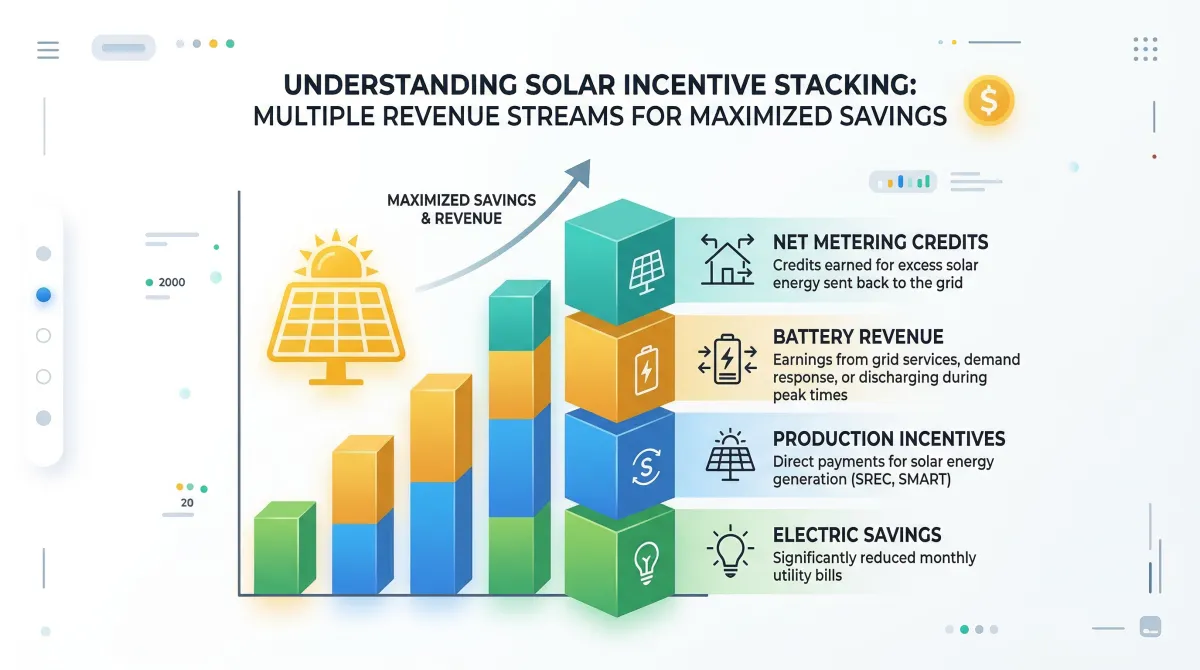
The states with the highest solar savings are not necessarily the sunniest — they are the ones that let you stack multiple income streams simultaneously. Here is what “incentive stacking” looks like in practice:
Texas, New Hampshire, and Maine have no statewide solar production incentive programs. In these states, solar savings come entirely from displacing utility electricity purchases. This is not necessarily bad — Maine proves it: CMP's $0.3027/kWh rate is the second-highest on this page, so electricity savings alone reach $2,906/year and pay the system back in about 9 years with zero incentive income. But at $0.136/kWh on a typical Texas REP plan, the payback stretches to 15-18 years.
TX at $0.136/kWh
$1,414/yr
electric only
NH at $0.2922/kWh
$2,805/yr
NEM 2.0 (~85% retail)
ME at $0.3027/kWh
$2,906/yr
NEB (1:1 rooftop)
In Massachusetts, Rhode Island, and Connecticut, adding a battery does not just provide backup power — it earns money through demand response programs. Your battery discharges during peak grid demand events (typically 10-30 events per summer), and the utility pays you for the capacity you provide.
Eversource territory
$1,000-$1,375
per year, per battery
$275/kW summer + $50/kW winter
RI Energy territory
$1,125
per year, per battery
$225/kW summer DR program
Eversource CT territory
$1,000-$1,375
per year, per battery
Same Eversource program as MA
Battery payback in ConnectedSolutions states
A typical 10 kWh battery costs $10,000-$15,000 installed. At $1,000-$1,375/year in ConnectedSolutions revenue alone (plus backup power value and potential TOU arbitrage), the battery pays for itself in 8-12 years — well within the 12-15 year battery warranty. In states without demand response programs, battery payback from savings alone is 15-20+ years.
The residential solar tax credit (Section 25D) expired on December 31, 2025. This means homeowners who purchase a system outright or with a loan no longer receive any federal incentive. Every solar savings calculation in 2026 must account for this change.
No 25D credit: Cash and loan buyers get zero federal tax credit. The full system cost comes out of pocket.
State incentives still active: SMART (MA), ADI (NJ), REG or REF (RI — pick one), and ConnectedSolutions battery programs are all independent of the federal tax credit.
Third-party ownership option: Section 48/48E commercial ITC is still available for systems where a financing company owns the panels (like Propel financing). The company claims the credit and passes savings through as lower rates.
The loss of the federal credit does not make solar unprofitable — it makes state incentives and utility rates more important than ever. In high-rate states with strong incentive programs, solar still pays back in under 10 years. The key is running the numbers with YOUR actual rate and YOUR state's current programs.
Most solar calculators use a single national average rate ($0.17/kWh) and apply a 30% tax credit that no longer exists for homeowners. The result is a savings estimate that is wrong in both directions — it understates savings in high-rate states and overstates them in low-rate states.
The numbers on this page use actual utility rate schedules as of June 2026, verified against each utility's published tariff. Incentive amounts use current program rates from each state's energy office. There is no 25D tax credit included because it does not exist for homeowners anymore.
Pull your last 12 months of utility bills. Divide total charges by total kWh to get your blended rate. This is the number that matters — not the supply charge alone.
Add up 12 months of kWh usage. The average US home uses 10,500 kWh/year, but this varies enormously. Homes with electric heat or EVs can use 15,000-25,000 kWh/year.
Divide your annual kWh by your location's production factor (1,200 kWh/kW in New England, 1,300 in TX). A 10,000 kWh home in MA needs about 8.3 kW. Round to the nearest panel count.
Multiply your system's annual production (kWh) by your utility rate. This is your base annual savings — the minimum you will save regardless of incentives.
Look up your state's current solar programs. In MA, add SMART payments. In RI, add either REG or REF (pick one — they're mutually exclusive). In NJ, add ADI/SREC-II income. In TX or NH, this number is zero.
Electricity rates have risen 2-4% annually over the past decade. Apply 2.5% annual escalation to your electric savings and 0.5% annual panel degradation. This gives you the lifetime value.
Or skip the math entirely:NuWatt's solar design team will pull your actual utility data, model your roof, and calculate exact savings using your real rate and every available state incentive. Get a free savings estimate →
For detailed breakdowns including city-level pricing, utility comparisons, and every available incentive program, visit your state's dedicated solar guide:
Is Solar Worth It Without the Tax Credit?
Deep dive into post-25D economics for cash and loan buyers.
Solar Financing Changed in 2026
How Propel and third-party ownership fill the ITC gap.
How Many Solar Panels Do I Need?
System sizing guide based on your actual electricity usage.
How to Compare Solar Quotes
What to look for in competing proposals — cost, equipment, warranties.
Net Metering by State (2026)
How each state credits you for excess solar production.
Truth About Solar in 2026
The honest economics of going solar after the ITC expired.
Monthly solar savings depend entirely on your utility rate and system size. In Massachusetts (Eversource at $0.3736/kWh), an 8 kW system saves about $299/month on electricity alone. In Texas at $0.136/kWh on a typical REP plan, the same system saves about $118/month. There is no single national number that is accurate for everyone.
Yes, but the math has changed. The residential 25D tax credit expired on December 31, 2025. In high-rate states like MA, NJ, RI, and CT, solar still pays back in 7-11 years through electricity savings and state incentive income (SMART, ADI/SREC-II, REG). In low-rate states like TX, payback takes 15-18 years without incentives.
Over 25 years, an 8 kW solar system can save between $45,000 and $124,000+ depending on your state. In Massachusetts, 25-year savings reach $121,000+ thanks to SMART payments and ConnectedSolutions battery income. In Texas with no production incentives, 25-year savings are around $45,000.
Rhode Island currently offers the highest solar savings in the Northeast, with 25-year values exceeding $120,000 for an 8 kW system. This is because RI stacks multiple income streams: pick one of two production tracks — REG (31.55¢/kWh for 15 years on Small-Scale Solar I) OR the REF rebate ($0.65/W, $5K cap) — plus net metering credits and ConnectedSolutions battery revenue. REF and REG are mutually exclusive per Commerce RI; REG usually wins on 15-year total value.
Yes. Research consistently shows solar adds 3-4% to home value nationally. In high-rate states, the premium is even higher because buyers value the locked-in electricity savings. In MA and NJ, solar panels are exempt from property tax assessment, so your home value increases without raising your property taxes.
An 8 kW system produces approximately 8,800-10,400 kWh per year depending on your location. In Massachusetts it is about 9,600 kWh/year (1,200 kWh/kW), in New Jersey about 9,440 kWh (1,180 kWh/kW), and in Texas about 10,400 kWh (1,300 kWh/kW) due to more sunlight.
National averages blend high-rate states ($0.24-$0.36/kWh) with low-rate states ($0.12-$0.14/kWh), producing a meaningless middle number. They also ignore state-specific incentive programs that can add $500-$3,000+ per year in income beyond electricity savings. The only accurate savings estimate uses YOUR utility rate and YOUR state incentives.
Incentive stacking means combining multiple state and utility programs simultaneously. For example, in Massachusetts you can stack SMART payments ($0.03/kWh), ConnectedSolutions battery revenue ($1,000-$1,375/year), and net metering credits — three separate income streams on top of your electricity savings. States like RI stack three: a production track (REG or REF — pick one), net metering, and ConnectedSolutions.
Net metering lets you send excess solar electricity to the grid and receive credits on your bill. In states with full retail net metering (like NJ at 1:1), you get the full value of your electricity. In states with reduced rates (like RI at 80% retail), credits are worth less. Net metering policies vary dramatically by state and directly impact your savings.
In states with demand response programs like ConnectedSolutions (MA, RI, CT), a battery can earn $1,000-$1,375 per year by providing grid services during peak demand events. At a battery cost of $10,000-$15,000, this pays back in 8-12 years while also providing backup power. In states without demand response programs, battery savings are limited to time-of-use rate arbitrage.
An 8 kW solar system in Massachusetts saves approximately $3,875 in the first year: $3,587 in electricity savings (Eversource at $0.3736/kWh) plus $288 from SMART 3.0 payments ($0.03/kWh). Adding a battery with ConnectedSolutions can push total annual value above $5,000. Over 25 years, total savings exceed $121,000.
Solar payback period varies dramatically by state. In Massachusetts, an 8 kW system (about $24,800) pays back in roughly 7 years through electricity savings plus SMART income. In Rhode Island, REG production payments can bring payback down to roughly 5-6 years. In Texas without production incentives, payback stretches to 15-18 years at current rates.
National averages do not apply to you. Get a savings estimate based on your actual utility rate, your roof, and every incentive available in your state.
Free, no-obligation estimate. Uses your actual utility rate and state incentive programs.