Loading NuWatt Energy...

We use your location to provide localized solar offers and incentives.
We serve MA, NH, CT, RI, ME, VT, NJ, PA, and TX
Loading NuWatt Energy...
NuWatt designs, installs, and manages solar, battery, heat pump, and EV charger systems across 9 states. One company, one warranty, one point of contact.
Get a Free QuoteYour heat pump's defrost cycle drips water. In a Massachusetts single-digit night, that water freezes solid in the drain line — dam up the pan, fault the unit, and in the worst case destroy the compressor.
$50-$150
Heat tape cost
$200-$400
Base pan heater
42-48"
MA frost line
$3,000+
Compressor repair (if it fails)
This failure mode is specific to cold-climate heat pumps in Zone 5 (all of MA). Here is the physics chain that turns a functioning unit into a block of ice.
In heating mode, the outdoor coil is COLDER than ambient air. Humidity in the air condenses and freezes on the coil surface — just like ice on a cold drink. By 20°F outdoor temp, a film of frost covers the coil within an hour.
Every 30-90 minutes, the reversing valve flips. The coil warms up and melts the ice off. This cycle takes 5-15 minutes and produces 0.5-2 gallons of meltwater — which drains out the bottom of the outdoor unit.
If outdoor temp is below 25°F, the water refreezes the moment it leaves the warm base pan. Ice accumulates in the drain opening, base pan, and on the ground directly below the unit. Each defrost cycle adds more.
Once the drain opening is iced over, defrost water can no longer escape. It pools in the base pan, rising until it freezes and physically locks the fan blade or submerges the refrigerant lines. Now the fault codes begin.
E9 (fan fault) fires first. Then P4/P5 (sensor error) as ice covers the defrost sensors. If left unresolved overnight, ice can crack the condenser housing or damage the compressor. Total repair cost: $800-$5,000+.
Modern units auto-shut-off when fault thresholds are exceeded — which saves the compressor but leaves you with no heat on a 5°F night. You need a service call to thaw the unit, re-commission, and usually replace whatever iced parts broke.
The best MA installs layer at least two protection methods. For example: heat tape on the drain line plus a base pan heater. Belt and suspenders.
Best for: Most MA homes, standard drain line lengths
Pros
Inexpensive, self-regulates to prevent overheating, widely available
Cons
Requires GFCI outlet within reach, adds $20-40/year in electricity
Best for: Homes with long horizontal drain runs or basement routing
Pros
Actively pumps water away; tray heater prevents freeze at source
Cons
Failure point in winter if pump dies; needs annual service
Best for: New installs - specify when ordering
Pros
Integrated with unit controls; prevents ice buildup in base pan itself
Cons
Must be specified at order time; retrofits cost more
Best for: New installs where ground conditions allow
Pros
Passive, no electricity, no failure points
Cons
Requires 3ft+ deep pit below frost line; not possible on ledge or high water table
Best for: Coastal MA, homes with heavy snow load
Pros
Keeps unit above snow accumulation; insulation slows drain freeze
Cons
Does not fully eliminate freeze risk in extreme cold alone
Coastal Massachusetts homes see significantly higher rates of heat pump drain freeze failures. It isn't the cold — inland MA gets colder. It's the humidity and temperature swings.
Coastal air carries 30-50% more moisture than inland MA air. That means the outdoor coil ices over 2-3x faster, triggering more defrost cycles per day and producing more meltwater to drain.
Coastal MA regularly swings from 35°F rain to 15°F freeze within 12 hours. A half-melted drain line refreezes into a thick ice plug that heat tape alone cannot fully clear — requiring a base pan heater.
Salt deposits on the outdoor coil reduce heat transfer, forcing more defrost cycles. Coastal MA installations should specify coated/marine-grade coils (available from Mitsubishi, Daikin) and annual coil washing.
Coastal sites should layer heat tape + base pan heater + elevated mounting. The $600-$900 combined cost is a fraction of a single failure event.
If you live in one of these zones, budget an extra $500-$900 for freeze protection as a non-negotiable line item in your installation quote. Do not let an installer skip it to hit a price target.
Four fault codes appear most often on Mitsubishi, Fujitsu, and Daikin cold-climate heat pumps in MA winters. Most are ice-related when they appear between December and February.
| Code | What It Means | First Response |
|---|---|---|
| E9 | Outdoor fan/motor error (often caused by ice jam in fan blade) | Kill power, clear ice from fan and coil, check fan spins freely before restart |
| P4 / P5 | Outdoor unit sensor error (water freezing on sensors) | Clear ice from sensor probes; check for blocked drain refreezing under unit |
| H6 | Outdoor fan motor not reaching RPM (frozen bearing or ice interference) | Professional defrost inspection; check defrost control board settings |
| U4 | Refrigerant issue often triggered by prolonged defrost failure | Stop operation immediately; call installer before compressor damage occurs |
Sounds obvious, but panicked homeowners do it every winter. Hot water instantly refreezes in contact with sub-freezing components, expands, and can crack the coil or condenser housing. Use a hair dryer or heat gun on low setting, or wait for the manufacturer defrost cycle. If you cannot safely clear ice, shut the unit off at the breaker and call your installer.
Schedule this in October or early November, before the first hard freeze. A $200 tune-up prevents 95% of winter freeze failures.
Outdoor Coil
Wash coil with low-pressure water; remove leaves, grass, cobwebs. Inspect for damage or corrosion.
Drain Line
Clear any obstruction, verify slope away from unit, confirm heat tape is plugged in and functional.
Heat Tape
Verify heat tape lights/draws current. Replace if older than 5 years or showing cracks in insulation.
Base Pan Heater
Confirm heater energizes during test cycle. Check factory control board settings for cold-climate mode.
Defrost Sensors
Inspect defrost and ambient sensor probes for ice damage, corrosion, or loose connections.
Fan Blade
Confirm fan spins freely without resistance. Lubricate bearing if manufacturer specifies.
Refrigerant Charge
Check subcool/superheat values. Undercharged systems run longer defrost cycles and produce more condensate.
Elevated Mounting
Verify unit is 18 inches or more above expected snow line. Adjust if snow accumulation has undermined pad.
Ground Area Below
Clear any ice accumulation from previous winter. Add gravel to drain area if pooling is visible.
Air Filter (Indoor)
Replace filters on all indoor units. Clogged filters reduce airflow and trigger more defrost cycles.
95%+ reliability through winter. Freeze events extremely rare. Warranty stays valid. Typical lifespan 15-20 years.
$150-$250/year
30-40% chance of a winter freeze-related service call. Repair cost averages $400-$1,500. Compressor damage risk after multiple untreated freeze events.
$500-$3,000 in repairs over 5 years
Half the freeze-protection battle is where the unit sits. These placement rules apply to every MA installation, regardless of unit brand.
Standard concrete pad is not enough. Use wall brackets, a 24-inch pedestal, or a raised composite deck. Unit must never sit in a snowbank — blocked airflow triples defrost cycles.
Do not place beside a long unbroken wall where wind piles snow. The northwest and north sides of homes accumulate the deepest drifts. Sheltered southeast placement is ideal when possible.
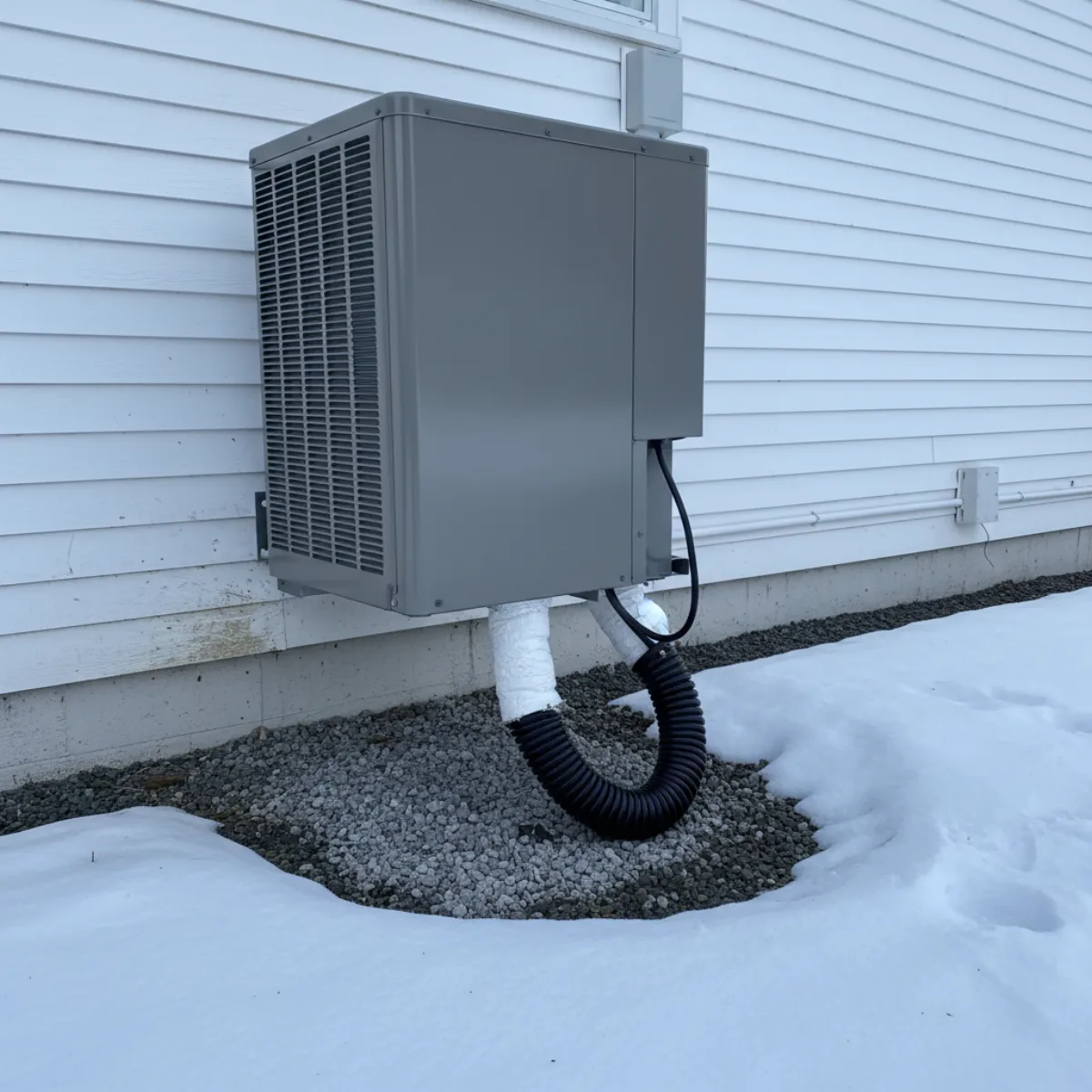
Condensate needs somewhere to go. Gravel bed, drainage pit, or sloped pad leading away from the unit base. Pooling meltwater refreezes and undermines the unit.
Leave 24 inches or more of clearance on all sides for maintenance. Installers need to reach the base pan, drain, and electrical connections. Tight cramming in landscaping shortcuts causes skipped tune-ups.
Heat tape needs a dedicated GFCI outlet. Most installers forget to run one. Specify it upfront or pay an electrician $200-$400 to retrofit later.
Ice and snow falling from a roof can damage the unit or dump huge melt loads into the drain area. If you must place under an eave, install a snow guard or relocate.
If your installer skipped heat tape and you want to add it yourself, the install takes 30-60 minutes and requires no specialized skills. Kill breaker power first.
Get a self-regulating tape (Frost King HC Series, Easy Heat Freeze Free, Raychem WinterGard) rated for outdoor/pipe use. Match the length to your drain run +2 feet. Do NOT use constant-wattage tape — it overheats PVC.
Turn off the heat pump at its dedicated breaker. Verify the outdoor unit is cold and unpowered before working near it.
Run the tape in a single straight run against the bottom side of the PVC drain pipe (do not spiral). Secure every 12 inches with foil tape (not vinyl electrical tape — it degrades in UV).
Wrap 1/2 inch to 1 inch foam pipe insulation over the taped pipe. Seal seams with foil tape. This traps the heat against the drain line and cuts electricity use by 50%.
Plug the tape into a dedicated outdoor GFCI outlet. Do NOT use an extension cord. If no GFCI is near, hire an electrician to add one ($200-$400). Test the tape by hand-feel — should warm slightly within 5 minutes.
Turn the heat pump breaker back on. Run a defrost cycle (most units have a test mode). Confirm drain water exits cleanly without refreezing at the pipe exit.
Any HVAC technician can add heat tape to an existing installation in under an hour. Typical service call runs $150-$300 including the tape. Combine it with your annual fall tune-up and the cost is minimal.
Total cost to fully freeze-protect a new MA heat pump installation. Spend now or spend 3-10x more on a mid-winter repair.
Self-Regulating Heat Tape (6 ft)
DIY or installer adds during install
$50-$150
Foam Pipe Insulation + Foil Tape
Wraps the heat tape for efficiency
$15-$30
Outdoor GFCI Outlet (if needed)
Electrician install; one-time cost
$200-$400
Factory Base Pan Heater (add-on)
Specify at order time - retrofits cost more
$200-$400
Elevated Mounting Bracket or Pedestal
Wall bracket or 24-inch pedestal for snow clearance
$150-$500
Gravel Drain Pit (optional)
Passive backup drainage if site allows
$200-$500
Annual Maintenance Visit
Schedule every fall before first freeze
$150-$250/yr
Full Protection Package (One-Time)
All measures except annual maintenance
$815-$1,980
Heat tape + insulation + GFCI outlet. Covers 85% of freeze scenarios.
$265-$580
Heat tape + base pan heater + elevated mount + gravel pit. Required for Cape, Islands, South Shore.
$815-$1,480
When a heat pump runs in heating mode, it absorbs heat from outdoor air. Ice builds up on the outdoor coil, and the unit periodically reverses into a defrost cycle — melting the ice into water that drains out the bottom. In MA winters when outdoor temps are below 25°F, that melted water refreezes as it leaves the unit. Over days of continuous cycling, ice dams in the drain line, floods the base pan, and freezes solid around the coil. Result: E9 fault codes, reduced heating output, and eventually compressor damage.
Self-regulating heat tape is the cheapest fully effective solution. For $50-$150 plus foam pipe insulation, you wrap the drain line end-to-end, plug into a nearby GFCI outlet, and it keeps the line above freezing automatically. Annual electricity cost is $20-$40 depending on winter severity. DIY install takes 30 minutes. Make sure to buy self-regulating tape (not constant-wattage), because standard heat tape can overheat and damage PVC drain lines.
Two reasons. First, wet salt-air humidity causes more aggressive ice formation on outdoor coils than dry inland air — meaning more frequent defrost cycles and more meltwater. Second, coastal MA temperature swings are rapid: rain at 35°F followed by a freeze at 15°F creates thick drain-line ice plugs that heat tape alone struggles to melt. Coastal installations should combine heat tape with a base pan heater and elevated mounting.
E9 is an outdoor unit fan/motor error. In MA winters, 80% of E9 codes are caused by ice jamming the outdoor fan blade or condensate freezing on the fan motor shaft. First step: kill power, physically inspect the outdoor unit, clear any visible ice from the coil and fan. If the fan spins freely by hand and the drain is clear, restart. If the code returns within 24 hours, call your installer — there may be a deeper drain or defrost-control issue.
In most of MA, heat tape alone is sufficient. Base pan heaters are recommended in three cases: coastal MA (salt-air, rapid temperature swings), homes that have already experienced a drain freeze event, and installations where the outdoor unit sits in a shaded spot that rarely gets sun. A base pan heater adds $200-$400 to a new install and $400-$700 to retrofit. It is cheap insurance for high-risk sites.
Massachusetts does not have a single statewide condensate drain freeze code, but 780 CMR (MA Building Code) requires HVAC systems to be installed per manufacturer specifications — and most cold-climate heat pump manufacturers now require or strongly recommend heat trace on drain lines in Climate Zone 5 (which covers all of MA). Skipping it can void the manufacturer warranty and is commonly flagged in Mass Save Quality Installation Verification inspections.
Annual maintenance by a certified HVAC technician, ideally in early fall (before first freeze). They will inspect and clean the outdoor coil, verify defrost cycle operation, check heat tape function and drain line clearance, inspect the base pan and sensors, and confirm refrigerant charge. Cost is $150-$250 per visit. Skipping fall maintenance is the number one predictor of mid-winter drain freeze failures — a $200 tune-up prevents a $3,000 compressor repair.
Yes, in the right conditions. A gravel pit 36-48 inches deep (below MA frost line) lined with landscape fabric and filled with washed stone lets condensate drain freely year-round without refreezing. It only works where groundwater table is below the pit bottom and the soil percolates — not on ledge, clay, or waterlogged sites common on Cape Cod and the North Shore. Many MA homes use both: gravel pit for the primary drain plus heat tape as insurance for the exposed section.
Our MA technicians freeze-protect every installation as a matter of course — and can retrofit protection onto any existing unit in under an hour.
How cold-climate heat pumps defrost themselves and what a normal cycle looks like.
Read guideWhich NEEP-listed models actually hold output below 0°F.
Read guideWhy coastal humidity affects heat pump performance year-round.
Read guideFull playbook for swapping oil heat for a cold-climate heat pump in MA.
Read guideInstalled cost for MA homes after all Mass Save rebates.
Read guideOff-peak rates and bonuses for Eversource heat pump customers.
Read guide