Loading NuWatt Energy...

We use your location to provide localized solar offers and incentives.
We serve MA, NH, CT, RI, ME, VT, NJ, PA, and TX
Loading NuWatt Energy...
NuWatt designs, installs, and manages solar, battery, heat pump, and EV charger systems across 9 states. One company, one warranty, one point of contact.
Get a Free Quote
Massachusetts Solar Viability Assessment 2026
Five factors determine whether your home is a strong solar candidate. Use our free scorecard to find out in 5 minutes — no sales call required.
Your Massachusetts home is good for solar if it has:
Important: The federal 25D residential solar ITC expired December 31, 2025. Massachusetts state incentives (SMART, net metering, tax exemptions) still make solar viable, but payback periods are now 9–14 years instead of 6–9.
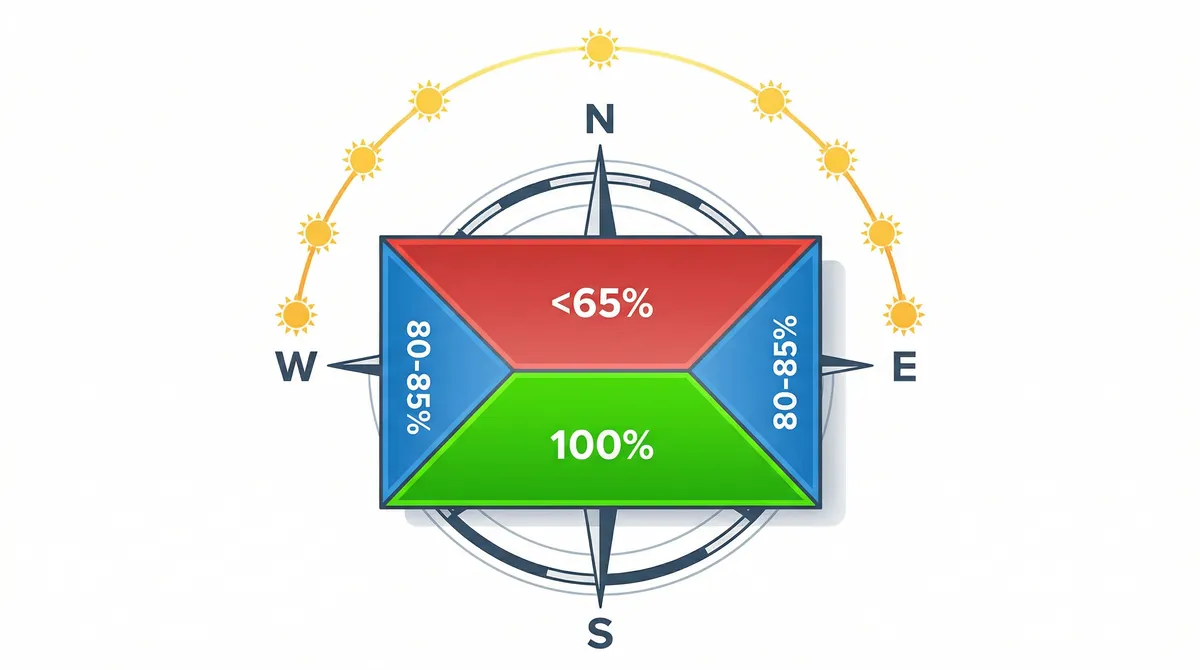
At Massachusetts' latitude (42°N), the sun tracks across the southern sky year-round. South-facing roof planes capture the most energy. But you do not need a perfectly south-facing roof to go solar — east and west orientations still produce 80–85% of maximum output.
| Direction | Production | Rating | Notes |
|---|---|---|---|
| South | 100% | Ideal | Maximum sun exposure throughout the day. Gold standard for solar. |
| South-East / South-West | 90–95% | Excellent | Slight morning or afternoon bias — minimal production loss. |
| East or West | 80–85% | Good | Works well with microinverters. Higher production in morning (E) or afternoon (W). |
| North-East / North-West | 65–75% | Marginal | Significant production penalty. May need a larger system or ground mount. |
| North | <65% | Poor | Not recommended for rooftop solar. Consider ground mount or community solar. |
MA Housing Styles & Orientation
Colonial homes (most common in MA) have symmetrical gable roofs — typically two large roof planes, one facing roughly south. Cape Cods have low-pitched roofs with good southern exposure. Saltbox styles have a long south-facing rear roof plane — ideal for solar. Ranch homes offer large continuous roof planes but at a lower pitch.
How to check: Open Google Maps, switch to satellite view, and find your home. The compass on the map shows north. If the largest roof plane faces within 45° of due south, you are in good shape. Or simply download a compass app on your phone and stand facing your main roof.
Solar panels last 25–30 years. If your roof needs replacement in 5 years, you will be paying to remove panels, re-roof, and reinstall them — adding $3,000–$5,000 in unnecessary cost. Your roof should have at least 10 years of life remaining before solar installation.
Asphalt Shingle
~70% of MA homes
Standard mounting with flashing. Needs 10+ years of life remaining.
Standing Seam Metal
Growing — new builds, cape cods
Best option — clamp-on mounting with zero penetrations.
Rubber / EPDM Flat
Common — triple-deckers, multi-family
Ballasted systems. Tilt racks optimize angle for MA latitude.
Slate
Historic homes — Cambridge, Beacon Hill
Fragile, expensive to mount. Historic commission review often required.
Wood Shake / Shingle
Cape Cod, older colonials
Fire risk concern. Many installers will not mount on wood shake.
Roof + Solar Bundle
If your roof is nearing end of life, a roof replacement + solar installation bundle saves money by combining the two projects. NuWatt coordinates with roofing contractors to handle both in one project — no double labor, no separate permits. Typical savings: $1,500–$3,000 vs. doing them separately.
Warning signs your roof needs replacement first: Curling or buckling shingles, missing granules in gutters, visible daylight through attic boards, sagging ridgeline, moss or algae growth, multiple layers of shingles. If you see any of these, get a roofing inspection before committing to solar.
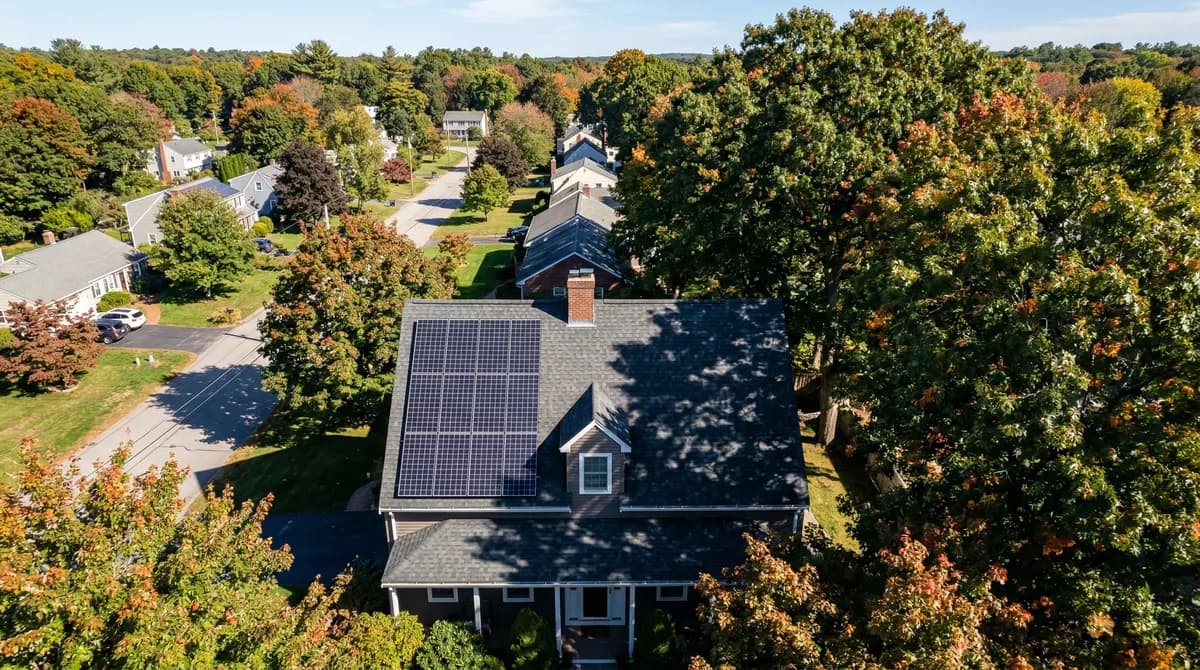
Trees are the #1 obstacle to solar in Massachusetts. The state is 62% forested — one of the most heavily wooded in the country. Even suburban neighborhoods have mature oaks, maples, and pines that cast significant shade on rooftops.
0–10%
Shade Coverage
ExcellentNo action needed. Standard string inverter works fine.
10–25%
Shade Coverage
ManageableUse microinverters (Enphase IQ8+). Each panel optimizes independently.
25%+
Shade Coverage
ProblematicTree trimming needed, or consider ground mount / community solar.
With traditional string inverters, shade on one panel can reduce the output of the entire string (typically 8–12 panels). This is why microinverters are critical for any MA home with partial shade — they isolate each panel so shaded panels do not drag down the rest.
Seasonal note: In MA, deciduous trees (oaks, maples) lose leaves in winter, allowing more sun through from November to March. But winter is also when sun angles are lowest and days shortest — so winter shade matters less than summer shade. Evergreens (pines, spruce) cause year-round shade and are a bigger concern.
For a detailed shade analysis including tree trimming costs and inverter technology comparison, see our Massachusetts Solar Shading & Tree Trimming Guide.
A standard 440W residential solar panel measures roughly 6.8 ft x 3.5 ft (~24 sq ft). Including spacing and setbacks, plan for about 180 square feet per kilowatt of solar capacity.
300–500 sq ft
$50–$80/mo offset
500–900 sq ft
$80–$140/mo offset
900–1,400 sq ft
$140–$220/mo offset
1,400–1,800 sq ft
$220–$280/mo offset
1,800+ sq ft
$280+/mo offset
Typical MA Home Example
A 2,000 sq ft colonial with a 30° pitched roof has roughly 1,600 sq ft of total roof area on the south side. After fire setbacks (-400 sq ft), one chimney (-50 sq ft), and two vents (-30 sq ft), you have about 1,120 sq ft of usable space — enough for a 6–7 kW system offsetting $170–$200/month of electricity.
Higher electricity bills mean faster solar payback. Massachusetts has some of the highest electric rates in the continental US — which is actually good news for solar economics because every kWh your panels produce displaces expensive grid power.
<$75/mo
Weak Case
Small system. Fixed costs make $/W expensive. Payback 15+ years. Consider community solar or wait until usage increases (EV, heat pump).
$100–$200/mo
Good Case
5–8 kW system. Solid payback of 10–13 years with SMART and net metering. Most MA homeowners fall in this range.
$200+/mo
Strong Case
8–12 kW system. Best payback in MA — 9–11 years. The higher your utility rate (Unitil at $0.48/kWh is the steepest), the more each solar kWh saves you. Add a battery for ConnectedSolutions revenue.
| Utility | Rate ($/kWh) | Avg Monthly Bill | Solar Payback |
|---|---|---|---|
| Unitil | $0.48 | $220–$290 | 9–11 years |
| National Grid | $0.42 | $200–$260 | 10–12 years |
| Eversource | $0.37 | $180–$240 | 11–13 years |
| Municipal (varies) | $0.10–$0.18 | $60–$120 | 15–20+ years |
Municipal Utility Warning
If your home is served by a municipal utility (Belmont Light, Reading Municipal, Taunton, etc.), solar economics are very different. Municipal rates are 40–60% lower than Eversource or National Grid, and net metering policies vary. Some municipal utilities do not offer net metering at all. Check your specific utility before proceeding.
Answer these 10 questions to estimate your home's solar potential. Print or screenshot your results.
Does your roof face south, south-east, or south-west?
Is your roof less than 15 years old (or recently replaced)?
Does your roof get direct sunlight for 5+ hours per day (10 AM – 3 PM)?
Do you have at least 300 sq ft of unobstructed roof space?
Is your monthly electricity bill above $100?
Is your roof free of major obstructions (dormers, skylights, chimneys)?
Are the trees around your home shorter than your roofline?
Do you plan to stay in your home for 8+ years?
Is your roof asphalt shingle, metal, or flat rubber (not slate or wood shake)?
Are you served by Eversource, National Grid, or Unitil (not a municipal utility)?
Ideal Home
14–16 ptsSouth-facing roof, minimal shade, high electricity bills, modern asphalt or metal roof
Example: 2,500 sq ft colonial in Wellesley, Eversource territory, $220/mo electric bill, 12-year-old architectural shingles, few trees on south side
Est. payback: 9–11 years
Strong candidate. Get a free site assessment to lock in your system design.
Moderate Home
9–13 ptsEast/west roof planes, some shade, decent usage, roof in fair condition
Example: Cape cod in Framingham, National Grid territory, $160/mo bill, west-facing roof, two mature oaks on east side
Est. payback: 11–14 years
Likely viable with microinverters and smart panel layout. A shade analysis will confirm.
Challenging Home
5–8 ptsSignificant shade, old roof, low usage, or north-facing orientation
Example: Victorian in Brookline, heavy tree canopy, slate roof, $90/mo bill, north-east facing primary roof plane
Est. payback: 15+ years or not viable for rooftop
Rooftop solar may not be practical. Explore community solar, ground mount, or address shade/roof issues first.
Not Viable (Rooftop)
0–4 ptsNorth-facing, heavy shade, very old roof, low usage, or municipal utility with no net metering
Example: Row house in Boston with north-facing roof, surrounded by taller buildings, Belmont Light territory, $65/mo bill
Est. payback: N/A — rooftop not recommended
Community solar is your best option. You can save 10–20% on electricity with zero installation.
Our IQ wizard analyzes your address, roof, and utility data in minutes.
We believe in honest assessments. Here are situations where rooftop solar may not be your best option:
Heavy, year-round shade
If mature evergreen trees block your roof from 10 AM to 3 PM and tree removal is not an option, rooftop solar will not produce enough to justify the investment.
North-facing-only roof
If all viable roof planes face due north with no south, east, or west exposure, production will be below 65% — too low for a reasonable payback.
Roof needs imminent replacement
If your roof has less than 5 years of life, solar now means paying to remove and reinstall panels later. Do the roof first or bundle both projects.
Very low electricity usage
If your bill is consistently under $60/month, the minimum system costs more per watt and payback stretches beyond 18 years. Community solar may be better.
You rent or plan to move within 3 years
Solar adds home value, but you need 5+ years of savings to recoup costs. Renters should look at community solar. Condo owners need HOA/condo association approval.
Municipal utility with low rates and no net metering
Some MA municipal utilities charge $0.10–$0.15/kWh and do not offer net metering. At those rates, solar payback can exceed 20 years.
A bad roof does not mean you cannot go solar. Three alternatives work well in Massachusetts:
If you have 1,000+ sq ft of open south-facing yard, a ground-mount system avoids all roof issues. Costs $0.20–$0.50/W more than rooftop but can be optimally oriented and tilted.
Subscribe to a shared solar farm with zero installation on your property. Save 10–20% on your electricity bill. Available to renters, condo owners, and anyone with a bad roof.
A solar carport or patio canopy covers a parking area or outdoor space while generating electricity. Ideal when roof is unsuitable but you have a south-facing driveway or patio.
Massachusetts has over 200 local historic districts. If your home is in one, you may need approval from your local historic commission before installing solar panels. The good news: MA is increasingly solar-friendly, and most commissions approve panels that are not visible from the street.
Massachusetts ground snow loads range from 40–70 psf depending on location (higher in western MA). Solar panels add 2–4 psf of dead load. Most homes built to MA building code handle this easily, but older homes (pre-1960) may need a structural engineer review.
About 14% of MA households are served by municipal utilities (41 towns). Municipal utilities set their own rates and net metering policies — which are often less favorable for solar than Eversource or National Grid.
| Factor | IOU (Eversource/NGrid) | Municipal |
|---|---|---|
| Rate | $0.37–$0.48/kWh | $0.10–$0.18/kWh |
| Net Metering | 1:1 retail rate | Varies — some none |
| SMART | Eligible | Not eligible |
| Solar Payback | 9–14 years | 15–20+ years |
| Recommendation | Strong case | Case-by-case |
Here is what each profile looks like in the real world:
South-facing roof, minimal shade, high electricity bills, modern asphalt or metal roof
Real example: 2,500 sq ft colonial in Wellesley, Eversource territory, $220/mo electric bill, 12-year-old architectural shingles, few trees on south side
Estimated payback: 9–11 years
Strong candidate. Get a free site assessment to lock in your system design.
East/west roof planes, some shade, decent usage, roof in fair condition
Real example: Cape cod in Framingham, National Grid territory, $160/mo bill, west-facing roof, two mature oaks on east side
Estimated payback: 11–14 years
Likely viable with microinverters and smart panel layout. A shade analysis will confirm.
Significant shade, old roof, low usage, or north-facing orientation
Real example: Victorian in Brookline, heavy tree canopy, slate roof, $90/mo bill, north-east facing primary roof plane
Estimated payback: 15+ years or not viable for rooftop
Rooftop solar may not be practical. Explore community solar, ground mount, or address shade/roof issues first.
The federal 25D residential solar investment tax credit (ITC) expired on December 31, 2025. It is now $0 for homeowner-owned systems purchased with cash or a loan. This changes the math significantly:
PPA/Lease alternative: Third-party owned systems can still claim the Section 48/48E commercial ITC (30%+). The savings are passed to you as a lower monthly rate. This makes leasing more competitive than it was when homeowners could claim 25D.
Our IQ wizard analyzes your address, roof, shade, and utility data to give you a personalized solar recommendation in minutes. No phone call, no obligation.
Solar Shading Analysis & Tree Trimming
Detailed shade impact analysis, tree trimming costs, and inverter technology comparison.
Best & Worst Roof Types for Solar
Ranked: standing seam metal (best) to slate (hardest) for solar in MA.
Solar Without the Federal Tax Credit
Post-ITC economics: payback, financing, and whether solar still pencils out.
Ground Mount Solar Guide
When rooftop does not work: costs, permits, and yard requirements for ground mount.
Community Solar Guide
No installation needed. Save 10–20% on your bill through a shared solar farm.
Historic District Solar Guide
Navigate historic commission approvals for solar panels in MA historic districts.
Roof Replacement Before Solar
When to replace your roof before going solar and how to bundle both projects.
MA Solar Panel Cost 2026
Current pricing: $3.00–$3.40/W installed. Cost breakdown by utility territory.
Five factors determine solar viability: (1) Roof orientation — south-facing is ideal, producing 100% of potential energy, (2) Roof condition — needs 10+ years of life remaining, (3) Shade — trees are the #1 issue in MA, (4) Roof size — need about 180 sq ft per kW of solar, and (5) Electricity usage — bills above $100/month make the strongest case. Use our free 10-question scorecard or request a professional site assessment at nuwattenergy.com/iq.
South-facing roofs produce the most solar energy in Massachusetts (100% of potential). South-east and south-west are excellent at 90–95%. East or west-facing roofs still produce 80–85% — very workable with microinverters. North-facing roofs produce less than 65% and are generally not recommended for rooftop solar. At MA latitude (42°N), the sun tracks across the southern sky year-round.
Partial shade is manageable with microinverters (Enphase IQ8+), which optimize each panel independently. If shade covers less than 25% of your roof during peak sun hours (10 AM – 3 PM), solar is typically still viable. However, if large trees block most of your roof, you may need tree trimming ($500–$2,000) or should consider community solar instead. MA is 62% forested, so shade is the most common issue.
Plan for approximately 180 square feet per kilowatt of solar capacity. The average MA system is 8–11 kW, requiring 1,440–1,980 sq ft of usable roof. However, fire setbacks (3 ft from edges and ridge), dormers, chimneys, vents, and skylights reduce available space. A typical 2,000 sq ft MA home with a 30° pitched roof has roughly 800–1,200 sq ft of usable south-facing area — enough for a 5–7 kW system.
Yes, but the economics have changed. The federal 25D residential solar ITC expired December 31, 2025 — it is now $0 for cash or loan purchases. However, MA still has the SMART 3.0 program ($0.03/kWh for 20 years), net metering at full retail rate, 20-year property tax exemption, and 6.25% sales tax exemption. Payback is now 9–14 years depending on system size, utility, and usage. High-usage households ($200+/month) on the priciest utility rates — Unitil is the steepest in MA — see the strongest returns.
If your monthly bill is below $75, solar is harder to justify without the federal ITC. At MA investor-owned rates ($0.37–$0.48/kWh), a $75 bill means you use only about 156–201 kWh/month — a very small system (2–3 kW) would offset that. The fixed costs of permitting, interconnection, and installation make small systems expensive per watt. Consider community solar (no installation, 10–20% savings) or wait until you add an EV or heat pump to increase usage.
Yes, but you need approval from your local historic commission first. Massachusetts law (G.L. c. 40C) allows historic commissions to regulate exterior changes. Solar panels are usually approved if they are not visible from the street, use low-profile black-on-black panels, and match the roofline. Cambridge, Salem, and Beacon Hill have specific solar guidelines. The approval process typically adds 4–8 weeks to your timeline.
Three main alternatives: (1) Ground-mount solar — if you have 1,000+ sq ft of open yard with south exposure, ground-mount systems cost $0.20–$0.50/W more but avoid all roof issues, (2) Community solar — subscribe to a shared solar farm with zero installation and save 10–20% on your bill, or (3) Carport mount — works if you have a south-facing driveway or parking area. In MA, community solar is especially attractive because projects receive SMART adders.
NuWatt's site assessment is 100% free and comes with no sales pressure. If your home is not a good fit, we will tell you — and recommend the best alternative (community solar, ground mount, or waiting).
Get Your Free AssessmentTakes 2 minutes. No phone call required.