Loading NuWatt Energy...

We use your location to provide localized solar offers and incentives.
We serve MA, NH, CT, RI, ME, VT, NJ, PA, and TX
Loading NuWatt Energy...
NuWatt designs, installs, and manages solar, battery, heat pump, and EV charger systems across 9 states. One company, one warranty, one point of contact.
Get a Free QuoteManual J is the ACCA standard that determines how many BTUs your Massachusetts home actually needs. It is the difference between a correctly sized heat pump and the 40 to 80 percent oversizing that plagues most quick quotes, and it unlocks the Mass Save Whole Home rebate (up to $10,000).
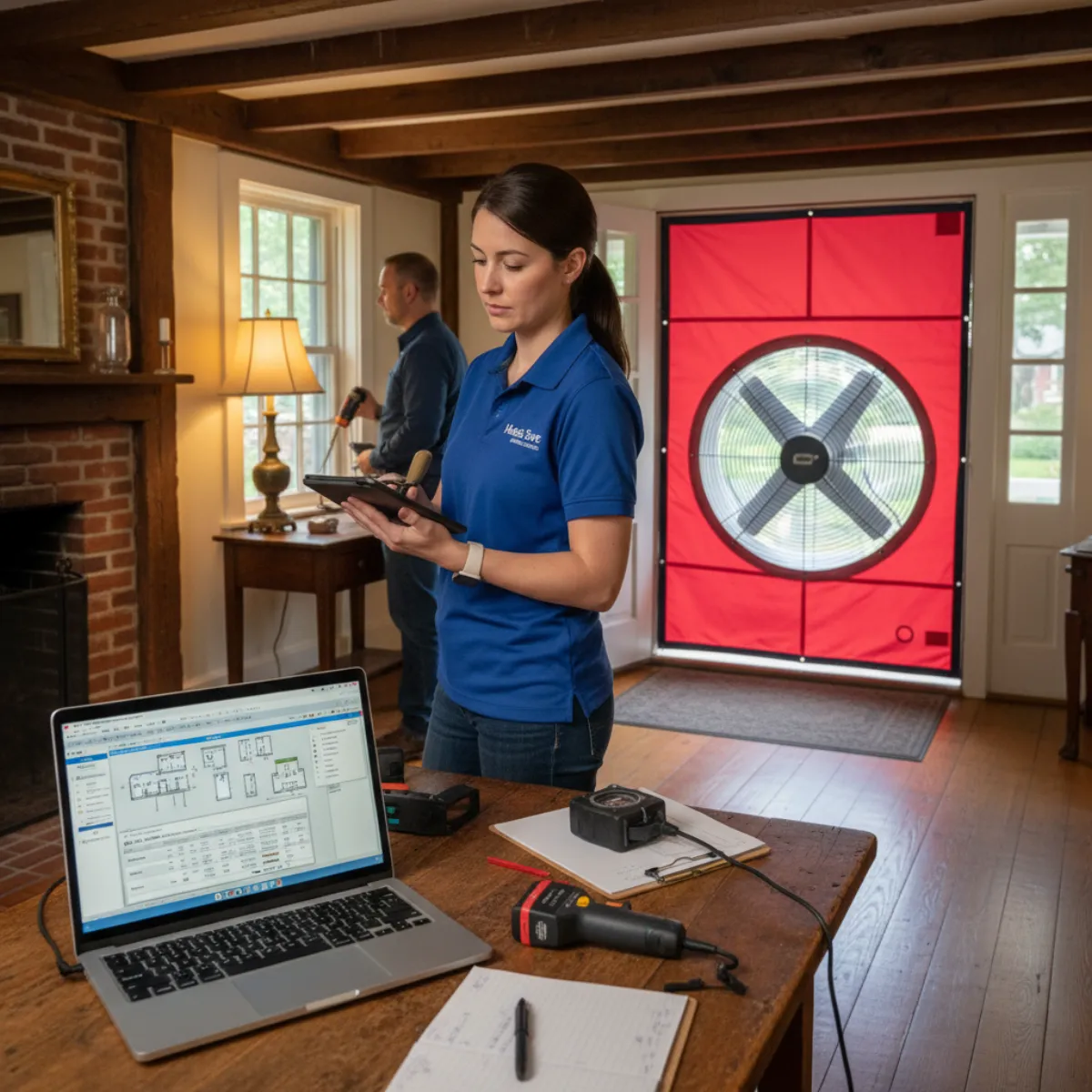
A Manual J is a room-by-room BTU calculation your installer (or an auditor) runs to size your heat pump correctly at the MA design temperature (9 F in Boston, -4 F in Pittsfield). Mass Save requires it for the Whole Home tier (up to $8,500 rebate). Expect to pay $200 to $500 standalone, or get it free bundled with a Mass Save home energy audit. If an installer quotes you a heat pump without one, that is a red flag, not a convenience.
ACCA Manual J is a 400+ page methodology. A competent report covers at least these six inputs for every room.
Every room is calculated separately, not as a lumped whole-house BTU. This matters for zoning ductless mini-splits correctly.
How much outside air leaks into your home. Measured by blower door test. MA older homes average 5 to 15 ACH50; newer builds 2 to 5.
Actual insulation in walls, attic, basement, rim joists. Pre-1940 MA homes often have R-0 walls. Post-weatherization typical R-13 walls, R-49 attic.
Old single-pane windows can have U-0.9+ (terrible). Modern double-pane low-e windows hit U-0.30. Window area and orientation drive cooling load.
The 99th-percentile cold hour for your town. Boston uses 9 F; Worcester 4 F; Pittsfield -4 F; Cape Cod 12 F. Equipment is sized at this point.
People, appliances, lighting, and electronics all add heat. Especially relevant for cooling load sizing.
Manual J sizes your equipment to the 99th-percentile coldest hour. Only 1 percent of winter hours are colder than this. Using colder design temps wastes capacity.
Why 99% and not 100%? If you size for the single coldest hour in a 10-year cycle (polar vortex -10 F), you install 25 to 40 percent more capacity than you need, and the unit runs oversized for 99.9 percent of the time. The standard approach is to size for the 99% design temp and let backup heat (electric resistance or existing furnace) cover the polar vortex outliers.
Air infiltration is usually the single biggest variable in a Manual J. Massachusetts housing stock spans 400 years of construction practice.
| Home era / envelope | Typical ACH50 | Impact on load |
|---|---|---|
| Pre-1940 (leaky Victorian, colonial) | 10 to 20 | Dominates load; weatherize first |
| 1940 to 1980 (typical MA Cape / ranch) | 7 to 12 | Large; weatherization pays back fast |
| 1980 to 2010 (some air sealing) | 4 to 8 | Moderate; worth air sealing |
| Post-2010 (IECC code) | 2 to 5 | Low; load driven by envelope losses |
| Passive House / net-zero builds | 0.6 to 1.5 | Negligible; mechanical ventilation needed |
Weatherize BEFORE sizing. Mass Save pays 75 to 100 percent of insulation and air sealing costs for most MA homeowners. If you air seal from 12 ACH50 down to 5 ACH50 before sizing the heat pump, you may drop a full ton of required capacity, saving $2,000 to $4,000 on equipment.
Punch in your square footage, home era, and insulation level to see a rough design-day BTU range. Use this to sanity-check an installer quote, not to size equipment.
This is a directional estimate only. A licensed MA installer should run a full ACCA Manual J load calculation (room-by-room, infiltration, window U-values) before sizing equipment. Rules of thumb routinely oversize by 40 to 80 percent.
Real examples from MA Mass Save audit data. The rule of thumb is wrong almost every time, and it is usually wrong in the expensive direction (oversizing).
| Home scenario | 1 ton / 500 sq ft | Actual Manual J | Verdict |
|---|---|---|---|
| 1,800 sq ft weatherized 1960s Cape, Boston | 3.5 to 4 tons | 1.8 to 2.2 tons | Rule of thumb oversizes ~90% |
| 2,400 sq ft 1910 Victorian, unweatherized, Worcester | 4.5 tons | 3.5 to 4 tons | Rule of thumb slightly oversizes |
| 1,400 sq ft post-2015 build, spray foam, Newton | 3 tons | 1.2 to 1.5 tons | Rule of thumb oversizes ~100% |
| 3,200 sq ft 1985 colonial, R-13 walls, Andover | 6 tons | 3.5 to 4 tons | Rule of thumb oversizes ~60% |
Any one of these should prompt a second opinion. Two or more, and you should walk.
This oversizes most MA homes by 40 to 80 percent. A 2,000 sq ft home does NOT automatically need 4 tons. A properly air-sealed 2,000 sq ft home in Boston often needs 2 to 2.5 tons.
Without measuring infiltration, the installer is guessing at your biggest load driver. MA Mass Save audits include a free blower door test; insist on using that data.
Your existing oil or gas furnace is almost certainly oversized by 50 to 150 percent. Sizing the new heat pump to match the old furnace perpetuates the mistake.
A real Manual J produces a multi-page report with inputs and room-level outputs. If the installer cannot produce it, it was not done.
Translation: we oversize. Oversized heat pumps short-cycle, run at poor COP, and wear out 30 to 50 percent faster. Comfort gets worse, not better.
Two homes of the same square footage can have 2x different load due to insulation, window quality, and air sealing. Cookie-cutter sizing is a tell.
Mass Save Whole Home heat pump rebate pays up to $8,500 (capped as $2,650/ton up to $8,500 plus $500 sizing bonus plus $500 weatherization bonus). To qualify, the installer must demonstrate that heat pump capacity at design temp meets at least 100 percent of the design heat load, which functionally requires a Manual J.
Mass Save Home Energy Assessments are free for all utility customers and include a blower door test, insulation survey, and basic thermal scan. Bring that report to your heat pump installer: most of the Manual J inputs (ACH50, R-values, square footage) are already documented.
A quote that skips room-by-room loads can look simpler while leaving the wrong equipment, zoning, or backup heat plan in place.
Confirm Mass Save HPLN status before counting on the Whole Home rebate path.
Require Manual J sizing, design-temperature capacity, zoning, and backup heat notes.
Make the proposal name the equipment, electrical scope, permits, and rebate paperwork owner.
Manual J is the ACCA (Air Conditioning Contractors of America) standard for calculating how many BTU per hour of heating and cooling a home needs at its local design temperature. It accounts for square footage, insulation R-values, window U-factors, air infiltration (ACH50), internal gains, and orientation. It is the industry benchmark for correctly sizing HVAC equipment, including heat pumps.
Mass Save Installation Standards require load calculations for Whole Home heat pump installations receiving the top-tier rebate (up to $8,500). Many participating contractors use Manual J or equivalent ACCA-compliant software (Wrightsoft, Cool Calc, Elite Right-J). Partial home installs have less strict documentation, but sizing must still be defensible.
Standalone Manual J reports from third-party energy auditors cost $200 to $500 in Massachusetts. However, most quality heat pump installers include it in their proposal free of charge, and Mass Save home energy audits (free) often generate the blower door data needed. If your installer quotes a Manual J fee on top of the install, shop around.
Free tools like Cool Calc, Loadcalc.net, and BetterBuilt allow DIY Manual J estimates. They are useful for sanity-checking an installer quote or for your own learning, but they rely on your inputs for insulation and air leakage. For permit applications and rebate paperwork in MA, a licensed HVAC contractor should sign off on the final calc.
ACH50 stands for Air Changes per Hour at 50 Pascals of pressure. It is the standard measurement of a home air leakage rate, determined by a blower door test. A MA home at 10 ACH50 leaks roughly twice as much as one at 5 ACH50, which doubles infiltration heat loss. It is typically the single biggest swing factor in whether a heat pump needs 2 tons or 4 tons.
Three reasons. First, rules of thumb (like 1 ton per 500 sq ft) are fast but wrong for MA is mixed housing stock. Second, installers are worried about callback complaints on the coldest day of winter. Third, homeowners sometimes demand "extra capacity." The result: oversized heat pumps that short-cycle, humidify poorly, and run at lower efficiency for 15+ years.
Yes. Most MA oil and gas furnaces installed before 2010 are oversized by 50 to 150 percent. If your installer sizes the new heat pump to match the old furnace BTU plate, you will inherit the oversizing problem. Manual J gives you the actual load, independent of what is already in the basement.
Yes. Manual J produces two numbers: design heating load (at the 99% cold hour) and design cooling load (at the 1% hot hour). For heat pumps, the cooling load usually sets the minimum size (so you do not oversize for cooling) while heating load determines whether backup is needed below the balance point.
A carefully done Manual J by a competent contractor is usually within 10 to 15 percent of measured real-world load. Most errors come from guessing ACH50 instead of testing, misjudging insulation, or ignoring thermal bridging. Post-install, monitor runtime and supplemental heat use during the first real cold snap to verify sizing.
ASHRAE 99% heating design temps for common MA cities: Boston 9 F, Worcester 4 F, Pittsfield -4 F, Cape Cod 12 F, Springfield 2 F. These are the 99th-percentile coldest hours, meaning only 1% of winter hours are colder. Sizing for extremes (like the -10 F polar vortex) wastes capacity that is unused 99% of the time.
How to translate Manual J BTU numbers into equipment selection.
The outdoor temp where the heat pump meets your load. Pairs with Manual J.
What happens when the Manual J is skipped: short cycling, high humidity, wear.
Which models maintain capacity at MA 99% design temps.
Why pre-1940 homes need aggressive air sealing before heat pump sizing.
Rebate tier requirements that depend on Manual J documentation.
NuWatt runs a full ACCA Manual J before quoting equipment, uses your Mass Save audit data when available, and files the Whole Home rebate paperwork for you.
NABCEP-certified installers • Mass Save participating contractor • Serving MA since 2008