Loading NuWatt Energy...

We use your location to provide localized solar offers and incentives.
We serve MA, NH, CT, RI, ME, VT, NJ, PA, and TX
Loading NuWatt Energy...
NuWatt designs, installs, and manages solar, battery, heat pump, and EV charger systems across 9 states. One company, one warranty, one point of contact.
Get a Free Quote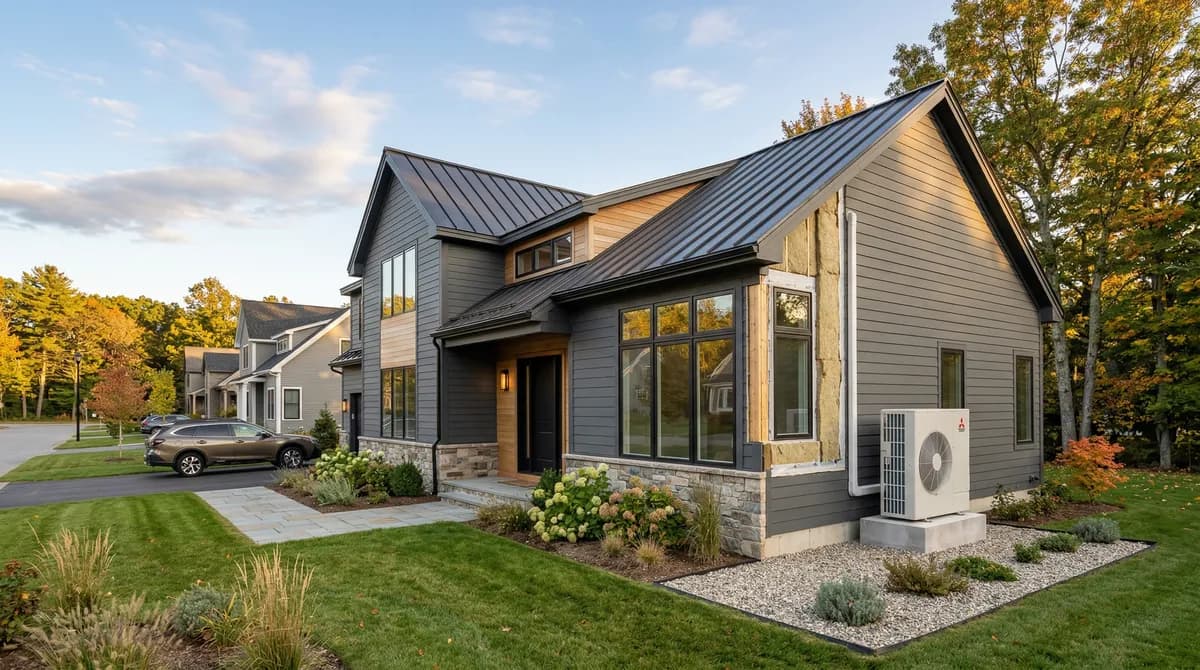
Massachusetts has the most aggressive building energy codes in the nation. Over 300 municipalities adopted the Stretch Code and 100+ adopted the Specialized Opt-in Code — both pushing heat pumps as the standard for new homes. Here is what builders must install and what buyers should know.
Massachusetts has a three-tier building energy code system. Each tier has different heat pump requirements. The Stretch Code and Specialized Code are adopted by individual municipalities — check with your local building department to confirm which applies.
IECC 2021 / 780 CMR
Not required. Gas furnace/boiler allowed.
AFUE 80% gas furnace
3.0 ACH50
R-21 walls, R-49 attic
All MA municipalities by default
Appendix RC / 225 CMR 22.00
Strongly incentivized via energy performance targets. Heat pump is easiest path to compliance.
If heat pump: HSPF2 >=8.8, SEER2 >=15.2
2.0 ACH50
R-25 walls, R-60 attic
300+ municipalities (~90% of new construction)
Municipal Opt-in / Net-Zero-Ready
Mandatory. Heat pump as primary HVAC system. No fossil fuel heating in new construction.
HSPF2 >=9.5, SEER2 >=16.0, cold-climate rated
1.5 ACH50 or lower
R-30 walls, R-60+ attic
100+ municipalities (Boston, Cambridge, Brookline, Newton, etc.)
Important: Check your specific municipality
The code tier is set at the municipal level, not the state level. A home in Cambridge (Specialized Code) has different requirements than a home in Framingham (Stretch Code). Always confirm with your local building department before starting a project.
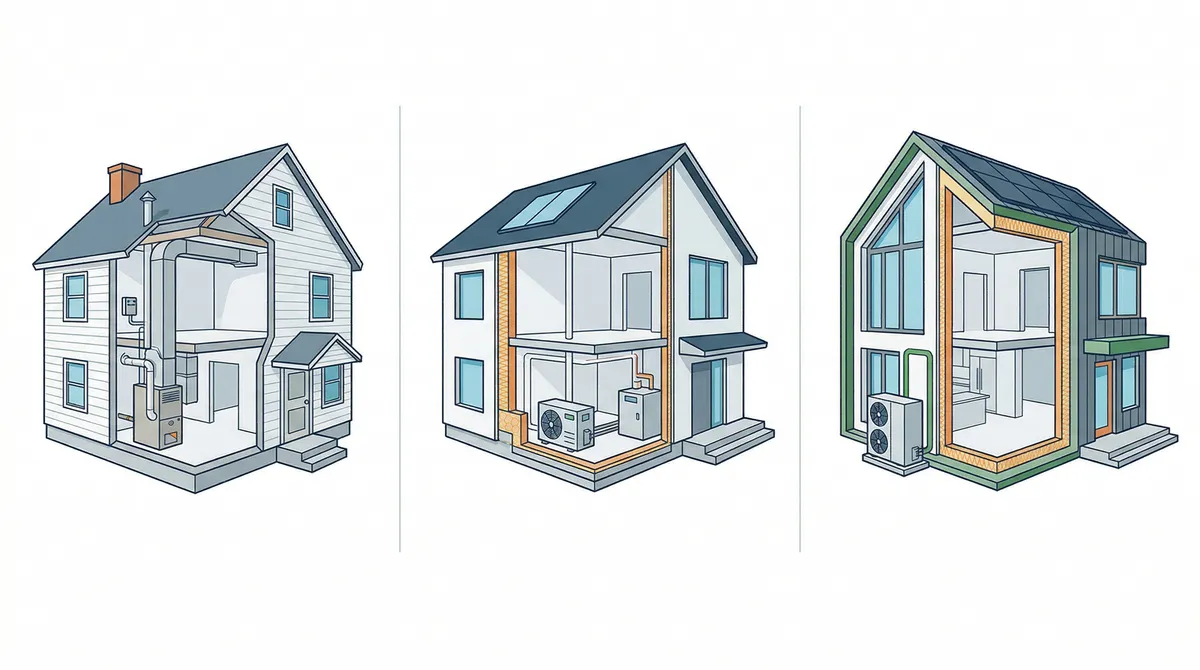
Heat pump efficiency is measured in HSPF2 (heating) and SEER2 (cooling) under the updated DOE testing standards that took effect January 2023. These are lower numbers than the old HSPF/SEER ratings — do not confuse them.
Heating Seasonal Performance Factor, version 2. Measures BTU output per watt-hour of electricity consumed over a heating season. Higher = more efficient.
Seasonal Energy Efficiency Ratio, version 2. Measures BTU cooling output per watt-hour over a cooling season. Higher = more efficient.
Cold-Climate Certification Matters
For Specialized Code municipalities, the heat pump must be rated for cold-climate operation (maintaining full heating capacity at 5F or lower). The NEEP Cold Climate Air Source Heat Pump List and the Mass Save Qualified Products List are the reference databases. Equipment not on these lists may not pass inspection.
These models exceed both Stretch Code and Specialized Code requirements and appear on the Mass Save Qualified Products List. All are cold-climate rated for MA winters.
| Brand / Model | Type | HSPF2 | SEER2 | Min Temp | Mass Save | Notes |
|---|---|---|---|---|---|---|
| Mitsubishi Hyper-Heating H2i (PUZ/MUZ-FS series) | Ducted / Ductless | 10.0-11.0 | 17.0-19.0 | -13F | Most popular cold-climate choice in MA. Full output to 5F. | |
| Fujitsu Halcyon XLTH (AOU/ASU series) | Ducted / Ductless | 10.0-12.5 | 17.0-20.0 | -15F | Excellent low-temp performance. Strong humidity control. | |
| Daikin Fit / Aurora Series | Ducted / Ductless | 9.7-10.5 | 16.5-18.0 | -13F | Good value option. Variable-speed compressor. | |
| Bosch IDS 2.0 / Climate 5000 | Ducted | 10.0-11.0 | 17.0-20.0 | -22F | Best-in-class cold-weather rating. Works with existing ductwork. | |
| LG Multi V S / Red Series | Ducted / Ductless | 9.6-10.5 | 16.0-20.0 | -13F | Strong multi-zone performance. Good for larger homes. | |
| Carrier Infinity / Performance Series (38MARBQ) | Ducted | 10.0-11.5 | 17.5-20.5 | -22F | Premium ducted option. Greenspeed intelligence. |
This is not an exhaustive list. Check the Mass Save Qualified Products List and the NEEP Cold Climate HP List for the full database.
The single biggest advantage of new construction heat pump sizing is the tight building envelope. A well-insulated, well-sealed new home needs dramatically less heating capacity than a leaky older home — which means a smaller, cheaper system.
Tight envelope = smaller system. Manual J with actual specs.
Even tighter envelope. Can often go one size smaller.
Leaky, poorly insulated. 2x the heating load of new build.
Insulate first, then size. Saves $2K-$5K on equipment.
Every new construction heat pump installation requires a Manual J load calculation using the as-designed envelope specifications: actual R-values, actual window U-factors, actual blower door test targets. Rule-of-thumb sizing (400 sq ft per ton, 1 ton per 500 sq ft) is outdated and will result in oversized or undersized systems. Mass Save requires Manual J for rebate approval. Building inspectors in Stretch and Specialized Code towns require it for permit sign-off.
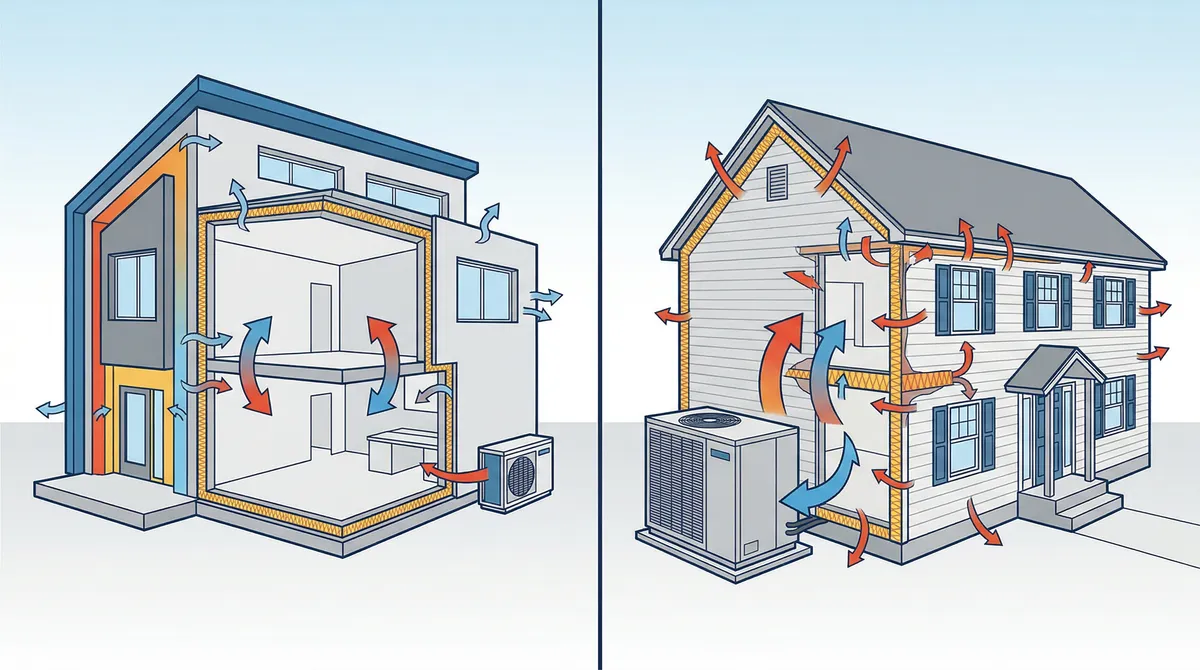
The headline cost of a heat pump system is higher than a gas furnace + AC combo. But when you account for eliminated gas infrastructure, the net delta is smaller than most builders expect — often $3,000-$8,000 net. Mass Save rebates can close the gap further.
| Item | All-Electric | Conventional | Delta | Notes |
|---|---|---|---|---|
| Heat pump system (2.5-3.0 ton ducted) | $8,000-$12,000 | $5,000-$7,000 (gas furnace + AC) | +$3,000-$5,000 | Eliminates gas meter, gas line, flue, gas piping = $2K-$4K saved |
| Heat pump water heater (50-80 gal) | $2,500-$3,500 | $1,200-$1,800 (gas tank) | +$1,300-$1,700 | Uses 1/3 the energy. Mass Save $1,250 rebate available. |
| Enhanced insulation + air sealing | $4,000-$8,000 | $2,000-$3,000 (base code) | +$2,000-$5,000 | Required for 1.5-2.0 ACH50. Pays back in 3-5 years. |
| No gas infrastructure | $0 | $3,000-$5,000 (gas meter, service, piping) | -$3,000-$5,000 | All-electric eliminates gas connection fees entirely. |
| Upgraded electrical panel (200A+) | $500-$1,000 (incremental) | Standard 200A | +$500-$1,000 | Spare capacity for future solar inverter, EV charger. |
| Net Additional Cost | After gas infrastructure savings | +$3K-$8K | Mass Save rebates can offset $5K-$12K of this | |
Annual operating savings for buyer
Payback on incremental cost
Added resale value (energy features)
Heat pump installations in Stretch and Specialized Code towns face more rigorous inspection than standard HVAC. Here is what inspectors check at each phase.
The blower door test is arguably the most critical inspection point. It measures how airtight the building envelope is by depressurizing the home to 50 pascals and measuring air infiltration in Air Changes per Hour (ACH50). Stretch Code requires 2.0 ACH50. Specialized Code requires 1.5 ACH50. A failure here means the builder must find and seal air leaks before the home can pass final inspection. Common failure points: rim joists, plumbing penetrations, electrical boxes, attic access doors, and window/door framing.
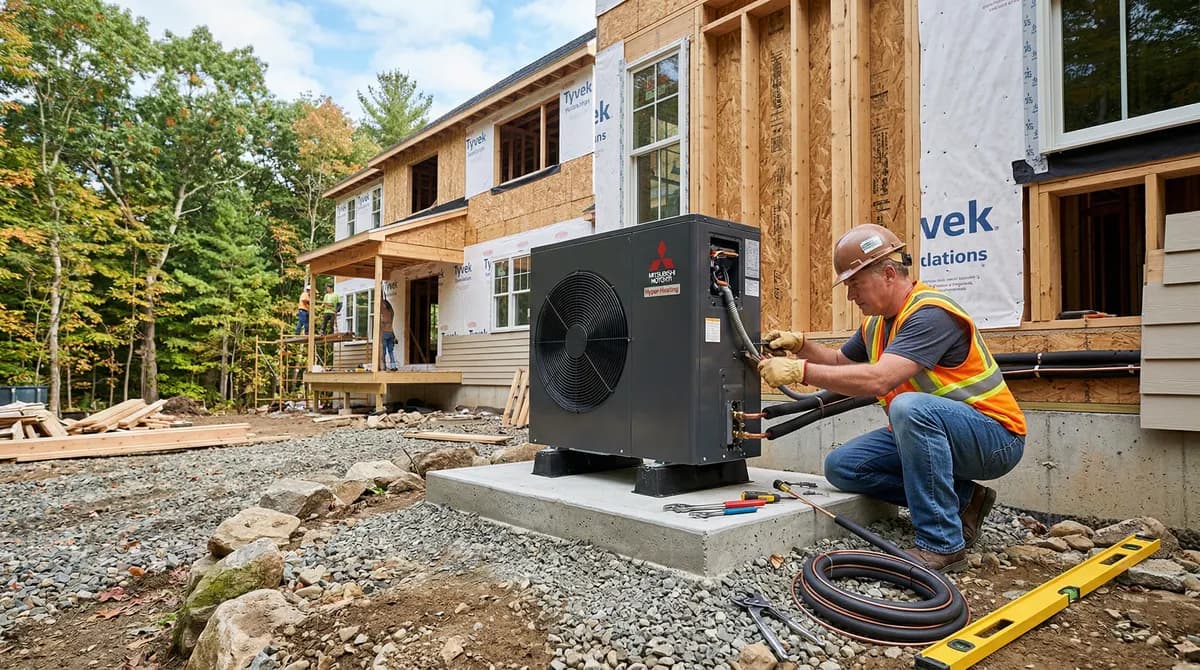
Builders transitioning from gas furnace installations to heat pumps face a learning curve. These are the most frequent mistakes we see in Massachusetts new construction projects.
Why it matters: Gas furnace sizing rules (1 ton per 500 sq ft) do not apply. Heat pumps need proper Manual J.
Fix: Always run Manual J with actual envelope specs. Mass Save requires it for rebates.
Why it matters: Oversized heat pumps short-cycle, waste energy, and cannot properly dehumidify.
Fix: Size to load. Variable-speed inverter systems handle some oversizing better, but right-sizing is still critical.
Why it matters: R-410A is being phased out under EPA AIM Act. New construction should use R-32 or R-454B.
Fix: Specify R-32 or R-454B systems. All major brands now offer next-gen refrigerant models.
Why it matters: Building inspectors in Specialized Code towns increasingly require documented load calculations.
Fix: Use Wrightsoft, Manual J Elite, or CoolCalc. Document and keep with permit file.
Why it matters: At MA design temps (0-5F), even cold-climate HPs may lose 15-30% capacity. Strip heat fills the gap.
Fix: Include factory-installed electric backup strip. Size for 15-20% of design load.
Why it matters: North-facing placement or locations that collect snow reduce efficiency and cause defrost issues.
Fix: South or west facing, elevated 12-18" above grade, clear of snow drifts and drip lines.
Why it matters: Heat pumps generate condensate in both heating (defrost) and cooling modes, year-round.
Fix: Drain to grade or condensate pump. Protect from freezing in winter with heat tape if needed.
Modern cold-climate heat pumps perform remarkably well in Massachusetts winters. But backup heat is still part of the design — here is when and why.
HP maintains 90-100% capacity
HP maintains 75-90% capacity
HP maintains 60-80% capacity
Best practice for new construction:Install a factory-integrated electric backup strip (5-10 kW) in the air handler. This is inexpensive ($200-$500 at time of install), invisible to the homeowner, and activates automatically during the rare hours when outdoor temps drop below the heat pump's rated minimum. It is NOT the same as a gas furnace backup — it is a safety net that may run 20-40 hours per year in most MA locations.
Mass Save rebates apply to new construction projects in most cases. The combination of whole-home rebates, equipment-specific rebates, and 0% financing can offset most or all of the incremental cost of an all-electric home.
Heat pump as sole heating system. Must meet Mass Save QPL efficiency. Manual J required.
Heat pump displacing portion of heating. Per-unit rebate structure.
ENERGY STAR certified HPWH. Must be primary water heater.
75% of cost covered. Applies to wall, attic, and rim joist insulation.
Covers heat pumps, insulation, HPWH, weatherization. 7-year term.
Must exceed code by defined margin. HERS rating typically required. Contact Mass Save directly.
No Federal Residential Tax Credit in 2026
The Section 25D residential solar ITC and Section 25C energy efficiency credit both expired December 31, 2025. There is no federal tax credit for residential heat pump purchases in 2026. Mass Save state rebates are the primary financial incentive for homeowners and builders.
If you are buying a new construction home in a Stretch or Specialized Code municipality, the heat pump is already there. Here is what that means for you.
No gas bill at all. Electric heating/cooling costs 40-60% less than gas furnace + AC in a tight-envelope home. Expect $1,500-$2,500/yr savings.
No gas infrastructure to maintain or replace. No risk of gas price spikes. The heat pump handles both heating and cooling with one system.
Tight envelope + variable-speed heat pump = even temperatures room to room. Better humidity control in summer. Quieter than furnace cycling.
Energy-efficient homes sell for 3-5% more. All-electric is increasingly preferred by buyers under 45. Mass Save certification adds credibility.
Specialized Code homes have pre-wired solar infrastructure. Adding panels later costs $3K-$5K less than retrofit. Pair with battery for peak savings.
Heat pumps have no combustion components: no burner, no flue, no gas valve. Annual maintenance is simpler and cheaper. Expect 15-20+ year equipment life.
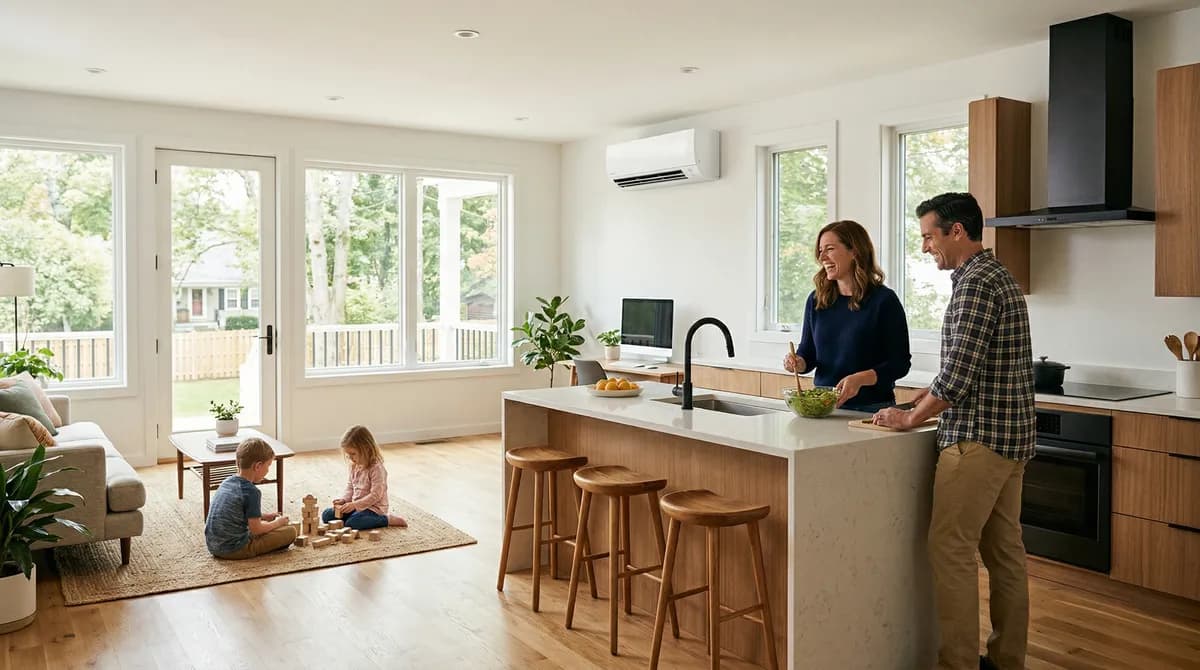
The heat pump requirement does not exist in isolation. It is one of several interconnected requirements in the Specialized Opt-in Code designed to make homes net-zero-ready.
A Specialized Code home is “net-zero-ready” — add solar panels to the pre-wired roof and the home can produce as much energy as it consumes annually. The heat pump is the cornerstone because it eliminates fossil fuel consumption for heating, making full electrification possible.
Full list maintained by MA DOER. Contact your local building department to confirm.
The standard Stretch Code (adopted by 300+ municipalities) does not strictly mandate heat pumps, but its energy performance targets make heat pumps the most practical path to compliance. The Specialized Opt-in Code (100+ municipalities including Boston, Cambridge, Brookline) does require heat pump HVAC as the primary heating system in all new residential construction.
For Stretch Code compliance, heat pumps should have HSPF2 >= 8.8 and SEER2 >= 15.2 minimum. For Specialized Opt-in Code, aim for HSPF2 >= 9.5 and SEER2 >= 16.0 with cold-climate certification. These exceed federal minimums and are aligned with Mass Save Qualified Products List requirements for rebate eligibility.
The net incremental cost is typically $3,000-$8,000. A heat pump system costs $8,000-$12,000 vs. $5,000-$7,000 for gas furnace + AC. However, eliminating gas infrastructure (meter, piping, flue) saves $2,000-$5,000, and Mass Save rebates cover up to $8,500. Many builders find the all-electric package is cost-neutral or cheaper when gas infrastructure savings are included.
Yes. Both the building code and Mass Save require a Manual J load calculation for heat pump installations. For new construction, the Manual J should use the as-built insulation values, actual window specifications, and blower door test results. This is not optional — building inspectors in Stretch and Specialized Code towns check for documented load calculations.
New construction built to Stretch or Specialized Code has dramatically better insulation (R-25-30 walls vs. R-11-13 in older homes) and air sealing (1.5-2.0 ACH50 vs. 5-10 ACH50 in older homes). This reduces the heating load by 40-60%, meaning a 2,000 sq ft new home may need only a 2.5-ton system where a leaky 1970s home of the same size needs 4-5 tons.
Modern cold-climate heat pumps (Mitsubishi Hyper-Heating, Fujitsu XLTH, Bosch IDS, Carrier Infinity) maintain full heating output down to 5F and partial capacity at -13F to -22F. In a code-compliant new construction home with tight envelope, a properly sized system handles MA winter alone. A small electric backup strip (factory-installed) covers extreme cold snaps below design temperature.
The Stretch Code requires <= 2.0 ACH50 (air changes per hour at 50 pascals). The Specialized Opt-in Code requires <= 1.5 ACH50. For context, a typical existing MA home tests at 5-10 ACH50. The tighter the envelope, the smaller the heat pump needed and the lower the operating costs. A failed blower door test means the home cannot pass final inspection.
Over 100 municipalities have adopted the Specialized Opt-in Code, which mandates heat pump HVAC. These include Boston, Cambridge, Brookline, Newton, Somerville, Arlington, Lexington, Concord, Northampton, Amherst, Wellesley, Watertown, and many more. The full list is maintained by the MA Department of Energy Resources (DOER). Check with your local building department before starting a project.
Mass Save offers up to $8,500 for whole-home heat pump installations, up to $1,250 for heat pump water heaters, and the HEAT Loan program (0% APR, up to $50,000). New construction projects may also qualify for additional performance-based incentives if the home exceeds code requirements by a defined margin. Contact Mass Save to confirm eligibility for your specific project.
Builders should specify R-32 or R-454B refrigerant systems for new construction in 2026. R-410A is being phased down under the EPA AIM Act, and by 2025-2026 all major manufacturers offer next-generation refrigerant models. Using R-32/R-454B avoids the risk of difficult or expensive refrigerant supply for future service needs.
Get a free heat pump sizing consultation for your new construction project. We work with builders and homeowners across Massachusetts to ensure code-compliant, right-sized installations that qualify for every available Mass Save rebate.
Full guide to solar-ready, EV-ready, and heat pump requirements.
Read guideManual J load calculations, BTU by home size, insulation impact.
Read guideUp to $10,000 in Mass Save rebates for whole-home heat pumps.
Read guideWhich brands and models qualify for Mass Save rebates.
Read guidePerformance at -13F to -22F. Which systems handle MA winters.
Read guideFull vs hybrid replacement. Mass Save whole-home rebates.
Read guideCombine solar and heat pump for maximum savings.
Read guideHP + HPWH + solar + battery + EV charger: the complete package.
Read guide