Loading NuWatt Energy...

We use your location to provide localized solar offers and incentives.
We serve MA, NH, CT, RI, ME, VT, NJ, PA, and TX
Loading NuWatt Energy...
NuWatt designs, installs, and manages solar, battery, heat pump, and EV charger systems across 9 states. One company, one warranty, one point of contact.
Get a Free QuoteMassachusetts loves its trees — and its solar panels. When the two conflict, you need to know your town's rules, costs, and alternatives before the first branch hits the ground.
60%
MA towns with tree permits
$500-$3K
Removal cost per tree
15-40%
Production loss from shade
2-6 wks
Permit timeline
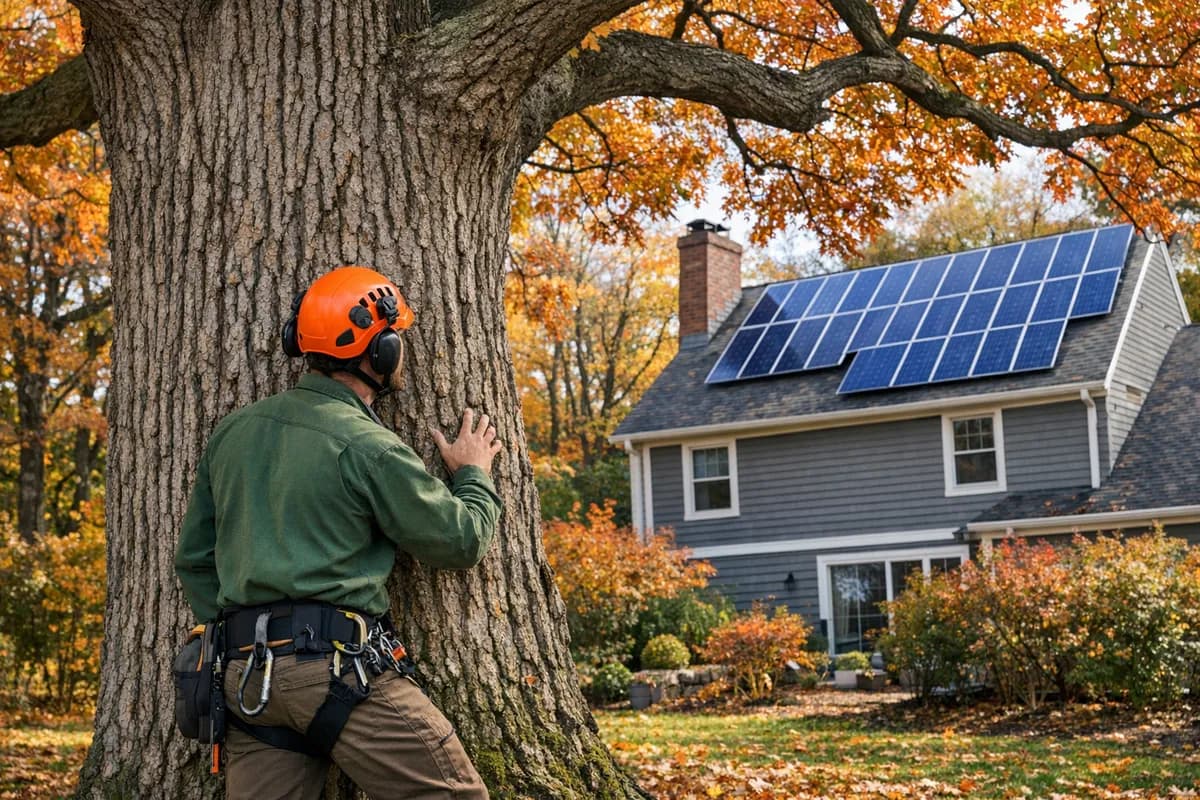
Massachusetts has no statewide tree removal law for private property. Instead, each town and city sets its own rules. About 60% of MA municipalities regulate tree removal on private land above a certain trunk diameter (measured at DBH — diameter at breast height, 4.5 feet above ground).
| Town | Min. Diameter | Permit Needed? | Fee | Timeline | Strictness |
|---|---|---|---|---|---|
| Boston | 6" DBH | Yes — BRA permit required | $0-$50 | 2-4 weeks | High |
| Cambridge | 6" DBH | Yes — Public Works permit | $0 | 2-6 weeks | High |
| Newton | 8" DBH | Yes — Tree Preservation Ordinance | $100 | 3-6 weeks | Very High |
| Brookline | 8" DBH | Yes — Tree Bylaw | $0 | 2-4 weeks | High |
| Wellesley | 10" DBH | Yes — Tree Bylaw Art. 51 | $0 | 2-4 weeks | High |
| Concord | 10" DBH | Yes — Scenic Road Bylaw applies | $0 | 3-6 weeks | Very High |
| Somerville | 6" DBH | Yes — Urban Forestry ordinance | $0 | 2-4 weeks | High |
| Arlington | 10" DBH | Yes — Tree Bylaw | $0 | 2-3 weeks | Moderate |
| Worcester | Public trees only | Only for public shade trees | N/A | 1-2 weeks | Low |
| Springfield | Public trees only | Only for public shade trees | N/A | 1-2 weeks | Low |
| Cape Cod towns | Varies (8-12") | Conservation Commission | $0-$100 | 4-8 weeks | Very High |
Check before you cut
Removing a protected tree without a permit in Massachusetts can result in fines of $500-$25,000 per tree, mandatory replacement planting (2:1 or 3:1 ratio), and even a stop-work order on your solar installation. Always verify with your town tree warden or conservation commission before any tree work begins.
Some trees get extra protection beyond standard permits. Knowing the categories helps you plan your solar installation without running into a wall of bureaucracy.
Trees within the public right-of-way or designated as public shade trees. Removal requires tree warden approval and a public hearing. These trees cannot be removed for private solar installations — period.
Trees above a certain diameter (usually 24-30" DBH) that towns designate as ecologically or aesthetically significant. Newton, Cambridge, and Brookline all have specimen tree classifications.
Any tree within 100 feet of a wetland, river, or vernal pool in Massachusetts requires Conservation Commission approval under the Wetlands Protection Act. Common in suburbs and Cape Cod.
Local Historic District Commission (HDC) may review tree removal if it changes the streetscape. This applies in districts like Beacon Hill, Old Deerfield, Lexington center, and Marblehead.
Tree removal is one of the most common add-on costs for Massachusetts solar installations. The total depends on tree size, location, species, and whether you need a permit or arborist report.
| Category | Cost | Examples | Timeline |
|---|---|---|---|
| Small tree (under 30 ft) | $500-$800 | Birch, ornamental cherry, small maple | 1 day |
| Medium tree (30-60 ft) | $800-$1,800 | Oak, ash, medium maple, pine | 1 day |
| Large tree (60+ ft) | $1,500-$3,000 | Mature oak, large pine, elm | 1-2 days |
| Stump grinding | $100-$300 | Per stump, any size | 2-4 hours |
| Branch trimming only | $200-$800 | Selective branch removal for solar access | 2-4 hours |
| Arborist report | $150-$300 | Required for permit applications | 1-2 weeks |
| Permit fees | $0-$100 | Most towns charge nothing or a small fee | 2-6 weeks |
The ROI of tree removal
Removing a $1,500 tree that shades 25% of a 10 kW array saves approximately $870/year in lost production (at $0.29/kWh). The tree removal pays for itself in under 2 years and continues generating extra solar income for 25+ years. Over the system life, that one tree removal is worth $20,000+ in additional energy production.
Not every shading tree needs to go. Sometimes strategic trimming delivers 80% of the benefit at 30% of the cost — with no permit headaches.
Cost: $200-$800 | No permit needed in most towns
Repeat every 2-3 years for continued solar access
Cost: $500-$3,000 | Permit may be required
One-time cost with permanent solar access improvement
An ISA-certified arborist provides a professional assessment of tree health, shade impact, and removal justification. Their letter is often required for permit applications.
Most towns with tree bylaws require an arborist letter explaining why removal is necessary. The letter should document tree species, size, health, shade impact on solar, and whether alternatives (trimming) were considered.
Some arborists offer a combined shade/solar analysis. They measure the tree canopy, predict shade patterns at different times of year, and estimate production loss. This is particularly useful when deciding trim vs. remove.
If the tree is near the planned array, an arborist can assess fall risk, root proximity to the building, and structural integrity. A tree at risk of falling on panels is a strong argument for removal in permit hearings.
Finding a certified arborist in MA
Search the ISA directory at treesaregood.org/findanarborist. Massachusetts has over 800 ISA-certified arborists. Ask your solar installer for recommendations — many have preferred arborist partners who understand solar shading and can provide the specific documentation permit boards want to see.
Follow this process to avoid fines, delays, and neighbor conflicts.
Your solar installer should include a shade analysis in their proposal using tools like Aurora Solar or SunEye. This tells you exactly how much production each tree costs you. If shade loss is under 10%, trimming or panel relocation may be better than removal.
Call your town hall or tree warden. Ask: (1) Do you regulate tree removal on private property? (2) What is the minimum diameter? (3) Do I need an arborist letter? (4) What is the process and timeline? Get answers in writing or by email.
For towns requiring a permit, an ISA-certified arborist provides the justification letter. They assess tree health, shade impact, and alternatives. Cost: $150-$300. This letter is the single most important document in your permit application.
File with the tree warden or conservation commission. Include the arborist letter, shade analysis, solar design plan, and photos. Some towns require a public hearing notice to abutters. Timeline: 2-8 weeks depending on town.
Once approved, hire a licensed tree service. Schedule removal at least 2 weeks before solar installation to allow for stump grinding and site cleanup. Your solar installer cannot begin until the site is clear.
Some towns require replacement planting — typically a 1:1 or 2:1 ratio of new trees to removed trees. Plant replacements in locations that will not shade the solar array. Native species are usually required.
This is one of the most common — and frustrating — situations for MA solar homeowners. Here is what the law says and what your options are.
Our design tool maps your roof and identifies shading from every tree. We will tell you exactly which trees impact production and whether trimming or removal makes financial sense.
It depends on your town. About 60% of Massachusetts municipalities require a permit for removing trees above a certain diameter (typically 6-10 inches DBH). Boston requires a permit for any tree over 6 inches on private property. Newton and Brookline require a permit for trees over 8 inches. Some towns only regulate public shade trees. Check with your town's tree warden or conservation commission before removing any tree.
Tree removal in Massachusetts costs $500-$3,000 per tree depending on size, location, and species. Small trees (under 30 ft): $500-$800. Medium trees (30-60 ft): $800-$1,800. Large trees (60+ ft, oaks, maples): $1,500-$3,000. Stump grinding adds $100-$300. Some solar installers include tree work in the project cost or have preferred arborist partners with discounted rates.
Trimming is often sufficient when: (1) The tree shades only 10-20% of the roof during peak sun hours (10 AM - 2 PM); (2) Only lower branches cause shade; (3) The tree is a protected species or in a heritage/conservation zone; (4) The tree is on a neighbor's property. Trimming costs $200-$800 and needs to be repeated every 2-3 years. Full removal makes sense when the tree shades 30%+ of the roof during peak hours or is within 15 feet of the array.
Massachusetts does not have a statewide "heritage tree" designation, but many towns protect notable trees. Cambridge has a Notable Tree List. Newton protects "significant trees" over 24 inches DBH. Brookline requires approval for any tree over 8 inches on private property. Some towns classify any tree over 30 inches DBH as heritage/landmark. Removing a protected tree without a permit can result in fines of $500-$25,000 per tree.
Under Massachusetts law (MGL Chapter 87), you have the right to trim branches that overhang your property up to the property line. You cannot enter their property to trim, cannot trim in a way that kills the tree, and cannot remove the tree itself. If a neighbor's tree causes significant shading, discuss it first. If they refuse trimming, you can trim at the property line at your expense. Some towns have solar access bylaws — check yours.
Massachusetts does not require a certified arborist for private tree removal, but many towns require the work to be done by a licensed contractor with liability insurance. For permit applications, most towns require a certified arborist letter justifying the removal — especially for protected trees. The letter costs $150-$300 and is essential for permit approval. ISA-certified arborists are listed at treesaregood.org.
A single large tree shading 20-30% of a solar array can reduce annual production by 15-40%, depending on shading pattern and inverter type. With microinverters (Enphase) or optimizers (SolarEdge), shaded panels only affect their own output. With a string inverter, one shaded panel can reduce the output of the entire string by 30-50%. For a 10 kW system in MA producing 12,000 kWh/year, a 25% shading loss = 3,000 kWh lost = approximately $870/year at $0.29/kWh.
Standard homeowners insurance does not cover elective tree removal for solar access. Insurance covers tree removal only when the tree falls due to a covered event (storm, lightning). If a tree falls on your solar panels, your dwelling coverage (Coverage A) should cover panel repair/replacement and the insurer will typically pay for tree removal (usually $500-$1,000 limit per tree). Proactive removal for solar access is your out-of-pocket expense.
How shading affects production
Read guideCurrent costs & payback
Read guideMA permit process explained
Read guideRoof, shade & orientation check
Read guideBest & worst roofs for panels
Read guideAlternative when roof shade is too much
Read guide