Loading NuWatt Energy...

We use your location to provide localized solar offers and incentives.
We serve MA, NH, CT, RI, ME, VT, NJ, PA, and TX
Loading NuWatt Energy...
NuWatt designs, installs, and manages solar, battery, heat pump, and EV charger systems across 9 states. One company, one warranty, one point of contact.
Get a Free QuotePJM's capacity auction cleared at an 833% increase, driving the largest electric rate hikes New Jersey has seen in a decade. PSE&G, JCP&L, and ACE all passed through massive capacity cost increases — and the 2026/2027 auction hit the price cap, meaning more increases are coming. This guide explains what happened, what the state is doing, and why solar is your best hedge.
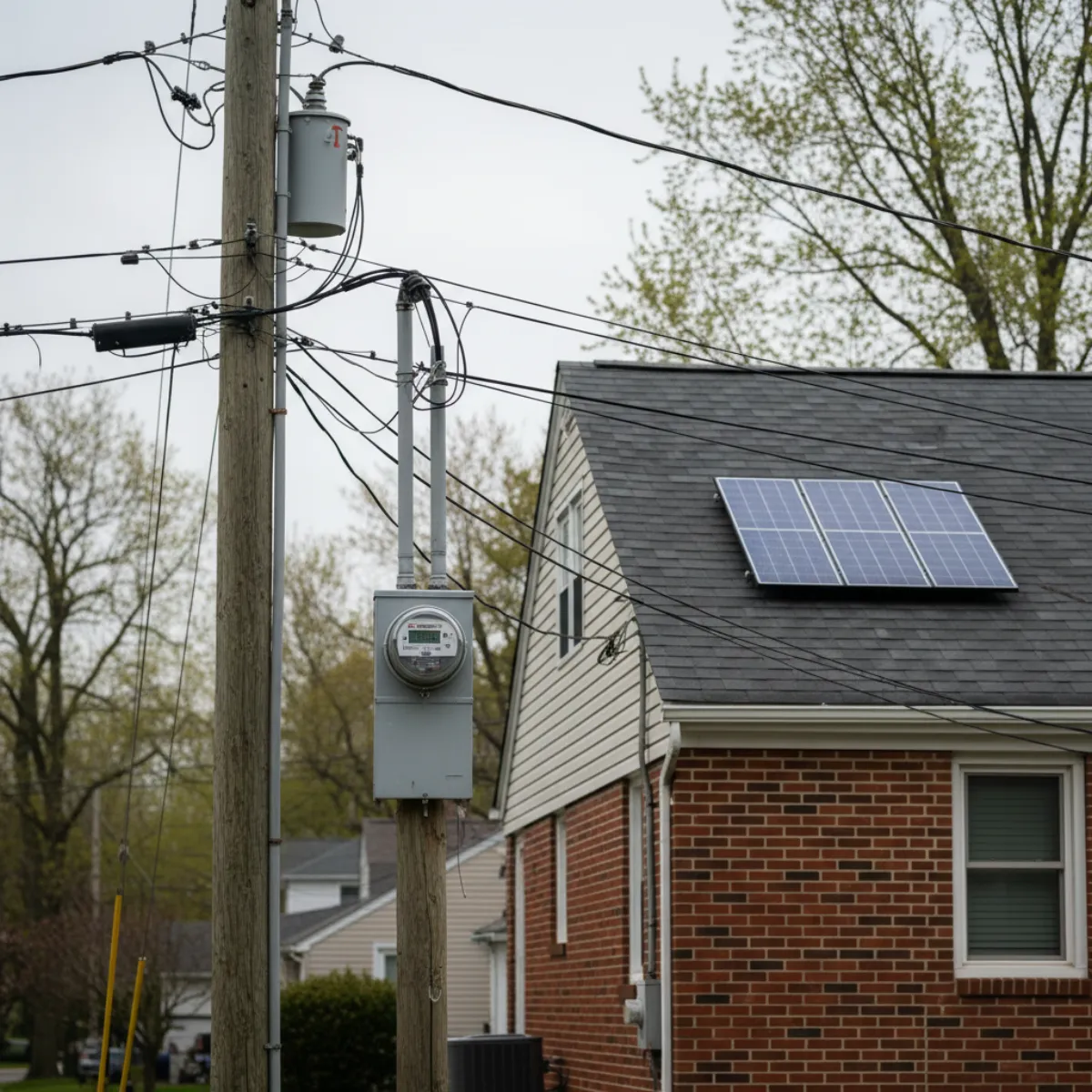
PJM's 2025/2026 capacity auction cleared at $269.92/MW-day — up from $28.92/MW-day the year before, an 833% increase. NJ utilities passed these costs directly to ratepayers: PSE&G bills rose 17.2%, JCP&L 20.2%, and ACE a staggering 40.6% effective June 2025. The 2026/2027 auction then hit the price cap at $329.17/MW-day, meaning another round of increases is coming in June 2026. Solar panels lock in your electricity cost and protect you from these capacity market pass-throughs.
PJM Interconnection is the regional transmission organization (RTO) that manages the electric grid across 13 states and Washington D.C. — serving 65 million people. Every New Jersey utility is part of PJM. There is no opt-out. When PJM costs rise, your NJ electric bill rises.
PJM runs a capacity market — a forward-looking auction where power plants bid to guarantee they will be available during peak demand periods (typically hot summer afternoons). This capacity cost is separate from the actual electricity you consume. Think of it as paying for the insurance that power plants will be there when needed — even if you never use that peak power.
NJ utilities — PSE&G, JCP&L, and ACE — must purchase their share of PJM capacity. These costs are passed through to you as a line item on your electric bill, typically labeled “capacity” or rolled into the supply charge. When PJM capacity prices spike, your bill spikes with them. That is exactly what happened.
Effective June 2025, all three NJ investor-owned utilities passed through dramatically higher capacity costs. ACE customers in southern NJ were hit hardest with a 40.6% increase.
+17.2%
North & Central NJ
+20.2%
Central & Western NJ
+40.6%
Southern NJ
ACE Customers Hit Hardest
Atlantic City Electric customers in southern NJ saw the largest increase at 40.6%. This translates to $55-$80 more per month for a typical household — or $660-$960 per year in additional costs. Southern NJ already had higher rates than the state average, making the impact even more painful. See our ACE rate tracker for the latest.
The trajectory of PJM capacity prices tells the story — and it is not getting better.
| Delivery Year | Clearing Price | Impact |
|---|---|---|
| 2023/2024 | $28.92/MW-day | Historically low clearing price |
| 2024/2025 | $49.49/MW-day | Moderate increase, manageable impact |
| 2025/2026 | $269.92/MW-day | 833% increase — drove 20-40% rate hikes |
| 2026/2027 | $329.17/MW-day | Hit price cap — more increases June 2026 |
2026/2027: Price Cap Hit at $329.17/MW-day
The 2026/2027 auction did not just see high prices — it hit the absolute price cap of $329.17/MW-day. This means demand for capacity exceeded supply at every price point up to the maximum allowed. NJ ratepayers should expect another round of capacity cost increases effective June 2026, on top of the already-elevated rates from June 2025. The exact bill impact will vary by utility but is estimated at an additional 5-15% increase.
The Basic Generation Service (BGS) auction held in February 2026 determines the default supply rate that NJ utilities charge customers who do not have a third-party supplier. The good news: supply rates came in largely stable compared to the prior year, reflecting steady natural gas prices and adequate generation supply.
The bad news: the BGS supply rate is only one piece of your bill. Capacity costs, which flow through separately, remain elevated at the 2025/2026 PJM auction level and will increase further when the 2026/2027 auction prices take effect in June 2026. The BGS auction stability does not offset the capacity cost crisis.
For homeowners evaluating solar, the BGS result actually strengthens the case: supply costs are predictable and manageable, but capacity costs are volatile, unpredictable, and rising. Solar eliminates your exposure to both components.
Governor Sherrill signed EO No. 1 in January 2026, directly addressing the electricity cost crisis caused by PJM capacity price increases.
The NJ Legislature is pursuing its own response to the PJM capacity cost crisis through two key measures.
Will These Measures Lower Your Bill?
The rate freeze and bill credits provide temporary relief for eligible households, but they do not address the underlying problem: NJ must purchase capacity through PJM auctions, and those prices remain at record highs. Legislative investigations and FERC reforms take years to produce results. The 2026/2027 capacity auction has already cleared at the price cap. For most homeowners, the fastest path to rate protection is generating your own power with solar.
Every kWh your solar panels generate is a kWh you do not buy from the grid — and that means you avoid the full retail rate, including the capacity charges that drove the 20-40% spike. Solar locks in your electricity cost at installation. Your cost per kWh never increases, while grid rates have risen 20-40% in a single year and are set to rise again.
NJ's 1:1 net metering policy means excess solar production offsets grid purchases at the full retail rate — including the capacity component. When you export solar during the day and draw from the grid at night, you are effectively getting paid the full inflated rate for every kWh you export. The higher grid rates go, the more valuable your solar becomes.
Grid Cost (June 2026 est.)
$0.22-$0.28/kWh
And rising — capacity costs set to increase again
Solar Cost (locked in)
$0.06-$0.09/kWh
Fixed for 25+ years — never increases
Solar alone eliminates most of your grid dependence. Adding a battery takes it further by letting you store excess solar generation and use it during evening peak hours when grid rates (including capacity charges) are highest. With NJ utilities rolling out time-of-use (TOU) rates in 2026, batteries become even more valuable.
PSE&G's RS-TOU-3P rate launching June 2026 will have an estimated $0.08-$0.12/kWh spread between off-peak and on-peak pricing. A battery charges from solar during cheap off-peak hours and discharges during peak hours, capturing the full spread. On top of TOU savings, a battery provides backup power during NJ's increasingly frequent storms.
The economics have shifted: before the PJM capacity spike, batteries were primarily a resilience purchase. Now, with rates 20-40% higher, the financial case for batteries has improved significantly. Every kWh you store and use during peak hours avoids the inflated grid rate, making payback faster.
TOU Savings
$350-$600/yr
Peak/off-peak arbitrage with battery
Backup Value
8-24 hrs
Storm backup with 13.5 kWh battery
Rate Avoidance
100%
Peak capacity charges eliminated
Look at your supply charge line items. The capacity component has increased 4-10x since 2024. Understanding your current cost makes the solar comparison clear.
Solar payback is now 6-8 years instead of 8-10 because you are avoiding a higher retail rate. Every month you wait, you pay the inflated grid rate.
With TOU rates coming and capacity costs at record highs, batteries provide both financial and resilience value. NJ battery incentives under GSESP Phase 2 may come in 2026.
The residential ADI rate is $77/MWh for registrations received on or after July 27, 2026 (NJ BPU order, May 21, 2026), locked for 15 years. The earlier $85/MWh tier closed to new registrations on July 26, 2026.
The primary driver is PJM's capacity market. The 2025/2026 Base Residual Auction cleared at $269.92/MW-day — an 833% increase from the prior year's $28.92/MW-day. Utilities pass these capacity costs directly to ratepayers through the supply portion of your electric bill. PSE&G rates rose 17.2%, JCP&L 20.2%, and ACE 40.6% effective June 2025.
PJM Interconnection is the regional transmission organization that manages the electric grid across 13 states plus Washington D.C., including all of New Jersey. PJM runs a capacity market where power plants bid to be available during peak demand. NJ utilities must purchase capacity through PJM auctions, and these costs are passed through to ratepayers. NJ has no choice but to participate — it is a mandatory market.
The 2026/2027 auction, which sets rates for June 2026 through May 2027, hit the price cap at $329.17/MW-day. This is even higher than the already-elevated 2025/2026 auction price of $269.92/MW-day. The result means NJ ratepayers face another round of capacity cost increases starting June 2026, on top of already-elevated bills.
Governor Sherrill signed Executive Order No. 1 in January 2026, which included a temporary rate freeze for vulnerable customers and directed the BPU to issue bill credits funded through utility surplus accounts. The order also directed the BPU to investigate PJM pricing mechanisms and pursue reforms at the federal level through FERC. The rate freeze applies to income-eligible households.
SJR-154 is a New Jersey Senate Joint Resolution directing the NJ Board of Public Utilities to formally investigate PJM capacity market pricing and its impact on NJ ratepayers. Companion bill A5463 requires greater transparency in how PJM auction costs are passed through to consumers. Both measures aim to give NJ more leverage to push for PJM market reforms at the FERC level.
Solar panels generate your own electricity, reducing what you buy from the grid. Every kWh you generate avoids the full retail rate — including the capacity charges that drove the 20-40% spike. With NJ's 1:1 net metering, excess solar production offsets grid purchases at the full retail rate. Your solar cost is locked in at installation and never increases, while grid rates have risen 20-40% in just one year.
The February 2026 Basic Generation Service (BGS) auction, which sets supply rates for NJ utilities, saw supply rates remain largely stable compared to the prior year. However, the capacity component of bills remains elevated because PJM capacity costs flow through separately. The BGS result means the supply portion of your bill is not the problem — capacity costs are.
Yes. With rates spiking 20-40%, every kWh you generate and store is worth more. A battery lets you store solar energy for evening peak hours when grid rates (including capacity charges) are highest. NJ utilities are rolling out time-of-use rates that make batteries even more valuable — you can avoid the most expensive hours entirely. Solar + battery provides both rate protection and backup power during storms.
Grid rates are up 20-40% and climbing. Solar locks in your electricity cost for 25+ years. Get a free solar design and see exactly how much you would save at current inflated rates.