Loading NuWatt Energy...

We use your location to provide localized solar offers and incentives.
We serve MA, NH, CT, RI, ME, VT, NJ, PA, and TX
Loading NuWatt Energy...
NuWatt designs, installs, and manages solar, battery, heat pump, and EV charger systems across 9 states. One company, one warranty, one point of contact.
Get a Free QuoteRhode Island is the most densely populated state in the US. Houses are close together, lots are small, and neighbors notice noise. Modern heat pumps are quieter than you think — here is how to choose and place one to avoid complaints.
Last updated March 2026
1,061/mi²
RI population density (highest in US)
19 dB
Quietest mini-split indoor unit
5-10 ft
Typical RI property line setback
Decibels are confusing. Here is a visual comparison of heat pump noise levels against everyday sounds. Remember: every 10 dB increase sounds roughly twice as loud.
dB measured at 3 feet from source. Sound drops 6 dB each time distance doubles.
Key insight:The quietest modern mini-splits (19 dB indoor, 42 dB outdoor) are quieter than a typical conversation. At your neighbor's property line (15 feet away), they measure 28-35 dB — below ambient background noise in most neighborhoods.
Rhode Island is the smallest state with the highest population density east of New Jersey. That means smaller lots, closer houses, and more noise sensitivity.
Rhode Island
3,000-8,000 sq ft typical
1,061/mi²
Massachusetts
5,000-15,000 sq ft typical
901/mi²
Connecticut
8,000-20,000 sq ft typical
739/mi²
New Hampshire
15,000-43,560 sq ft typical
153/mi²
Maine
20,000-87,120 sq ft typical
44/mi²
How noise drops with distance — critical for tight RI lots.
At 12 ft (typical RI property line), 42 dB drops to ~30 dB — quieter than a whisper.
There is no statewide noise ordinance for HVAC equipment. Each RI town sets its own rules. Here are the major towns:
| Town | Daytime Limit | Nighttime Limit | Setback |
|---|---|---|---|
| Providence | 65 dB at property line | 55 dB at property line (10 PM - 7 AM) | 5 ft from property line (residential) |
| Warwick | 60 dB at property line | 50 dB at property line (11 PM - 7 AM) | 10 ft from property line |
| Cranston | 65 dB at property line | 55 dB at property line (10 PM - 7 AM) | 5 ft from property line |
| Newport | 65 dB at property line | 50 dB at property line (10 PM - 7 AM) | 5 ft from property line |
| Narragansett | 60 dB at property line | 50 dB at property line (10 PM - 7 AM) | 5 ft from property line |
| East Greenwich | 65 dB at property line | 55 dB at property line (10 PM - 6 AM) | 5 ft from property line |
Bottom line: Even the strictest RI nighttime limit (50 dB at property line) is easily met by any modern mini-split (42 dB at unit = ~30 dB at 12-15 ft). Ducted systems at 55 dB may come closer to limits on very tight lots — use sound blankets and placement strategies.
Always check with your local building department before installation. Some towns have additional zoning overlays in historic districts.
All models below are ENERGY STAR 6.1 Cold Climate certified and qualify for Clean Heat RI rebates (60% of cost, up to $11,500).
Hyper-Heat MSZ-FH
Indoor
19 dB
Outdoor
42 dB
Ductless Mini-Split
Quietest indoor unit on market. Variable speed compressor reduces outdoor noise at partial load.
Halcyon XLTH
Indoor
21 dB
Outdoor
44 dB
Ductless Mini-Split
Ultra-quiet mode available. Excellent for bedrooms. Cold climate rated to -15°F.
Red Series
Indoor
22 dB
Outdoor
45 dB
Ductless Mini-Split
Low-noise inverter technology. Nighttime quiet mode drops outdoor unit by 3-5 dB.
FIT / Altherma
Indoor
N/A (ducted)
Outdoor
as low as 45 dBA
Ducted Central
Sound blanket available for outdoor unit. Ducted units keep indoor noise in mechanical room.
Greenspeed 25VNA
Indoor
N/A (ducted)
Outdoor
51 dB
Ducted Central
Variable speed runs at lower RPM most of the time, reducing noise. Compressor sound blanket included.
IDS 2.0
Indoor
N/A (ducted)
Outdoor
56 dB
Ducted Central
Reliable mid-range option. Sound blanket available as accessory.
On a tight Rhode Island lot, where you put the outdoor unit matters as much as which model you choose. These strategies can reduce perceived noise by 15-30 dB.
Face the outdoor unit toward your own yard, not the neighbor's bedroom window. Sound drops 6 dB with each doubling of distance.
Reduction: 6-12 dBA dense hedge, fence, or retaining wall between the unit and the property line absorbs and deflects sound. Solid barriers are more effective than open fences.
Reduction: 5-10 dBRubber anti-vibration pads under the unit prevent sound transmission through the ground and structure. Cost: $30-80.
Reduction: 3-5 dBFactory or aftermarket compressor sound blankets wrap around the outdoor unit. Most effective on ducted systems with exposed compressors.
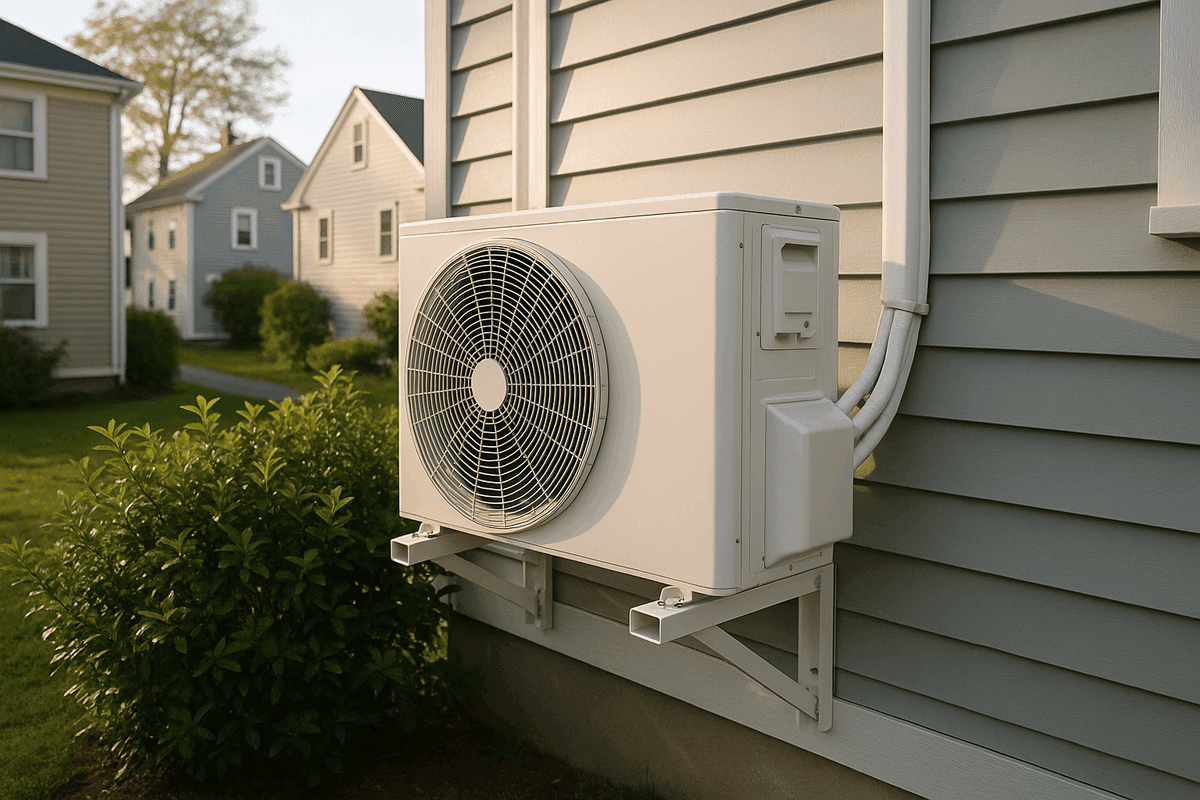
Reduction: 3-8 dBMounting the outdoor unit on a wall bracket (common for mini-splits) raises it above ear level and reduces ground-level reflection.
Reduction: 2-4 dBDirty condenser coils, loose fan blades, and failing bearings all increase noise. Annual maintenance keeps noise at factory spec.
Reduction: Prevents 5-15 dB increaseComplaints are rare with modern equipment, but they happen. Here is how to handle it constructively.
Your neighbor has a legitimate concern about their living environment. Acknowledge it. Most complaints are resolved through conversation, not litigation.
Use a free smartphone decibel meter app at the property line. Document the reading. Most modern heat pumps will measure well below town limits. Share the reading with your neighbor.
Verify the unit meets local setback requirements. Check for loose mounting, missing vibration pads, or debris against the unit. A simple maintenance visit often solves noise issues.
Install a sound blanket ($80-150), add anti-vibration pads ($30-80), or plant a dense hedge. These small investments often resolve concerns completely.
A good installer will return to address noise concerns. They may reposition the unit, replace a noisy fan motor, or add acoustic treatments at minimal cost.
Keep records of noise measurements, maintenance receipts, and any communication with your neighbor. If the complaint escalates to the building department, documentation protects you.
Modern ductless mini-splits produce 19-45 dB outdoors — about the same as a quiet library to a gentle rainfall. Ducted systems are slightly louder at 50-56 dB. At 15 feet away (a typical property line distance in RI), sound drops by 10-15 dB. Your neighbor would hear 30-40 dB — comparable to background ambient noise. Older AC compressors they are replacing were often 65-75 dB, so a new heat pump is actually a noise improvement.
Technically yes, but it is extremely rare for modern heat pumps. Most RI towns set nighttime noise limits at 50-55 dB at the property line. A mini-split outdoor unit at 42 dB measured at the unit drops to 28-35 dB at 15 feet — well below any town limit. If a complaint is filed, the town building inspector typically measures the noise. Ensure your unit is placed per setback rules and maintained properly.
The Mitsubishi Hyper-Heat MSZ-FH is the quietest residential heat pump, with an indoor noise level of just 19 dB (barely perceptible) and 42 dB outdoor. Fujitsu Halcyon XLTH (21 dB indoor) and LG Red Series (22 dB indoor) are also extremely quiet. All three are ductless mini-splits and qualify for Clean Heat RI rebates.
Most RI towns require the outdoor unit to be at least 5 feet from the property line, though Warwick requires 10 feet. There is no statewide standard — each town sets its own rules. Always check with your local building department before installation. On small RI lots (many are 5,000-8,000 sq ft), placement options are limited, making quiet models even more important.
Yes, slightly. Heat pumps run at higher compressor speeds in cold weather to maintain heating output, which increases outdoor noise by 3-8 dB. Variable-speed inverter models (Mitsubishi, Fujitsu, LG) handle this better than single-speed units because they ramp up gradually rather than cycling between off and full blast. Defrost cycles can also produce brief noise spikes.
Rhode Island has the smallest average residential lot sizes in New England — many urban lots are 3,000-6,000 sq ft with 5-15 feet between houses. This means outdoor units are closer to neighbors than in other states. Sound drops 6 dB each time distance doubles: a unit producing 42 dB at 3 feet will be 30 dB at 24 feet. On a tight RI lot, you may only have 10-15 feet to the property line, so choosing a quiet model is essential.
Yes. A solid fence or wall between the heat pump and the property line can reduce noise by 5-10 dB. The barrier must be taller than the unit and have no gaps. A 6-foot solid vinyl or wood fence is most effective. However, maintain at least 24 inches of clearance on all sides of the unit for airflow — blocking airflow causes the unit to work harder and actually increases noise.
Almost always no. Modern heat pumps are significantly quieter than older AC compressors (65-75 dB vs 42-55 dB). Indoor mini-split heads at 19-25 dB are far quieter than forced-air furnace blowers (50-65 dB). If your neighbor is complaining about the existing AC unit, upgrading to a heat pump with Clean Heat RI rebates will actually solve the noise problem while improving efficiency.
Clean Heat RI covers 60% of installation cost (up to $11,500). Modern mini-splits operate at just 19 dB indoor — quieter than a whisper.
What to look for including proper placement, setback compliance, and noise mitigation experience.
Read more15-20 years inland, 10-15 near coast. Signs to replace and Clean Heat RI rebates.
Read moreDuctless is quieter. Ducted hides the indoor unit. Which is right for your home?
Read moreNoise data: Manufacturer specification sheets (Mitsubishi, Fujitsu, LG, Carrier, Daikin, Bosch).
Town bylaws: Providence Code of Ordinances Ch. 16, Warwick Code, Cranston Code, Newport Code.
Population density: US Census Bureau 2024 estimates.
Sound physics: Inverse square law (6 dB drop per doubling of distance in free field).
Clean Heat RI: Rhode Island Office of Energy Resources, program guidelines 2026.